LAW: Healthy Buildings Indoor Air Quality Compliance
Indoor Air Quality Law: What US Employers Must Do to Protect Occupants
No single federal law governs indoor air quality in non-industrial workplaces. IAQ compliance for healthy buildings draws from OSHA’s General Duty Clause, ASHRAE ventilation standards, EPA guidance, and state-level regulations. This guide explains the legal framework, what employers must do, what employees are entitled to, and what violations look like in practice.
Legal Disclaimer
This article provides educational information about indoor air quality compliance requirements in the United States. It is not legal advice. Employers should consult qualified legal counsel and certified industrial hygienists to ensure their programs meet all applicable federal, state, and local requirements.
$6B+
Annual Cost of Poor IAQ
EPA estimates poor indoor air quality costs US employers over $6 billion annually in lost productivity, increased absenteeism, and healthcare costs. Sick building syndrome and building-related illness affect workers across all sectors.
90%
Time Spent Indoors
Americans spend approximately 90% of their time indoors, where concentrations of some pollutants are often 2 to 5 times higher than typical outdoor levels. This makes IAQ a critical occupational health concern for all employers with permanent indoor workforces.
$165K
Max OSHA Willful Violation Penalty
OSHA’s maximum penalty for a willful or repeat General Duty Clause violation is $165,514 per citation. IAQ-related GDC citations have been issued when employers knowingly allowed workers to be exposed to recognized IAQ hazards without adequate controls.
Law Summary: The IAQ Regulatory Framework
Unlike hazardous substances such as lead, asbestos, or silica, indoor air quality in general office and commercial buildings does not have a dedicated federal OSHA standard. The regulatory framework for IAQ compliance is built from three overlapping sources: OSHA’s General Duty Clause, EPA guidance and voluntary programs, and ASHRAE consensus standards referenced by building codes and lease agreements.
OSHA General Duty Clause
Section 5(a)(1) of the OSH Act requires every employer to provide a workplace free from recognized hazards that are causing or likely to cause death or serious physical harm. IAQ hazards recognized by the industry and exceeding levels known to cause harm can be cited under the GDC even without a specific IAQ standard.
29 USC 654(a)(1)
ASHRAE Standard 62.1
ASHRAE 62.1 establishes minimum ventilation rates for acceptable indoor air quality in commercial buildings. It is not directly enforceable as a federal regulation but is incorporated by reference in many state and local building codes, making it effectively mandatory for new construction and major renovations in those jurisdictions.
ASHRAE Standard 62.1-2022
EPA Guidance and Voluntary Programs
EPA does not regulate IAQ in private workplaces but publishes guidance and voluntary programs including Tools for Schools and I-BEAM. EPA guidance is referenced in OSHA GDC enforcement to establish what constitutes a recognized IAQ hazard.
EPA Indoor Air Quality Program
Who Must Comply
IAQ compliance obligations under the General Duty Clause apply to every employer covered by the OSH Act, which includes virtually all private sector employers in the United States. There is no minimum employee count threshold and no industry exemption for office environments.
Employer Type
Covered?
Key IAQ Obligations
Private sector office employers
Yes
GDC applies to recognized IAQ hazards including CO, mold, VOCs, and inadequate ventilation. Must investigate and respond to worker IAQ complaints.
Manufacturing, warehouse, industrial facilities
Yes
GDC plus substance-specific OSHA standards (PELs) and ventilation requirements under 29 CFR 1910.94 apply in addition to GDC obligations.
Healthcare facilities
Yes
GDC plus healthcare-specific ventilation requirements under Joint Commission standards, CMS Conditions of Participation, and FGI Guidelines.
Schools (K-12, public)
State-dependent
Public schools are generally exempt from OSHA but subject to state occupational safety laws and EPA voluntary guidance. Several states have enacted specific school IAQ requirements.
Federal government workplaces
Separate framework
Federal agencies are required to maintain safe workplaces under Executive Order 12196 and 29 CFR Part 1960. GSA and OPM publish IAQ guidance for federal facilities.
Applicable Standards and Their Legal Status
Standard
Issuing Body
Legal Status
Relevance to Employers
OSH Act Section 5(a)(1) – General Duty Clause
OSHA / US Congress
Federally enforceable
Primary enforcement tool for IAQ violations. Four-element test: recognized hazard, causing or likely to cause serious harm, feasible controls exist, employer knew or should have known.
29 CFR 1910.94 – Ventilation
OSHA
Federally enforceable
Applies to industrial ventilation including abrasive blasting, grinding, polishing, and spray finishing. Does not govern general office ventilation but applies to industrial spaces within general industry workplaces.
ASHRAE Standard 62.1
ASHRAE
Enforceable via building codes
Mandatory in jurisdictions that adopt it by reference. Sets minimum outdoor air ventilation rates, filtration requirements, and IAQ management procedures. Failure to meet 62.1 rates can support a GDC citation.
EPA NAAQS and IAQ guidance
EPA
Guidance, not directly enforceable indoors
EPA does not regulate indoor air quality in private buildings but publishes guidance that OSHA references in GDC enforcement to establish what constitutes a recognized hazard.
Key Definitions
Sick Building Syndrome (SBS)
A pattern of symptoms including headaches, eye and throat irritation, fatigue, and difficulty concentrating experienced in a particular building but not attributable to a specific illness or cause. SBS can support a GDC complaint when building conditions are the likely cause.
Building-Related Illness (BRI)
A diagnosable illness with symptoms directly attributable to airborne building contaminants. Legionnaires disease and hypersensitivity pneumonitis are examples. Employers who allow BRI-causing conditions to persist face significant GDC and civil liability exposure.
Recognized Hazard
For GDC purposes, a hazard is recognized if the employer’s industry acknowledges it as hazardous (industry recognition) or if the employer itself knows the condition is hazardous (employer recognition). Published OSHA, NIOSH, and EPA IAQ guidance constitutes evidence of industry recognition.
Minimum Ventilation Rate
The outdoor air supply rate per occupant or per unit of floor area specified by ASHRAE 62.1 for a given space type. Rates vary by occupancy (office, classroom, retail, healthcare) and are expressed in cubic feet per minute per person or CFM per square foot.
Volatile Organic Compounds (VOCs)
Organic chemicals that off-gas from building materials, furniture, cleaning products, paints, and adhesives at room temperature. Some VOCs have OSHA PELs; others are addressed under the GDC using NIOSH RELs or ACGIH TLVs as the standard of care.
Demand-Controlled Ventilation (DCV)
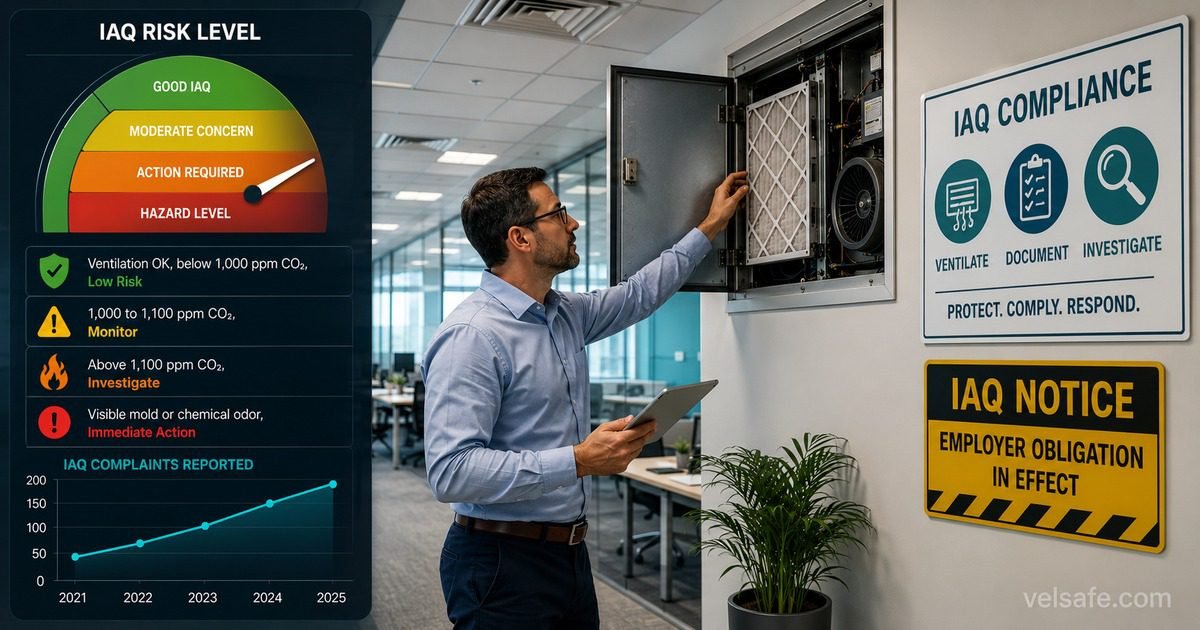
An HVAC control strategy that uses CO2 sensors to modulate outdoor air supply based on actual occupancy. ASHRAE 62.1 permits DCV as an alternative compliance pathway. CO2 levels above 1,100 ppm with DCV in place indicate the system is not maintaining minimum ventilation rates.
Employer Responsibilities
Under the General Duty Clause, employers are responsible for identifying recognized IAQ hazards, implementing feasible controls, and responding to worker complaints. The standard of care is what a reasonably prudent employer in that industry would do given knowledge of the hazard. Documented IAQ programs, regular inspections, and prompt response to complaints reduce both GDC citation risk and civil liability from occupant health claims.
Responsibility
What It Requires and Why
HVAC system maintenance
Employers must maintain HVAC systems in proper working condition, including filter replacement on schedule, coil cleaning, condensate drain maintenance, and damper operation verification. A poorly maintained HVAC system is the most common source of building-wide IAQ problems and is a recognized hazard for GDC purposes.
Ventilation rate verification
Employers must verify that outdoor air supply meets applicable minimum rates for the occupancy type and load. This requires air balance testing when occupancy changes and periodic verification that outdoor air dampers are functioning. Operating with outdoor air dampers closed is a recognized IAQ violation.
Mold investigation and remediation
Employers must investigate reports of water intrusion, visible mold growth, or musty odors and take corrective action. OSHA’s GDC has been applied to mold situations where employers were aware of mold growth and failed to remediate it. EPA and NIOSH mold guidance establish the standard of care.
Chemical product management
Employers must ensure cleaning products, pesticides, renovation materials, and other chemical sources are appropriate for the space and are applied under conditions preventing occupant exposure above hazardous levels. This includes scheduling high-VOC activities during unoccupied periods with adequate flush-out ventilation after application.
Complaint investigation and response
When workers report IAQ symptoms or concerns, employers must investigate promptly and document their findings and response. Dismissing IAQ complaints without investigation is an independent GDC liability factor regardless of whether the underlying condition was actually actionable.
Employee Rights
Right to Report IAQ Concerns
Employees may file IAQ complaints with OSHA at no cost and without giving their employer advance notice. OSHA must respond to formal written complaints with a determination of whether an inspection is warranted. Employees may request that their identity be kept confidential.
Protection from Retaliation
Section 11(c) of the OSH Act prohibits retaliation against employees who file OSHA complaints, participate in inspections, or exercise other rights under the Act. An employee fired or demoted after filing an IAQ complaint may file a retaliation complaint with OSHA within 30 days.
Right to Refuse Unsafe Work
Under limited circumstances, employees may refuse work that presents imminent danger of death or serious physical harm when the danger is real, there is insufficient time to correct it through normal channels, and the employee has tried but failed to get the employer to act.
Access to Workplace Health Information
Employees are entitled to access their exposure and medical records under 29 CFR 1910.1020 when those records exist. For IAQ situations involving specific chemical exposures, employees may request air monitoring results and any medical surveillance records maintained by the employer.
Common IAQ Violations Under the General Duty Clause
Most Frequently Cited IAQ-Related GDC Violations
Inadequate ventilation and outdoor air supply
Most Common
Operating buildings with insufficient outdoor air supply is the most frequently identified IAQ hazard in OSHA inspections. This includes closed outdoor air dampers, inadequate HVAC capacity for actual occupancy, and failure to increase ventilation after building modifications increased occupant density.
Unaddressed mold growth
High
Visible mold in occupied spaces, mold behind wall systems discovered during renovation, and persistent musty odors without investigation are recognized hazards. Employers who receive mold complaints and fail to investigate and remediate face GDC citations and civil liability from affected workers.
Chemical exposure from renovation during occupancy
High
Applying paints, adhesives, solvents, or pesticides in occupied or partially occupied buildings without adequate ventilation or off-hours scheduling exposes workers to VOCs above safe levels. This is particularly common in phased renovation projects where construction and occupancy overlap.
Failure to investigate and respond to complaints
Common
Employers who dismiss worker IAQ complaints without investigation create independent GDC liability even if the underlying IAQ condition might not have been independently actionable. OSHA considers the employer’s response to complaints as evidence of whether a hazard was recognized.
Compliance Checklist
HVAC and Ventilation
Verify outdoor air dampers are operational and set correctly for occupancy type
Confirm HVAC filters are on replacement schedule per manufacturer specification
Verify ventilation rates meet ASHRAE 62.1 minimums for current occupant load
Confirm condensate drains and cooling coils are clean and free of standing water
Contaminant Sources
Inspect for visible mold, water stains, and moisture intrusion quarterly
Review chemical product storage and use for compatibility with occupied building use
Schedule renovation and maintenance chemical activities off-hours or with temporary ventilation
Verify CO detectors are installed and functional near combustion appliances and parking areas
Programs and Documentation
Maintain written IAQ management program with assigned responsibilities and inspection schedule
Document all IAQ complaints received, investigations conducted, and corrective actions taken
Retain HVAC maintenance records, air balance reports, and air monitoring data for at least 3 years
Provide workers a clear process for reporting IAQ concerns and designate a responsible contact person
Key Takeaways
No Specific Standard Does Not Mean No Obligation
The absence of a specific OSHA IAQ standard for offices does not eliminate employer obligations. The General Duty Clause applies wherever recognized IAQ hazards exist and feasible controls are available. Published OSHA, EPA, and NIOSH guidance establishes what is recognized in the industry.
Complaints Must Be Investigated and Documented
An employer’s response to IAQ complaints is itself a compliance issue. Dismissing complaints without investigation creates independent GDC liability. Every complaint should be received, investigated, documented, and responded to in writing, regardless of the employer’s initial assessment of its validity.
HVAC Maintenance Is a Legal Obligation
Deferring HVAC maintenance for budget reasons when workers are experiencing IAQ symptoms is not a defensible compliance position. Employers who know their HVAC system is not performing adequately and continue to operate have constructive knowledge of a recognized hazard, satisfying the GDC’s knowledge element.
Frequently Asked Questions
Can OSHA cite an employer for IAQ problems without a specific IAQ standard?
Yes. OSHA uses the General Duty Clause to cite employers for IAQ violations when four conditions are met: a recognized hazard exists, the hazard is causing or likely to cause serious physical harm, the employer knew or should have known about the hazard, and feasible means exist to correct it. Multiple OSHA citations have been issued under the GDC for inadequate ventilation, mold exposure, and chemical off-gassing in general industry workplaces.
Is ASHRAE 62.1 legally required for existing buildings?
It depends on jurisdiction. ASHRAE 62.1 is a voluntary consensus standard, not a federal regulation. However, many state and local building codes adopt it by reference, making it legally required for new construction and significant renovations in those jurisdictions. For existing buildings, failure to meet ASHRAE 62.1 ventilation rates can be used as evidence of a recognized hazard in GDC enforcement even where it is not directly codified.
What should an employer do when workers report IAQ-related symptoms?
The employer must investigate promptly. Investigation should include interviewing affected workers about symptom patterns, reviewing HVAC maintenance records, conducting a walkthrough inspection, and in some cases engaging an industrial hygienist for air monitoring. All findings and corrective actions must be documented. OSHA’s guidance recommends a systematic approach beginning with the most common IAQ causes: inadequate ventilation, outdoor contamination, and indoor contaminant sources.
Does the General Duty Clause protect employees in home offices?
No. The General Duty Clause applies to employer-controlled workplaces. Home offices controlled by the employee are generally outside OSHA’s jurisdiction. However, employers retain GDC obligations for client facilities, job sites, and other employer-controlled locations where workers perform duties away from the primary workplace.
Government and Regulatory Sources
Related VelSafe Articles
IAQ Compliance Is an Ongoing Operational Obligation
The General Duty Clause does not allow employers to satisfy their IAQ obligations with a one-time building survey and no follow-up. IAQ conditions change as occupancy shifts, HVAC systems age, renovation activities introduce new contaminants, and seasonal conditions affect infiltration and moisture. Employers who maintain documented IAQ programs, respond promptly to complaints, and keep HVAC systems in working order protect their workers and build a compliance record that limits exposure to GDC citations and civil liability. Find more healthy buildings compliance resources at velsafe.com.