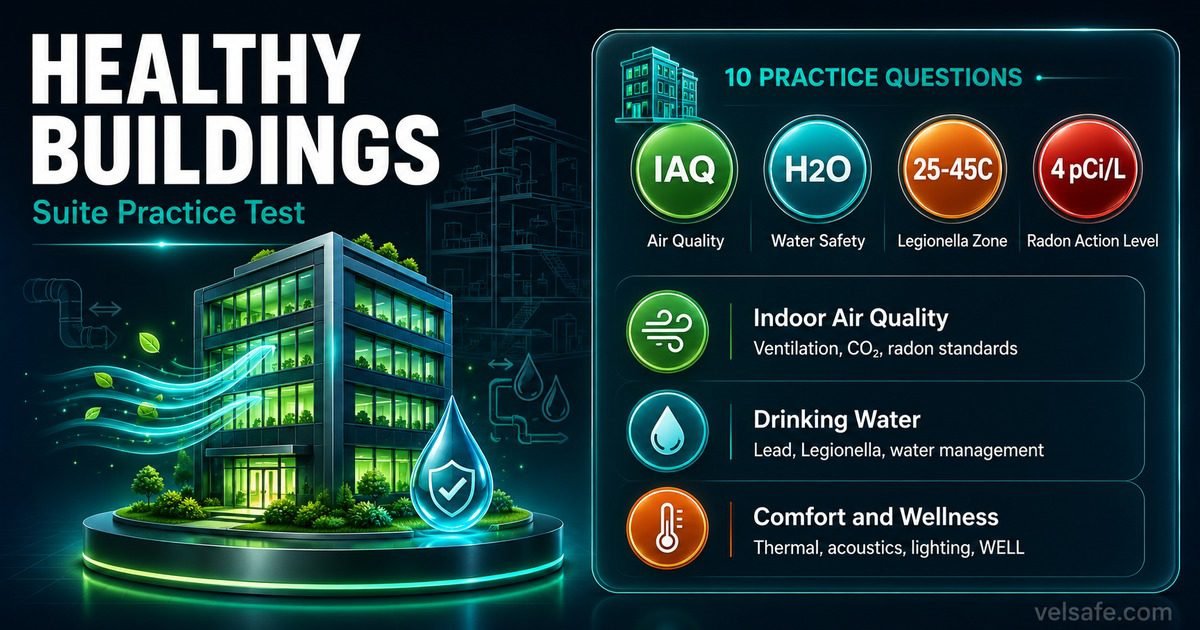
PRACTICE TEST: Healthy Buildings Suite
Healthy Buildings Suite: Practice Test and Knowledge Review
Test your understanding of healthy buildings principles: indoor air quality, drinking water safety, thermal comfort, acoustics, lighting, and occupant wellness. Questions reflect the core competencies assessed in healthy buildings certification programs and align with ASHRAE, WELL Building Standard, and EPA guidance for building health assessments.
How to Use This Practice Test
Read each question carefully before checking the explanation. These questions cover all major domains of the healthy buildings framework. Review the referenced standards for any questions you answer incorrectly before your certification examination.
Section 1: Indoor Air Quality
Indoor air quality is the foundational domain of healthy buildings assessment. Poor IAQ is associated with reduced cognitive performance, increased absenteeism, and elevated rates of respiratory illness. Understanding ventilation standards, pollutant sources, and acceptable concentration thresholds is essential for healthy buildings practitioners.
Question 1: According to ASHRAE Standard 62.1, the primary purpose of minimum ventilation rates in occupied buildings is to:
A. Reduce energy costs by limiting outdoor air intake
B. Dilute indoor-generated contaminants and maintain acceptable indoor air quality for occupants
C. Maintain building pressurization for structural integrity
D. Prevent outdoor pollutants from entering the building
Correct Answer: B
ASHRAE 62.1 establishes minimum ventilation rates to dilute occupant-generated contaminants (CO2, bioeffluents) and building-generated pollutants (VOCs from furniture, cleaning products, building materials) to acceptable concentrations. Energy reduction (A) is a competing concern managed through demand-controlled ventilation, not a purpose of minimum rates. Structural pressurization (C) and outdoor pollutant exclusion (D) are separate building science considerations.
Question 2: Which indoor air pollutant is primarily associated with combustion appliances, attached garages, and inadequate ventilation?
A. Radon
B. Carbon monoxide
C. Formaldehyde
D. Particulate matter (PM2.5)
Correct Answer: B
Carbon monoxide is produced by incomplete combustion and is the primary hazard from gas appliances, furnaces, generators, and vehicles in attached garages. It is colorless and odorless, making detection without monitors impossible. Radon (A) enters through soil and foundation cracks. Formaldehyde (C) off-gasses from composite wood products and adhesives. PM2.5 (D) comes from multiple sources including outdoor infiltration, cooking, and candles.
Question 3: The EPA recommends that indoor radon levels be mitigated when testing shows concentrations at or above:
A. 1 pCi/L
B. 2 pCi/L
C. 4 pCi/L
D. 10 pCi/L
Correct Answer: C
The EPA recommends fixing buildings when radon levels are 4 picocuries per liter (pCi/L) or higher, and considers taking action at 2 to 4 pCi/L. Radon is the second leading cause of lung cancer in the US after smoking. The average indoor radon level is about 1.3 pCi/L; mitigation systems such as sub-slab depressurization can typically reduce levels below 2 pCi/L.
Section 2: Drinking Water Quality
Building water systems can harbor Legionella, lead, copper, and disinfection byproducts at concentrations that affect occupant health. Healthy buildings assessments include water quality evaluation as a distinct domain from plumbing code compliance.
Question 4: Legionella bacteria proliferate most readily in building water systems when water temperatures fall within which range?
A. Below 20 degrees C (68 degrees F)
B. 25 to 45 degrees C (77 to 113 degrees F)
C. Above 60 degrees C (140 degrees F)
D. Legionella proliferates equally at all temperatures
Correct Answer: B
Legionella proliferates most readily between 25 and 45 degrees C. It is killed at temperatures above 60 degrees C and does not grow well below 20 degrees C. This temperature range makes warm water zones in large building plumbing systems, cooling towers, and hot tubs particularly susceptible. Water Management Plans under ASHRAE 188 and CDC guidance maintain hot water above 60 degrees C at the heater and 51 degrees C at outlets to prevent growth.
Question 5: The EPA action level for lead in drinking water at the tap under the Lead and Copper Rule is:
A. 5 parts per billion (ppb)
B. 10 parts per billion (ppb)
C. 15 parts per billion (ppb)
D. 50 parts per billion (ppb)
Correct Answer: C
The EPA Lead and Copper Rule sets an action level of 15 ppb for lead in drinking water at the tap. When more than 10% of tap water samples exceed this level, water systems must take action including corrosion control treatment, public notification, and lead service line replacement. The EPA has also established a Maximum Contaminant Level Goal (MCLG) of zero for lead, recognizing there is no safe level of lead exposure.
Section 3: Thermal Comfort and Acoustics
Thermal comfort and acoustic quality are occupant experience domains that directly affect productivity, satisfaction, and health outcomes in buildings. Both are measurable against established standards and are assessed as part of comprehensive healthy buildings programs.
Question 6: ASHRAE Standard 55 defines thermal comfort as a condition of mind that expresses satisfaction with the thermal environment. The six primary factors that determine thermal comfort include all of the following EXCEPT:
A. Air temperature and mean radiant temperature
B. Air speed and relative humidity
C. Metabolic rate and clothing insulation
D. Noise level and CO2 concentration
Correct Answer: D
The six primary factors in ASHRAE 55’s thermal comfort model are: air temperature, mean radiant temperature, air speed, relative humidity, metabolic rate (activity level), and clothing insulation (clo value). Noise level and CO2 concentration are important building health parameters assessed in acoustics and IAQ domains respectively but are not components of the thermal comfort model.
Question 7: In healthy buildings assessment, speech privacy in open-plan offices is most effectively achieved through:
A. Increasing HVAC fan noise to mask conversations
B. A combination of absorption, blocking, and covering (the ABC approach)
C. Requiring all occupants to whisper
D. Installing windows that open to provide background noise
Correct Answer: B
The ABC approach to acoustic design combines three strategies: Absorbing sound with ceiling tiles, carpet, and soft surfaces to reduce reverberation; Blocking sound transmission with partitions, walls, and physical barriers; and Covering residual sound with a consistent, low-level background sound such as an electronic sound masking system. This combination achieves speech privacy more effectively than any single strategy. Answer A describes an uncontrolled approach that does not provide consistent coverage.
Section 4: Lighting and Occupant Wellness
Lighting quality encompasses both illuminance levels adequate for visual tasks and the spectral and temporal characteristics of light that affect circadian rhythm, alertness, and long-term health outcomes. Occupant wellness encompasses mental health, stress, and the building features that support physical activity and social connection.
Question 8: Circadian lighting design in healthy buildings prioritizes exposure to short-wavelength (blue-enriched) light during:
A. Evening hours to support sleep preparation
B. Morning and midday hours to support alertness and circadian entrainment
C. All hours equally to maintain consistent productivity
D. Only during winter months to compensate for reduced daylight
Correct Answer: B
Blue-enriched light suppresses melatonin and promotes alertness. Providing higher levels of short-wavelength light during morning and midday supports circadian entrainment and daytime alertness. Reducing blue light exposure in the evening allows melatonin to rise naturally and supports sleep quality. Healthy buildings circadian lighting strategies typically use tunable lighting systems that shift from cooler color temperatures in the morning to warmer temperatures in the evening.
Question 9: The WELL Building Standard’s Mind concept addresses occupant mental health primarily by requiring:
A. Mandatory employee therapy sessions
B. Building design and policy features that reduce stress, support mental health resources, and foster social connection
C. Banning electronic devices in meeting rooms
D. Requiring minimum window size in all workspaces
Correct Answer: B
The WELL Mind concept uses building design and organizational policies to promote mental health, including dedicated quiet spaces, access to nature views and biophilic elements, mental health benefit programs, workload management policies, and spaces that support social interaction. It addresses mental health through the built environment and organizational culture rather than mandating clinical services.
Question 10: A healthy buildings assessment finds that CO2 levels in a conference room consistently reach 1,500 ppm during occupied periods. The most direct corrective action is:
A. Limit the number of occupants to one person per room
B. Increase outdoor air supply or implement demand-controlled ventilation
C. Install CO2 monitors and post the readings for occupants
D. Replace the carpet and ceiling tiles to reduce off-gassing
Correct Answer: B
Elevated CO2 in occupied spaces is a direct indicator of inadequate outdoor air ventilation relative to occupant load. The corrective action is increasing outdoor air supply or implementing demand-controlled ventilation (DCV) with CO2 sensors that modulate outdoor air based on occupancy. Monitoring alone (C) identifies the problem but does not solve it. Carpet and ceiling tiles (D) affect VOC levels, not CO2. Limiting occupancy (A) may be impractical and does not address the underlying ventilation deficiency.
Answer Key Summary
Q
Topic
Answer
1
Purpose of ASHRAE 62.1 minimum ventilation rates
B
2
Pollutant from combustion appliances
B
3
EPA radon mitigation action level
C
4
Temperature range for Legionella proliferation
B
5
EPA action level for lead at the tap
C
6
ASHRAE 55 thermal comfort factors
D
7
ABC approach to speech privacy
B
8
Timing of blue-enriched light for circadian health
B
9
WELL Mind concept and mental health
B
10
Corrective action for elevated CO2 in conference room
B
Score Interpretation
9-10
Strong Understanding
Solid grasp of healthy buildings principles across IAQ, water, thermal comfort, acoustics, lighting, and wellness domains.
6-8
Review Recommended
Review the water quality and thermal comfort sections. Revisit ASHRAE 55, ASHRAE 62.1, and CDC Legionella guidance.
0-5
Additional Study Needed
Review all healthy buildings domains before your certification examination. Focus on IAQ standards, water safety thresholds, and WELL Building concepts.
Government and Regulatory Sources
Related VelSafe Articles
Continue Preparing for Your Healthy Buildings Certification
The healthy buildings framework integrates multiple disciplines: industrial hygiene, mechanical engineering, building science, occupational health, and organizational wellness. Practitioners who perform well in certification examinations understand not just the threshold values but the reasoning behind each standard and how the domains interact. A building with excellent IAQ but poor acoustic quality still harms occupant productivity. A building with safe water but inadequate ventilation still elevates respiratory risk. Find more healthy buildings study resources at velsafe.com.