

Who Is Covered, What Training Is Required, and What Employers Must Provide
What HAZWOPER Is and Why It Exists
HAZWOPER (Hazardous Waste Operations and Emergency Response) is OSHA’s comprehensive safety standard for workers who may be exposed to hazardous substances during cleanup operations, facility work, and emergency response. Published under 29 CFR 1910.120, it was finalized in 1989 and took effect in 1990 after growing national concern about contaminated waste sites and inadequate worker protection during hazardous chemical incidents.
The standard establishes mandatory training, medical surveillance, personal protective equipment, site safety planning, and emergency response requirements. It applies to both general industry (29 CFR 1910.120) and construction (29 CFR 1926.65), with substantively identical requirements in both. For state plan states, the state equivalent regulation may contain additional or stricter requirements.
HAZWOPER is one of OSHA’s most comprehensive standards. Unlike single-topic regulations that govern a specific hazard, HAZWOPER creates an integrated program framework that must be built and maintained by the employer before workers begin covered activities. An employer cannot comply with HAZWOPER by providing training alone: training is one element of a program that must also include a written safety and health program, site characterization and analysis, engineering controls, medical surveillance, and a trained response organization.
Training Requirements by Worker Role
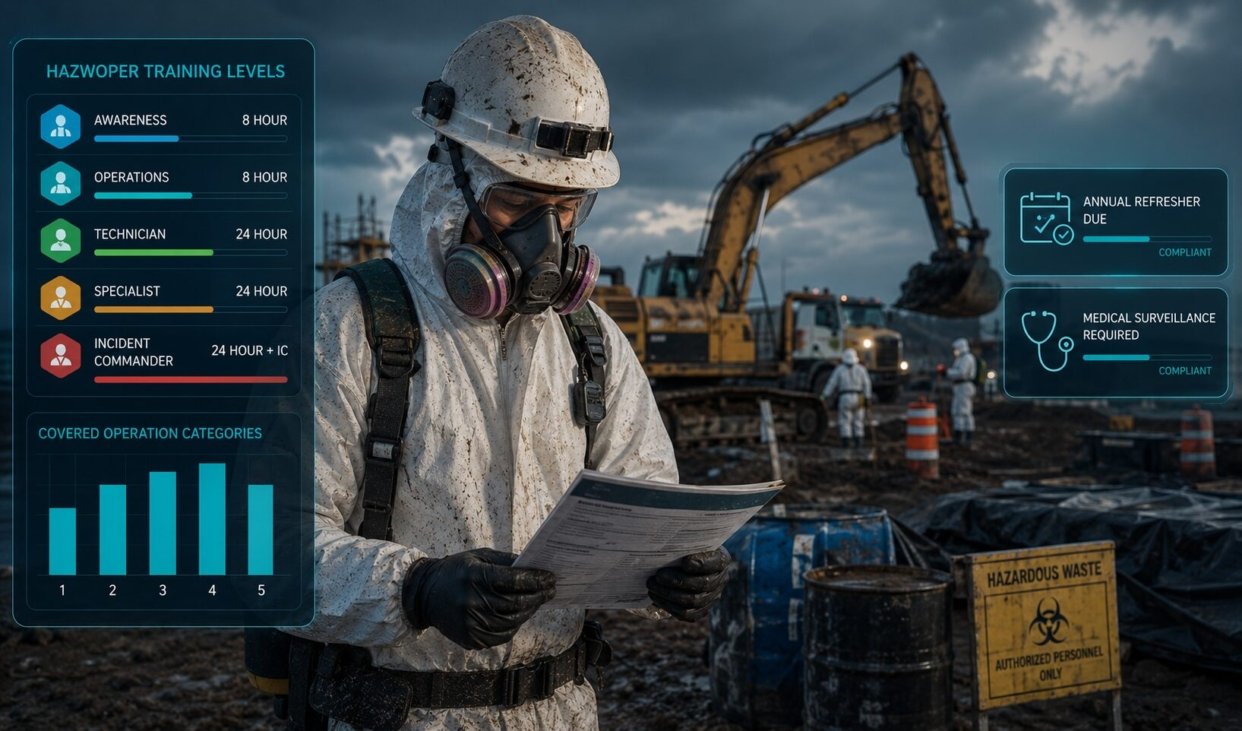
HAZWOPER training requirements are role-based. The specific training hours, content, and certification required depend on the worker’s duties and potential exposure level, not simply on whether their employer operates a covered site. A worker at a Superfund site who performs only administrative tasks in a clean office area has different training requirements than a worker who enters contaminated areas. Matching the training level to the actual job duties is an employer responsibility under 29 CFR 1910.120(e).
The 8-Hour Annual Refresher: What It Is and When It Lapses
Every worker who has completed initial HAZWOPER training must complete an 8-hour annual refresher to maintain their certification. Under 29 CFR 1910.120(e)(8), this refresher must be completed within 12 months of the previous training. There is no grace period built into the regulation.
What Employers Must Provide Beyond Training
Training is the most visible HAZWOPER requirement but not the only one. Employers with workers in any of the five covered categories must establish and maintain a comprehensive safety and health program. The training requirement is one component of this broader program obligation.
Who Is NOT Covered by HAZWOPER
Understanding who is not covered by HAZWOPER is as important as understanding who is. Applying HAZWOPER requirements to workers whose activities do not fall within the five covered categories creates unnecessary cost and may generate false confidence that regulatory compliance has been achieved where it was not actually required.
Role-Based Safety Guidance
HAZWOPER applies differently depending on your specific role and how it intersects with covered operations. The following guidance addresses the most common role types.
- Written site-specific safety and health plan reviewed before your first day
- Site characterization data telling you what hazardous substances are present
- Air monitoring before and during work in contaminated areas
- PPE appropriate to the hazards identified in monitoring
- Buddy system and communications before entering any exclusion zone
- Decontamination corridor before you can remove PPE
- Written operating procedures specific to the TSDF operations you perform
- Medical surveillance at no cost to you
- Emergency response plan covering your facility
- PPE program appropriate to the waste streams handled
- Pre-established ICS with a designated Incident Commander before any incident
- Emergency Response Plan you have reviewed and practiced in drills
- PPE appropriate to your response level (SCBA required for Technician and above)
- Buddy system and accountability before any hot zone entry
- Medical surveillance as a hazmat team member
- Recognize releases and initiate notifications, nothing more
- Never enter a contaminated area without Operations-level training and PPE
- Know the emergency notification sequence for your facility
- Know how to read a placard and use the ERG for initial hazard identification
Construction vs General Industry: 29 CFR 1926.65 vs 1910.120
Both 29 CFR 1910.120 (general industry) and 29 CFR 1926.65 (construction) apply to HAZWOPER operations. They contain substantively identical requirements. The distinction matters for determining which standard governs a specific employer’s obligations.
Employers performing HAZWOPER-covered operations as part of a construction project are covered by 29 CFR 1926.65. The same five categories of covered operations apply. Training requirements, medical surveillance, site safety planning, and emergency response requirements are identical to 1910.120. Employers working on a mixed general industry and construction site must determine which activities are governed by each standard and ensure the applicable regulation is followed for each activity type.
Key Takeaways
Frequently Asked Questions
Does HAZWOPER apply to a company that generates hazardous waste but only stores it temporarily on site?
Not automatically. Hazardous waste generators who store waste temporarily are primarily covered by EPA’s RCRA regulations and OSHA’s Hazard Communication standard (29 CFR 1910.1200). HAZWOPER applies to generators only if their employees respond to emergency releases beyond incidental releases. If workers are trained to notify authorities and evacuate in the event of a spill, but not to respond to it, HAZWOPER’s emergency response requirements under paragraph (q) do not apply to those workers. However, OSHA’s General Duty Clause may still require some level of preparedness.
Can prior HAZWOPER experience substitute for the initial training hours?
OSHA permits equivalent experience or training to substitute for formal training hours if the employer can demonstrate through testing or documented evaluation that the worker has the required competency. This is an employer determination that requires documentation. A worker who claims 40-hour equivalent experience based on years of site work must be evaluated by the employer against the specific competencies that 40-hour training is designed to produce. Undocumented claims of equivalent experience are not acceptable.
What is the difference between an Awareness-level and Operations-level emergency responder?
Awareness-level responders recognize releases and notify the appropriate authorities. They take no further action. Operations-level responders take defensive action to protect the public and environment without entering the hazard zone or trying to stop the release. A plant employee who calls 911 and activates the building alarm is acting at the Awareness level. An industrial firefighter who establishes a perimeter and protects exposures without entering the hot zone is acting at the Operations level. The key distinction is whether the responder enters the hazard area or attempts to stop the release: those actions require Technician-level training.
Government and Regulatory Sources
- OSHA. Hazardous Waste Operations and Emergency Response (HAZWOPER). US Department of Labor.
- eCFR. 29 CFR 1910.120: Full Standard Text including paragraphs (a) through (q).
- eCFR. 29 CFR 1910.120(e): Training Requirements for Hazardous Waste Operations Workers.
- eCFR. 29 CFR 1910.120(q): Emergency Response Training Requirements by Level.
- eCFR. 29 CFR 1910.120(f): Medical Surveillance Program Requirements.
- OSHA. HAZWOPER: Hazardous Waste Operations and Emergency Response (Publication 3114). US Department of Labor.
- eCFR. 29 CFR 1926.65: HAZWOPER Requirements for Construction Operations.
Related VelSafe Articles
- HAZWOPER Emergency Response: Complete Step-by-Step Guide
- HAZWOPER: Incident Command System (ICS) Overview
- HAZWOPER: Monitoring and Medical Surveillance (US)
Know Your Category, Know Your Training, Know Your Limits
HAZWOPER applies to five categories of operations and five levels of emergency responders, each with distinct training requirements and role-specific obligations. The standard does not protect workers by itself. It creates the framework within which employers must build programs that actually protect workers before they enter contaminated areas. If you work at a covered site, know which training level applies to your duties, confirm your annual refresher is current, and know exactly what actions your training authorizes and what actions require a higher-trained responder. Find more HAZWOPER compliance resources at velsafe.com.