SITUATIONAL: HAZWOPER Emergency Response Operations
HAZWOPER: Incident Command System (ICS) Overview
How It Works, Who Commands, and What OSHA Requires
A chemical release has just been reported at your facility. Who takes command? Who communicates with the fire department? Who decides when it is safe to re-enter? The Incident Command System answers all of these questions before the incident happens. OSHA’s HAZWOPER standard makes ICS mandatory for all hazardous substance emergency response operations under 29 CFR 1910.120(q)(3).
1
Incident Commander at All Times
OSHA requires that all HAZWOPER emergency response activity be coordinated through a single ICS structure with one designated Incident Commander in overall command at all times during the response.
OSHA, 29 CFR 1910.120(q)(3)
24hr
Min IC Training Required
On-scene Incident Commanders who assume control beyond the Awareness level must have at least 24 hours of training equal to the First Responder Operations level, plus demonstrated competency in ICS command and management.
OSHA, 29 CFR 1910.120(q)(6)(v)
5
Core ICS Command Functions
The ICS structure is organized around five core functions: Command, Operations, Planning, Logistics, and Finance/Administration. Not every incident activates all five, but the structure scales to fit any emergency size.
FEMA NIMS, ICS Framework
The Scenario: A Release Is Reported
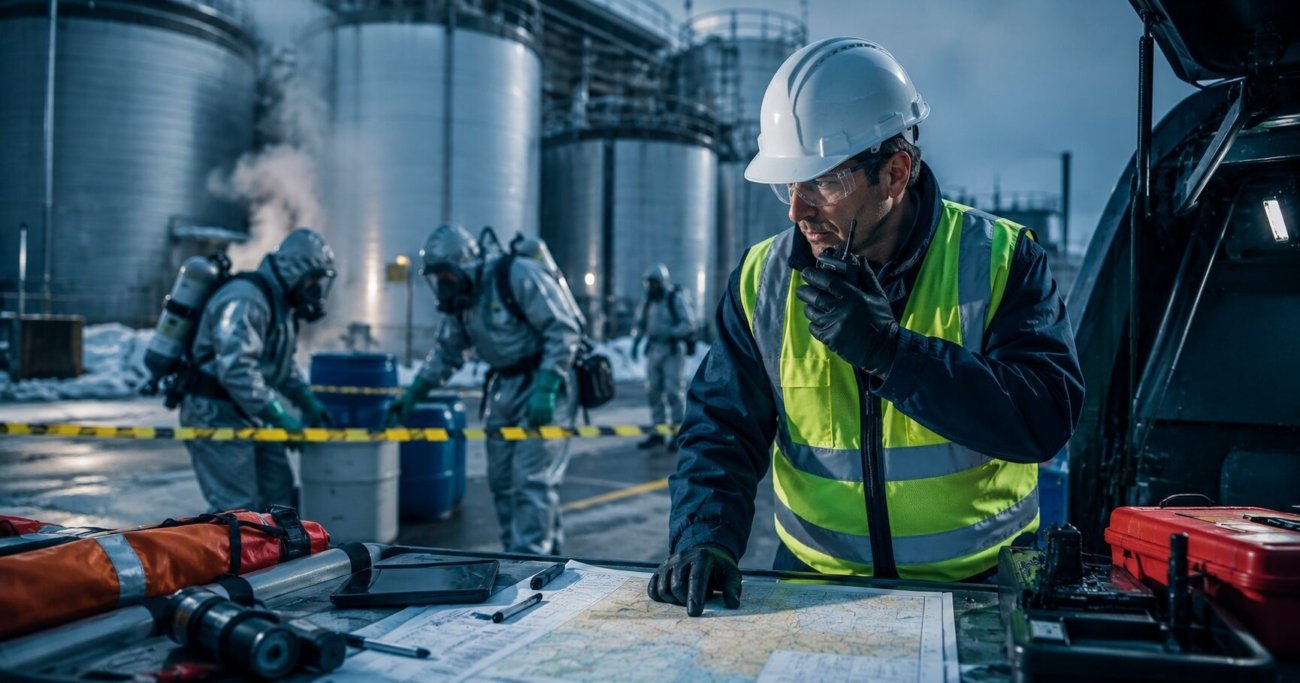
It is 9:40 a.m. on a Tuesday. A maintenance worker reports a strong chemical odor near Tank 7 in the northeast corner of the facility. Two workers in the adjacent area are already showing eye irritation. The facility EHS coordinator is called. The fire department has been notified and is en route. Your emergency response team is suiting up.
In the next four minutes, someone will take command of this incident. Every decision made in the next two hours, from zone establishment to media contact to re-entry authorization, will flow through that person. If your facility does not have a pre-established Incident Command System, this four-minute window will be chaotic, contradictory, and potentially fatal. If you have one, the structure activates automatically and your team knows exactly what to do.
OSHA’s HAZWOPER standard does not leave ICS implementation to chance. 29 CFR 1910.120(q)(3) requires that all emergency response operations be organized using a compatible Incident Command System. The structure must be in place before the incident, tested in drills, and integrated with the plans of local emergency response agencies. This article explains how ICS works in a HAZWOPER context, who fills each role, and what OSHA requires for each position.
What Is the Incident Command System?
Standardized Structure
ICS is a standardized on-scene incident management concept that allows responders to adopt an integrated organizational structure regardless of the size, type, or complexity of the incident. The same command structure applies whether the response involves two responders or two hundred.
Part of NIMS
ICS is a component of the National Incident Management System (NIMS). Both OSHA HAZWOPER and FEMA reference ICS because it enables coordinated response across organizational and jurisdictional boundaries. When the fire department, police, and your hazmat team arrive, they all speak the same command language.
OSHA Mandate
Under 29 CFR 1910.120(q)(3)(i), emergency response operations at HAZWOPER-covered facilities must be organized using the Incident Command System or a Unified Command model that integrates with local emergency response agencies. This is not a recommendation. It is a requirement.
Scalable by Design
ICS expands and contracts based on incident complexity. A small release may require only an Incident Commander and an Operations Section. A major incident may activate all five functional areas and involve multiple agencies. The structure grows to fit the need without creating a new command hierarchy each time.
The Five ICS Functions at a HAZWOPER Site
ICS organizes response activities into five functional areas. In a small HAZWOPER response, a single person may fulfill more than one function. In a large, multi-agency response, each function has its own section chief and subordinate teams. What never changes is the structure itself.
THE INCIDENT COMMANDER AND COMMAND STAFF
The Command function is occupied by the Incident Commander (IC) and three optional Command Staff positions: Safety Officer, Public Information Officer, and Liaison Officer. The IC holds overall authority for the incident. All major decisions flow to and from this position.
At a HAZWOPER site:
The IC must be the most senior, appropriately trained responder on scene. Per OSHA 1910.120(q)(6)(v), the IC must have at minimum 24 hours of training equivalent to Operations Level, plus demonstrated competency in ICS command and management. An Awareness-level responder can hold the IC role only until a more qualified person arrives.
TACTICAL RESPONSE ACTIVITIES
Operations manages all tactical actions taken to address the incident: hazmat team entry, containment, rescue if needed, and decontamination. The Operations Section Chief reports directly to the IC and directs all responders working within the hot and warm zones.
At a HAZWOPER site:
Operations typically includes the hazmat entry team, the decontamination corridor team, and any rescue resources. The Operations Section Chief must have sufficient training to understand the technical hazards being managed and the capabilities of the teams under their command.
INFORMATION AND SITUATION STATUS
Planning collects, evaluates, and disseminates information about the incident and the status of resources. It develops action plans and tracks what is happening in real time so the IC can make informed decisions. In a HAZWOPER response, Planning tracks chemical identity, exposure data, wind direction, and resource availability.
At a HAZWOPER site:
The Hazmat Specialist level responder often supports Planning with technical reference information from SDS sheets, the ERG, and real-time air monitoring data. This feeds directly into the IC’s decision-making on PPE levels, evacuation distances, and re-entry timing.
RESOURCES AND SUPPORT
Logistics provides the resources and services to support the incident: PPE supply, communication equipment, medical support, fuel, food, and facilities for an extended response. Without Logistics, even a well-commanded response runs out of what it needs.
At a HAZWOPER site:
Logistics manages the cold zone support area: the cooling station, replacement PPE, SCBA refills, medical monitoring supplies, and communications equipment. For extended responses, Logistics coordinates with external suppliers and tracks resource consumption.
5
Finance and Administration
COSTS AND DOCUMENTATION
Finance and Administration tracks all incident-related costs, manages contracts with outside vendors or response contractors, handles time recording for personnel, and manages compensation claims. This function becomes critical in large, extended responses or where regulatory cost recovery is involved.
At a HAZWOPER site:
Documentation generated by Finance and Administration supports post-incident insurance claims, OSHA recordkeeping requirements, and regulatory agency cost recovery if a government emergency response is triggered. In smaller incidents, the IC often handles this function directly.
The Three Command Staff Roles
The Incident Commander is supported by three optional Command Staff positions that are activated based on incident complexity. In a HAZWOPER emergency involving any public-facing risk, media interest, or multi-agency coordination, all three are typically needed.
Role
Reports To
Responsibilities at a HAZWOPER Incident
Safety Officer
Incident Commander
Monitors all site conditions for hazards to responders. Has authority to immediately stop or suspend any operation that poses an imminent threat to safety, without IC approval. The only ICS role with this unilateral stop-work authority. In HAZWOPER operations, the Safety Officer monitors PPE integrity, air monitoring results, and decontamination corridor operations continuously.
Public Information Officer
Incident Commander
Manages all communications with the media, public, and other external organizations. All information released publicly must be approved by the IC. In a HAZWOPER incident involving community exposure risk, the PIO coordinates shelter-in-place announcements and provides updates to the Local Emergency Planning Committee (LEPC) and National Response Center (NRC) if required.
Liaison Officer
Incident Commander
Point of contact for representatives of cooperating and assisting agencies. When the fire department, EPA, or state environmental agency arrives at a HAZWOPER incident, they report to the Liaison Officer, not directly to the IC. This prevents command confusion and keeps the IC focused on operational decisions.
The Incident Commander in a HAZWOPER Emergency
The Incident Commander is the single most important position in a HAZWOPER emergency response. OSHA’s interpretation of 1910.120(q) is clear: one person must be in overall command at all times, and that person must be the most senior, appropriately trained individual present at the response site.
OSHA Required IC Competencies: 29 CFR 1910.120(q)(6)(v)
Know and implement the employer’s ICS
The IC must have working knowledge of the facility’s ICS structure, their Emergency Response Plan, and how to activate each component. This is demonstrated through training and drills, not just documentation.
Implement the emergency response plan
The IC activates the relevant sections of the facility’s written Emergency Response Plan immediately upon taking command. Pre-incident familiarity with the plan is mandatory.
Establish site safety and health plan for emergency response
Site safety and health requirements for the specific incident must be communicated to all responders before entry into any hazard zone.
Identify and implement appropriate decontamination procedures
The IC ensures decontamination procedures are established and operating before any responder enters the hot zone. No one exits the hot zone without completing decontamination.
Implement local emergency response plan and understand hazard and risk
The IC must understand the local emergency response plan and how site operations coordinate with local emergency services. Pre-incident coordination with local fire and LEPC is a HAZWOPER requirement for this reason.
Know and implement the employer’s standard operating procedures for PPE and advance warning
PPE selection and community warning protocols must be implemented by the IC based on pre-established SOPs, not decided ad hoc during an active incident.
Command Transfer: OSHA explicitly permits command transfer during a HAZWOPER incident. If a more senior and qualified person arrives on scene, command can be transferred to that individual through a formal briefing process. The transfer must be deliberate and communicated to all ICS personnel. An undocumented, informal shift in who is giving orders is not a valid command transfer and leaves the response without a legally compliant command structure.
How ICS Zones Map to the HAZWOPER Response Structure
HAZWOPER’s three-zone model (hot zone, warm zone, cold zone) integrates directly with the ICS structure. Each ICS function operates primarily in one zone, and zone boundaries are set and controlled through the Command function.
Hot Zone
Exclusion Zone
Access restricted to trained Operations Section personnel in appropriate PPE. The IC sets and enforces entry criteria. The Safety Officer monitors from the perimeter and can pull personnel immediately if conditions change.
ICS Functions Active: Operations, Safety Officer oversight
Warm Zone
Contamination Reduction Zone
Decontamination corridor operates here under Operations direction. All personnel and equipment exiting the hot zone pass through. Entry requires appropriate PPE. The Safety Officer monitors decontamination procedures and must confirm completion before PPE removal.
ICS Functions Active: Operations (decon), Safety Officer oversight
Cold Zone
Support Zone
The ICS Command Post is established here. All Planning, Logistics, and Finance activities operate from the cold zone. Medical monitoring, equipment staging, personnel accountability, and agency coordination all happen here. The IC manages the incident from this location.
ICS Functions Active: Command, Planning, Logistics, Finance/Admin
ICS Activation Sequence in a HAZWOPER Emergency
1
Recognition and Notification
Awareness-level worker identifies release and notifies designated emergency contact per the ERP. Alarm is activated. Awareness-level worker does not enter the hazard area.
The designated Incident Commander takes command and announces it. All responders acknowledge the command structure. The IC activates the relevant ERP sections immediately.
3
Command Post Established
The IC designates the Command Post location in the cold zone. Safety Officer and Command Staff positions are activated. Zone boundaries are set based on initial size-up information.
Operations deploys the entry team. Logistics stages PPE and support equipment. Planning begins collecting chemical identity, exposure, and weather data. Decontamination corridor is set up in the warm zone.
Arriving external agencies (fire, EMS, EPA) are directed to the Liaison Officer. The IC briefs the senior fire official. Unified Command may be established if jurisdictional authority warrants it.
6
Termination and Critique
IC declares incident termination when the scene is stabilized. All personnel are accounted for. Documentation begins immediately. A post-incident critique is conducted as required by 29 CFR 1910.120(q)(2)(x).
Common ICS Failures at HAZWOPER Sites
No Pre-Designated Incident Commander
The most common ICS failure is not having a designated IC before the incident. When an emergency happens, the first minutes are spent deciding who is in charge instead of managing the hazard. OSHA requires ICS to be pre-established, not improvised on scene.
IC Not Trained to Required Level
Designating a supervisor as IC without the minimum 24-hour Operations-level HAZWOPER training creates a compliance violation before the incident even starts. The IC’s training level determines what they can legally command at the scene.
ICS Not Compatible with Local Agencies
If your facility ICS uses different terminology, zone names, or command structures than the local fire department, integration during a real incident will fail. Pre-incident coordination and joint exercises are the only way to verify compatibility.
No Personnel Accountability System
ICS requires that all personnel be accounted for at all times. Without a system to track who is in each zone, the IC cannot make accurate decisions about resource use, exposure risk, or safe evacuation. Personnel accountability is an ICS requirement, not an optional best practice.
Key Takeaways
ICS Must Be Established Before the Incident
OSHA requires ICS to be pre-established as part of the Emergency Response Plan. An IC must be designated, trained, and ready before any incident occurs. Improvising an ICS structure during an active chemical release violates 29 CFR 1910.120(q)(3) and creates a command vacuum at the worst possible moment.
One Commander, One Chain of Command
Every HAZWOPER response must have a single Incident Commander in overall command. Parallel command structures, informal decision-making outside the ICS, or responders taking independent action without IC authorization all undermine the system and create the exact conditions that lead to preventable injuries.
The Safety Officer Has Unilateral Stop-Work Authority
In the ICS structure, the Safety Officer is the only person who can stop an operation without IC approval. This authority exists specifically for HAZWOPER operations where a hazard to responders may emerge faster than a normal command communication chain can respond. The Safety Officer must be trained, designated, and empowered to use this authority.
Test Your ICS in Drills Before You Need It
A written ICS that has never been practiced is a compliance document, not a functional system. OSHA expects HAZWOPER facilities to test their ICS through tabletop exercises and field drills, and to coordinate with local emergency agencies to verify that the structures are compatible. Drills expose gaps that no amount of planning will find.
Frequently Asked Questions
Is ICS specifically required by OSHA for HAZWOPER or is it just a best practice?
It is a specific OSHA requirement. 29 CFR 1910.120(q)(3)(i) states that emergency response operations must be coordinated using a compatible Incident Command System. This is a mandatory compliance standard, not guidance. Employers who respond to hazardous substance releases without an ICS are in violation of the HAZWOPER standard regardless of how well the response goes operationally.
Can an Awareness-level trained employee serve as the Incident Commander?
Temporarily, yes, but only until a more qualified person arrives. OSHA’s interpretation allows an Awareness-level employee to assume IC duties as the first senior person on scene, but the standard requires that the IC role be filled by the most senior, appropriately trained individual present. An Operations-level IC must assume command as soon as one is available. An Awareness-level IC has no authority to direct responders into the hot zone.
What is Unified Command and when is it used?
Unified Command is a variation of ICS used when multiple agencies with legal jurisdictional authority over an incident need to share command. In a HAZWOPER incident that triggers a fire department response, an EPA Superfund activation, or a state emergency, Unified Command allows the facility IC, fire incident commander, and agency representatives to share command decisions while maintaining a single ICS structure. Unified Command is established by agreement between the participating agencies, typically through pre-incident coordination.
Does the ICS for HAZWOPER need to match FEMA’s NIMS structure exactly?
It must be compatible with the structures used by local emergency response agencies, not necessarily identical. OSHA requires a “compatible” ICS, specifically so that when outside agencies arrive, they can integrate without confusion. The safest approach is to build your facility ICS using NIMS/ICS standard terminology and structure, which is what your local fire department will use.
Where does the post-incident critique fit into the ICS?
The post-incident critique is required by 29 CFR 1910.120(q)(2)(x) and is typically managed by the IC after termination is declared. It reviews what worked, what failed, and what needs to change in the ERP or the ICS itself. The findings are documented in writing, assigned corrective actions, and used to update the Emergency Response Plan. A critique that produces no corrective actions is rarely a realistic outcome of a real incident.
Government and Regulatory Sources
Training and Industry References
Related VelSafe Articles
Build an ICS That Works When It Has To
The Incident Command System is only as effective as the preparation behind it. A pre-designated IC with the right training, a written ERP that all responders have practiced, and a command structure that has been tested alongside your local fire department are the three conditions OSHA expects and that your workers deserve. Find more HAZWOPER compliance resources at velsafe.com.