WORKER SAFETY: Hazardous Operations and Chemical Hazard Control
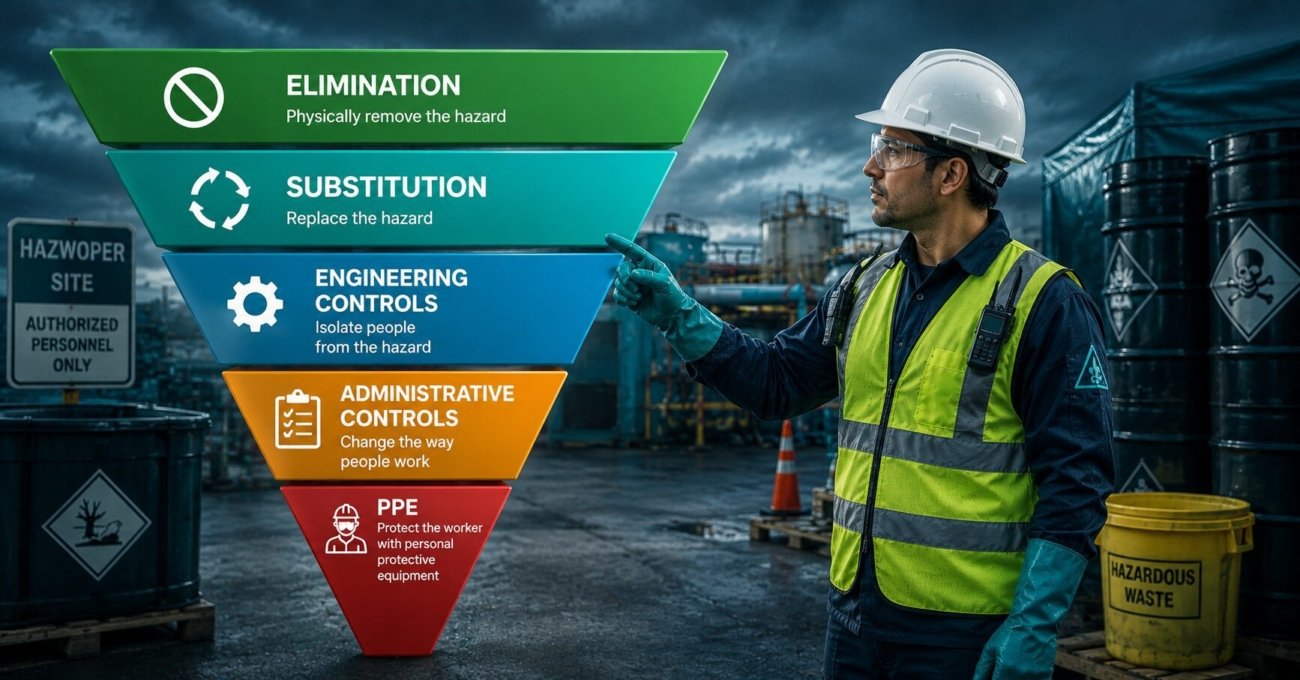
HAZWOPER: Hierarchy of Controls Overview
What Every Worker Needs to Know About Controlling Hazards
The hierarchy of controls tells you the safest order to address workplace hazards. At HAZWOPER sites, knowing this framework means understanding why your employer chose certain controls, and why PPE is always the last line of defense, not the first.
5
Control Levels
NIOSH and OSHA define five levels of hazard controls ranked by effectiveness, from elimination at the top to personal protective equipment at the bottom.
NIOSH, CDC Hierarchy of Controls
#1
Elimination Is Always Best
Removing the hazard entirely is the most effective control because it prevents exposure without relying on human behavior, equipment, or training to work correctly every time.
OSHA, General Industry Guidance
Last
PPE Is a Last Resort
OSHA considers PPE the last line of defense. It does not eliminate the hazard and only protects if selected correctly, worn properly, and maintained consistently by every worker every time.
OSHA, Hierarchy of Controls
Why the Hierarchy of Controls Matters at HAZWOPER Sites
At a HAZWOPER site, the hazards you face are serious. Toxic chemicals, flammable materials, unknown substances, and contaminated environments create risks that cannot be managed by willpower or caution alone. The hierarchy of controls gives your employer, your safety manager, and you a structured way to think about which protections to put in place, and in which order.
The hierarchy works because it ranks controls by how much they rely on human behavior. Elimination removes the hazard entirely, so no one can be exposed no matter what. PPE sits at the bottom because it only protects when a worker selects the right equipment, puts it on correctly, maintains it, and never removes it too early. At HAZWOPER sites, even small lapses in PPE use can lead to serious chemical exposures. That is why the hierarchy pushes you to use the strongest controls available before reaching for PPE.
Understanding this framework helps you recognize why your site operates the way it does. When your employer rotates work schedules to limit chemical exposure time, that is an administrative control. When ventilation systems remove contaminated air before you enter a space, that is an engineering control. When a hazardous chemical has been replaced with a less toxic alternative, that is substitution. Each of these choices reflects a deliberate decision to use the hierarchy of controls to protect you.
Why This Matters for Your Safety
At HAZWOPER sites, PPE is always required. But PPE alone is not enough. OSHA requires employers to use every feasible control higher in the hierarchy before relying on PPE as the primary protection. If you notice that your site depends entirely on PPE while feasible engineering or administrative controls exist, you have the right to raise that concern with your supervisor or safety officer.
The Five Levels of Hazard Control
Each level of the hierarchy controls hazards differently. The levels at the top reduce or remove the hazard itself. The levels at the bottom only reduce your exposure to a hazard that still exists. At HAZWOPER sites, multiple levels are often combined, but the goal is always to use the highest level of control that is feasible for each specific hazard.
Hierarchy of Controls: Effectiveness from Most to Least
1. Elimination
Most Effective
Physically removes the hazard from the workplace. No hazard means no exposure, regardless of worker behavior or equipment performance.
2. Substitution
Highly Effective
Replaces a hazardous material or process with a safer alternative. Reduces risk at the source without eliminating the work process entirely.
3. Engineering Controls
Effective
Physically separates workers from the hazard. Includes ventilation systems, enclosures, guards, and containment. Works without relying on worker behavior once installed.
4. Administrative Controls
Moderate
Changes how work is organized or performed to reduce exposure. Includes rotation schedules, safe work procedures, and training. The hazard still exists but exposure is limited.
5. Personal Protective Equipment (PPE)
Least Effective Alone
Protects the individual worker from the hazard. The hazard remains present. Protection depends on correct selection, proper fit, consistent use, and regular maintenance.
Signs That Controls May Be Inadequate at Your Site
Workers at HAZWOPER sites are in the best position to notice when controls are not working. Knowing the signs of inadequate hazard control protects you and your coworkers.
PPE Is the Only Control
If PPE is the only thing standing between you and a serious chemical hazard, ask whether engineering or administrative controls should also be in place. OSHA requires employers to implement all feasible higher-level controls before relying solely on PPE.
Workers Get Sick or Injured Repeatedly
Recurring incidents involving the same hazard are a signal that current controls are not adequate. A single incident may be an anomaly; a pattern signals a systemic control failure that needs to be addressed higher in the hierarchy.
Ventilation or Containment Is Bypassed
Engineering controls only work when they are operating correctly and fully. If ventilation systems are offline, guards are removed, or containment barriers are damaged, the engineering control layer is gone and you are relying only on controls below it.
How the Hierarchy of Controls Is Applied at a HAZWOPER Site
Here is how each level of the hierarchy plays out in a real HAZWOPER work environment. Understanding these examples helps you recognize the controls already in place around you.
WHAT IT LOOKS LIKE AT YOUR SITE
A process step that previously required workers to handle a corrosive acid has been redesigned so the acid is no longer used. The work still gets done, but the hazard no longer exists on site.
WHY IT IS THE STRONGEST CONTROL
No hazard means no exposure. You cannot be harmed by something that is not there. No amount of PPE failure, human error, or equipment malfunction changes that outcome.
WHAT IT LOOKS LIKE AT YOUR SITE
A highly toxic solvent previously used in a cleaning process has been replaced with a water-based cleaner that performs the same function with a much lower toxicity profile. The hazard still exists but it is significantly reduced.
IMPORTANT CAUTION
Always verify that the substitute does not create a new hazard. A less toxic chemical that is highly flammable may not be a net improvement if the site also has ignition sources.
WHAT IT LOOKS LIKE AT YOUR SITE
A local exhaust ventilation system captures chemical vapors at the source before they can reach worker breathing zones. A sealed containment structure prevents contaminated soil from becoming airborne during excavation work.
WHY THESE MATTER TO YOU
Engineering controls work in the background without relying on you to do anything extra. But they only protect you if they are operating correctly. Report any damaged, offline, or bypassed engineering controls immediately.
4
Administrative Controls
WHAT IT LOOKS LIKE AT YOUR SITE
Worker rotation schedules limit how long any one person is exposed to a chemical or physical hazard during a shift. Mandatory decontamination procedures before breaks prevent contamination spread. Safe work procedures define exactly how a task must be performed.
YOUR RESPONSIBILITY
Administrative controls depend on workers following them consistently. They only work if everyone on the team adheres to the schedule, procedure, or practice every single time.
5
Personal Protective Equipment
WHAT IT LOOKS LIKE AT YOUR SITE
Respirators, chemical-resistant gloves, eye protection, Tyvek suits, and steel-toed boots protect you from hazards that remain after all other controls are applied. At HAZWOPER sites, PPE is always present because residual hazards almost always exist.
CRITICAL REMINDER
PPE protects only you, and only when worn correctly. It does not protect coworkers nearby. It does not reduce the hazard. If your PPE fails or fits incorrectly, your exposure is the same as wearing nothing.
Do and Don’t: Applying the Hierarchy of Controls
DO
DO NOT
Ask your supervisor which controls are in place for each hazard you face
Assume PPE is enough protection on its own without other controls
Report ventilation systems, guards, or containment barriers that are damaged or offline
Bypass or disable engineering controls to make a task faster or easier
Follow all administrative controls including rotation schedules and safe work procedures
Skip or shorten administrative controls such as decontamination or rotation breaks
Inspect PPE before every use and replace damaged equipment before entering a hazard zone
Wear damaged, ill-fitting, or incorrect PPE and hope it is good enough
Raise concerns if you believe higher-level controls exist but are not being used
Stay silent about safety concerns out of fear of slowing the job down
Supervisor Tips: Applying the Hierarchy Correctly
Start from the Top, Every Time
For every new task or hazard identified, begin the control selection process at elimination. Only move down the hierarchy when a higher-level control is genuinely not feasible. Document your reasoning for each decision.
Combine Controls When Possible
Multiple levels of the hierarchy used together are stronger than any single control. Engineering controls combined with administrative controls and PPE provide layered protection. Redundancy matters when hazards are serious.
Review Controls After Every Incident
Any near-miss or incident is a signal that current controls were insufficient. Conduct a hazard reassessment after every incident and ask whether a higher level of control could have prevented it.
Worker Checklist: Hierarchy of Controls at Your Site
Phase
Check
Before Work
Know which hazards are present at your work area today
Before Work
Confirm all engineering controls (ventilation, guards, containment) are operational
Before Work
Review today’s administrative controls: rotation schedule, safe work procedures, decon steps
Before Work
Inspect all PPE before donning. Replace any damaged, expired, or ill-fitting equipment
During Work
Monitor for any changes in conditions that may affect control effectiveness
During Work
Report immediately if any engineering control goes offline or is bypassed
During Work
Follow all administrative controls including rotation and decontamination procedures
After Work
Complete full decontamination before removing PPE
After Work
Report any concerns about control adequacy to your supervisor before leaving the site
Key Takeaways
The Strongest Controls Remove the Hazard
Elimination and substitution protect you without requiring anything from you. No equipment to maintain, no procedure to remember, no behavior to sustain. When these controls are feasible, they are always the right choice.
Engineering Controls Work Even When You Make Mistakes
A properly functioning ventilation system protects you whether or not you remember to follow a procedure. That is what makes it stronger than administrative controls or PPE. Keep these systems running and report problems immediately.
PPE Is Last, Not Optional
At HAZWOPER sites, PPE is always required because residual hazards always exist. But being last in the hierarchy means your employer must also use all higher-level controls that are feasible before PPE becomes the primary protection.
You Have the Right to Know What Controls Protect You
OSHA gives workers the right to know about the hazards they face and the controls in place to protect them. If you do not understand why a specific control is or is not being used at your site, ask. A good safety program welcomes that question.
Frequently Asked Questions
Why is PPE considered the least effective control if HAZWOPER sites require it constantly?
PPE is least effective in the hierarchy because it only protects you if you select the right type, fit it correctly, maintain it, and never remove it too early. Every one of those steps can fail. Controls higher in the hierarchy work independently of human behavior. At HAZWOPER sites, PPE is always required because residual hazards remain after all other controls are applied, but it is used alongside those controls, not instead of them.
Can administrative controls ever be as effective as engineering controls?
In theory, administrative controls can significantly reduce exposure, but in practice they are less reliable because they depend on consistent human behavior. A rotation schedule is only effective if supervisors enforce it and workers follow it every shift. An engineering control like local exhaust ventilation reduces exposure whether or not anyone remembers to activate a procedure. When engineering controls are feasible, they provide more consistent protection.
What should I do if I believe my employer is relying too much on PPE and not using available higher-level controls?
Raise the concern with your supervisor or site safety officer first. If you do not receive a satisfactory response, you have the right to contact OSHA directly to file a complaint. OSHA’s anti-retaliation protections under Section 11(c) of the OSH Act protect workers who raise good-faith safety concerns from being punished for doing so.
Is substitution always safe? Can a substitute create new hazards?
Substitution is not automatically safe. A chemical that is less toxic but highly flammable, corrosive, or reactive with other materials on site may not be a net safety improvement. Any substitution should be evaluated for all hazard types, including fire, chemical reactivity, environmental impact, and worker exposure, before the change is implemented.
Government and Regulatory Sources
Training and Industry References
Related VelSafe Articles
Know Your Controls, Know Your Rights
The hierarchy of controls is not just a training concept. It shapes every decision your safety team makes about how to protect you at work. Understanding it helps you recognize when the right protections are in place, and when they are not. Find more worker safety resources at velsafe.com.