TIPS: Chemicals and Hazard Communication, Driver and Transportation Safety
HAZWOPER Heat Stress Awareness Tips
Protect Workers Before Heat Becomes a Medical Emergency
Heat stress is one of the most underestimated hazards at HAZWOPER sites. Workers in encapsulating PPE can face extreme heat buildup even on mild weather days. These tips cover recognition, prevention, and emergency response for heat illness in hazardous operations environments.
Most workers can shed excess body heat through sweat evaporation. HAZWOPER workers in Level A or Level B encapsulating suits cannot. The suit traps heat against the body, blocks airflow, and prevents sweat from cooling the skin. On a 90-degree day, a worker in a vapor-protective suit may experience conditions equivalent to well over 100 degrees of effective temperature inside the suit, with no way to cool down until they exit, decontaminate, and doff their PPE.
That constraint makes heat stress both more dangerous and harder to manage at hazardous waste sites. Workers cannot simply step into the shade or take a drink of water mid-task. They must plan cooling into the work schedule before entry, not after heat symptoms appear. By the time a worker inside an encapsulating suit notices the early signs of heat exhaustion, they may already be approaching a dangerous physiological threshold.
OSHA has historically enforced heat protections through the General Duty Clause. In August 2024, OSHA proposed its first comprehensive Heat Injury and Illness Prevention Standard, which, if finalized, will establish specific enforceable requirements for heat monitoring, acclimatization, water and rest breaks, and emergency response procedures. For HAZWOPER sites, those requirements must be integrated into the Health and Safety Plan (HASP).
Heat illness does not arrive without warning. It progresses through stages, and workers who recognize the early signs can intervene before a minor heat cramp becomes a life-threatening heat stroke. At HAZWOPER sites, the buddy system is critical precisely because workers inside PPE often cannot self-assess accurately.
Heat Illness Progression: From Mild to Life-Threatening
Heat Cramps
Mild
Painful muscle spasms, usually in legs or abdomen. Often the first sign of dehydration and heat stress. Move to shade, rest, hydrate with water or electrolyte drink.
Heat Syncope
Moderate
Dizziness, light-headedness, or fainting from prolonged standing or sudden movement in the heat. Lay worker flat, elevate legs, move to cool area, hydrate.
Heat Exhaustion
Serious
Heavy sweating, weakness, cold or pale skin, weak pulse, nausea, possible fainting. Remove from heat immediately. Cool with wet cloths, fan, ice packs to neck, armpits, groin. Monitor closely. Seek medical attention if no improvement within 15 minutes.
Heat Stroke
Life-Threatening: Call 911
Body temperature above 103 degrees F. Hot and red skin (may be dry or damp). Rapid strong pulse. Possible confusion, slurred speech, loss of coordination, or unconsciousness. This is a medical emergency. Call 911 immediately and begin rapid cooling while waiting for EMS.
1
Set Entry Time Limits Based on PPE Level
WHY IT MATTERS
Encapsulating suits prevent the body’s primary cooling mechanism. Without pre-set time limits, workers have no objective signal to exit before heat stress becomes dangerous.
WHAT TO DO
Use NIOSH work-rest guidelines and the OSHA-NIOSH Heat Safety Tool app to calculate maximum safe entry times for each PPE level before work begins. Post limits visibly at the entry control point.
PRO TIP
Cut calculated time limits by 25% in high humidity, and reduce further for workers who are new, returning from absence, or known to have individual risk factors.
2
Start Hydration Before Workers Suit Up
WHY IT MATTERS
Workers in encapsulating suits cannot drink during operations. Entering already dehydrated dramatically accelerates heat illness onset and shortens the window before a dangerous incident occurs.
WHAT TO DO
Require workers to drink at least 16 ounces of water or electrolyte drink before donning PPE. Have cool water (50 to 60 degrees F) ready for prompt rehydration after exit and decon.
COMMON MISTAKE
Providing water only after workers report thirst. By the time thirst is felt, dehydration is already affecting performance and safety.
3
Acclimatize All New and Returning Workers
WHY IT MATTERS
The body requires 7 to 14 days to adapt to sustained heat exposure. Most heat fatalities occur in the first days of a new assignment or after workers return from even a brief absence.
WHAT TO DO
For experienced workers returning to heat conditions, NIOSH recommends starting at 50% exposure on day one, then 60%, 80%, and 100% on successive days. For new workers, begin at 20% and increase by 20% each day.
PRO TIP
Treat workers returning from illness, vacation, or weekend breaks the same as new workers during heat waves. Acclimatization degrades faster than most supervisors assume.
4
Use a Buddy System for Hot Zone Monitoring
WHY IT MATTERS
Heat illness impairs judgment before workers realize something is wrong. A worker in the early stages of heat exhaustion may feel fine until they collapse. No one should monitor their own heat status inside a hot zone.
WHAT TO DO
Assign each hot zone entrant a buddy who monitors from outside or alongside. Establish hand signals or radio check-in intervals. Any change in movement pattern, coordination, or response speed is an exit signal.
COMMON MISTAKE
Relying on workers to self-report symptoms. The person most at risk is often the last to recognize it.
5
Stage a Cooling Station in the Cold Zone
WHY IT MATTERS
Minutes matter when a worker exits a hot zone showing heat illness signs. If cooling equipment is not already in place, the delay between exit and treatment can allow a manageable case to become critical.
WHAT TO DO
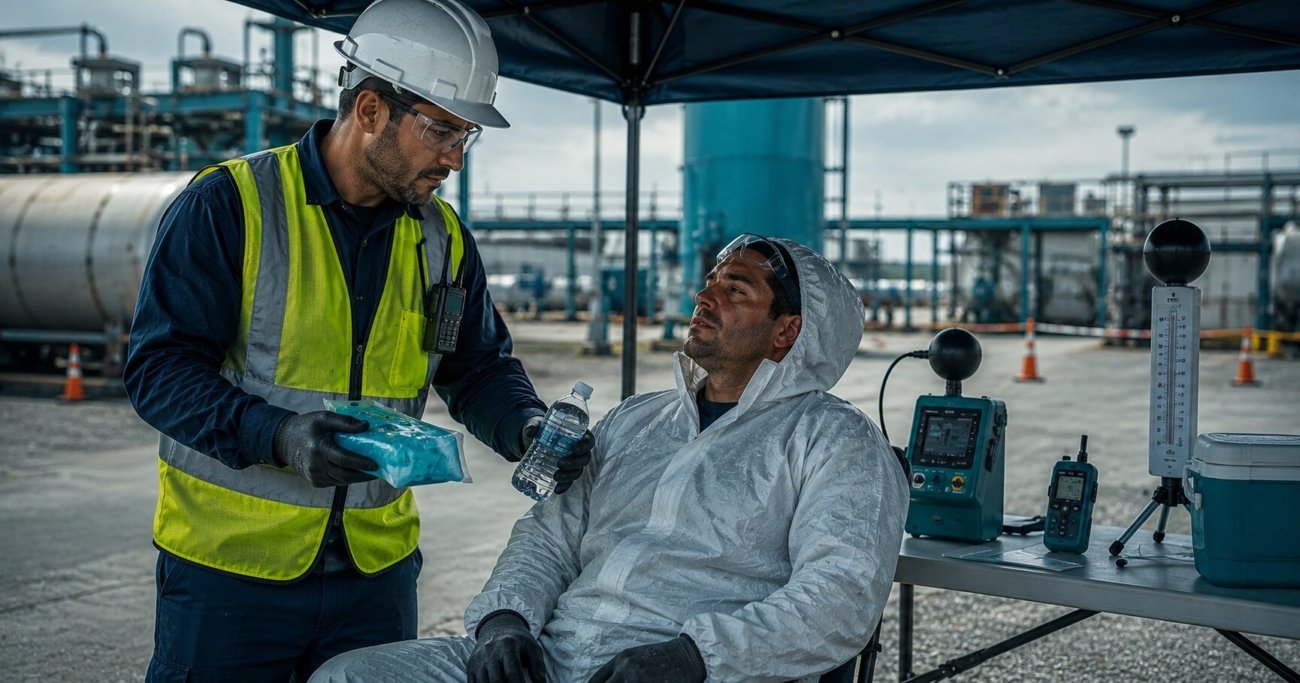
Set up a shaded or air-conditioned rest area in the cold zone before any work begins. Stock it with cool water, ice packs, cooling towels, and a cot or reclining chair. Know the route to the nearest emergency medical facility.
PRO TIP
Cooling vests worn under or between suit layers can extend safe work time for workers who must perform moderate-intensity tasks in high-heat conditions.
6
Monitor Conditions Throughout the Shift
WHY IT MATTERS
Heat conditions change during a shift. A morning that starts at 80 degrees F may reach 95 degrees F by midday. Work-rest cycles calculated at the start of a shift may become unsafe within hours.
WHAT TO DO
Use a Wet Bulb Globe Temperature (WBGT) meter for the most accurate heat stress measurement, or track heat index via the OSHA-NIOSH Heat Safety Tool app. Check at shift start, peak midday, and whenever conditions visibly change.
COMMON MISTAKE
Setting work-rest schedules once in the morning and not revisiting them as the day heats up. Conditions at noon are rarely the same as conditions at 7 a.m.
7
Screen for Individual Risk Factors Before Assignment
WHY IT MATTERS
Some workers are significantly more vulnerable to heat illness. Certain medications, cardiovascular conditions, prior heat illness episodes, and low fitness levels all increase risk in ways that are not visible from the outside.
WHAT TO DO
Include heat risk screening in pre-employment and seasonal medical evaluations under the HAZWOPER medical surveillance program. Train supervisors to confidentially identify workers who may need modified assignments during extreme heat.
PRO TIP
A heart rate check one minute after moderate exertion is a simple physiological field indicator. Resting heart rate that remains above 180 minus age after one minute of rest signals excessive heat strain.
8
Schedule Heavy Work for the Coolest Hours
WHY IT MATTERS
Physical exertion generates internal metabolic heat on top of environmental heat. Scheduling high-exertion hot zone entries during the hottest part of the day compounds both heat sources and dramatically reduces safe work duration.
WHAT TO DO
Schedule the most physically demanding hot zone work for early morning hours. Use the midday heat peak for documentation, equipment checks, planning, and lower-intensity cold zone tasks. Resume physically demanding work in late afternoon if conditions allow.
COMMON MISTAKE
Planning the work schedule around operational deadlines rather than environmental conditions. Heat does not adjust to project timelines.
9
Integrate Heat Controls into the Site HASP
WHY IT MATTERS
Heat stress controls at HAZWOPER sites must be documented as part of the Health and Safety Plan, not improvised day-to-day. OSHA’s proposed heat standard explicitly states that HAZWOPER HASP integration is required.
WHAT TO DO
Add a dedicated heat illness prevention section to your HASP covering: heat monitoring methods, work-rest schedules by PPE level, acclimatization protocol, hydration requirements, first aid procedures, and emergency contact numbers.
PRO TIP
Update the HASP heat section at the start of each warm-weather season and after any heat-related incident, even a minor one.
10
Know the Heat Stroke Emergency Protocol Before You Need It
WHY IT MATTERS
Heat stroke kills. The difference between survival and death often comes down to how fast cooling begins. At a HAZWOPER site, workers must complete decontamination before full medical treatment is possible, adding critical minutes to the response timeline.
WHAT TO DO
Call 911 immediately for any suspected heat stroke. Begin aggressive cooling as fast as decontamination procedures allow: remove outer PPE layers, apply ice packs to neck, armpits, and groin, and fan the worker. Do not wait for EMS to begin cooling.
COMMON MISTAKE
Treating heat stroke as heat exhaustion and waiting to see if the worker improves. If the worker is confused, unresponsive, or has stopped sweating in the heat, call 911 first and cool aggressively while waiting.
Requirement
Regulatory Basis
HAZWOPER Application
Heat illness prevention program
OSHA General Duty Clause; proposed HIIPP standard
Must be integrated into site HASP
Water, rest, and shade access
OSHA heat guidance; state plans (CA, CO, MD, MN, NV, OR, WA)
Cold zone rest area must be set up before work begins
Acclimatization program
NIOSH recommended standard; OSHA proposed HIIPP
Required for new and returning workers before full-duration hot zone assignments
Heat stress monitoring (WBGT or heat index)
OSHA HAZWOPER preparedness guidance
Monitor at shift start, peak, and when conditions change
Heat illness first aid training
29 CFR 1910.120(q)(2)(viii); OSHA General Duty Clause
All site workers must know symptoms and first response steps
Medical surveillance integration
29 CFR 1910.120(f)
Pre-placement and seasonal heat risk screening for HAZWOPER workers
PPE Is the Problem, Not Just the Solution
At HAZWOPER sites, the same PPE that protects workers from chemical exposure also blocks their ability to cool down. Heat stress controls must be built around PPE constraints, not added as an afterthought.
Prevention Happens Before the Shift Starts
Work-rest schedules, hydration, cooling stations, and buddy assignments must all be in place before the first worker enters the hot zone. Reactive heat management after symptoms appear is already too late for the safest possible outcome.
New Workers Face the Highest Risk
Most heat fatalities strike in the first days of exposure. Acclimatization protocols protect new workers and those returning after absence. Never send an unacclimatized worker into a full-duration hot zone assignment.
Heat Stroke Is Always a 911 Call
Confusion, loss of coordination, stopped sweating in the heat, or unconsciousness means heat stroke. Call 911 and begin cooling immediately. Do not wait to see if the worker improves on their own.
Heat stress is preventable. The workers most at risk are the ones wearing the most protective gear, and they deserve the same level of planning that goes into chemical hazard controls. Use these tips to build heat protection into every HAZWOPER site plan before the temperature rises. Find more workplace safety resources at velsafe.com.