
Your Legal Guide to US Hazmat Compliance
What the Law Requires: HAZWOPER and the DOT ERG at a Glance
Two federal frameworks govern workplace safety during hazardous materials incidents in the United States. The first is OSHA’s Hazardous Waste Operations and Emergency Response standard, universally known as HAZWOPER, codified at 29 CFR 1910.120 for general industry and mirrored at 29 CFR 1926.65 for construction. The second is the Department of Transportation’s Emergency Response Guidebook, published by the Pipeline and Hazardous Materials Safety Administration (PHMSA) and updated every four years.
These two frameworks do different jobs but overlap significantly for employers whose operations involve transporting, storing, or responding to releases of hazardous chemicals. HAZWOPER establishes training requirements, emergency response planning obligations, and personal protective equipment (PPE) standards. The ERG provides first responders with the operational reference material they need during the initial phase of a hazmat transportation incident.
Understanding how these frameworks interact is not optional. Employers who fail to train workers appropriately, maintain compliant emergency response plans, or equip their teams with up-to-date response resources face OSHA citations, civil liability, and preventable worker fatalities.
Who Must Comply with HAZWOPER?
HAZWOPER does not apply to every employer who handles chemicals. The standard targets a specific set of operations where the hazard profile is significantly elevated. OSHA defines five categories of operations that fall within its scope under 29 CFR 1910.120(a)(1).
One category that surprises many employers is the emergency response provision. If your facility has workers whose job includes responding to a hazmat release (even defensively, even without direct contact with the chemical), HAZWOPER may apply to them. The standard draws a critical distinction between an “incidental release” that a worker can handle with standard PPE and training, and an “emergency response” that requires HAZWOPER-trained personnel and a formal emergency response plan (ERP).
Understanding the Five HAZWOPER Emergency Responder Training Levels
For employers whose workers respond to hazardous substance releases, OSHA identifies five training levels under 29 CFR 1910.120(q)(6). Each level has specific minimum training requirements and competencies that responders must demonstrate. These are not optional tiers: the level assigned to a worker must match the actual duties they perform during an emergency.
Competency-Based (No Set Hour Minimum)
Min. 8 Hours
Min. 24 Hours
Min. 24 Hours (plus Technician competencies)
Competency-Based
All five levels require annual refresher training. The refresher does not have a fixed minimum duration but must be of sufficient content to maintain competencies. Many employers document this through tabletop exercises, drills, and formal coursework combined.
Compliance Note: OSHA draws a hard line between an “incidental release” and an emergency response requiring HAZWOPER compliance. If an employer simply evacuates all workers and calls a trained response team without any employees performing response activities, an Emergency Action Plan under 29 CFR 1910.38 may satisfy requirements instead of a full HAZWOPER Emergency Response Plan. Document your decision and the reasoning behind it.
What Is the DOT Emergency Response Guidebook?
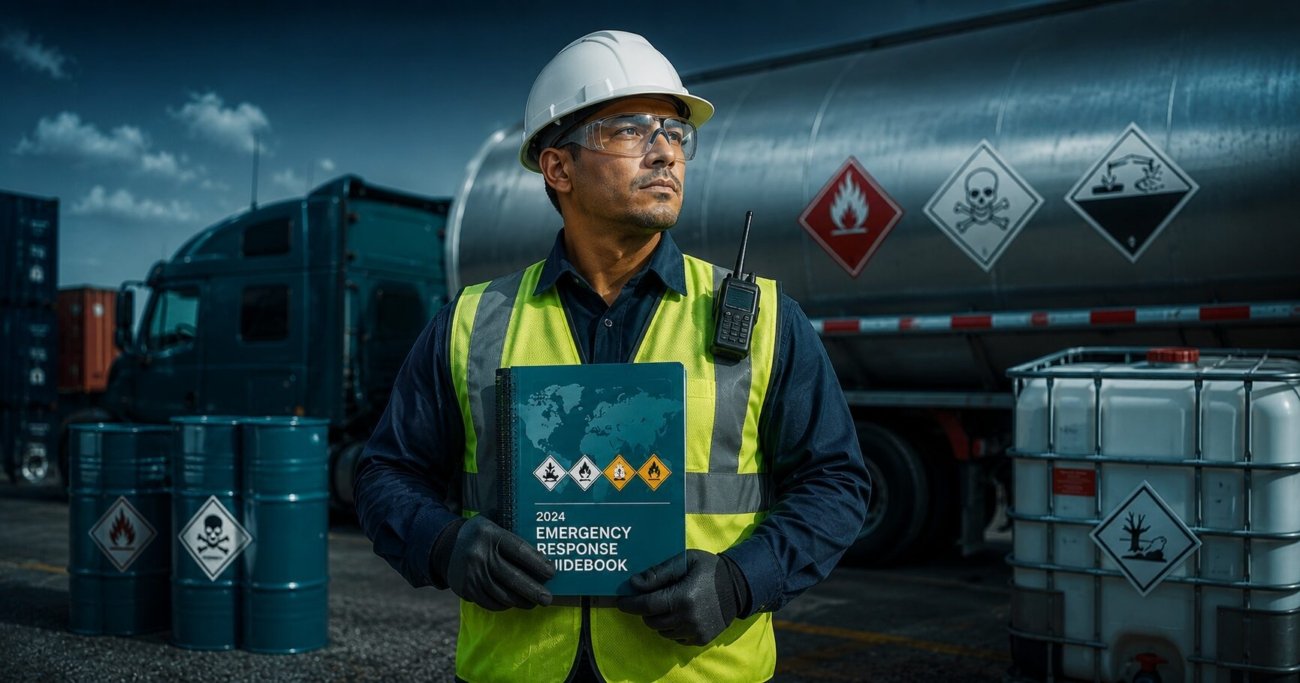
The Emergency Response Guidebook (ERG) is published by the US Department of Transportation’s Pipeline and Hazardous Materials Safety Administration (PHMSA), in collaboration with Transport Canada and Mexico’s Secretariat of Infrastructure. The 2024 edition is the most current version and is designed specifically for use during the first 30 minutes of a hazardous materials transportation incident.
The ERG is not a HAZWOPER training document, but it is deeply linked to HAZWOPER compliance. OSHA’s Awareness Level training typically includes instruction on how to read and use the ERG, and the book satisfies the DOT requirement under 49 CFR 172.602 that hazmat shipments be accompanied by emergency response information. Employers in transportation, distribution, construction, and environmental services frequently rely on it as both a training tool and a field reference.
Key Changes in the 2024 ERG Edition
The 2024 edition introduced several updates that employers and safety professionals should be aware of. These changes affect how responders access information and make initial protective action decisions in the field.
Employer Responsibilities Under HAZWOPER
Employers covered by HAZWOPER face a multi-layered set of obligations. The specific requirements depend on which of the five covered operation types applies, but the core employer duties are consistent across the standard.
- Written Safety and Health Program. Employers at uncontrolled hazardous waste sites must develop and implement a written safety and health program addressing site evaluation, employee training, medical surveillance, engineering controls, PPE, and work practices. (29 CFR 1910.120(b))
- Site-Specific Safety Plans. A site safety and health plan must be developed before work begins, covering all hazards, required controls, and emergency procedures specific to site conditions. (29 CFR 1910.120(b)(4)(ii))
- Emergency Response Plan (ERP). Employers must develop and implement an ERP before beginning operations likely to involve emergency response. The ERP must address pre-emergency planning, personnel roles, lines of authority, training, and post-emergency critique procedures. (29 CFR 1910.120(q)(1))
- Training Commensurate with Duties. Every worker must be trained at a level appropriate to their role in emergency response operations. Training must be completed before assignment and refreshed annually thereafter. (29 CFR 1910.120(q)(6-8))
- Medical Surveillance. Workers exposed or potentially exposed to hazardous substances above established action levels must have access to a medical surveillance program conducted by a licensed physician. (29 CFR 1910.120(f))
- PPE Program. Employers must select, provide, and ensure use of appropriate PPE for each task and exposure level. Selection must be based on site hazard assessment and compatible with the specific chemicals involved. (29 CFR 1910.120(g))
- Decontamination Procedures. Written decontamination procedures must be established before any worker or equipment enters a hazardous area. (29 CFR 1910.120(k))
- Incident Command System. Emergency response operations must be organized using the Incident Command System (ICS) or a Unified Command model that integrates with local emergency response agencies. (29 CFR 1910.120(q)(3))
Employee Rights Under HAZWOPER
Workers covered by HAZWOPER have specific rights that employers cannot waive. These are grounded in both the HAZWOPER standard and OSHA’s General Duty Clause.
Common HAZWOPER Violations to Avoid
OSHA enforcement data consistently shows a cluster of recurring violations in HAZWOPER-covered industries. Most are preventable with proper program design and documentation.
High Risk
High Risk
Moderate-High
Moderate
Moderate
Penalties for HAZWOPER Non-Compliance
OSHA penalties for HAZWOPER violations can be substantial. The agency adjusts penalty amounts periodically for inflation under the Federal Civil Penalties Inflation Adjustment Act.
HAZWOPER and ERG Compliance Checklist
Key Takeaways
Frequently Asked Questions
Does HAZWOPER apply to food distribution facilities?
It depends on whether workers respond to chemical releases or if the facility handles materials that trigger OSHA’s hazardous substance definition. Ammonia refrigeration systems are a common HAZWOPER trigger in food distribution. Review your chemical inventory and emergency response duties with a qualified EHS professional.
Is the ERG required for every commercial vehicle carrying hazmat?
The ERG itself is not always mandatory, but DOT requires emergency response information to accompany every hazmat shipment under 49 CFR 172.602. The ERG is one accepted method of satisfying this requirement. Confirm what method your company uses to comply.
What is the difference between an Emergency Action Plan and an Emergency Response Plan under HAZWOPER?
An Emergency Action Plan (EAP) under 29 CFR 1910.38 covers evacuation and basic procedures when no employees perform response activities. An Emergency Response Plan (ERP) under HAZWOPER applies when employees take active response roles. The ERP has significantly more detailed requirements covering roles, resources, decontamination, and post-emergency operations.
Do I need to retrain workers every time the ERG is updated?
Not automatically, but annual HAZWOPER refresher training is required. When the ERG updates every four years, that content should be incorporated into refresher training so workers use current isolation distances and response guidance. The 2024 ERG contains updated identification charts and new protective action guidance.
Can HAZWOPER training be completed online?
OSHA permits certain components through computer-based formats, but hands-on competency demonstration is required. Pure online-only training without a hands-on component typically does not satisfy HAZWOPER requirements for Operations Level and above.
Government and Regulatory Sources
- OSHA. Hazardous Waste Operations and Emergency Response (HAZWOPER). US Department of Labor.
- OSHA. HAZWOPER Preparedness: Employer Requirements by Operation Type. US Department of Labor.
- DOT/PHMSA. Pipeline and Hazardous Materials Safety Administration. Official source for ERG distribution and 49 CFR 172.602.
Training and Compliance References
- CHEMTREC. How to Use the Emergency Response Guidebook During a Hazmat Incident. 2026.
- Lion Technology. Five Levels of HAZWOPER Training Explained. April 2026.
Related VelSafe Articles
- Extreme Driving Conditions (US): Law
- Excavation and Trenching Safety Tips
- FDA 483s: Inspectional Observations (Insights)
Strengthen Your HAZWOPER Compliance Program
HAZWOPER compliance requires active program management, documented training for every responder at the correct level, current emergency response plans, and an updated ERG in every vehicle and response kit. VelSafe provides the workplace safety content your team needs to stay current. Explore our full library of compliance guides at velsafe.com.