

A cubic yard of soil can weigh as much as 3,000 pounds. When a trench wall collapses, workers have seconds to react, and the outcome is often fatal. Trenching and excavation consistently rank among the most hazardous activities in US construction.
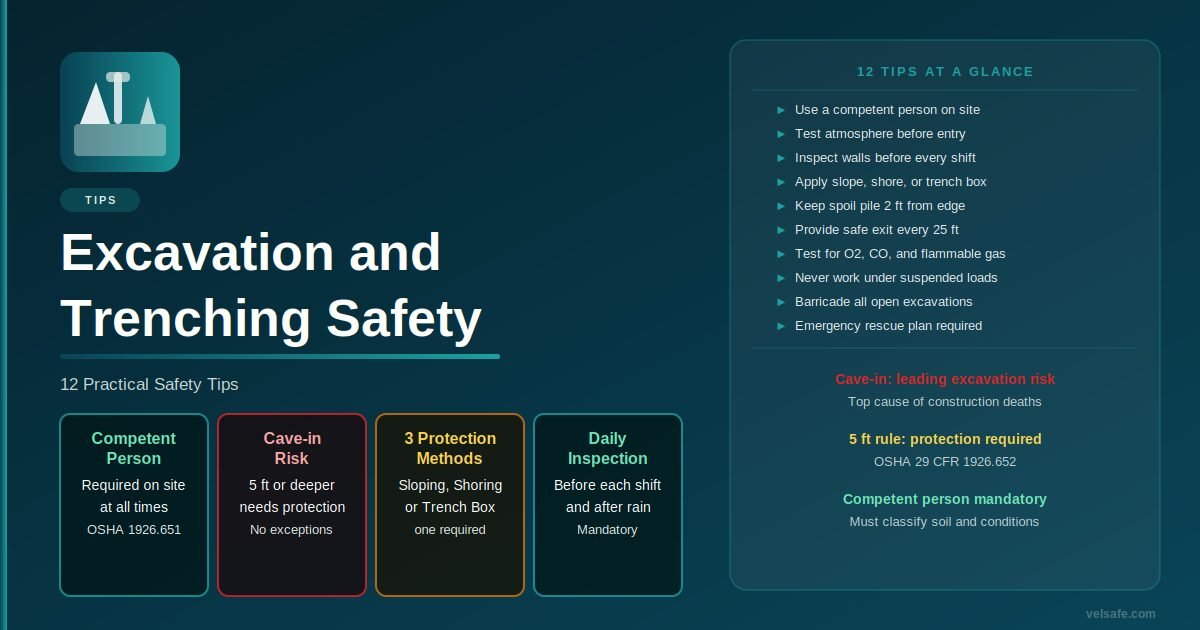
These 12 tips translate OSHA’s 29 CFR 1926 Subpart P requirements into practical site-level habits for supervisors, competent persons, and construction workers.
1. Assign a Competent Person Before Any Excavation Begins
OSHA requires that a competent person classify the soil, inspect the site daily, and authorise entry into any trench or excavation. This is not a paperwork role: the competent person must be physically present, capable of identifying hazardous conditions, and authorised to stop work immediately if something changes.
Competent person responsibilities (OSHA requirement)
2. Know Your Protective System Thresholds
Trenches 5 feet deep or greater require a protective system unless the excavation is made entirely in stable rock. Below 5 feet, a competent person may determine no system is needed, but that determination must be made actively, not assumed. For trenches 20 feet or deeper, a registered professional engineer must design the protective system.
Depth thresholds at a glance
3. Never Skip Soil Classification
The type of protective system required depends directly on soil classification. Type A soil (the most stable, such as clay) allows steeper slopes than Type B or Type C. Type C soil, which includes granular and submerged soils, is the least stable and the most common factor in unexpected cave-ins.
Clay, silty clay. Maximum slope 3/4:1 (horizontal:vertical). Field test: thumb does not penetrate more than 1/4 inch.
Silt, sandy loam, previously disturbed soil. Maximum slope 1:1. More susceptible to water and vibration.
Granular soils, gravel, submerged soil. Maximum slope 1.5:1. Cannot be used for benching. Most common cave-in factor.
In site assessments involving trench work, we consistently find soil classified as Type B when field test results clearly indicate Type C. The motive is nearly always to avoid the more restrictive slope requirements. That decision transfers the cave-in risk entirely to the workers in the trench.
4. Keep Spoils and Materials at Least 2 Feet from the Edge
Excavated soil, equipment, and materials must be kept at least 2 feet from the edge of any trench, as required by OSHA. The weight of material placed close to the edge increases the surcharge load on the trench wall and raises the risk of collapse. This minimum applies to all materials: pipes, equipment, vehicles, and any other surcharge load.
5. Inspect the Trench at the Start of Every Shift
Inspections are required before each shift begins and after any rainstorm, earthquake, or other event that could affect trench stability. Conditions that were safe yesterday may not be safe today if there has been overnight rain, freeze-thaw cycling, or nearby heavy equipment operation.
Inspection triggers (any one requires re-inspection)
6. Provide Safe Entry and Exit at Intervals No Greater Than 25 Feet
Ladders, steps, ramps, or other safe means of entry and exit must be provided in all trenches 4 feet deep or deeper, and positioned so that workers do not travel more than 25 feet laterally to reach one. This matters most in an emergency: if a worker needs to exit quickly because conditions change, the time it takes to find a ladder is time they do not have.
Ladder or ramp placed before any worker enters. Positioned so no worker is more than 25 feet from an exit at any point in the trench.
One ladder at the entry point for a 60-foot trench. Workers at the far end are 35 feet from the exit and cannot reach it in a rapid egress scenario.
7. Test the Atmosphere Before Entry and Monitor Continuously
Trenches can accumulate hazardous atmospheres including oxygen-deficient air, carbon monoxide from nearby equipment, and toxic gases from underground utilities or decomposing organic material. Workers must never enter a trench until a competent person has determined the atmosphere is safe.
Atmospheric monitoring parameters
We regularly encounter trench sites where atmospheric testing was performed at the start of the shift and not repeated after a fuel-powered pump was brought onsite to manage water. Carbon monoxide from that equipment reached hazardous levels within an hour of operation. Atmospheric hazards are not static.
8. Locate and Mark All Underground Utilities Before Breaking Ground
Striking an underground utility line is a leading cause of excavation fatalities and injuries. Call 811 before any digging begins to have utilities marked. This is a legal requirement in all US states.
9. Keep Water Out and Monitor for Water Intrusion
Water weakens soil, increases the weight of saturated material, and dramatically increases the risk of cave-in. Standing water in a trench is a hazard that requires immediate attention: dewatering equipment should be used and the trench re-inspected after water removal before workers re-enter.
10. Apply the Three Protective Options: Slope It, Shore It, or Shield It
OSHA’s trench protection comes down to three approaches. Each has technical requirements and limitations that must be matched to the specific soil type, depth, and site conditions.
Protective system options compared
11. Keep Heavy Equipment Away from Trench Edges and Manage Vibration
Heavy equipment operating near a trench edge creates vibration and surcharge loading that can destabilise walls. OSHA requires that such equipment be kept away from trench edges and that all sources capable of affecting trench stability be identified and factored into the hazard assessment.
We find equipment exclusion zones defined verbally but not physically marked on roughly 40% of active trench sites we assess. When equipment operators change between shifts, verbal instructions frequently do not transfer. Physical barriers are the only reliable control for managing equipment proximity to trench edges.
12. Train Every Worker and Make Sure They Know They Can Stop Work
Training requirements under OSHA’s excavation standards cover the hazards specific to trenching and excavation, the protective measures in use, and workers’ rights, including the right to refuse unsafe work. Training must be provided in a language and vocabulary that workers understand.
At what trench depth is a protective system always required under OSHA, regardless of soil conditions (except stable rock)?
Show answer
5 feet (1.5 metres) under 29 CFR 1926 Subpart P. At 20 feet or deeper, a registered professional engineer must design the system.
Common Mistakes
A competent person must still actively evaluate whether a protective system is needed. No depth is automatically safe.
Thumb penetration and ribbon tests are required. Visual classification alone is not sufficient and frequently leads to incorrect (optimistic) soil typing.
Hazardous gases are invisible and odourless. Open air above the trench does not indicate safe atmosphere within it.
Workers more than 25 feet from an exit cannot reach it in an emergency. Egress must be within 25 feet of every worker at all times.
A trench shield protects workers inside it from a collapse that has already occurred. It does not prevent the collapse or protect workers who step outside the shield zone.
Utility locations change. Marks from a prior project may be inaccurate or outdated. Call 811 for every new excavation.
Additional Recommendations
OSHA’s excavation standard (29 CFR 1926 Subpart P) is the primary reference for US sites. OSHA Publication 3974, “Trenching Safety: 5 Things You Should Know to Stay Safe,” is a useful field reference for supervisors and workers. NUCA’s annual Trench Safety Stand Down, held every June, provides site-level resources and outreach materials at no cost.
Organisations looking to reduce trench incidents should conduct mock trench inspections with competent persons, test soil classification skills before assigning the role, and review any near-miss or close-call incidents involving trenching. These often reveal systemic gaps before a fatality occurs.