

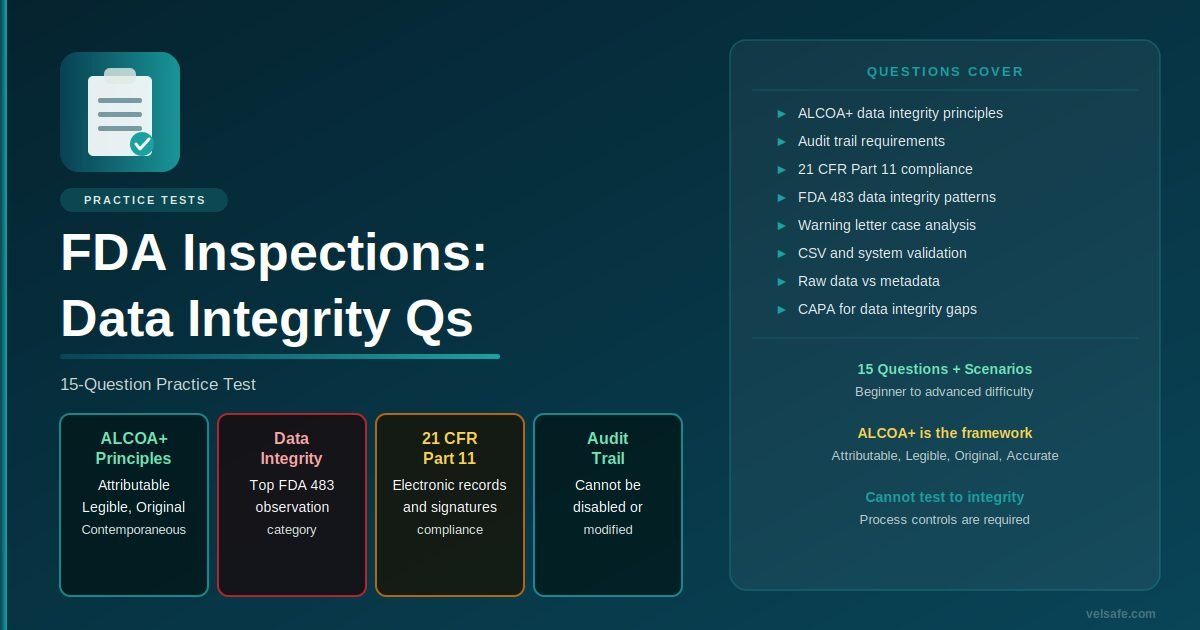
In every FDA inspection, whether GCP, GMP, or GLP, the fundamental question is the same: can the organisation prove that what it says happened actually happened, in the way it says it happened, when it says it happened? That question is answered through evidence: source documents, audit trails, training records, batch records, deviation reports, and the systems that capture and protect them.
This practice test covers the ALCOA+ framework, audit trail requirements, 21 CFR Part 11, source data definitions, and advanced scenario-based questions drawn from the pattern of real FDA inspection findings. Work through each question before revealing the answer.
Section 1: Fundamentals
Question 1 | Beginner
What does the acronym ALCOA stand for in the context of GxP data integrity?
- A) Accurate, Legible, Compliant, Organised, Archived
- B) Attributable, Legible, Contemporaneous, Original, Accurate
- C) Auditable, Legible, Correctable, Organised, Accountable
- D) Attributable, Linked, Contemporaneous, Official, Accurate
ALCOA was formalised by the FDA to describe the minimum quality attributes that source data must possess: Attributable (who created it), Legible (readable and permanent), Contemporaneous (recorded at the time of the event), Original (the first record or a certified copy), and Accurate (correct, truthful, and complete). The framework has since been extended to ALCOA+ which adds Complete, Consistent, Enduring, and Available. Options A and C include terms that are not ALCOA attributes. Option D substitutes “Linked” and “Official” for terms not in the framework.
Question 2 | Beginner
A clinical investigator documents a protocol deviation in the source record three weeks after it occurred, without noting that it is a late entry. Which ALCOA attribute does this most directly violate?
- A) Accurate
- B) Legible
- C) Contemporaneous
- D) Original
“Contemporaneous” means the record is created at the time the event occurs, or as close to it as practically possible. A three-week delay is a contemporaneity failure. The entry may be factually accurate, but accuracy alone does not make a late entry compliant. Late entries are not automatically disqualifying if they are clearly identified as late entries with an explanation, a current date, and the estimated date of the original event. Failing to note that it is a late entry compounds the violation by making the record misleading.
Question 3 | Beginner
Under GMP regulations, what does the phrase “if it isn’t documented, it didn’t happen” most accurately describe?
- A) A legal standard that allows inspectors to impose criminal penalties for missing records
- B) The regulatory expectation that actions and decisions must be proven through contemporaneous documentation
- C) An FDA policy that invalidates entire batches if any record is missing
- D) A GCP-specific rule that applies only to clinical trials
This phrase describes the evidentiary standard in GxP environments: regulators and inspectors cannot accept verbal assurances that something occurred if no contemporaneous record exists. The phrase applies across GMP, GCP, and GLP. Missing records can lead to enforcement action, but the phrase itself describes an evidentiary expectation, not a criminal standard. Individual missing records do not automatically invalidate entire batches, though pervasive documentation failures across a batch record can lead to product rejection.
Section 2: Documentation and Records
Question 4 | Intermediate
An FDA inspector asks for documentation proving that a technician was trained on a specific SOP before performing a procedure. Which of the following constitutes acceptable evidence?
- A) The supervisor’s verbal statement that the technician completed training
- B) A training record signed and dated by both the technician and trainer, completed before the procedure date
- C) The technician’s email to the supervisor confirming they read the SOP
- D) The SOP itself, which the technician initialled on a sticky note
A training record signed and dated by both parties, completed before the procedure date, meets ALCOA requirements: it is attributable, legible, contemporaneous (predates the procedure), original, and accurate. Verbal testimony from a supervisor is not documented evidence. An email may be attributable but is informal and typically not part of a controlled training management system. An initialled sticky note is not a controlled document and would fail to meet GMP record integrity standards. Training records are among the most frequently requested documents during FDA inspections.
Question 5 | Intermediate
During an FDA GMP inspection, an inspector reviews a batch record and notices that an entry recording a critical measurement has been corrected by drawing a single line through the original entry, writing the correction next to it, and signing and dating the correction. Is this acceptable?
- A) No, corrections must always be made electronically to be valid
- B) Yes, this is the correct method for correcting a paper GMP record
- C) No, the entire page must be reprinted and re-signed
- D) Only acceptable if a supervisor also countersigns the correction
The correct method for correcting a paper GMP record is: a single line through the original entry (so the original remains legible), the correction written next to or above it, signed and dated by the person making the correction. Electronic records are not required for GMP batch records. Reprinting and re-signing entire pages destroys the original record, which violates the “original” ALCOA requirement. Whether a countersignature is required depends on the SOP and the criticality of the entry, but the question asks about the correction method itself, not approval requirements. Common data integrity red flags include corrections where the original entry cannot be read (obliterated), corrections made with correction fluid (whiteout), or corrections lacking a signature and date.
Question 6 | Intermediate
A clinical research site uses an electronic data capture (EDC) system for a clinical trial. An FDA inspector asks for the audit trail. What must the audit trail demonstrate?
- A) Only that the subject consented to the trial
- B) A chronological record of who created or changed each data entry, when, and what the original value was
- C) That all data was entered within 24 hours of each visit
- D) Only changes made after database lock
An audit trail in an EDC system must capture the full history of each data entry: who created it (user ID), when (date and time stamp), what was entered, and if changed, who changed it, when, the original value, the new value, and the reason for change. FDA 21 CFR Part 11 requires that audit trails for electronic records be computer-generated and not modifiable by users. Audit trails must be retained for the same period as the records they support and made available to FDA upon request. Informed consent is separately documented. The 24-hour rule does not exist in regulations. Audit trails must capture the full data lifecycle from first entry, not just post-lock changes.
Section 3: Scenario-Based Questions
Question 7 | Advanced
During a routine monitoring visit, a clinical research associate (CRA) discovers that temperature logs for a trial medication storage unit are missing for a four-day period. The site coordinator says the logs exist but cannot locate them. What is the correct action?
- A) Accept the coordinator’s verbal assurance and document this in the monitoring report as “verbally confirmed”
- B) Document the finding as a monitoring observation, request written confirmation of the logs’ location within a defined timeframe, and escalate to the sponsor if not resolved
- C) Request that the site recreate the temperature logs from memory
- D) Close the finding if the medication was never removed from the storage unit during that period
A four-day gap in temperature logs is a documentation failure and likely a protocol deviation. Verbal assurance cannot replace a contemporaneous record. Option B is correct: document as a monitoring finding, set a defined timeframe for resolution, and escalate per the monitoring plan if not resolved. Recreating logs from memory is prohibited under ALCOA (the contemporaneous requirement means logs must be made at the time of the measurement, not reconstructed later). Closing the finding based on the assumption that medication was not removed is not acceptable without documented evidence. Retrospective documentation of events that should have been recorded contemporaneously is one of the most serious data integrity violations inspectors encounter.
Question 8 | Advanced
An FDA GCP inspector reviews a trial master file and finds that several serious adverse event (SAE) reports were submitted to the sponsor 20 or more days after the investigator first learned of the event, in violation of the 7- and 15-day reporting requirements. The investigator explains that the delays were due to high patient volume. How should this finding be characterised?
- A) An acceptable explanation: workload is a mitigating factor under ICH GCP
- B) A significant protocol deviation with potential for regulatory action regardless of workload explanation
- C) A minor finding if the SAEs were eventually reported with complete information
- D) Not a violation if the SAE narratives are accurate and complete
SAE reporting timelines are set in regulation (21 CFR 312.32), the ICH GCP guideline (E6), and the protocol. They are not subject to exception for workload. Workload is not an accepted justification for regulatory non-compliance under GCP. The inspector must document this as a significant finding. The completeness of the eventual report is a separate consideration; late reporting is a separate and distinct violation from incomplete reporting. A pattern of late SAE reporting across multiple events is a systemic finding and would typically result in a Form 483 observation and potentially a warning letter.
Section 4: Compliance Requirements
Question 9 | Intermediate
Under 21 CFR Part 11, what is a key requirement for electronic signatures in GxP records?
- A) Electronic signatures may only be used if the organisation has received prior FDA approval
- B) Electronic signatures must be unique to one individual and not reused by or reassigned to another person
- C) Electronic signatures require a physical token device in all cases
- D) Electronic signatures are only valid for internal documents, not submissions to FDA
21 CFR Part 11 requires that electronic signatures be unique to one individual and not reused by or reassigned to any other person (21 CFR 11.100). Prior FDA approval is not required for organisations implementing electronic signatures, though they must certify in writing to FDA their intention to use electronic signatures if those signatures are intended as the equivalent of handwritten signatures. Physical token devices are one method of achieving the “something you have” component of two-factor authentication but are not universally required. Electronic signatures under Part 11 are fully valid for regulatory submissions to FDA.
Question 10 | Beginner
What does “source data” mean in the context of GCP?
- A) The original trial protocol, from which all other documents are derived
- B) All information contained in original records and certified copies used to reconstruct and evaluate a trial
- C) Only laboratory results generated during a clinical trial
- D) Electronic data only, as paper records do not qualify as source data under modern GCP
ICH GCP defines source data as all information contained in original records and certified copies of original records of clinical findings, observations, or other activities in a clinical trial. Source data includes both paper and electronic records. The protocol is a directing document, not source data. Laboratory results are one type of source data among many (visit notes, vital signs, adverse event records, concomitant medication records). Paper records fully qualify as source data under ICH GCP and 21 CFR.
Section 5: Advanced Scenarios
Question 11 | Advanced
An FDA inspector discovers that a study site uses a shared administrator login for its EDC system, meaning multiple staff members use the same credentials to enter and modify data. How should this be characterised?
- A) No finding, as long as the shared login is documented in an SOP
- B) A minor observation that the site should resolve at the next protocol amendment
- C) A critical data integrity finding: shared logins make records non-attributable and violate 21 CFR Part 11
- D) Acceptable if the site can provide training records for each staff member who uses the shared login
Shared login credentials directly violate the “attributable” requirement of ALCOA: if multiple people use the same account, the audit trail cannot identify who made any specific entry or change. This is a critical finding. An SOP documenting the use of shared credentials does not make the practice compliant; it simply documents a non-compliant practice. Training records for each staff member do not resolve the attributability gap, because the audit trail still cannot distinguish which individual acted on any given record. 21 CFR Part 11 explicitly requires that electronic signatures and the systems that support them ensure individual accountability.
Question 12 | Advanced
A company’s quality system flags a consistent pattern of deviation reports being submitted two to three weeks after the date of the deviation, across multiple product lines and departments. Each individual report is complete and accurate when submitted. What is the most appropriate characterisation of this pattern?
- A) No concern, since each individual report is complete and accurate when submitted
- B) A trend reporting concern: the systematic delay may indicate a cultural or systemic process failure that requires CAPA at the system level
- C) A minor finding limited to the departments involved
- D) Acceptable as long as deviations are reported within the same calendar month
While individual completeness is positive, a systematic pattern of late reporting across multiple departments indicates a process failure at the system level, not an isolated event. The contemporaneity requirement of ALCOA applies to deviation reports; consistent delays suggest that the deviation identification and reporting process is broken, understaffed, or not understood. Individual completeness does not resolve a systemic process gap. A calendar-month rule does not exist in regulations. An FDA inspector reviewing this pattern would expect to see a systemic CAPA addressing the root cause, not just individual report completeness. This is one of the patterns that most commonly leads to repeat 483 observations.
Quick Reference: ALCOA+ Framework
Sources
- FDA, “Data Integrity and Compliance With Drug CGMP” (Guidance, 2018)
- ICH E6(R3) Good Clinical Practice Guideline (2023)
- 21 CFR Part 11: Electronic Records and Electronic Signatures
- 21 CFR 312.32: IND Safety Reporting
- FDA, “Inspection of Clinical Investigators” (Compliance Program 7348.811)
- MHRA, “GxP Data Integrity Guidance and Definitions” (2018)