

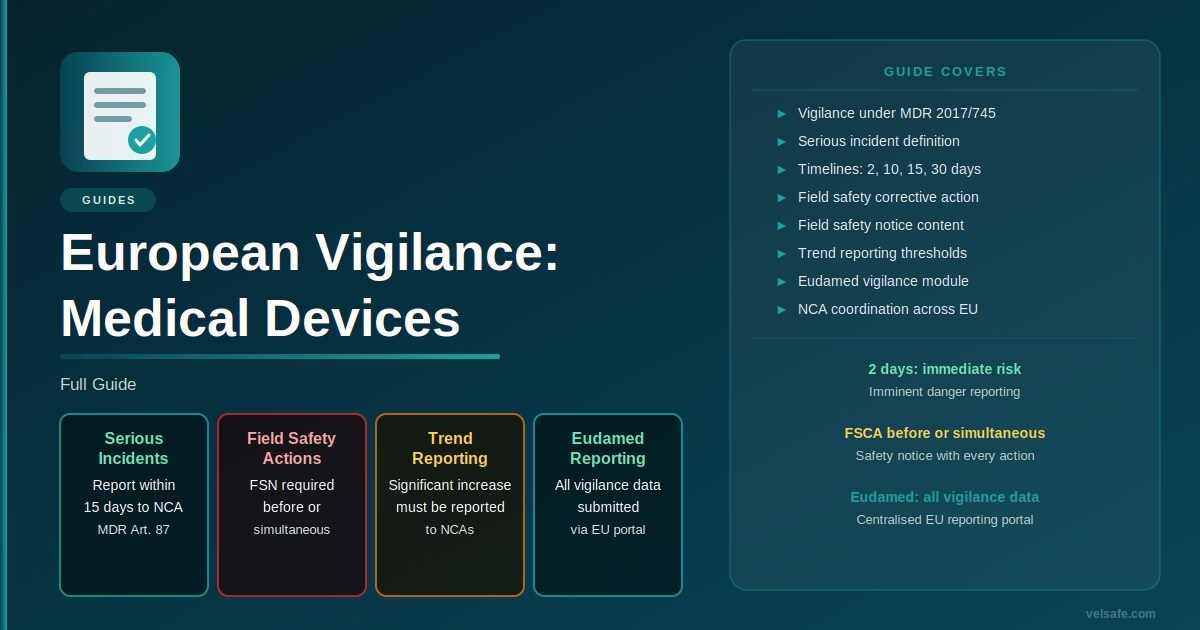
Vigilance is the cornerstone of post-market safety oversight for medical devices in the European Union. Under Medical Device Regulation (MDR) No. 2017/745 and In Vitro Diagnostic Regulation (IVDR) No. 2017/746, manufacturers are legally required to report serious incidents and field safety corrective actions to national competent authorities within defined timelines, and to maintain a documented vigilance system throughout the commercial life of every device.
This guide covers the full EU vigilance framework: what triggers reporting, the six-step reporting process, FSCA and FSN requirements, EUDAMED obligations, trend reporting under Article 88, and the most frequently cited vigilance compliance failures in NCA inspections and notified body audits.
Fundamental Concepts
What Is Vigilance?
In the context of EU medical devices regulation, vigilance refers to the systematic processes by which manufacturers detect, investigate, evaluate, and report serious incidents, and take field safety corrective actions. Vigilance is distinct from post-market clinical follow-up (PMCF), which involves actively gathering clinical data to confirm ongoing safety and performance. Vigilance is reactive: it responds to actual events. PMCF is proactive: it generates data before problems occur.
Vigilance reporting also differs from post-market surveillance (PMS) more broadly. PMS encompasses all methods of monitoring device safety and performance in commercial use, including literature review, complaint analysis, registry data, and periodic safety update reports. Vigilance is the specific obligation to report defined events to competent authorities within defined timelines.
Incident vs Serious Incident
Who Must Report?
Under MDR 2017/745, the manufacturer or their authorised representative (AR) must file serious incident reports. For non-EU manufacturers, the authorised representative carries the reporting obligation on behalf of the manufacturer. Importers and distributors have separate obligations: they must immediately inform the manufacturer, AR, and relevant competent authority if they become aware of a serious incident or FSCA.
Step-by-Step: Serious Incident Reporting
Step 1: Detect and Document the Event
Vigilance begins with event detection. Sources include customer complaints, post-market surveillance data, clinical literature, spontaneous reports from users or patients, and information from healthcare professionals. All events that may involve a device malfunction or deterioration must be documented at intake regardless of whether they ultimately require NCA reporting.
Step 2: Assess Whether the Incident Is Serious and Reportable
Not every incident triggers a reporting obligation. The assessment must determine whether the incident led to, could have led to, or could lead to death or serious deterioration in health including life-threatening illness, permanent impairment of a body function or structure, or a condition requiring medical or surgical intervention.
Step 3: Report Within the Required Timeline
Reports are submitted to the national competent authority (NCA) of the member state where the incident occurred. For incidents in multiple member states, manufacturers must report to each relevant NCA unless EUDAMED’s vigilance module is operational and accepts centralised reporting.
Step 4: Submit the Manufacturer Incident Report (MIR)
The Manufacturer Incident Report (MIR) is the standardised format for serious incident reporting. Initial reports may be submitted before a full investigation is complete, as long as follow-up reports are submitted as more information becomes available. The MIR must include: device identification, incident description, patient and user information (where available), assessment of seriousness and causality, and planned corrective actions.
Step 5: Investigate and Submit Follow-up Reports
Serious incident reports are not one-time submissions. Manufacturers must submit follow-up reports as the investigation progresses and a final report when the investigation is concluded. The final report must identify the root cause, the FSCA taken or determined not to be necessary, and the outcome.
Step 6: Submit an FSCA Report If Corrective Action Is Taken
A Field Safety Corrective Action (FSCA) is any action taken by a manufacturer to reduce a risk of serious incident in relation to a device already on the market. FSCAs include device recalls, software updates, labelling changes, device modifications, and instructions to discontinue use.
FSCAs must be reported to the NCA before being implemented — or simultaneously in cases where immediate action is required for patient safety. The NCA cannot be notified after the FSCA has already been carried out.
FSCAs communicated to users and healthcare professionals are communicated via a Field Safety Notice. The FSN must be approved by the relevant NCA before distribution in most member states. Content requirements are specified in MDCG guidance.
All recalls are FSCAs, but not all FSCAs are recalls. A software update, a labelling clarification, or an instruction to users to modify device settings are FSCAs that do not involve physical product retrieval.
Requirements and Considerations
EUDAMED Obligations
Under Article 92 of MDR 2017/745, vigilance reports are to be submitted to the EUDAMED database rather than to individual national CAs. Until the EUDAMED vigilance module is operational and mandatory, manufacturers submit reports directly to NCAs using national reporting formats or the harmonised MIR template.
Manufacturers, authorised representatives, and importers must register in EUDAMED and obtain a Single Registration Number (SRN). Device registration, UDI assignment, and vigilance report submission will all eventually centralise through EUDAMED. Manufacturers should track EUDAMED module activation dates and update their vigilance SOPs accordingly.
Trend Reporting Under Article 88
MDR 2017/745 introduces a trend reporting requirement: manufacturers must report statistically significant increases in the frequency or severity of incidents that are not individually serious enough to require NCA reporting. The threshold for what constitutes a “significant increase” must be documented in the manufacturer’s post-market surveillance plan.
Trend reporting under Article 88 is the vigilance obligation most commonly absent from manufacturer procedures in NCA inspections and notified body audits. Many manufacturers have serious incident reporting SOPs but no documented trend analysis procedure, no defined statistical threshold for “significant increase,” and no mechanism for escalating trend signals to the vigilance team. This is a direct gap against MDR requirements and will receive increased inspection focus as the MDR surveillance framework matures.
Post-Market Surveillance System
Vigilance sits within the wider PMS system required by MDR Article 83. Manufacturers must document their PMS system in a Post-Market Surveillance Plan and summarise outputs in either a Periodic Safety Update Report (PSUR, for Class IIa, IIb and III devices) or a Post-Market Surveillance Report (PMSR, for Class I devices). Vigilance data feeds directly into PSUR and PMSR preparation.
Notified Body Role in Vigilance
Notified bodies do not serve as primary actors in the vigilance reporting system. Their role is to audit the implementation of vigilance procedures during technical documentation review and quality management system audits, and to assess whether the manufacturer’s PSUR reflects vigilance data appropriately. The NCA is the primary recipient of vigilance reports.
Common Mistakes
Reporting timelines run from the date of awareness, not from investigation completion. Initial reports are expected to be incomplete; that is why follow-up and final reports exist. A late report cannot be excused by an ongoing investigation.
Where causality is ambiguous, the default is to report. A non-report based on assumed patient causality that is later challenged by NCA is a worse outcome than an over-report of a borderline event.
FSCAs must be reported to the NCA before implementation, or simultaneously in urgent cases. Notifying after the FSCA is already underway is a procedural violation in most member states.
Article 88 trend reporting requires a documented statistical threshold. Many manufacturers have serious incident reporting SOPs but no trend analysis procedure. This is a direct MDR compliance gap increasingly cited in NCA inspections.
Sales representatives are often first to hear of a device problem from a customer or HCP. If they are not trained to recognise a potential serious incident and escalate immediately, the reporting timeline starts running without the manufacturer’s knowledge. Sales team vigilance training is a direct MDR obligation.
Frequently Asked Questions
Yes. MDR vigilance requirements apply to all CE-marked medical devices regardless of risk class, including Class I devices that are self-declared without notified body involvement. The class affects the regulatory pathway to market; it does not affect post-market vigilance obligations.
If a malfunction did not lead to harm but could have caused serious deterioration in health or death if it had occurred in different circumstances, the serious incident definition may still apply. The assessment is probabilistic: could this malfunction lead to harm? Not: did this malfunction cause harm in this instance?
All recalls are FSCAs, but not all FSCAs are recalls. An FSCA includes any corrective action taken to reduce risk of serious incident: device retrieval (recall), software updates, labelling changes, modification of instructions, or advice to users to inspect or modify device settings. The FSCA category is broader than “recall” in common usage.
The manufacturer or their AR submits the MIR. For non-EU manufacturers, the AR carries the reporting obligation. The AR cannot simply pass on the obligation to the manufacturer without taking responsibility for ensuring timely and accurate reporting. AR obligations under MDR are substantive and subject to NCA enforcement.
Once the EUDAMED vigilance module is operational and mandatory, manufacturers will submit vigilance reports through EUDAMED instead of directly to individual NCAs. Until then, direct NCA reporting using national formats or the harmonised MIR template applies. Monitor the European Commission’s EUDAMED implementation timeline for activation dates.
Sources
- MDR 2017/745 full text (EUR-Lex)
- MDCG 2023-3: Guidance on serious incident reporting under MDR and IVDR
- Emergo by UL, “EU Medical Device Vigilance and Incident Reporting”
- MHRA, “European vigilance system for medical devices” (pre-Brexit reference)
- European Commission EUDAMED portal
- MDCG 2022-21: Guidance on FSCAs and FSNs under MDR/IVDR
- Greenlight Guru, “EU MDR Vigilance: What Medical Device Companies Need to Know”