

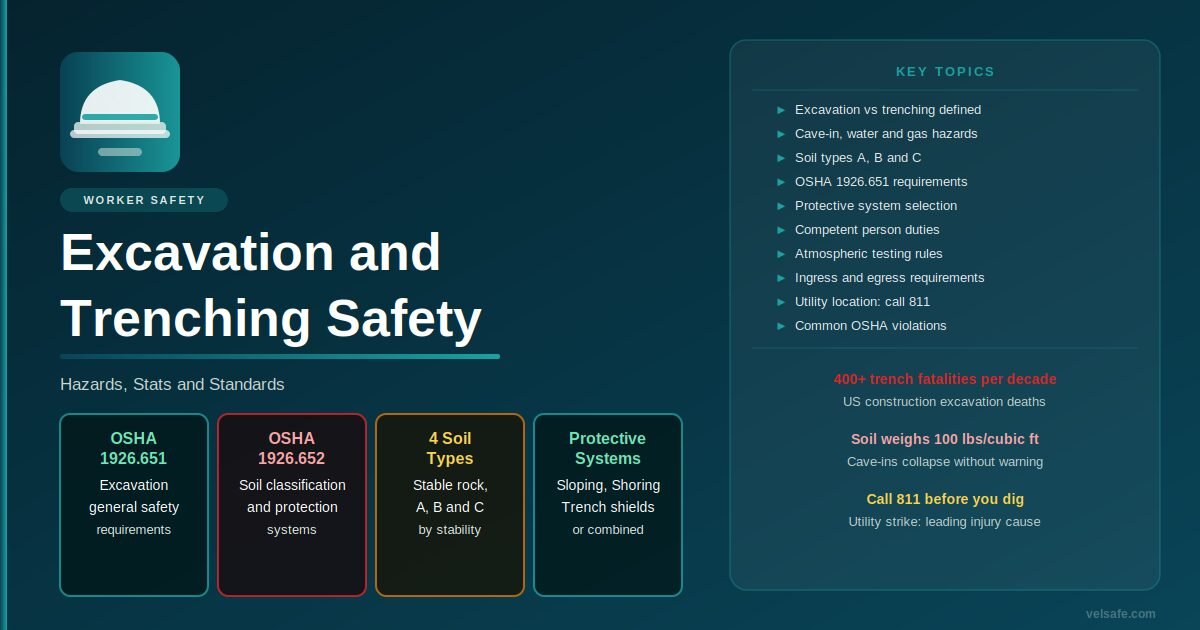
Trench work kills people. Not as a rare or unpredictable occurrence, but regularly, and in ways that are almost entirely preventable. In the first half of 2022 alone, 22 US workers died in trench-related incidents, surpassing the total for all of 2021. By the end of 2022, 39 workers had died, prompting OSHA to announce enhanced nationwide enforcement and introduce a “zero tolerance” policy for unprotected trenches.
The story since 2022 is more encouraging, but far from resolved. This guide covers the data behind trench fatalities, the four major hazard categories, the current regulatory environment, and what has actually driven the recent decline in deaths.
The Numbers Behind the Hazard
Since 2013, more than 250 workers have been killed in trench collapses, according to an investigation by NPR. OSHA reported that trench-related fatalities declined nearly 70 percent from 2022 to 2024, falling from 39 deaths to 12, attributing the improvement to intensified outreach and education, state plan engagement, and aggressive enforcement. Still, 12 workers died in 2024, and OSHA issued 629 citations for excavation safety violations in the same year.
The consistent finding across this data is that trench deaths are not accidents in any meaningful sense. They are the predictable outcome when basic protective measures are skipped, usually by employers who know what the requirements are.
The Four Major Hazard Categories
Cave-ins are the leading cause of trench fatalities. A trench wall does not always give visible warning before it fails: soil can appear stable right up until it isn’t. The risk depends on soil type, moisture content, depth, and nearby loads, none of which are static conditions.
OSHA requires protective systems (sloping, shoring, or shielding) for all trenches 5 feet deep or greater, unless the excavation is entirely in stable rock. Below 5 feet, a competent person must still evaluate the site and make a documented determination. For trenches 20 feet or deeper, a registered professional engineer must design the protective system. OSHA’s enforcement data consistently shows that cave-in fatalities occur overwhelmingly at sites where no protective system was in place, not at sites where protective systems failed.
Trenches can accumulate oxygen-deficient air, combustible gases, carbon monoxide from nearby equipment, and toxic gases from decomposing organic material or nearby utility lines. Workers entering a trench without atmospheric testing can lose consciousness before they recognise they are in danger. OSHA requires that a competent person test the atmosphere before entry whenever hazardous conditions are possible, and maintain continuous monitoring in situations where conditions can change. A portable multi-gas detector, calibrated before each use, is the minimum appropriate tool.
Heavy equipment operating near a trench edge creates two distinct risks: the surcharge load on the trench wall (increasing cave-in probability) and the direct risk of equipment tipping, rolling, or dropping materials into the trench. OSHA requires that excavated soil (spoils) and all materials be kept at least 2 feet from trench edges, and that heavy equipment be excluded from zones near the edge.
According to OSHA data from a 2022 Midwest enforcement campaign, six fatalities during that year involved workers being pinned between equipment, trapped by cave-ins, or asphyxiated by hazardous gases. Equipment proximity was a factor in multiple cases.
Workers entering or exiting trenches face fall risk, particularly at sites where ladders, ramps, or steps are not provided or are inadequately positioned. OSHA requires safe means of access and egress in all trenches 4 feet or deeper, with an entry and exit point no more than 25 feet from any worker. Objects dropped from the surface into a trench, including tools, soil, and equipment components, present a separate hazard. Hard hats are required, but surface organisation matters as much as PPE: keeping the trench edge clear of loose materials is a basic control.
What the Regulatory Environment Looks Like Now
OSHA has maintained a National Emphasis Program (NEP) on Trenching and Excavation since 2018. The NEP requires OSHA compliance officers to open an inspection any time they observe an open trench or excavation, regardless of whether a violation is visibly obvious. Any on-site OSHA officer encountering an open trench is required to open a separate trenching inspection, even if it was not the original purpose of their visit.
The practical implication for employers: an open trench is a guaranteed inspection trigger. There is no equivalent situation in construction where a visible worksite condition automatically triggers regulatory scrutiny in the same way. OSHA’s zero tolerance stance, introduced in 2022, includes the possibility of criminal referrals for federal or state prosecution when employer actions or inactions result in worker deaths. Several employers have faced criminal charges following trench fatalities where protective systems were absent despite known requirements.
From 2011 to 2023, over half of trenching citations were issued to companies in Heavy and Civil Engineering Construction, according to CPWR’s analysis of Department of Labor enforcement data. Trenching citations represented between 2.8 and 3.9 percent of all construction citations annually during that period, with a 36.8 percent increase in citations in 2019 following the NEP launch.
Worker Rights in Trenching and Excavation
Workers have specific rights under OSHA’s excavation standards that go beyond the general right to a safe workplace.
What Has Actually Driven Fatalities Down
The 70 percent decline in trench fatalities between 2022 and 2024 is one of the more significant short-term improvements in a specific occupational hazard category in recent OSHA history.
OSHA’s zero tolerance stance, combined with the NEP’s automatic inspection trigger for open trenches, meant non-compliant sites faced a much higher probability of being caught than before. Criminal referrals for fatal incidents sent a signal that consequences were not just financial.
OSHA’s Trench Safety Stand Down, held annually in June and co-organised with the National Utility Contractors Association (NUCA), has grown into a significant outreach effort reaching employers and workers across the construction sector.
The 12 remaining fatalities in 2024, and the 629 citations issued that year, indicate gaps persist, particularly among smaller contractors and in regions with less OSHA presence.
Common Protective System Failures
The table below summarises the most frequently cited failures in OSHA trenching inspections, based on enforcement data patterns across 2018 to 2023.
Supporting Resources
- A practice test on excavation and trenching safety knowledge, covering OSHA standards and competent person responsibilities, is available in the Practice Tests section.
- A step-by-step tips guide on excavation and trenching safety, including soil classification and the three Ss, is available in the Tips section.
- A guide to OSHA enforcement and inspection rights for construction workers is available in the Guides section.
Sources
- OSHA, “Alarming Rise in Trench-Related Fatalities Spurs Enhanced Nationwide Enforcement” (July 2022)
- OSHA, “Department of Labor Encouraged by Decline in Worker Death Investigations” (November 2024)
- NPR, “Trench Collapses Have Killed Hundreds of Workers in the U.S. Over the Last Decade” (July 2024)
- CPWR, “Data Bulletin: Trenching and Excavation Safety in the US” (May 2024)
- US DOL, “Campaign to Educate Midwest Employers on Excavation Hazards” (April 2023)
- OSHA, “Trenching and Excavation Overview”