

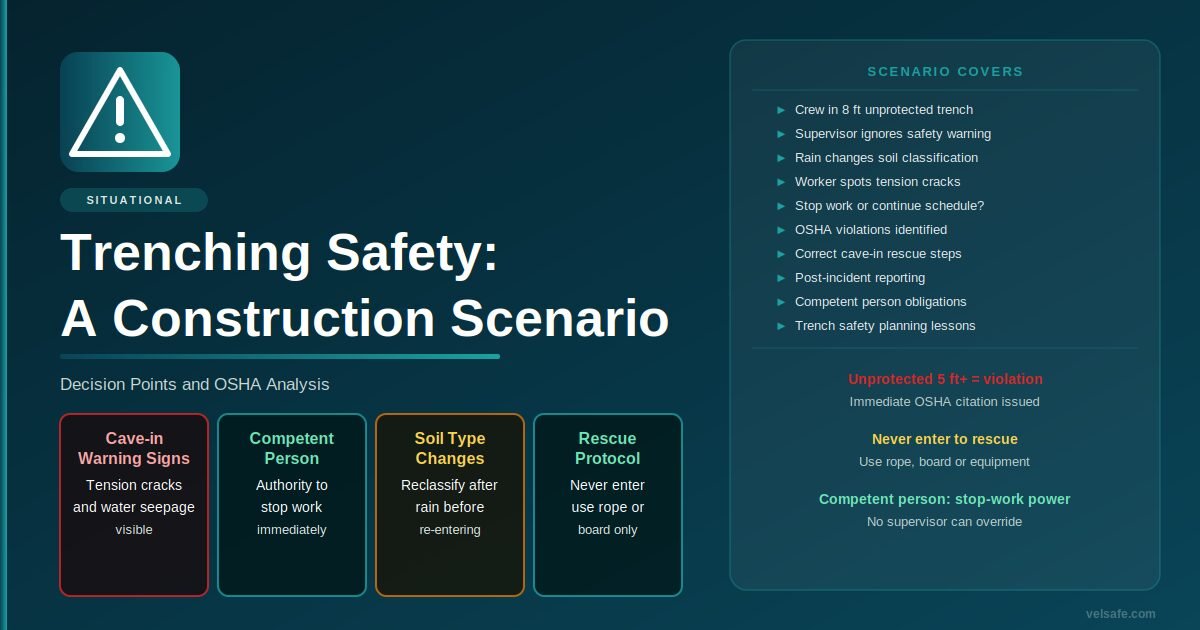
It’s a Tuesday morning on a residential utility installation job. A crew of four is laying sewer pipe in a trench running along the side of a suburban street. The trench is 7 feet deep and about 4 feet wide. A trench box has been positioned at the active working end where two crew members are placing pipe. A third worker, Marcus, has finished his section and stepped out for water. As he reaches for his bottle, he notices a measuring tape sitting at the bottom of the trench, about 15 feet behind the trench box, outside the protected zone.
His supervisor is on the phone. The other two crew members are working steadily inside the shield. The walls look solid. Marcus thinks: it’ll only take a second. This scenario works through the decision he faces, the four options available, and why the choice that feels obviously fine is the one that kills people.
The Scenario
Decision Point
Does Marcus step into the unprotected section of the trench to retrieve the measuring tape?
Step quickly into the unprotected section, grab the tape, and step back out. It’s only 5 seconds and the walls look stable.
Ask one of the crew members inside the trench box to pass the tape along, since they’re closer to it from the protected end.
Wait for the supervisor to finish the call, report the unprotected section behind the trench box, and let the competent person assess before anyone enters that area.
Use the excavator to lift the measuring tape out, since the equipment is already on site.
Analysis: Why Option C Is Correct
Not occasionally, not rarely, but consistently and predictably. The National Utility Contractors Association’s vice president of safety has stated plainly: “They just should not take the chance of going into an unprotected trench for any reason, for any period of time. Even 30 seconds, a minute. That’s all it takes. Cave-ins happen in a fraction of a second. You turn around and it’s on you.” The condition Marcus is assessing, a wall that “looks fine,” is not a reliable indicator of trench stability. Type B soil, which includes clay loam, can fail without visible warning, particularly when it has absorbed moisture from overnight rain. OSHA data consistently shows that most trench fatalities occur at depths of less than 10 feet, in soils that workers described as appearing stable before the collapse. One cubic yard of soil weighs as much as 3,000 pounds, approximately the weight of a compact car. If the wall fails while Marcus is in the unprotected section, he has no path of escape and no time to use one.
The crew members inside the trench box are at the active working end, which is ahead of the tape, not behind it. Asking them to retrieve it would require them to step outside the protected zone as well. This option does not actually solve the problem; it transfers the same risk to a different worker.
The measuring tape is not urgent. The five-second retrieval is not worth the risk. The competent person, the supervisor, should be made aware that there is an unprotected open trench section behind the box, and should assess the situation before anyone enters it. The appropriate next step may be repositioning the trench box to cover that section, using sloping or shoring for the trailing area, or using a retrieval method that doesn’t require anyone to enter the unprotected zone.
A non-entry retrieval method is worth considering, but it should be coordinated with the supervisor rather than attempted unilaterally, since excavator positioning near a trench edge adds surcharge load and creates its own risk if not managed carefully.
Learning Points
The most common misunderstanding about trench shields is that their presence on a site means the site is protected. The box protects the section of trench it occupies. Open sections behind or ahead of the box are unprotected, and no entry should occur there without the competent person’s assessment and an appropriate protective measure in place.
Soil stability cannot be reliably judged by visual appearance alone, particularly after rain, temperature changes, or nearby equipment operation. The competent person must actively classify the soil using field tests, not observation from above the trench.
According to OSHA data, the fatality rate for excavation work is more than double that of general construction. The work feels routine on sites where nothing has gone wrong before. That familiarity is one of the most significant risk factors in trench incidents.
Workers who have safely exited a trench and then re-enter for what they expect to be seconds are not making a dramatic gamble; they are making a calculation that feels reasonable and is wrong. The calculation fails to account for the difference between “looks stable” and “is stable,” and for the zero warning time that cave-ins provide.
If Marcus interrupts his supervisor to flag an open unprotected trench section behind the box, that is the correct action. OSHA’s excavation standards exist precisely because the short-term convenience of skipping a safety step is always more immediate and tangible than the risk of a collapse that feels unlikely until it isn’t.
Related Resources
- OSHA Trenching and Excavation Overview
- CDC/NIOSH Trenching and Excavation Safety
- A practice test on excavation and trenching safety knowledge, covering OSHA standards, soil classification, and competent person responsibilities, is available in the Practice Tests section.
- A tips guide on excavation and trenching safety, covering protective systems and the three Ss, is available in the Tips section.
- A Worker Safety overview of US excavation fatality trends and the enforcement environment is available in the Worker Safety section.