

Disclaimer: This article provides general information about US federal and state driving laws and is not legal advice. Requirements vary by state, vehicle type, and specific conditions. Consult a qualified legal or regulatory professional for guidance on your specific situation.
Extreme driving conditions, including snow, ice, sleet, fog, heavy rain, and smoke, create legal obligations that go beyond the standard posted speed limit. In the United States, both federal and state law recognise that adverse conditions change what safe driving looks like, and require drivers to adjust accordingly.
For commercial motor vehicle (CMV) operators, these obligations are codified in federal regulation and enforced through FMCSA. For all drivers, state-level “basic speed laws” establish that the posted speed limit is a maximum, not a target. This guide covers the key federal and state legal frameworks, what commercial operators must do, how the adverse driving conditions HOS exception works, and what penalties apply when requirements are ignored.
Key Federal Requirements: Commercial Motor Vehicles
49 CFR Part 392: Extreme Caution and Mandatory Speed Reduction
Federal regulation at 49 CFR 392.14 sets the core obligation for CMV operators in hazardous conditions: extreme caution shall be exercised when hazardous conditions, such as those caused by snow, ice, sleet, fog, mist, rain, dust, or smoke, adversely affect visibility or traction. Speed shall be reduced when such conditions exist. If conditions become sufficiently dangerous, operation shall be discontinued and shall not be resumed until the vehicle can be safely operated.
When any of the listed conditions arise, the driver must exercise extreme caution. This is not discretionary.
The regulation does not specify by how much, but FMCSA guidance instructs commercial drivers to reduce speed by one-third on wet roads, by half on packed snow, and to stop entirely on icy roads.
If conditions are sufficiently dangerous, the driver must stop and not resume until safe. The driver determines when this threshold is met, but enforcement officers reviewing logs and incident data can assess whether that judgment was reasonable.
49 CFR Part 395: The Adverse Driving Conditions HOS Exception
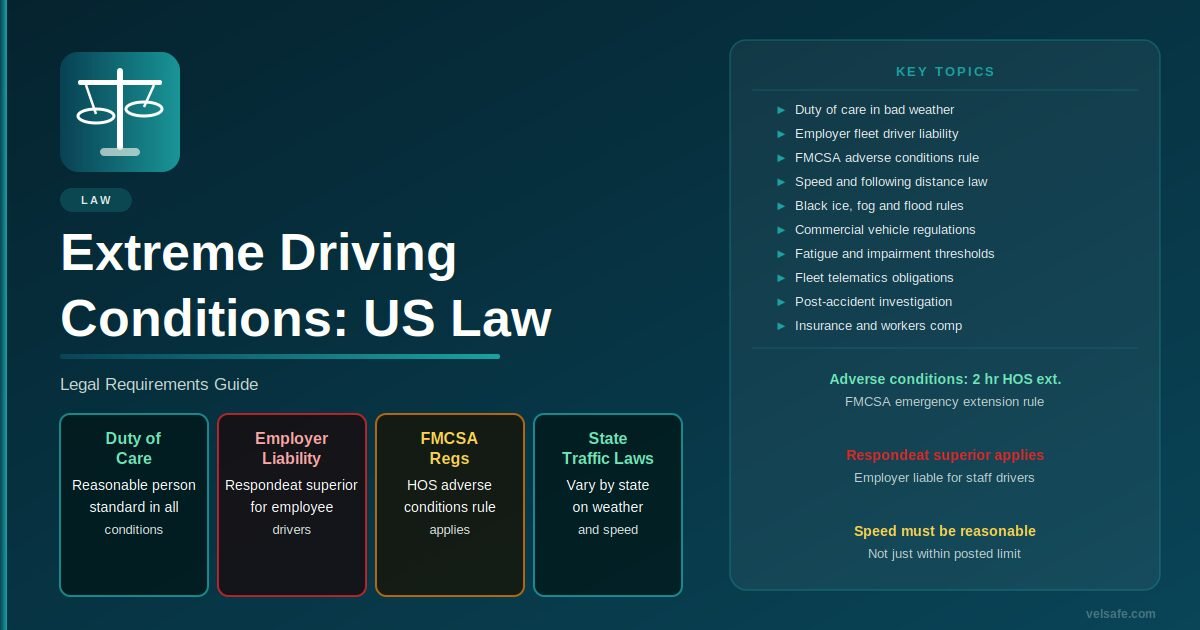
Hours of Service regulations under 49 CFR Part 395 normally limit property-carrying CMV drivers to 11 hours of driving within a 14-hour on-duty window. The adverse driving conditions exception at 49 CFR 395.1(b) allows drivers to extend both limits by up to two hours when conditions meeting the regulatory definition are encountered unexpectedly.
The exception was revised in FMCSA’s June 2020 Hours of Service Final Rule, which extended the duty day window, not only the driving time, by two hours. The driver must be able to demonstrate they would have completed the trip within normal HOS limits had the adverse conditions not occurred. The extension is meant to allow a driver to reach a safe stopping point, not to add hours to a planned schedule.
Chain Laws: State-Level Variation for CMVs
Traction device requirements for commercial vehicles vary by state and are typically tiered by severity. California’s Sierra Nevada chain control system operates at multiple levels: Level 1 requires commercial vehicles to carry chains or approved traction devices and have them ready for use. Level 2 requires all commercial vehicles to chain up, regardless of drive configuration, with chains required on specified axles for CMVs over 26,000 pounds gross vehicle weight or designed for 16 or more passengers.
Other states with active chain requirements for CMVs in mountain passes or during winter weather events include Colorado, Oregon, Washington, Idaho, and Nevada. Requirements vary in scope and enforcement, and some states update them dynamically based on current road conditions. Ignoring chain law requirements where they apply can result in fines ranging from $250 to $1,000 or more depending on the state, and drivers may be prohibited from continuing their route until compliance is achieved.
Key Requirements: All Drivers
The Basic Speed Law
Every US state has adopted some form of the basic speed law, requiring drivers to operate at a speed that is reasonable and prudent given current conditions, regardless of posted limits. Poor weather, including rain, snow, ice, and fog, reduces traction and visibility such that driving the posted limit in those conditions may be reckless, not merely inadvisable. This is a legal standard, not a recommendation. A driver who causes an accident on a snow-covered road while travelling at or below the posted speed limit may still face liability if the speed was not reasonable for the actual conditions.
Pennsylvania’s general negligence standard, for example, requires drivers to reduce speed appropriately for road conditions even below posted limits if necessary, increase following distance on ice or snow, and maintain adequate vehicle control, with liability attaching to failures on any of these counts.
Vehicle Preparation Obligations
Several states impose specific legal obligations on clearing snow and ice from vehicles before driving. Pennsylvania’s 75 Pa. C.S. Section 4527 creates mandatory fines for commercial vehicle drivers if snow or ice flies from their vehicle and causes injury or property damage. New Jersey has a similar requirement. Beyond specific statutes, the general negligence standard in most states means that a driver who fails to clear windows, mirrors, or lights before driving in winter weather, and then causes an accident, faces civil liability.
Compliance Requirements
Penalties and Consequences
FMCSA can impose civil penalties on motor carriers and drivers for HOS violations, reaching up to $16,000 per violation. Operating a CMV while fatigued or in violation of driving hour limits in conditions that result in an accident exposes carriers and drivers to both regulatory penalties and significant civil liability.
State penalties for failing to comply with chain requirements range from $250 to $750 for Level 2 violations in states like California, and can reach $1,000 or more elsewhere. Drivers may also be held at inspection points until compliance is achieved, adding delay costs on top of fines.
The most significant financial exposure in most extreme driving condition incidents is not the regulatory fine but the civil liability that follows when an accident occurs. A commercial vehicle accident in winter weather can expose a carrier to multi-million dollar verdicts.
Practical Implementation
Dispatchers play a significant role in extreme driving condition compliance. Under 49 CFR 392.14, FMCSA’s authority extends to motor carriers as well as drivers: a carrier that pressures or incentivises drivers to continue driving in conditions that should have triggered a stop, or to use the HOS exception in ways that extend schedules rather than enable safe stopping, faces regulatory and civil exposure alongside the driver.
Pre-trip weather briefings for any route with forecast adverse conditions, clearly communicated expectations that drivers will stop when conditions deteriorate, and ELD systems that make it easy to log the adverse conditions exception correctly are all practical steps that demonstrate reasonable care.
Drivers who invoke the exception should annotate their ELD or paper log to document the conditions encountered, the location and time the conditions were met, and confirmation that the conditions were not foreseeable before the trip began. FMCSA’s guidance makes clear that drivers are required to annotate their records when using the exception. Enforcement officers reviewing logs during roadside inspections and post-accident investigations will assess whether the exception’s use was justified. Frequent use of the exception, or use on routes where adverse weather was publicly forecast before departure, is likely to attract scrutiny.
Frequently Asked Questions
No. The exception at 49 CFR 395.1(b) applies to property-carrying commercial motor vehicles. Passenger-carrying CMVs operate under different HOS rules with different exceptions.
No. The exception requires that the conditions were not known and could not reasonably have been known before the trip began or before the last qualifying rest break. If a driver was aware of forecast adverse weather before departure, the exception does not apply, even if the conditions turn out to be worse than expected.
They may still use the time they needed due to the adverse conditions. However, if conditions clear and they no longer need the additional time, they should not use the full two-hour extension simply because it is available.
No. Federal regulations on extreme driving conditions apply to commercial motor vehicles under FMCSA authority. Passenger vehicle drivers are subject to state basic speed laws and any state-specific winter driving requirements.
No. 49 CFR 392.14 specifically requires stopping when conditions are sufficiently dangerous. A driver who stops due to unsafe conditions is complying with federal law, not violating it.
References
Sources
- eCFR, “49 CFR Part 392: Driving of Commercial Motor Vehicles”
- eCFR, “49 CFR Part 395: Hours of Service of Drivers”
- FMCSA, “Adverse Driving Conditions FAQ”
- FMCSA, “Hours of Service Final Rule Fact Sheet” (2020)
- LegalClarity, “How Far Under the Speed Limit Can You Go: Laws and Penalties”
- CNS Chains, “Understanding Snow Chain Laws for Trucking”