

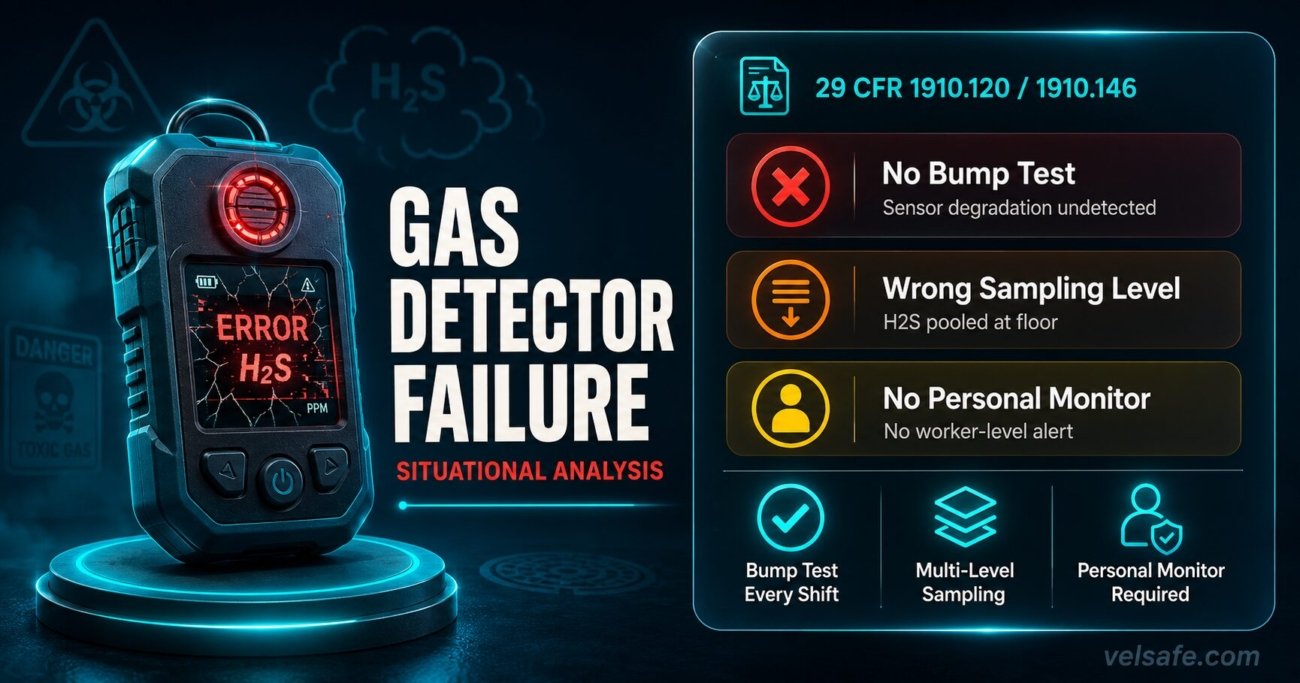
Direct-reading gas monitor showing a failure alert beside a confined space manhole, illustrating HAZWOPER atmospheric monitoring risks

When the Gas Detector Fails: HAZWOPER Situational Analysis

SITUATIONAL ANALYSIS – HAZWOPER Gas Detector Failure
When the Gas Detector Fails:
HAZWOPER Situational Analysis
A direct-reading gas monitor provides real-time data on the atmospheric conditions that determine whether a worker lives or dies. When it fails, or is used incorrectly, the margin for error collapses instantly. This analysis traces the decisions, conditions, and failures behind a preventable confined space fatality.
Note: The scenario below is illustrative, based on documented patterns from real OSHA enforcement cases and fatality investigations. It is not a verbatim account of any specific incident.
56%
Confined Space Deaths from Atmospheric Hazards
More than half of all confined space fatalities result from atmospheric hazards – the exact category that gas detectors are designed to catch
BLS / OSHA Confined Space Data
100ppm
H2S IDLH Threshold
NIOSH defines the immediately dangerous to life or health threshold for hydrogen sulfide at 100 ppm. At this level, loss of consciousness can occur within minutes
NIOSH / CDC
$621K
OSHA Citation for Similar Failure
Minnesota OSHA issued a $621,600 citation following a confined space fatality tied to 10 serious violations of 29 CFR 1910.146, including failure to test atmosphere before entry
Minnesota OSHA, August 2024

Situation Overview

Situation Overview
Location
Municipal utility contractor worksite, underground sewer section entry
Workers Involved
Two-person crew: 4-year experienced lead worker and a 3-month new hire
Outcome
One worker fatal. One worker hospitalized. Multiple OSHA willful and serious citations issued.
Primary Cause
Degraded gas monitor sensor, inadequate sampling depth, and no personal monitors during entry

Workplace Background

The contractor had been operating in this region for eight years with a generally acceptable safety record. HAZWOPER training certifications were on file for both workers. The lead worker had completed 40-hour initial training and was current on his annual refresher. The second worker had completed 40-hour training six months earlier.

The confined space entry permit program, reviewed annually, was procedurally compliant on paper. The company owned four direct-reading portable gas monitors. Calibration records showed that three of the four had been calibrated within the past 30 days. The fourth, the one used this morning, had last been calibrated 22 days ago against a 30-day calibration interval.

The specific section of sewer being entered was newly installed but had been connected to the live system for 11 days. The potential for hydrogen sulfide accumulation from the connected network was not noted in the morning’s hazard assessment.

Incident Timeline

Incident Timeline – Tuesday Morning
6:48 a.m.
Crew Arrives on Site
Entry permit reviewed and signed. No site-specific briefing on potential gas sources in the newly connected sewer section.
6:54 a.m.
Pre-Entry Atmospheric Test
Lead worker performs test using the four-gas monitor. No bump test performed before use. Probe lowered approximately 18 inches into the 20-foot manhole. Wait time approximately 30 seconds. All readings appear within acceptable range.
6:56 a.m.
Entry Begins
Second worker begins descent. Lead worker follows seconds later.
6:57 a.m.
Workers Reach the Bottom
Both workers reach the bottom, approximately 8 feet below the probe sampling level. Sensor cross-contamination causes delayed response. Hydrogen sulfide concentration at floor level is above IDLH. Neither worker carries a personal monitor.
6:58 a.m.
Workers Collapse
Second worker collapses. Lead worker attempts to assist and also collapses.
7:04 a.m.
Discovery
Passing utility worker observes the situation and calls 911.
7:11 a.m.
Emergency Services Arrive
Emergency services begin rescue operations.
7:23 a.m.
Workers Recovered
Both workers recovered. Second worker is unresponsive.
8:47 a.m.
Fatal Outcome
Second worker pronounced dead at hospital.
Source: Composite scenario based on documented OSHA enforcement case patterns

What Happened? Three Overlapping Failures

Failure 1
No Bump Test Before Entry
OSHA SHIB 11-26-2024 supports bump tests before each use to verify sensor functionality. The monitor had experienced heavy use in a sulfur-heavy environment. Sensor cross-contamination had degraded its hydrogen sulfide response. A bump test that morning would have revealed the anomaly before entry.
OSHA SHIB 11-26-2024
Failure 2
Inadequate Probe Sampling Depth
The probe was lowered only 18 inches into a 20-foot space. Hydrogen sulfide is heavier than air and accumulates at the lowest point. At floor level, concentrations were far higher than at the entry point. OSHA 1910.146(c)(5)(ii)(C) requires testing the internal atmosphere before entry. Industry best practice requires multi-level sampling.
OSHA 29 CFR 1910.146
Failure 3
No Personal Monitors During Entry
The crew had only one monitor between them, and neither worker was wearing a personal unit during entry. Had personal monitors been worn, the alarm would have triggered before the workers reached the accumulated concentration at the bottom, providing time to evacuate.
OSHA Confined Space Entry Best Practice

Investigation Findings: OSHA Violations

Type
Violation
Standard
Willful
Failure to test atmospheric conditions adequately before entry. Probe sampling method did not meet requirements for testing atmosphere at the actual work level.
29 CFR 1910.146(c)(5)
Serious
Failure to perform bump test before using the gas monitor. Sensor degradation would have been identified had bump test procedures been followed.
OSHA SHIB 11-26-2024
Serious
Failure to identify H2S as a potential atmospheric hazard despite the space being connected to a live sewer system for 11 days.
29 CFR 1910.146(d)(3)
Serious
Failure to provide continuous atmospheric monitoring during entry. Permit required monitoring but lacked a mechanism to ensure it was carried out.
29 CFR 1910.146(d)(5)
Comparable case: Minnesota OSHA issued $621,600 citation for similar confined space fatality, August 2024

Root Cause Analysis

Root Cause Analysis – Four Systemic Failures
Normalization of Deviation Systemic
Bump tests were required but not followed consistently for months. When shortcuts become routine and nothing bad immediately happens, risk perception decouples from reality.
Hazard Assessment Did Not Reflect Actual Conditions Procedural
Template hazard assessment used for generic sewer entry. The potential for H2S from a live connected network was not evaluated. A site-specific assessment would have identified this.
Equipment Verification Treated as Administrative, Not Operational Cultural
Calibration records maintained. Bump test requirements existed in writing. But the operational culture treated both as paperwork. The gap between documented procedure and field practice was where the fatal risk lived.
No Second Layer of Detection at Work Level Equipment
Single shared monitor sampling from the entry point rather than the work level provided false assurance without real protection for workers at the bottom of the space.
Source: OSHA Investigation Findings | Composite based on documented fatality patterns

Corrective Actions

1
Mandatory Bump Test Before Every Use, Documented
No direct-reading gas monitor enters operational use without a bump test that morning. The result is logged. If the sensor fails to respond within manufacturer specifications, the instrument is removed from service until serviced and recalibrated. This is not a calibration substitute – it is an immediate-use verification.
OSHA SHIB 11-26-2024
2
Multi-Level Atmospheric Testing, Documented Per Level
Pre-entry testing must sample at top, middle, and bottom of any confined space deeper than 5 feet. For spaces with known heavy gas risks (sewers, tanks, pits), bottom-level sampling is required regardless of depth. The testing procedure and level-by-level readings must be recorded on the entry permit.
OSHA 29 CFR 1910.146(c)(5)
3
Personal Monitors for All Workers During Entry
Every worker who enters a permit-required confined space wears a personal four-gas monitor set to alarm below threshold concentrations. The shared ‘team monitor’ is not a substitute for individual continuous monitoring during work.
OSHA Confined Space Best Practice
4
Site-Specific Hazard Assessment Reviewed Before Each Entry
The hazard assessment must reflect the specific conditions of the space being entered that day. Newly connected utilities, recent chemical additions, changed work activities, or any condition not present at the last entry requires a fresh assessment. Templates are a starting point, not a final document.
OSHA 29 CFR 1910.146(d)(3)
5
Supervisory Verification of Pre-Entry Procedures
A supervisor or designated entry attendant verifies that bump test results have been logged and that multi-level sampling is complete before authorizing entry. Authorization is documented on the permit. The permit does not become valid until verification is signed off.
OSHA 29 CFR 1910.146(f)

Lessons Learned

A Clean Display Is Not a Safe Atmosphere
If the instrument is degraded, miscalibrated, or sampling from the wrong location, a clean reading is meaningless. The pre-entry procedure must verify the instrument before trusting the reading.
H2S Kills Faster Than Experience Teaches
At concentrations above 100 ppm, hydrogen sulfide paralyzes the sense of smell. Workers cannot detect it by odor at the concentrations that are most dangerous. Instrumentation must detect what senses cannot.
The Entry Permit Is a Living Document
Signing a permit written for yesterday’s conditions in today’s changed space is not compliance. The permit must reflect what is actually present in the space on the day of entry.
Personal Monitoring Is Not a Luxury
Over 56% of confined space deaths result from atmospheric hazards. A personal monitor costs a fraction of what a confined space fatality costs. Treating them as optional for ‘routine’ entries eliminates protection precisely when complacency is highest.
Normalization of Deviation Kills
When shortcuts become habits and nothing bad immediately results, the organization’s risk perception decouples from reality. The absence of a previous incident is not evidence the shortcut is safe – it is evidence the hazard has not materialized yet.

Quick Checklist: Pre-Entry Gas Monitor Protocol

Quick Checklist – Direct-Reading Gas Monitor Pre-Entry Protocol
Bump test performed this shift and result logged
Calibration date verified and within manufacturer interval
Probe in good condition and appropriate for the application
Multi-level sampling completed: top, middle, and bottom
All four parameters tested: O2, LEL, CO, H2S (at minimum)
Readings at each level documented on entry permit
All readings within acceptable range before entry authorized
Personal monitors assigned to every worker entering the space
Continuous monitoring confirmed during entry
Site-specific hazards reviewed and reflected in hazard assessment
Supervisory sign-off on pre-entry verification logged on permit
Emergency response plan confirmed before first entry

Key Takeaways

Bump Test Every Use – Not Just Periodic Calibration
A sensor cross-contaminated by prior exposures may display normal readings in a lethal atmosphere. Calibration verifies accuracy over time. Bump tests verify functionality before each use. Both are required.
Test at the Actual Work Level
Atmospheric testing must occur at top, middle, and bottom of any confined space. Heavier-than-air gases like H2S accumulate at the bottom. Sampling only from the opening leaves the work level uncharacterized.
Every Worker Needs a Personal Monitor
A single shared instrument sampled from the entry point does not provide worker-level protection during entry. Every worker in a permit-required confined space wears a personal direct-reading monitor.
Hazard Assessments Must Be Space-Specific and Day-Specific
Template-based permits that do not account for changed conditions fail at the point of contact with the actual hazard. A space connected to a live sewer network for 11 days is not the same space it was on installation day.
Normalization of Deviation Is the Consistent Root Cause
Shortcuts that become habits without immediate consequences create a false sense of safety. The previous 50 successful entries without a bump test are not evidence that the 51st will be safe. They are evidence that the hazard has not yet materialized.

Frequently Asked Questions

What is a bump test and why does it matter for HAZWOPER confined space entry?
A bump test exposes a direct-reading gas monitor’s sensors to a known concentration of test gas to confirm that the sensors respond and the alarms trigger correctly. Unlike calibration, which verifies accuracy over time, a bump test verifies functionality before each use. A sensor damaged by prior exposure or chemical cross-contamination may display normal readings despite being unable to detect the hazard accurately.

At what levels must I test the atmosphere of a confined space?
OSHA 1910.146 requires testing the internal atmosphere before entry with a calibrated direct-reading instrument. Industry best practice and enforcement guidance support testing at multiple vertical levels: top, middle, and bottom. Gases such as hydrogen sulfide are heavier than air and accumulate at the lowest point. Testing only from the entry point leaves the work level uncharacterized.

Can one gas monitor serve an entire entry crew?
No. A single monitor sampling from the entry point does not provide individual continuous monitoring for workers at the work level. Every worker entering a permit-required confined space should wear a personal direct-reading monitor. The team monitor used for pre-entry testing is supplemental, not a substitute for personal protection during entry.

What gases must be tested for in HAZWOPER confined space entry?
At minimum: oxygen content, flammable gases and vapors (measured as lower explosive limit percentage), and potential toxic air contaminants specific to the site hazard assessment. For sewers and wastewater environments, hydrogen sulfide and carbon monoxide must be specifically included. The hazard assessment drives the full list.

What is the IDLH for hydrogen sulfide?
NIOSH defines the IDLH for hydrogen sulfide as 100 ppm. At this concentration and above, exposure can cause rapid loss of consciousness and death within minutes. Hydrogen sulfide also causes olfactory fatigue at lower concentrations, removing the sense of smell as a warning signal before reaching dangerous levels. Instrumentation, not sensory detection, is the required control.

What should an attendant do if a worker loses consciousness inside a confined space?
Call 911 immediately. Do not enter the space without proper respiratory protection and retrieval equipment. Alert coworkers and the site safety officer. Provide emergency services with the entry permit, the hazard assessment, and the chemical inventory. Attempting a rescue without proper equipment is the most common cause of secondary fatalities in confined space incidents.

Sources

Related VelSafe Articles

Build Monitoring Competency Before the Next Entry

Gas detector failures do not announce themselves. Sensor degradation, probe sampling errors, and atmospheric stratification are invisible hazards until an alarm that should have sounded does not. The procedures that prevent confined space fatalities are not difficult, but they must be followed every time, not most of the time.

Explore the VelSafe training library to ensure your crews know what to do before they step to the edge of the opening.

Add a Comment

Your email address will not be published. Required fields are marked *