
Across the United States, private industry employers reported 2.5 million nonfatal workplace injuries and illnesses in 2024, while 5,070 workers lost their lives to on-the-job injuries the same year. Behind every one of those numbers is a person, a family, and a workplace that could have done more. A general industry safety program built on OSHA’s 29 CFR 1910 standards is the structured framework that closes the gap between awareness and action.
This guide covers the core components of a compliant general industry safety program, the most cited violations in FY 2025, what is changing in 2026, the role of IACET-accredited CEU training, and a step-by-step framework for building or strengthening your program.
Why General Industry Safety Training Matters in 2026
The financial stakes of non-compliance are significant. According to OSHA, businesses spend more than $1 billion per week on direct workers’ compensation costs alone. Indirect costs (lost productivity, damaged reputation, increased insurance premiums, legal fees) can run four times higher than the direct expenses.
Up to $16,550 per citation for a single serious or other-than-serious OSHA violation as of 2025.
Up to $165,514 per citation for willful or repeated violations, adjusted annually for inflation.
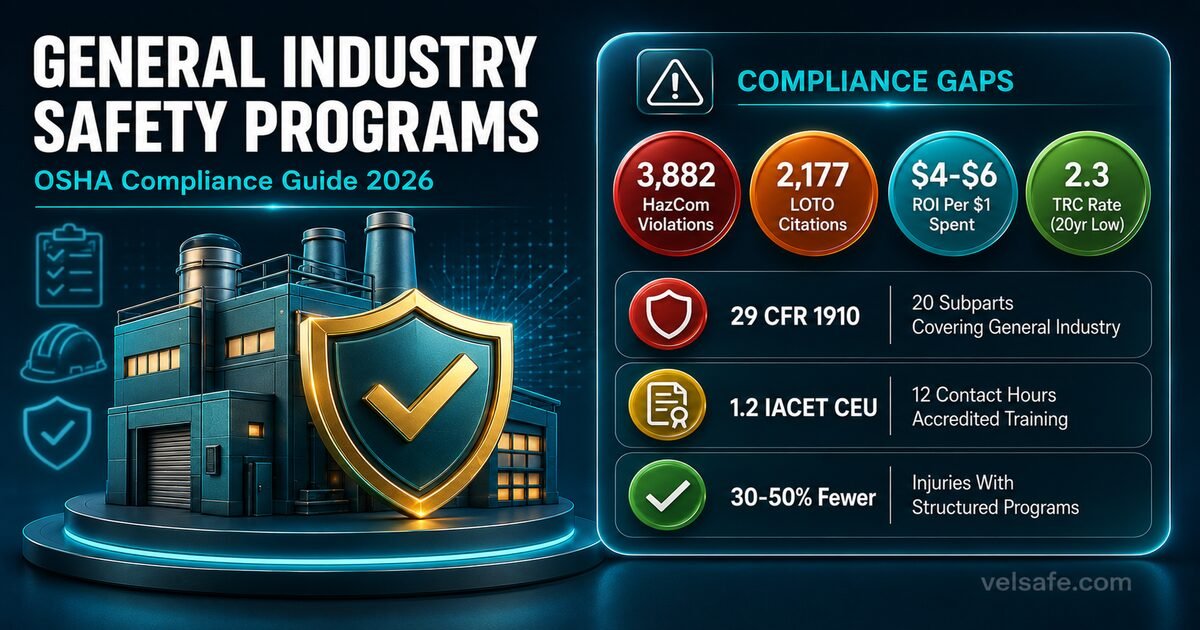
For every $1 invested in safety and health programs, organizations can expect $4 to $6 in cost savings and productivity gains.
Companies with comprehensive safety training have documented 30% to 50% reductions in workplace injuries compared to those without structured programs. The 2024 BLS data confirms this trend: the total recordable case rate for private industry fell to 2.3 cases per 100 full-time equivalent workers, the lowest level in more than two decades.
OSHA's Top General Industry Citations: FY 2025
The same general industry standards appear on OSHA’s most-cited list year after year. Understanding where violations cluster is the first step toward preventing them in your own facility.
Based on preliminary data, total top-10 OSHA citations in FY 2025 (23,537) were down roughly 17% compared to FY 2024 (28,337). Progress is real, but the same standards dominate the list year after year, which means the underlying compliance gaps have not been resolved across American workplaces.
Core Components of a Compliant Safety Program
Building an effective general industry safety program requires addressing several interconnected areas that mirror the structure of 29 CFR 1910. Each area carries its own training requirements, documentation standards, and enforcement expectations.
Maintain a written program, keep updated Safety Data Sheets for all workplace chemicals, label secondary containers, and train workers on chemical hazards they encounter. The 2024 HazCom update aligned the standard with GHS Revision 7, requiring reclassification of substances and updated labels by January 2026.
Develop and document machine-specific energy control procedures, train authorized and affected employees, and conduct periodic inspections to verify procedures are being followed. Uncontrolled energy releases can cause immediate, severe injuries or death.
Implement a written program whenever employees are exposed to airborne contaminants above permissible exposure limits. This includes medical evaluations, annual fit testing, proper equipment selection and maintenance, and worker training.
All operators must be at least 18, complete formal training (classroom instruction, practical exercises, and a workplace evaluation), and receive refresher training at least every three years or after an incident.
Install and maintain guards on all moving parts (rotating shafts, gears, belts, blades) that could expose workers to amputation, crushing, or laceration hazards. Conduct regular inspections and document all findings.
General industry fall protection applies at four feet above a lower level. Conduct hazard assessments, provide appropriate protection systems (guardrails, safety nets, or personal fall arrest systems), and deliver training on recognizing fall hazards.
Maintain written emergency action and fire prevention plans covering evacuation procedures, reporting protocols, alarm systems, and employee accounting. Communicate both plans to all employees and conduct evacuation drills at regular intervals.
What Changed in 2026: New Regulatory Priorities
Several regulatory shifts affect how general industry safety programs should be structured going forward. Even where final rules have not been issued, OSHA is already enforcing expectations under the General Duty Clause.
The Role of IACET-Accredited CEU Training
Not all continuing education is created equal. The term “CEU” is in the public domain, and many organizations use it loosely to describe professional training hours. Only CEUs issued by providers accredited by the International Accreditors for Continuing Education and Training (IACET) meet the ANSI/IACET Standard, a globally recognized benchmark for instructional quality.
Building Your Program: A Step-by-Step Framework
Review your OSHA 300 logs, incident reports, near-miss data, and existing written programs against 29 CFR 1910 requirements. Identify which subparts apply to your operations and where documented procedures are missing or outdated.
Break each job role into individual tasks and identify the hazards associated with each step. This analysis drives your training priorities, PPE selections, and engineering control decisions.
At minimum: a written hazard communication program, an emergency action plan, an energy control (lockout/tagout) program, a respiratory protection program (if applicable), and a fire prevention plan. Each must be specific to your worksite, not a generic template.
Select IACET-accredited training providers to ensure your employees’ continuing education meets nationally recognized standards. Track CEU completion for each employee and verify that training records include the date, topics covered, instructor, and attendee signatures.
Form committees with management and frontline representatives. Establish a confidential hazard reporting system that encourages employees to flag concerns without fear of retaliation. Track both leading indicators (near misses, training completion) and lagging indicators (injury rates, lost workdays).
Conduct quarterly internal inspections and an annual comprehensive program review. Compare incident data year over year, verify that all written programs reflect current operations, and update training content to address any new equipment, chemicals, or processes.
Common Mistakes That Trigger OSHA Citations
The 2024 Injury Landscape: Where Progress Is Being Made
The Bureau of Labor Statistics’ 2024 data offers encouraging signs alongside persistent challenges.
The total recordable case rate fell to 2.3 per 100 FTE workers, the lowest level since 2003. Injury cases declined for the first time since 2020.
Fatal workplace injuries dropped 4% to 5,070, with the rate falling to 3.3 per 100,000 FTE workers. Exposure-related fatalities dropped 16.2%.
Overexertion remains the leading cause of serious injuries, with nearly 1 million DART cases in 2023-2024. Transportation incidents caused 1,937 deaths (38.2%).
These trends confirm that structured safety programs are making a measurable difference, but the persistence of the same leading hazards year after year underscores the need for sustained investment in training, supervision, and engineering controls. A general industry safety program is not a one-time project; it is an ongoing operational discipline.
Frequently Asked Questions
The 10-hour course is designed for entry-level workers and provides awareness of common job-related safety and health hazards. The 30-hour course goes deeper into hazard identification, avoidance, and prevention, and is intended for supervisors and workers with safety responsibilities. Both are available for general industry and construction.
They are complementary but distinct. OSHA training hours measure time spent in OSHA-authorized training. IACET CEUs measure participation in accredited continuing education that meets the ANSI/IACET Standard for instructional quality. Many IACET-accredited safety courses also satisfy OSHA training requirements, but the accreditation adds a layer of quality assurance that employers and licensing bodies recognize.
OSHA does not mandate a single review frequency for all programs, but best practice is to conduct quarterly internal inspections and an annual comprehensive program review. Individual standards have their own timelines: lockout/tagout procedures must be inspected at least annually, forklift operator evaluations are required every three years, and HazCom training must be updated whenever new chemicals are introduced.
Sources
- Bureau of Labor Statistics, “Census of Fatal Occupational Injuries 2024”
- Bureau of Labor Statistics, “Employer-Reported Workplace Injuries and Illnesses 2024”
- National Safety Council, “BLS Report Shows Workplace Injuries at 20-Year Low”
- OSHA, “Top 10 Most Frequently Cited Standards FY 2025”
- IACET, “Continuing Education and Training Accreditation”
- National Association of Safety Professionals, “Key Regulatory Changes 2026”
- WorkCare, “OSHA’s 2026 Priorities: Key Changes Employers Must Know”