

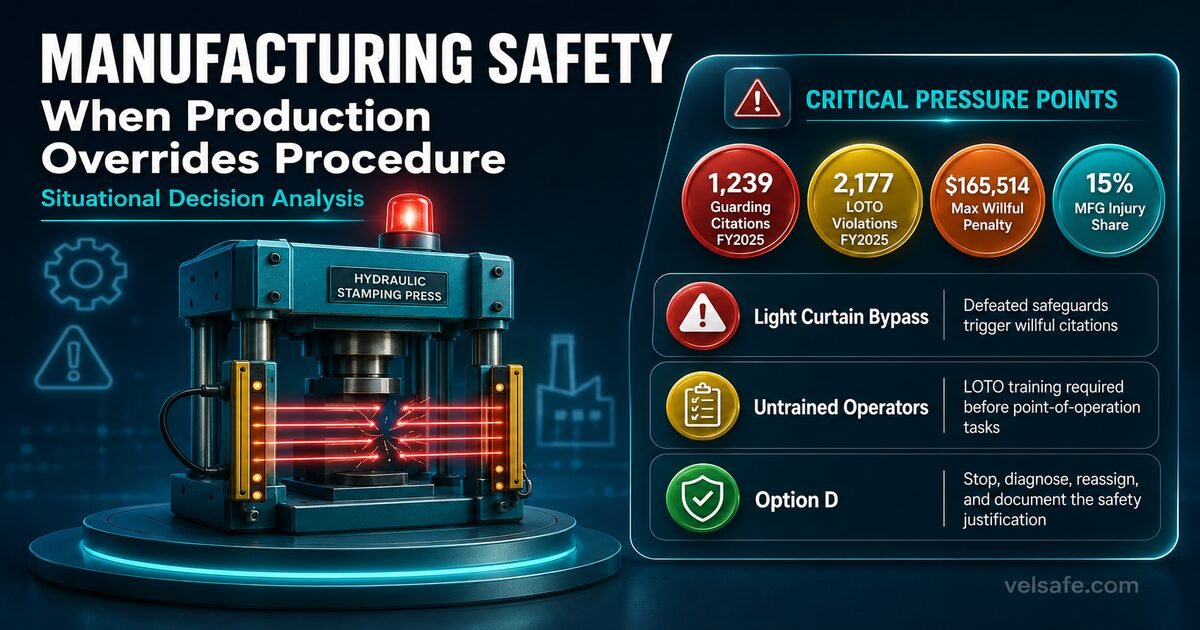
It is 2:15 PM on a Thursday at Ridgeline Metal Products, a mid-size fabrication plant producing stamped and welded steel components for agricultural equipment. The plant employs 74 production workers across two shifts and has a total recordable incident rate of 3.2. Day shift supervisor Marcus Cole is under pressure: a key customer has moved up a delivery deadline by 48 hours, and the plant manager has asked Marcus to push output on Press Line 3 to meet the order.
The light curtain on Press Line 3 has been intermittently faulting since yesterday’s second shift. Each fault stops the press and requires a 90-second manual reset, cutting effective output by nearly 30%. Marcus is considering his options, including one that would bypass the faulting sensor entirely. This scenario works through the decision he faces, why the wrong choice leads to amputations and willful citations, and what should have been in place before the pressure arrived.
The Scenario
At 2:30 PM, the light curtain faults again. Janet resets it and resumes production. Fifteen minutes later, it faults once more. Marcus checks the production board: 340 parts behind. The plant manager calls on the radio and makes it clear that losing Press Line 3 output for the rest of the day is not an option.
Marcus considers a common workaround: switching the press to single-stroke mode, where each cycle requires the operator to use both hands on palm buttons to initiate the stroke, bypassing the faulting light curtain entirely. He also notices that Daniel, the new operator who has not yet completed machine-specific LOTO training, has been hand-loading blanks into the die area while Janet operates the palm buttons.
Decision Point
What should Marcus do next?
Switch Press Line 3 to single-stroke mode with two-hand controls, allowing production to continue without light curtain interruptions. Keep Daniel loading blanks while Janet operates the press.
Shut down Press Line 3 entirely until the replacement light curtain sensor arrives on Monday. Inform the plant manager that the Friday deadline cannot be met.
Continue running with the intermittent faults, accepting the reduced output and resetting the light curtain each time it trips.
Stop production on Press Line 3. Pull the maintenance technician to diagnose the light curtain fault. Reassign Daniel away from the press until his LOTO training is completed. Communicate the delay and revised timeline to the plant manager with a documented safety justification.
Analysis
Switching to single-stroke mode specifically to bypass a faulting safety device violates the intent of 29 CFR 1910.212 and can constitute a willful violation if OSHA determines the employer knowingly operated equipment with a defeated safeguard. The two-hand control protects only the person operating the palm buttons. It does not protect Daniel, who is hand-loading blanks into the die area. If Daniel’s hands are in the point of operation when Janet initiates the stroke, the two-hand control will not prevent injury. Light curtains exist precisely to protect workers other than the primary operator. Additionally, Daniel has not completed machine-specific LOTO training. Placing an untrained worker in the point-of-operation zone of a 200-ton press with a compromised safeguarding system compounds the violation and the risk. OSHA’s National Emphasis Program on Amputations in Manufacturing specifically targets this pattern during inspections.
This option eliminates all risk from the faulting press but may be disproportionate. The light curtain is faulting intermittently, not completely failed. A full multi-day shutdown without first attempting diagnosis and repair removes production capacity unnecessarily and does not demonstrate good-faith problem solving to management or the customer. From a safety standpoint, this option is defensible. From an operational standpoint, it skips a critical step: having maintenance evaluate whether the fault can be resolved the same day.
Continuing production with a known intermittent fault is a grey area. Each fault causes the light curtain to trigger a protective stop, which is the system functioning as designed. The danger is normalisation. As resets become routine, operators may begin treating them as nuisance stops rather than safety events, resetting faster without verifying the zone is clear. Daniel, new to the facility, may learn to treat safety device activations as production interruptions rather than protective functions. This option also leaves the untrained worker issue unaddressed.
This is the correct response. It addresses every layer of risk without defaulting to either a dangerous workaround or an unnecessarily extended shutdown. Stop production: a press with a faulting safety device should not operate until the root cause is identified (29 CFR 1910.212). Pull maintenance to diagnose: an intermittent light curtain fault may be caused by a dirty lens, a loose connection, vibration-related misalignment, or a failing emitter, many of which can be resolved in under an hour. Reassign Daniel: until he completes machine-specific LOTO training, he should not be working in the point-of-operation zone of any press (29 CFR 1910.147(c)(7)). Communicate with documentation: informing the plant manager in writing that Press Line 3 is down for a safety device repair protects Marcus, the company, and the workers. If the deadline must be adjusted, the safety justification provides a clear, defensible reason any OSHA inspector would recognise as responsible management.
What Should Have Happened Before This Moment
The decision Marcus faces at 2:30 PM did not begin when the light curtain faulted. It began when several systems that should have prevented this situation were absent or incomplete.
The replacement light curtain sensor will not arrive until Monday. A facility running presses with amputation potential should stock critical safety components (light curtain sensors, interlock switches) on site. A $200 spare sensor eliminates a multi-day shutdown or the temptation to bypass.
Daniel is in his third week and has not yet completed machine-specific LOTO training, which is scheduled for next Tuesday. He should never have been assigned to hand-load blanks into the die area of Press Line 3. OSHA requires that all employees working in areas with energy control procedures understand their purpose and function before exposure (29 CFR 1910.147(c)(7)).
Marcus is weighing production pressure from the plant manager against safety. A documented stop-work policy that explicitly authorises supervisors to halt equipment for safety reasons, without requiring prior management approval, removes the decision from a pressure environment and makes the correct action the default action.
Learning Points
OSHA does not recognise customer deadlines, shift quotas, or management directives as justification for operating equipment with compromised safeguards. Operating a press with a known faulty light curtain violates the General Duty Clause (Section 5(a)(1)) and can constitute a willful violation of 29 CFR 1910.212 if the bypass is deliberate.
A two-hand control protects only the operator at the palm buttons. It provides zero protection for a second worker loading material into the die area. Light curtains exist precisely because press operations frequently involve more than one person near the point of operation. Switching to an alternative mode to bypass the curtain removes the only safeguard that protects the loader.
General safety orientation is not sufficient for press operations. Daniel’s LOTO training for Press Line 3 is scheduled for next Tuesday, but he is already working in the die area. Under 29 CFR 1910.147(c)(7), employees must understand the purpose and function of energy control procedures before working in areas where those procedures are used. This is an independent regulatory violation regardless of the light curtain status.
The single most valuable action Marcus can take is documenting his decision to stop production and the safety reasoning behind it. If the order ships late, the documentation explains why. If OSHA later inspects the facility, the documentation shows the supervisor recognised a hazard, took corrective action, and communicated through the chain of command. That record transforms a potential citation into evidence of a functioning safety culture.
A light curtain sensor costs a fraction of a single OSHA penalty. Facilities running presses, shears, or other equipment with amputation potential should maintain spare safety components (light curtain emitters and receivers, interlock switches, safety relay modules) so that a device failure results in a same-day repair, not a multi-day shutdown or a temptation to bypass.
Related Resources
- OSHA’s machine guarding standard (29 CFR 1910.212) sets point-of-operation protection requirements for all general industry equipment that can cause amputations, crushing, or laceration injuries.
- OSHA’s control of hazardous energy standard (29 CFR 1910.147) governs lockout/tagout procedures for servicing and maintenance of machines with hazardous energy sources.
- A practice test covering OSHA general industry standards, including machine guarding and LOTO requirements, is available in the Practice Tests section.
- OSHA, “Machine Guarding: 29 CFR 1910.212”
- OSHA, “Control of Hazardous Energy (Lockout/Tagout): 29 CFR 1910.147”
Sources
- OSHA Top 10 Most Frequently Cited Standards, FY 2025
- OSHA Top 10 Violations in Manufacturing, FY 2025 (MSC Industrial)
- Cal/OSHA Citations: All FAB Precision Sheetmetal Amputation Case, 2025
- OSHA National Emphasis Program on Amputations in Manufacturing
- Manufacturing Safety: Preventing the 15 Most Common Workplace Injuries (OxMaint)
- World Economic Forum: Safety as Strategic Advantage in Manufacturing
- OSHA Commonly Used Statistics