

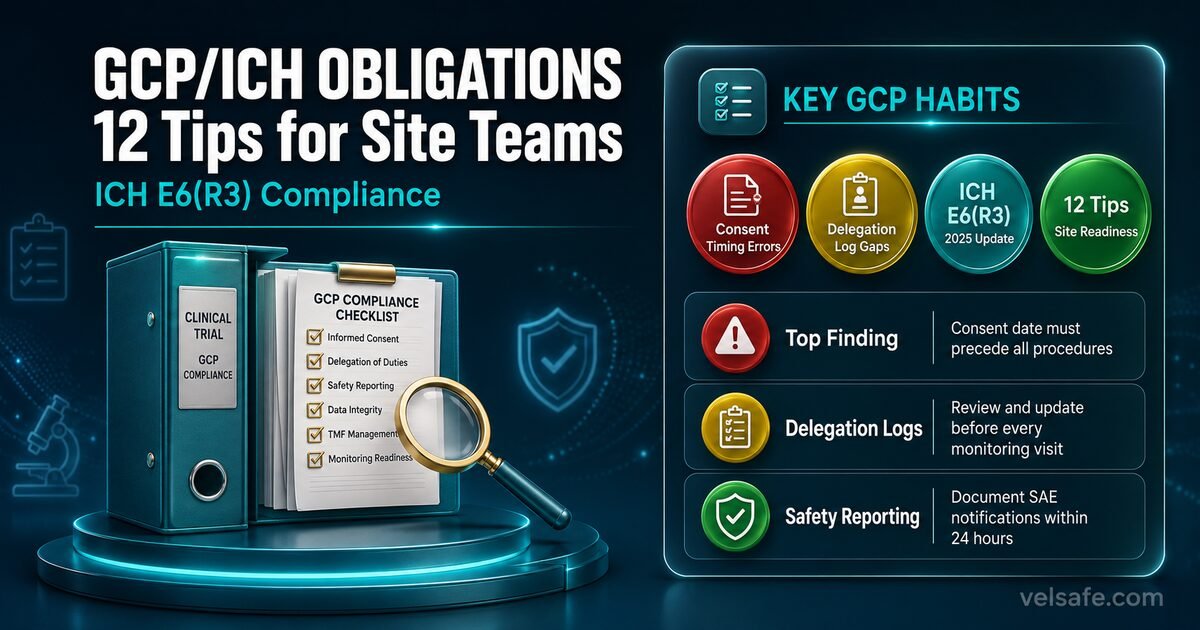
ICH E6(R3) — effective July 2025 under EMA and published by FDA in September 2025 — is the most significant update to Good Clinical Practice in nearly three decades. While the guideline introduces a risk-proportionate, Quality by Design framework, the core obligations of sponsors, monitors, and investigators remain grounded in the same principles that have defined GCP since 1996: protect participants, ensure data integrity, and document everything.
These 12 tips translate ICH E6(R3)’s requirements into practical habits for site teams. Each tip is drawn from documented inspection findings, common assessment gaps, and the updated framework’s key changes. Apply them before your next monitoring visit, site initiation visit, or inspection.
Tips 1-3: Consent and Participant Protection
Tip 1: Verify consent date precedes procedure date — every time, for every participant
Build a simple check into your enrolment workflow: before entering a participant’s screening or baseline visit into the CRF, confirm that the signed consent date in the source documents is earlier than the earliest trial procedure date. This check takes under 60 seconds and catches the most consequential finding in GCP compliance before it becomes a deviation.
Practical action: Create a site SOP that requires the coordinator to record the consent date separately in the screening log on the day consent is obtained, before any procedures begin. This creates an independent date-stamped record that precedes all subsequent documentation.
Tip 2: Re-consent proactively when new safety information emerges — do not wait for the sponsor to prompt you
Under ICH E6(R3), investigators must inform participants promptly when significant new information becomes available that may affect their willingness to continue. “Promptly” means as soon as the new information is available and understood — not at the next scheduled visit.
Establish an internal trigger within your site SOP: when a new Investigator’s Brochure version or protocol amendment is received, the coordinator reviews it within 5 business days and flags any new safety information. The investigator determines within 3 business days whether re-consent is required. Document both the review and the determination, even if re-consent is not required.
Practical action: Keep a re-consent tracking log in your ISF. For each IB or amendment received, record the date received, who reviewed it, whether re-consent was determined to be necessary, and if so, the date each active participant was re-consented.
Tip 3: Document the consent discussion, not just the signed form
The signed consent form proves that the document was signed. It does not prove that a proper discussion occurred. Under ICH E6(R3), the consent process — including the discussion, the opportunity for questions, and the time given to consider — must be documented.
Add a brief note to the source documents (or a site-specific consent process log) describing the consent discussion: who conducted it, who was present, approximately how long it lasted, what questions the participant raised, and how those questions were addressed. This documentation protects the site in the event of an inspection dispute about whether consent was genuinely informed.
Tips 4-5: Delegation and Site Team Management
Tip 4: Review and update the delegation log before every monitoring visit
Make delegation log review a standing agenda item before every monitoring visit. Confirm that every person currently performing trial activities is listed on the log for each specific task they perform, that all date ranges are current and accurate, and that the investigator’s signature is on the most recent version. If any staff member left the site, record the end date for their delegation.
Practical action: Assign one coordinator as the delegation log owner. That person updates the log within 48 hours of any staff change and reviews it against current activity assignments monthly.
Tip 5: Train all new staff before they perform any trial activity — not concurrently
Under ICH E6(R3), all trial-related activities must be performed by qualified individuals. “Qualified” means trained and documented as trained before the activity is performed — not in the same week, not at the next training session.
When a new team member joins the site, their training completion, CV update, and delegation log entry must all be completed and signed off before they perform a single trial-related task. This is a common finding when sites are understaffed and onboard new staff informally while they are already working.
Tips 6-7: Protocol Compliance and Deviations
Tip 6: Report deviations immediately — a late deviation report is itself a GCP finding
Protocol deviations must be documented at the time they are identified, not retrospectively when a monitor visit is approaching. A deviation reported promptly with an accurate date is a compliance event. The same deviation discovered at a monitoring visit and then backdated is a data integrity problem on top of the original deviation.
Create a site deviation log maintained in real time. Any team member who identifies a deviation — including the investigator, coordinator, or pharmacist — should have clear authority to enter it in the log immediately, with the protocol and the corrective action to follow.
Practical action: Include deviation identification and reporting in all site staff training. “If in doubt, report it” is the right default. An over-reported deviation is a manageable finding. An undetected deviation that surfaces at inspection is not.
Tip 7: Distinguish between protocol deviations and protocol violations — and document your assessment
Not all protocol departures carry the same weight. A missed non-critical assessment window is a deviation. Enrolling a participant who does not meet eligibility criteria is a violation. Under ICH E6(R3), the investigator must assess the impact of each deviation on participant safety and data integrity, and this assessment must be documented.
For each deviation, document: what happened, when, why, the investigator’s assessment of impact on participant safety and data integrity, the corrective action, and the preventive action. A deviation report that consists only of “participant missed visit” without impact assessment is an incomplete record.
Tips 8-9: Safety Reporting
Tip 8: Report SAEs to the sponsor immediately — the 24-hour clock starts when you first become aware
Establish a site SAE escalation procedure: any team member who becomes aware of a potential SAE must notify the principal investigator and the site coordinator within 2 hours, regardless of time of day. The initial sponsor notification should follow within 24 hours of the site first becoming aware. Do not wait for the participant’s medical workup to be complete before making initial contact with the sponsor.
Tip 9: Document the investigator's causality assessment in the source records — not just on the SAE form
The investigator’s assessment of whether the SAE is related to the investigational product is a medical judgment that must be documented in the source records, not just transcribed onto the SAE report form. The source documentation should reflect the clinical reasoning: what the investigator observed, what alternative causes were considered, and why the conclusion of “related” or “not related” was reached.
This matters because in the event of a regulatory inspection, the source record is the primary evidence of the investigator’s clinical assessment — not the SAE form, which is a summary document.
Tips 10-11: Monitoring and Sponsor Oversight
Tip 10: Prepare a monitoring visit response before the monitor arrives — not after
When you receive a monitoring visit report with findings and action items, the site’s response should not be the first time you are thinking about corrective actions. For routine findings that recur across visits (delegation log gaps, late deviation reports, missing source data), build the corrective action into your SOP before the next visit.
Practical action: After each monitoring visit, hold a 30-minute site team debrief to review findings. Assign each finding an owner and a completion date. Review progress at the next team meeting. When the monitor arrives for the follow-up visit, the site should be able to demonstrate that each previous finding has been addressed — not by explaining what is planned, but by showing what was done.
Tip 11: For sponsors and CROs — use central monitoring signals to trigger on-site visits, not replace them
ICH E6(R3)’s risk-based monitoring framework allows reduced on-site visit frequency, but central monitoring data should actively inform when on-site visits are needed. A site with unusually low deviation rates, unusually high enrolment speed, or unusual data patterns should receive an escalated visit — not a reduced one.
In FDA inspection data, sites that were found to have data fabrication or systematic GCP failures are frequently sites that received fewer monitoring visits because their data appeared clean. Central monitoring identified no anomalies — because the data was fabricated consistently. Risk-based monitoring requires active interpretation of signals, not just absence of flags.
Tip 12: Build the TMF from day one — not before the inspection
Tip 12: Treat the TMF as a living record, updated in real time throughout the trial
Establish a TMF filing schedule: every essential document received or generated at the site should be filed within 5 business days. Assign one person as the TMF owner with authority to request documents from all site team members. Conduct a monthly self-assessment of the TMF against the ICH E6(R3) Annex 1 essential document list.
Practical action: Use the DIA Reference Model checklist or equivalent to do a quarterly TMF review. For each required document category, verify that the most current version is filed and that the date on the document reflects the actual date of the activity — not a later filing date.
Quick Reference Checklist
Sources
- ICH E6(R3) Guideline for Good Clinical Practice, Step 4 (January 2025)
- FDA, “E6(R3) Good Clinical Practice Guidance for Industry” (September 2025)
- EMA, “ICH E6 Good Clinical Practice: Scientific Guideline”
- DIA, “Trial Master File Reference Model”
- GCP Blog, “ICH E6(R3) GCP Guidelines for Clinical Trials”