

Administrative Controls and Training
HAZWOPER compliance does not start with a respirator. It starts with the decisions made before workers ever enter a hazardous area. Administrative controls, the policies, schedules, procedures, and training programs that shape how work gets done, are one of the most underused tools in the HAZWOPER toolbox. When applied correctly, they reduce chemical exposure, protect worker health, and support a defensible compliance record under 29 CFR 1910.120.
Administrative controls sit in the middle of the NIOSH hierarchy of controls, below elimination and engineering controls, but above PPE. They play a critical role in operations where hazard elimination is not practical, and they are only as strong as the documentation, communication, and enforcement behind them.
These 10 practical tips cover everything from Health and Safety Plan design to annual refresher requirements. Each tip includes what to do, why it matters, the most common mistake, and a pro tip drawn from OSHA compliance experience.
HAZWOPER Training Requirements by Role
10 Actionable Tips for HAZWOPER Administrative Controls
OSHA requires that a HASP be developed before cleanup operations begin under 29 CFR 1910.120(b)(1). When administrative controls are written into the HASP, they become auditable. When they exist only as habits or verbal agreements, OSHA inspectors find nothing to verify compliance.
For each identified hazard, document: the administrative control in place, who is responsible for implementing it, how compliance is verified, and what triggers a review. Common controls to document include rotation schedules, work zone designations, buddy system requirements, entry and exit logging, and communication check-in procedures.
Writing a HASP once and treating it as permanent. HASPs must be updated when site conditions change, when new hazards are identified, or when site characterization data changes.
Assign a named HASP owner who reviews the document before each phase of operations begins. A rotating ownership structure where anyone is technically responsible usually means no one reviews it.
Many chemical exposures at hazardous waste sites operate on cumulative dose. A worker exposed to lower concentrations for shorter periods accumulates less total exposure than one spending an entire shift in the same area. Rotation spreads exposure across a larger crew rather than concentrating it on a single worker.
Set maximum time limits for work in high-hazard zones and document them in the HASP. Rotate workers out of exclusion zones on a fixed schedule. Do not rely on workers to self-monitor or self-exit – the schedule must be enforced by a site supervisor who has no override authority under production pressure.
Building rotation schedules in theory but abandoning them under production pressure. If the schedule is not supervisor-enforced and documented, it will not hold on high-pressure days.
Post rotation schedules visibly at the site safety officer station and at zone entry points. When the schedule is visible to everyone on site, it is harder to ignore.
HAZWOPER work zones (Exclusion Zone, Contamination Reduction Zone, and Support Zone) are more than geographic designations. They are administrative controls that define who can work where, in what PPE, and under what conditions. A zone that is not actively managed is not a control.
Define all three work zones in the HASP before site entry begins. Require logged entry and exit for the exclusion zone. Verify that all personnel working in each zone have completed the training level required for that zone. Document zone boundary changes whenever site conditions shift.
Allowing unqualified personnel to enter the exclusion zone during equipment deliveries or supervisory walkthroughs. Every person who crosses the exclusion zone boundary must meet the training and PPE requirements – no exceptions.
Use a physical sign-in/sign-out log at zone entry points rather than relying on memory or electronic records alone. Physical logs are easier for OSHA inspectors to review on-site and harder to lose.
HAZWOPER training requirements vary based on job duties and exposure potential. Not everyone on a HAZWOPER site needs the same level of training. Calibrating training requirements to actual job duties is both a compliance requirement under 29 CFR 1910.120(e) and a practical resource decision.
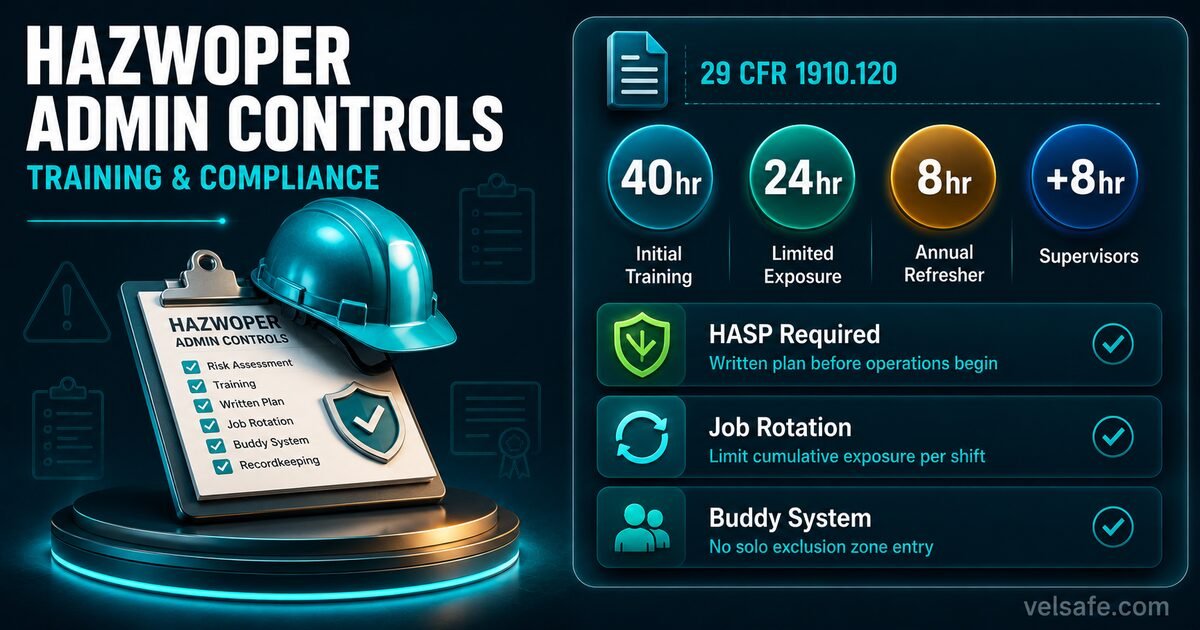
Map each role on your site to its HAZWOPER training requirement: 40-hour initial training plus three days supervised field experience for general site workers; 24-hour initial training plus one day supervised field experience for workers with limited exposure; the same initial training as the workers they supervise, plus eight additional supervisory hours for on-site managers.
Sending everyone for 40-hour training regardless of role. While conservative, this does not replace the mandatory site-specific and supervisory training requirements, and it may create a false sense of full compliance.
Document the role-to-training mapping in the HASP so that new workers or subcontractors can be slotted into the correct training tier immediately upon site assignment, with no guesswork.
Initial HAZWOPER certification is the foundation, but site-specific training is what makes it actionable for the conditions workers will actually encounter. A worker who completed 40-hour HAZWOPER training six months ago still needs site orientation before Day 1 at a new site.
Before any worker enters a new HAZWOPER site, conduct a documented site-specific orientation covering: the chemicals identified in site characterization, the HASP highlights, emergency contact numbers and evacuation routes, decontamination procedures, and the work zone map. Keep it brief and always document it.
Treating site-specific training as a one-time event. When site conditions change – new contaminants identified, zone boundaries shift, or different tasks begin – a new site-specific briefing is warranted regardless of how recently the last one occurred.
A 20-minute briefing backed by a signed acknowledgment form creates a clear compliance record. A two-hour lecture with no documentation creates nothing that OSHA can verify.
The annual refresher is not optional and does not reset on a calendar year basis. It runs from the anniversary of the worker’s last refresher or initial training completion. A worker whose annual refresher lapses is no longer in compliance, even if their original 40-hour certificate still appears current on its face.
Maintain a training expiration tracking log for every HAZWOPER-covered worker. Set renewal reminders at 60 and 30 days before expiration. Stagger refreshers throughout the year based on individual expiration dates rather than batching them all in January.
Scheduling all annual refreshers in a single batch at the start of the year. If workers were trained at different times throughout the year, their expiration dates differ. A January batch will leave some workers out of compliance for part of the year.
Use your HASP documentation system to track refresher expiration dates alongside training records. Any worker whose refresher has lapsed should be removed from HAZWOPER-covered tasks until training is renewed.
The buddy system is not a soft safety culture practice. In HAZWOPER operations it is an administrative control that reduces the risk of undetected medical emergencies, unmonitored chemical exposure, and delayed emergency response. Workers experiencing early symptoms of chemical exposure may not recognize their own impairment.
Require that no worker enters the exclusion zone alone. Assign buddy pairs at the start of each shift. Define what buddy check-ins look like – verbal confirmation on a fixed schedule, visual contact throughout the work period, or both. Document buddy pair assignments in the daily site safety log.
Implementing the buddy system in the HASP but not enforcing it during operations. An unverified buddy system that exists only on paper is not a control – it is a documentation record of a control that was not active.
Pair new or less experienced workers with experienced workers, not with each other. Buddy pairings should be skills-complementary, not convenience-based.
Decontamination is typically discussed as a safety procedure, but it also functions as an administrative control by preventing the spread of contamination from the exclusion zone to lower-hazard areas and ultimately to workers’ homes and families through secondary exposure pathways.
Establish a decontamination line between the exclusion zone and the contamination reduction zone before operations begin. Write the decontamination procedure into the HASP and practice it before first entry. Ensure that decontamination stations are stocked and operational at the start of each shift – not restocked reactively.
Treating decontamination as optional for brief exclusion zone entries or for workers with low-visibility tasks. Decontamination applies every time a worker exits the exclusion zone, regardless of how short the entry was.
Designate a dedicated decontamination officer for shifts involving multiple workers in the exclusion zone. A single person responsible for decontamination compliance prevents shortcuts under production pressure.
Supervisors have additional responsibilities under 29 CFR 1910.120(e)(4): they must complete the same initial training as the workers they supervise, plus an additional eight hours of specialized supervisory training. Supervisors make real-time decisions about work zone entry, PPE selection, work pace, and emergency response – and they need the grounding to make those decisions correctly.
Verify that all supervisors of HAZWOPER operations hold both their worker-level certification and the eight-hour supervisory supplement. Confirm that their annual refreshers are current. Include supervisory-specific topics in pre-shift briefings: today’s zone boundaries, today’s hazard monitoring readings, today’s buddy pair assignments.
Promoting an experienced worker to site supervisor without verifying they have completed the supervisory training supplement. Seniority does not satisfy the regulatory requirement under 29 CFR 1910.120(e)(4).
Document the supervisory training supplement on a separate certificate from the worker-level training. Keep both in the personnel file. When OSHA asks, both records need to be immediately available – not reconstructed.
Administrative controls are not set-and-forget measures. A near miss on a HAZWOPER site is a signal that something in the control system was not working as designed. An administrative control failure – a skipped buddy check, an expired refresher, an undocumented zone change – is just as actionable as a physical equipment failure.
After every incident or near miss, review the administrative controls that were in place. Ask: Was the control documented? Was it communicated to workers? Was it enforced during the shift? Did site conditions change in a way that made the control inadequate? Update the HASP accordingly and brief workers on the change before operations resume.
Treating near misses as close calls rather than data. Near misses that are logged but not reviewed are missed opportunities to prevent the next incident – and to build the review record that demonstrates a functioning safety management system.
Create a brief near-miss reporting template that specifically asks whether administrative controls were followed and whether they were adequate. The question itself reinforces that administrative controls are expected to be active, not just documented.
Quick Compliance Checklist
Common Mistakes to Avoid
Key Takeaways for HAZWOPER Safety Managers
Frequently Asked Questions
What are administrative controls in a HAZWOPER context?
Administrative controls are policies, procedures, training requirements, and work practices that reduce worker exposure to hazardous substances. Under HAZWOPER, they include rotation schedules, work zone access procedures, buddy systems, site-specific training, decontamination requirements, and Health and Safety Plan provisions. They sit between engineering controls and PPE in the NIOSH hierarchy of controls.
Is a Health and Safety Plan required for all HAZWOPER operations?
Yes. OSHA 29 CFR 1910.120(b)(1) requires that a Health and Safety Plan be developed before cleanup operations at uncontrolled hazardous waste sites begin. The HASP must address hazard identification, personnel roles, training requirements, PPE selection, medical surveillance, site control, emergency response, and decontamination procedures.
How often must HAZWOPER workers complete refresher training?
Workers who have completed initial HAZWOPER training must complete an 8-hour annual refresher every 12 months. The 12-month period runs from the date of the worker’s most recent training completion, not from a calendar year. A lapsed refresher removes the worker from compliance even if the original certificate has not expired on its face.
Does the buddy system apply to brief exclusion zone entries?
Yes. The buddy system applies to every exclusion zone entry, regardless of duration. A brief entry is not exempt from the requirement, because chemical exposure, medical emergencies, and PPE failures do not wait for longer shifts.
Do subcontractors on a HAZWOPER site need site-specific training?
Yes. Subcontractors working on a HAZWOPER site must meet the same training requirements as direct-hire workers performing equivalent tasks. The host employer retains responsibility for ensuring that subcontractor workers have received appropriate training and site-specific orientation before beginning work.
What is the difference between HAZWOPER training and site-specific training?
HAZWOPER training (40-hour, 24-hour, or supervisory level) provides the foundational knowledge and skills required for hazardous waste operations. Site-specific training orients workers to the particular hazards, site layout, emergency procedures, and administrative controls of the individual site they are entering. Both are required – one does not replace the other.
Sources
Government and Regulatory Sources
- OSHA. HAZWOPER General Businesses. U.S. Department of Labor.
- OSHA. HAZWOPER Preparedness. U.S. Department of Labor.
- OSHA. HAZWOPER Standards. 29 CFR 1910.120. U.S. Department of Labor.
- OSHA. HAZWOPER Background. U.S. Department of Labor.
Training and Technical Sources
- CPWR. HAZWOPER 40-Hour Hazardous Waste Worker Training, Chapter 6.
- OSHACode. (2026). Complete HAZWOPER Training for OSHA 29 CFR 1910.120.
- OSHACode. (2025). HAZWOPER Training Requirements for Employers.
- OSHACode. (2025). HAZWOPER Site Controls: Zones, Access Control and Site Safety Procedures.
- DuraLabel. (2026). Understanding OSHA 1910.120 HAZWOPER Requirements.
Related VelSafe Articles
Build Your HAZWOPER Administrative Controls Program with VelSafe
Administrative controls are only as strong as the training behind them. Workers who understand why a rotation schedule exists, why buddy checks matter, and why the HASP needs to be reviewed before every phase of operations will follow those controls more reliably than workers who are simply told to comply.
Explore the VelSafe training library to support your HAZWOPER compliance program from the ground up.