

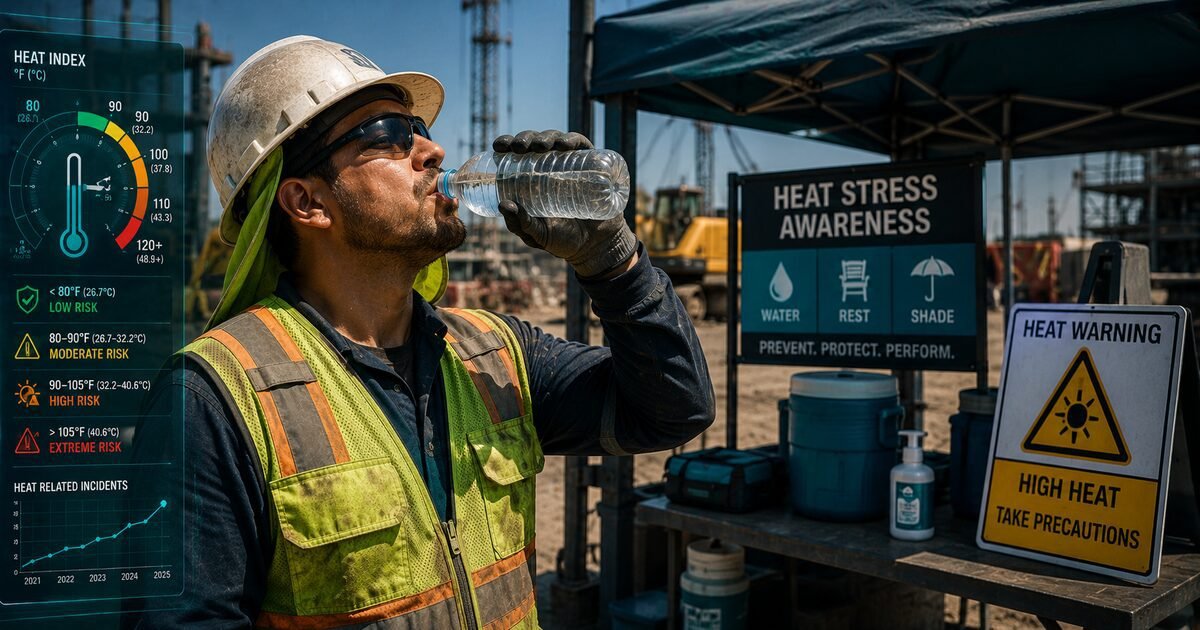
A worker in PPE drinking water at a heat rest station with a heat warning sign and Water Rest Shade signage visible in the background

Heat Stress Awareness: What the Data Says and What Prevention Actually Requires

HEAT STRESS INSIGHTS: Workplace Safety
Heat Stress at Work: What the Data Says
and What Prevention Actually Requires
2.4 billion workers globally face occupational heat exposure risk. 55 U.S. workers died from heat in 2023 alone. Heat stroke can kill within 15 minutes. Yet most heat deaths are preventable with the right program built before conditions turn critical.
55
U.S. Worker Deaths, 2023
Deaths attributed to environmental heat exposure in U.S. workplaces, and the true toll is higher due to misclassification
Bureau of Labor Statistics, 2023
2.4B
Workers at Global Heat Risk
More than 70% of the global working population face some level of occupational heat exposure risk
World Economic Forum, 2024
3 Days
When Most Deaths Occur
Most heat fatalities happen within the first three days of exposure, making acclimatization the most critical prevention factor
OSHA / NIOSH Data

Heat kills workers faster than almost any other environmental hazard. It is one of the most predictable occupational risks, and one of the most preventable. Yet dozens of U.S. workers die from heat-related causes every year, and thousands more suffer serious illness that could have been avoided.

Heat stress awareness is not simply about recognizing when someone feels uncomfortable. It covers a physiological cascade that can move from mild cramps to fatal organ failure within minutes. For safety managers, EHS professionals, and business owners, understanding how that progression works, who faces the greatest risk, and what controls actually prevent illness is what separates a heat program that functions from one that just exists on paper.

This article examines current occupational heat data, the six illness types recognized by NIOSH, where federal and state regulation stands as of mid-2026, and what high-performing safety programs consistently do differently.

Key Statistics: Heat Stress at Work
55 Deaths
U.S. workers killed by environmental heat exposure in 2023, with an annual average of 41 deaths between 2011 and 2023, and public health researchers confirm the real figure is higher
Bureau of Labor Statistics, 2023
23 Million
Workplace injuries globally each year attributed to excessive heat, making it one of the most prevalent occupational hazards across every industry sector
United Nations, 2024
10-15 Minutes
Time for core temperature to reach 106°F or higher once heat stroke onset begins, why immediate 911 contact and aggressive cooling are the only acceptable responses
NIOSH / OSHA Heat Stroke Guidance
26.2 Million
People worldwide living with chronic kidney disease directly linked to occupational heat stress, a long-term health consequence rarely connected to the workplace
ILO, 2023
7,000+
Programmed workplace heat inspections conducted by OSHA between April 2022 and late 2024 under the National Emphasis Program on Heat, which expired April 8, 2026
OSHA National Emphasis Program
$161,323
Maximum OSHA penalty per incident for willful or repeat heat violations under the General Duty Clause, a single inspection with multiple violations can reach six figures
OSHA Penalty Schedule

1. What Is Heat Stress? Understanding the Physiology

Heat stress occurs when the body absorbs more heat than it can effectively release. The body maintains a core temperature of approximately 98.6 degrees Fahrenheit through sweating, blood flow changes, and respiratory adjustments. When environmental heat, humidity, physical exertion, or protective clothing interfere with those cooling mechanisms, core temperature begins to climb.

NIOSH defines heat stress as the net heat load to which a worker may be exposed, accounting for both environmental conditions and the metabolic heat generated by physical activity. The resulting physiological response is called heat strain. That distinction matters for program design.

Expert Insight: A program focused only on environmental temperature will miss a substantial portion of risk. A worker in impermeable chemical protective clothing in a moderate-temperature environment can face heat strain equivalent to unprotected work in extreme summer heat. Workload and PPE type belong in every heat hazard assessment alongside thermometer readings.

The body has four mechanisms for releasing heat: radiation, conduction, convection, and evaporation through sweating. At high ambient temperatures or high humidity, the first three become much less effective. Sweating becomes the dominant cooling pathway. A physically active worker in hot conditions can sweat one to two liters per hour. At that rate, a worker who does not replace fluids regularly can become clinically dehydrated within a single shift.

High humidity compounds this significantly. When air is already saturated with moisture, sweat cannot evaporate, and the body’s primary cooling mechanism stalls. This is why the Heat Index, which combines temperature and relative humidity, is a more useful hazard indicator than air temperature alone. A temperature of 91 degrees Fahrenheit at 90 percent relative humidity produces a Heat Index of approximately 122 degrees Fahrenheit.

2. The Six NIOSH Heat-Related Illnesses: Severity and Response

Six NIOSH Heat-Related Illnesses, Severity and Urgency
Heat Rash (Miliaria) Warning Signal
Blocked sweat ducts, not dangerous itself but signals elevated risk for more serious illness
Heat Cramps Early Warning
Painful muscle spasms from dehydration and electrolyte loss, stop work, cool area, rehydrate
Heat Syncope Moderate, Fall Risk
Sudden fainting from blood pooling, secondary injury risk from falls near machinery or at height
Heat Exhaustion Serious, Urgent
Cooling failure under sustained exposure, remove from heat immediately; can progress to heat stroke rapidly
Rhabdomyolysis (Heat Rhabdo) Severe, Emergency
Rapid muscle breakdown releasing kidney-damaging proteins, emergency medical evaluation required immediately
Heat Stroke LIFE-THREATENING: Call 911
Total thermoregulation failure, core temp 106°F+ in 10-15 minutes; permanent disability or death without immediate intervention
Source: NIOSH Six Heat-Related Illnesses | OSHA Heat Illness and First Aid
  • Heat Rash (miliaria) develops when sweat ducts become blocked, trapping perspiration under the skin. Workers experience clusters of red bumps or blisters on the neck, upper chest, elbow creases, and groin. On its own it is not dangerous, as a signal, it matters. A worker with heat rash is showing early evidence that their cooling system is compromised. (NIOSH / CDC Heat-Related Illnesses)
  • Heat Cramps are painful, involuntary muscle spasms resulting from dehydration and electrolyte loss through heavy sweating. The correct response is to stop activity, move to a cool area, and drink water or an electrolyte beverage. If cramps do not resolve within one hour, the worker needs medical evaluation. (OSHA Heat-Related Illnesses and First Aid)
  • Heat Syncope is a sudden, brief loss of consciousness caused by blood pooling in the extremities as the body redirects circulation toward the skin. The secondary risk is significant: a worker who loses consciousness near machinery, at height, or while carrying materials can sustain serious injury from the fall itself. (NIOSH)
  • Heat Exhaustion develops when the body’s cooling mechanisms begin to fail under sustained heat exposure and fluid loss. Symptoms include heavy sweating, headache, dizziness, nausea, weakness, thirst, elevated heart rate, and clammy skin. Without treatment, heat exhaustion can progress to heat stroke. (OSHA / NIOSH)
  • Rhabdomyolysis (Heat Rhabdo) is a serious condition in which muscle tissue breaks down rapidly, releasing proteins into the bloodstream that can damage the kidneys. Symptoms include muscle pain, weakness, and dark or cola-colored urine. Kidney damage can begin within hours of onset. Any worker showing these signs needs immediate emergency medical evaluation, not an observation period. (NIOSH)
  • Heat Stroke is a medical emergency. Core temperature rises to 106°F or higher within 10 to 15 minutes of onset. Symptoms include confusion, slurred speech, loss of consciousness, and seizures. Call 911 immediately. Begin aggressive cooling, cold water immersion or cold wet cloths applied to head, neck, armpits, and groin. Do not give fluids to an unconscious person. The speed of cooling is the primary determinant of survival. (OSHA / NIOSH / CDC)

3. Who Faces the Highest Risk? Industries and Individual Factors

#1 Risk Factor
Lack of Acclimatization
Workers in their first days on a new job or returning after 1+ week away. Most heat fatalities occur within the first 3 days of exposure.
OSHA / NIOSH Data
High-Risk
Occupational Groups
Firefighters, construction workers, agricultural workers, miners, boiler room operators, factory workers, foundry workers, and bakery workers
NIOSH ABLES Data
Indoor Too
Not Just Outdoor Work
Warehouses, bakeries, commercial kitchens, foundries, laundries, and manufacturing facilities generate heat loads comparable to outdoor summer conditions
OSHA Proposed Standard, 2024
Individual
Susceptibility Factors
Age, cardiovascular disease, kidney disease, certain medications, prior heat stroke, and alcohol consumption the night before all increase risk
NIOSH / CDC

4. The Regulatory Landscape as of Mid-2026: OSHA and State Standards

Regulatory Status
Detail
Federal heat standard
No specific enforceable OSHA heat standard as of mid-2026
Current enforcement basis
General Duty Clause (OSH Act Section 5(a)(1))
Proposed rule published
August 2024, Federal Register, 43,000+ public comments received
Lower heat trigger (proposed)
Heat Index of 80°F, initial action required
High heat trigger (proposed)
Heat Index of 90°F, mandatory rest breaks and shade
Public hearings held
June 16 through July 2, 2025
OSHA National Emphasis Program
Expired April 8, 2026
State binding standards
Washington, Minnesota, California, Oregon, Colorado
Max penalty, serious violation
Approx. $16,131 per incident
Max penalty, willful or repeat
Exceeds $161,323
Source: OSHA Heat Injury and Illness Prevention NPRM August 2024 | Federal Register

5. Acclimatization: The Factor That Determines Most Outcomes

OSHA-NIOSH Rule of 20% – Acclimatization Schedule for New Workers
Day 1 20% of normal workload duration
Highest risk period, most heat fatalities occur in first 3 days
Day 2 40% of normal workload duration
Day 3 60% of normal workload duration
Day 4 80% of normal workload duration
Day 5+ 100% – Full schedule reached
Full physiological adaptation takes 7-14 days, continued monitoring required
Source: OSHA-NIOSH Rule of 20 Percent | OSHA Protecting New Workers from Heat
  • Public health and occupational medicine evidence consistently identifies lack of acclimatization as the leading cause of heat-related illness and death at work. OSHA and NIOSH data show that most heat fatalities occur within the first few days of a new worker’s exposure, often within the first three days. (OSHA / NIOSH)
  • Acclimatization is the physiological process by which the body adapts to sustained heat exposure over 7 to 14 days. Acclimatized workers begin sweating at lower core temperatures, produce greater sweat volume, distribute sweat more efficiently across the body surface, experience smaller heart rate increases under heat load, and maintain better fluid and electrolyte balance. (NIOSH)
  • Workers returning from absences of one week or more have lost a significant portion of their acclimatization. They should follow a modified return-to-work schedule even if they previously performed the same job without incident, this is one of the most commonly missed exposure risks in heat safety programs. (OSHA Protecting New Workers from Heat)
  • Supervisors must actively monitor newly acclimatizing workers. Workers experiencing early heat illness may not recognize or report their own symptoms. Buddy systems and regular check-ins during the acclimatization period are protective, not optional. (OSHA)

6. What Effective Prevention Programs Include

Written Prevention Plan
Documents specific procedures for heat-triggered conditions, emergency response, acclimatization schedules, and worker training. Available to OSHA upon inspection. Demonstrates due diligence under the General Duty Clause even without a final federal rule.
OSHA General Duty Clause
Heat Index Monitoring
Effective programs use Heat Index, not thermometer readings alone. The OSHA-NIOSH Heat Safety Tool app provides Heat Index readings and work/rest guidance by location and workload category. Check at shift start and at regular intervals.
OSHA-NIOSH Heat Safety Tool
Water, Rest, Shade
Eight ounces of cool water every 20 minutes, even without feeling thirsty. Thirst is a late indicator of dehydration. Rest breaks in shaded or air-conditioned spaces. Caffeinated and energy drinks should be avoided during heat exposure.
OSHA Water Rest Shade Framework
Engineering Controls First
Engineering controls sit above administrative controls and PPE in the NIOSH hierarchy. Air conditioning, local exhaust ventilation, radiant heat shields, moisture control, and cooling stations within the work area, these are first-line prevention, not supplements to hydration reminders.
NIOSH Hierarchy of Controls
Emergency Response Readiness
Every site needs a documented emergency response procedure before workers are on site in hot conditions, not after an incident. Supervisors must have clear authority to call 911 immediately without seeking management permission. Response speed is the primary variable in heat stroke survival.
OSHA Emergency Response Standards
Acclimatization Program
New workers at 20% of normal workload on day one, increasing by 20% each subsequent day. Modified return-to-work schedule for anyone absent 7+ days. Active supervisor monitoring during the acclimatization period with buddy systems and regular check-ins.
OSHA-NIOSH Rule of 20 Percent

7. Industry Trends Shaping Heat Stress Management

  • Extended heat seasons. Climate data from NOAA shows that 2024 was the warmest year on record for the United States, and the decade ending in 2024 was the hottest globally. Workers who previously faced high heat risk only during summer months now encounter dangerous conditions earlier in spring and later in fall. Programs designed around a three-month window need updating. (NOAA, 2024)
  • Indoor heat under greater regulatory scrutiny. The OSHA proposed standard’s inclusion of indoor workplaces reflects enforcement data showing that warehouses, fulfillment centers, commercial kitchens, and manufacturing facilities generate heat loads comparable to outdoor summer conditions. The regulatory gap between indoor and outdoor heat enforcement is closing. (OSHA NPRM, August 2024)
  • Wearable monitoring technology. Devices that track heart rate, skin temperature, and sweat rate in real time are moving into broader commercial workplaces. The data allows supervisors to make evidence-based decisions about individual work/rest schedules rather than relying on population-level guidelines alone. (Industry Trend Data, 2025)
  • Heat as a cognitive hazard. Research is building on heat stress as a contributing factor in slips, falls, struck-by events, and equipment operation errors. Heat affects judgment, reaction time, and situational awareness before it causes obvious physical symptoms. This is shifting how forward-looking safety programs position heat training: not as a summer health add-on, but as a year-round operational safety factor. (Occupational Health Research, 2024-2025)

Key Takeaways for Safety Managers and EHS Professionals

Heat Is a Year-Round Hazard
2.4 billion workers globally face occupational heat exposure risk. In the U.S., it causes dozens of fatalities annually with the true figure higher due to systematic undercounting. Extended heat seasons mean programs limited to summer months are already inadequate.
Six Illnesses, One Emergency
NIOSH recognizes six distinct heat-related illnesses from heat rash at the mild end to heat stroke at the severe end. Heat stroke is the only one that requires immediate 911 contact and aggressive cooling, but every earlier stage signals increasing risk and must be acted on.
Acclimatization Prevents Most Deaths
The majority of heat fatalities occur within the first three days of exposure. The OSHA-NIOSH Rule of 20 Percent provides a structured framework that any employer can implement today, no final federal rule required, no special equipment needed.
No Federal Standard Yet, But Enforcement Is Real
OSHA’s proposed heat standard has not been finalized as of mid-2026. The General Duty Clause applies. Five states have binding standards. Willful or repeat violations can exceed $161,323. Waiting for a final rule is not a compliance strategy.
Engineering Controls Belong at the Top
Programs that focus exclusively on hydration and rest breaks are not at the top of the NIOSH control hierarchy. Air conditioning, local exhaust ventilation, radiant heat shields, and cooling stations come first, then administrative controls, then PPE.
Response Speed Determines Outcomes
Core temperature can reach 106°F within 10-15 minutes of heat stroke onset. Any program that requires supervisors to seek permission before calling 911, or that sends a symptomatic worker home unaccompanied, introduces delays that can be fatal.

Frequently Asked Questions

What is the difference between heat stress and heat strain?
Heat stress refers to the external conditions that load the body with heat: environmental temperature, humidity, radiant heat sources, and physical exertion. Heat strain is the body’s internal physiological response to that load, including elevated core temperature, increased heart rate, and sweating. Safety programs that only address environmental conditions will miss the full range of individual and workload-related risk factors.

At what temperature does heat become a workplace hazard?
There is no single temperature threshold. Heat hazard depends on air temperature, humidity, radiant heat, air movement, workload, and PPE type. The Heat Index is a more useful indicator than thermometer readings alone. OSHA’s proposed standard identified a Heat Index of 80 degrees Fahrenheit as the lower action trigger for protective measures.

How quickly can heat stroke develop?
Exertional heat stroke can develop within minutes of intense physical activity in hot conditions. Core temperature can reach 106 degrees Fahrenheit or higher within 10 to 15 minutes of onset. This is why heat stroke requires immediate emergency response, not a monitoring period to see if the worker improves.

Can heat illness happen indoors?
Yes. Bakeries, commercial kitchens, laundries, foundries, warehouses, and factories can generate heat loads comparable to or exceeding outdoor summer conditions. OSHA’s proposed standard covers indoor and outdoor work settings for this reason.

What is acclimatization and how long does it take?
Acclimatization is the process by which the body physiologically adapts to repeated heat exposure. The full process takes 7 to 14 days of graduated exposure. OSHA and NIOSH recommend starting new workers at 20 percent of normal work duration on day one and increasing by 20 percent each subsequent day. Workers returning after a week or more away lose significant acclimatization and need a modified return schedule.

What does a buddy system accomplish in heat safety?
Buddy systems pair workers so each monitors the other for early signs of heat illness. Workers experiencing heat exhaustion or early heat stroke may not recognize or report their own symptoms. A coworker who knows the warning signs can intervene before a situation becomes critical.

What are employers’ legal obligations for heat safety right now?
As of mid-2026, there is no finalized federal heat standard. OSHA enforces heat safety under the General Duty Clause, which requires employers to protect workers from recognized hazards. Five states have enacted their own standards: Washington, Minnesota, California, Oregon, and Colorado. Willful violations can exceed $161,323 per incident.

Sources

Government and Regulatory Sources

Research and Data Sources

  • Bureau of Labor Statistics. (2023). Census of Fatal Occupational Injuries. U.S. Department of Labor.
  • World Economic Forum. (2024). Global Heat Exposure Risk to Workers, 2.4 billion workers affected.
  • International Labour Organization. (2023). Report on Heat Stress and Chronic Kidney Disease, 26.2 million cases.
  • NIOSH. (2016). Criteria for a Recommended Standard: Occupational Exposure to Heat and Hot Environments.
  • Congressional Research Service. (2025). OSHA Regulation of Employee Exposure to Heat.

Related VelSafe Articles

Take Heat Safety Seriously Before Conditions Turn Critical

Heat illness does not give workers much warning. The move from uncomfortable to critical can happen in minutes, particularly for workers who have not yet acclimatized. Explore the VelSafe training library to build a heat stress program your workers can rely on year-round.

Add a Comment

Your email address will not be published. Required fields are marked *