

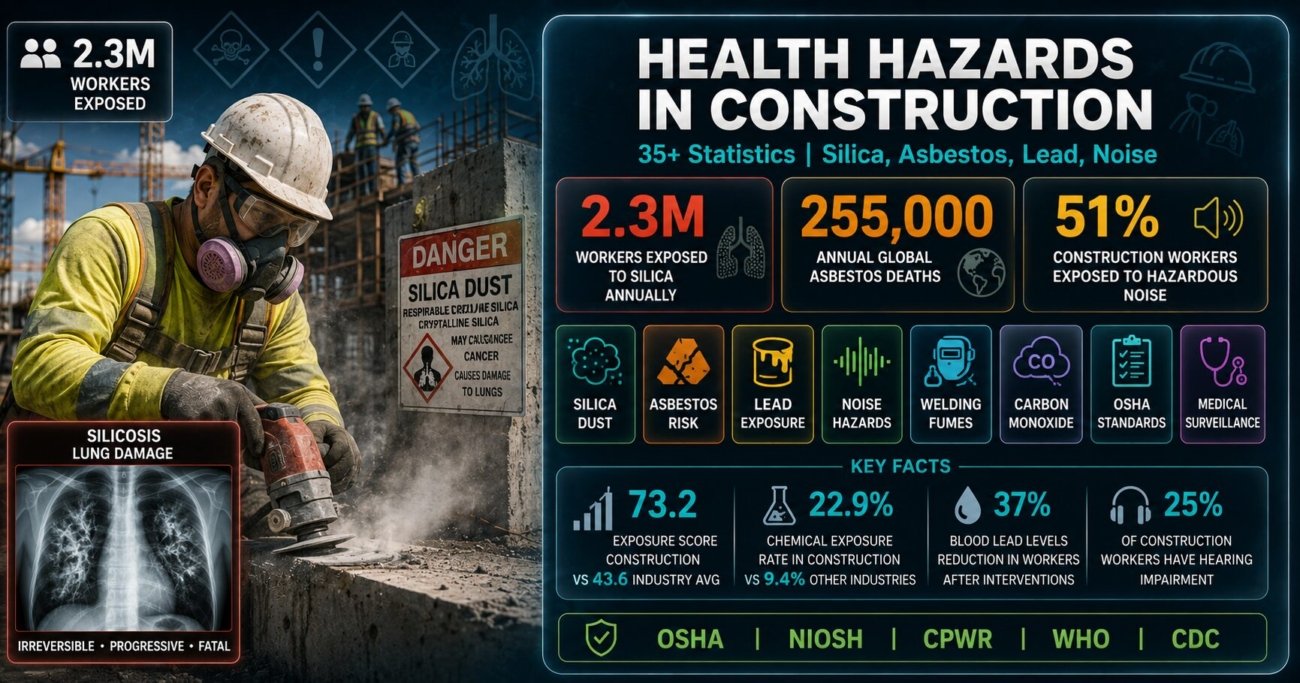
Infographic on health hazards in construction showing 35+ statistics: 2.3 million workers exposed to silica dust annually, 255,000 global asbestos deaths per year, 51% of construction workers exposed to hazardous noise, and a 73.2 chemical exposure score versus 43.6 for other industries. Covers silica, asbestos, lead, noise, and welding fume hazards with OSHA regulatory thresholds.

Health Hazards in Construction: 35+ Statistics on Silica, Asbestos, Lead and Noise

CONSTRUCTION – Chemical and Health Hazards
Health Hazards in Construction:
35+ Statistics on Silica, Asbestos, Lead, Noise and Chemical Exposure
2.3 million U.S. construction workers are exposed to silica dust every year. 255,000 people die globally from asbestos-related diseases annually. 51% of construction workers have been exposed to hazardous noise levels.
2.3M
Workers Exposed to Silica
U.S. construction workers exposed to hazardous silica dust levels every single year
OSHA Silica Standard, 2019
255K
Annual Asbestos Deaths
People who die globally from asbestos-related diseases every year – 91% work-related
WHO / Asbestos.com, 2024
22.9%
Chemical Exposure Rate
Construction workers exposed to hazardous chemicals 4+ hours per week vs 6.7% in other industries
CPWR Data Bulletin, December 2025

A mason cutting concrete blocks on a renovation site. A plumber sweating copper pipe in a poorly ventilated basement. A demolition crew breaking apart ceiling tiles in a 1970s office building. Each of these workers is doing a job that appears routine. Each is also, in that moment, being exposed to chemicals capable of causing irreversible lung disease, cancer, or permanent hearing loss decades later.

Health hazards in construction are not limited to what workers can see or feel immediately. Silica dust is invisible at safe concentrations. Asbestos fibers are odourless. Lead exposure produces no immediate symptoms at low doses. Carbon monoxide has no smell at all. This invisibility is precisely what makes chronic chemical exposure so dangerous in construction – and precisely why the data on health outcomes, exposure rates, and regulatory violations paints a picture that physical safety statistics alone cannot capture.

Below we have compiled 35+ statistics and data points on construction health hazards, covering silica dust exposure and silicosis, asbestos and mesothelioma risk, lead poisoning in construction, occupational noise-induced hearing loss, welding fumes and carbon monoxide, and the regulatory framework that governs employer obligations under OSHA chemical exposure standards.

Editor’s Choice – Key Statistics
12,900+
People who die from silicosis globally every year – a disease that is entirely preventable with proper dust controls
Global Burden of Disease Study 2021, published 2024
73.2
Average harmful contaminant exposure score for construction workers vs 43.6 for non-construction workers – a 68% higher chemical burden
CPWR Data Bulletin, December 2025
51%
Construction workers who have been exposed to hazardous noise levels – and 52% of those report not wearing hearing protection
NIOSH / OSHA, 2024
37%
Decrease in elevated blood lead levels among construction workers from 2010 to 2023 – progress, but exposure remains ongoing
NIOSH Blood Lead Surveillance, 2023
25%
Construction workers with hearing impairment that affects their day-to-day activities – making construction the second most affected industry after mining
NIOSH / OSHA Listen Up Campaign, 2024
18.8%
Silica (quartz) share of the 10 most common substances sampled in OSHA construction inspections – the single most frequently identified chemical hazard
OSHA Chemical Exposure Health Database / CPWR 2025

1. Silica Dust: The Construction Industry's Most Pervasive Chemical Hazard

Top 3 Chemical Substances in OSHA Construction Samples
Silica (Quartz) 18.8% of samples
Carbon Monoxide 9.1% of samples
Inorganic Lead Third most common
Source: OSHA Chemical Exposure Health Database, personal samples – Construction NAICS 23 | CPWR December 2025
  • Approximately 2.3 million construction workers in the United States are exposed to hazardous levels of respirable crystalline silica dust every year, generated when cutting, grinding, drilling, or crushing concrete, stone, brick, and similar materials. (OSHA Silica Standard / CDC)
  • Globally, 230 million workers are exposed to crystalline silica in occupational settings, and over 12,900 die from silicosis annually – a disease that involves irreversible fibrotic scarring of lung tissue and for which there is no cure. (Global Burden of Disease Study 2021, published 2024)
  • OSHA reduced the permissible exposure limit (PEL) for crystalline silica to 50 micrograms per cubic metre (µg/m³) in 2016, with an action level of 25 µg/m³ triggering mandatory air monitoring and medical surveillance for workers exposed for 30+ days per year. (OSHA 29 CFR 1926.1153)
  • In California alone, 296 confirmed silicosis cases were identified between 2019 and 2024 – 82% linked to engineered stone fabrication – with 25% of those cases referred for lung transplant evaluation and 12% actually receiving transplants. (California Department of Public Health / American Journal of Public Health, 2025)
  • OSHA launched a focused inspection initiative for engineered stone fabrication in September 2023. By May 2025, 371 inspections had been conducted, reflecting the agency’s recognition that silica-related illness in this trade has reached crisis levels. (OSHA Silica Enforcement Data, 2025)
  • A 2024 OSHA enforcement action against a Chicago countertop manufacturer found silica dust at nearly six times the permissible exposure limit, resulting in penalties exceeding $1 million after multiple workers required lung transplants. (Envigilance OSHA Silica Review, 2026)

2. Asbestos in Construction: Legacy Exposure and Ongoing Risk

255,000
Annual Global Deaths
Deaths from asbestos-related diseases each year globally – 91% are occupational
WHO, 2024
10-50 yrs
Mesothelioma Latency
Time from first asbestos exposure to mesothelioma symptoms – median 32 years per CDC data
CDC / Asbestos.com, 2022
65%
Construction Job Types
Proportion of construction job types in a major study that had definite past asbestos exposure
Italian Mesothelioma Study (31,000+ cases)
20.2%
Rise in U.S. Deaths
Increase in occupational asbestos-related deaths in the U.S. from 1990 to 2019
BMC Public Health
  • Asbestos is the only known cause of mesothelioma and was used extensively in construction materials – including insulation, drywall, ceiling tiles, floor tiles, roofing shingles, and masonry compounds – until the 1980s. Legacy asbestos in existing structures continues to expose renovation and demolition workers today. (Mesothelioma Guide / OSHA)
  • Construction workers rank third highest for mesothelioma incidence among all occupations in U.S. research data, behind shipbuilders and U.S. Navy veterans – confirming that construction remains an ongoing asbestos exposure pathway, not merely a historical one. (Georgetown / Duke University Research, NIOSH)
  • The EPA finalized a ban on chrysotile asbestos – the last type still in use in the United States – in March 2024, prohibiting ongoing manufacturing, processing, and importation of new asbestos products, though existing in-place asbestos in buildings remains a major exposure source. (EPA Chrysotile Ban, March 2024)
  • The median interval from first occupational asbestos exposure to death from malignant mesothelioma is 32 years per CDC data – meaning construction workers exposed during renovation work today may not develop symptoms or receive a diagnosis until 2050 or beyond. (CDC Mesothelioma Latency Data, 2022)
  • Occupational asbestos exposure accounted for more than 70% of all work-related cancer fatalities globally in 2016, based on WHO estimates – making it the dominant occupational carcinogen by fatality count and placing construction employers under heavy regulatory and legal scrutiny. (WHO Asbestos Fact Sheet, 2024)

3. Lead Exposure in Construction: A Persistent and Underestimated Hazard

Construction Lead Exposure – Key Risk Indicators
Elevated blood lead rate (construction) 32 per 100,000 workers
Reduction in elevated blood lead levels (2010-2023) 37% decrease
Workers exposed to lead (1987-1994, above NIOSH limit) 6.3% of workers
Source: NIOSH Blood Lead Epidemiology and Surveillance 2010-2023 / CPWR / CDC Construction Research
  • Despite OSHA publishing a comprehensive lead standard for construction in 1993, NIOSH reported that approximately 32 per 100,000 construction workers still have elevated blood lead levels (defined as 10 µg/dL or higher) – a rate that persists three decades after the standard took effect. (NIOSH / CPWR, 2018)
  • Lead remains a pervasive hazard in construction because it still coats much of the nation’s inventory of bridges, steel structures, and older buildings – meaning ironworkers, painters, and demolition crews continue to encounter lead-based coatings on projects involving renovation or structural work. (AIHA IH Exposure Profiles, Construction)
  • Construction workers experienced a 37% decrease in elevated blood lead levels from 2010 to 2023, which CPWR describes as encouraging progress – though they note the decrease should not be read as the problem being solved, given that construction workers are still regularly exposed to hazardous lead for longer durations than workers in most other industries. (CPWR Data Bulletin, December 2025)
  • Lead exposure in construction causes neurological disorders, kidney damage, and cardiovascular disease, and has no safe level of exposure – yet painters, ironworkers, and laborers working on demolition projects involving lead-painted steel and masonry face ongoing exposure unless employers implement respiratory protection, engineering controls, and blood lead monitoring. (AIHA / OSHA Lead Standard 29 CFR 1926.62)
  • A key risk with construction lead exposure is take-home contamination – workers who do not shower and change clothes before leaving a site can carry lead dust on their clothing and skin, potentially exposing family members including children who face greater neurological risk from even low-level lead exposure. (OSHA Lead in Construction Guidance)

4. Occupational Noise: The Silent Epidemic in Construction

Hearing Health Outcomes Among U.S. Construction Workers (NIOSH)
Exposed to hazardous noise levels 51%
Not wearing hearing protection (of those exposed) 52%
Hearing impairment affecting daily activities 25%
Have tinnitus (ringing in ears) 7%
Source: NIOSH / OSHA Listen Up Campaign, 2024 | 8.2 million total U.S. construction workers
  • Of the 8.2 million construction workers in the United States, approximately half a million have tinnitus and 14% report difficulty hearing – making noise-induced hearing loss one of the most prevalent occupational health outcomes in the industry. (NIOSH / OSHA Listen Up, 2024)
  • The CDC estimates that 22 million workers across all U.S. industries are exposed to potentially damaging noise at work each year, with construction, manufacturing, and mining/oil and gas showing the highest percentage of workers with material hearing impairment. (CDC / OSHA OTM Section III, Chapter 5)
  • OSHA requires a hearing conservation programme in construction when exposures exceed 90 dBA as an 8-hour time-weighted average (29 CFR 1926.52) – yet jackhammers routinely reach 100 dBA, at which NIOSH recommends a maximum exposure of less than 15 minutes per day without protection. (OSHA Construction Noise Standard)
  • Noise hazard in construction is compounded by secondary exposure sources – workers whose own tasks are quiet may still be overexposed because neighbouring trades using jackhammers, compressors, or welding equipment affect everyone in the work area simultaneously. (OSHA Hearing Conservation Programme for Construction)
  • Chemical compounds including carbon monoxide, toluene, and organic solvents – all common at construction sites – are ototoxic, meaning they can amplify noise-induced hearing damage even at noise exposure levels below the OSHA permissible limit, creating combined hazards that standard noise monitoring alone fails to capture. (OSHA / NIOSH Safety Bulletin, 2018)

5. Welding Fumes, Carbon Monoxide and Other Chemical Hazards

52% of Welders
Exposed to hazardous conditions caused by welding fumes at work – fumes contain hexavalent chromium (a Group 1 carcinogen), manganese, and fine particulates
National Center for O*NET Development, 2015 / CDC
9.1% of Samples
Carbon monoxide found as the second most common chemical in OSHA construction personal samples – an odourless gas that can cause rapid incapacitation and death in enclosed spaces
OSHA Chemical Exposure Health Database / CPWR 2025
Parkinsonism Risk
Welders exposed to manganese in welding fumes face elevated risk of Parkinsonism – a neurological disorder causing tremors and rigidity – recognised by NIOSH and AIHA as a construction-specific occupational disease
AIHA IH Exposure Profiles, Construction
  • Welding fumes are classified as a Group 1 human carcinogen by the International Agency for Research on Cancer (IARC) – a classification that applies to all welding fumes, not just those from stainless steel, and which directly affects construction employers whose workers weld structural steel, pipework, and reinforcing bars. (IARC Monographs, 2017)
  • Carbon monoxide is the second most commonly sampled chemical substance in OSHA construction inspections (9.1% of personal samples), with major sources including gas-powered tools, generators, compressors, and concrete saws operated in partially enclosed or poorly ventilated areas. (OSHA Chemical Exposure Health Database / CPWR, 2025)
  • Hexavalent chromium, generated during stainless steel welding, causes lung cancer and bronchitis in construction welders – and manganese exposure from the same welding operations is associated with Parkinsonism, a neurological disorder that develops gradually over years of cumulative exposure. (AIHA / NIOSH Construction Research, NCBI)
  • Construction workers are exposed to asphalt fumes during road paving and roofing operations, isocyanates in spray foam insulation, solvents in paints and adhesives, and man-made mineral fibres in insulation products – a chemical mix that AIHA identifies as requiring systematic industrial hygiene assessment rather than generic hazcom training alone. (AIHA IH Exposure Profiles, Construction)
  • Contact dermatitis, caused primarily by cement and concrete skin exposure among masons and concreters, is one of the most common occupational skin diseases in construction – yet it rarely appears in injury statistics because it develops gradually, is rarely hospitalised, and is frequently misattributed to non-occupational causes. (NIOSH Construction Research, NCBI)

6. How Construction Compares: The Chemical Exposure Gap with Other Industries

CPWR Hazard Exposure Scores – Construction vs All Industries (2024 O*NET Data)
Harmful Contaminant Exposure Score
Construction 73.2
All Industries (average) 43.6
Working at Height Exposure Score
Construction 54.9
All Industries (average) 14.0
Source: CPWR Data Bulletin December 2025 | 2024 O*NET OnLine Database
  • The CPWR December 2025 report assigned construction workers a harmful contaminant exposure score of 73.2 versus 43.6 for non-construction workers – a 68% higher chemical burden that makes construction one of the most chemically hazardous industries in the U.S. economy. (CPWR Data Bulletin, December 2025)
  • Construction workers are exposed to hazardous chemicals for four or more hours per week at a rate of 22.9% – more than three times the 6.7% rate reported by workers in other industries – confirming that chemical exposure in construction is not incidental but structural. (CPWR / Safety+Health Magazine, December 2025)
  • Over one in three (37.8%) construction and extraction workers reported constantly working outdoors in 2024, which compounds chemical hazard exposure with UV radiation, extreme heat risk, and seasonal variation in chemical behaviour – factors that indoor industrial hygiene assessments may not fully capture. (CPWR Data Bulletin, December 2025)
  • Construction workers are three times more likely to be exposed to working at height than non-construction workers (score 54.9 vs 14.0) – a dual hazard environment where chemical exposure and fall risk combine, since respiratory impairment from silica or CO exposure can affect balance, alertness, and the ability to self-rescue from an elevated position. (CPWR / O*NET, 2024)
  • Understanding these exposure patterns, CPWR notes, “is critical to mitigating exposures” – a finding that directly supports the case for systematic chemical hazard identification programmes in construction, not just reactive PPE provision after a complaint or inspection. (CPWR, 2025)

7. OSHA Standards and Employer Obligations for Construction Chemical Hazards

Hazard
OSHA Standard
Key Requirement
Respirable Crystalline Silica
29 CFR 1926.1153
PEL 50 µg/m3; written exposure control plan; competent person; medical surveillance
Asbestos
29 CFR 1926.1101
PEL 0.1 f/cc; air monitoring; regulated areas; medical surveillance; training
Lead
29 CFR 1926.62
PEL 50 µg/m3; blood lead monitoring; medical removal protection
Noise
29 CFR 1926.52
Hearing conservation programme at 90 dBA TWA; PPE when controls insufficient
Hexavalent Chromium
29 CFR 1926.1126
PEL 5 µg/m3; engineering controls; respiratory protection; medical surveillance
Source: OSHA Construction Standards / CPWR Construction Chart Book 7th Edition
  • OSHA requires construction employers to implement a written exposure control plan for silica that identifies tasks involving silica exposure, control methods used, and procedures to restrict access to high-exposure areas – and to designate a competent person responsible for implementing the plan. (OSHA 29 CFR 1926.1153)
  • The asbestos standard for construction (29 CFR 1926.1101) requires air monitoring, regulated work areas, hygiene facilities, warning signs, medical surveillance, and training – obligations that apply to renovation, alteration, repair, maintenance, and demolition work in buildings where asbestos may be present. (OSHA Asbestos Construction Standard)
  • Medical surveillance for construction chemical hazards is not optional for covered workers – employers must offer chest X-rays and lung function tests every three years for workers required to wear respirators for silica, and blood lead testing and medical removal protection for lead-exposed workers whose blood lead levels reach defined thresholds. (OSHA Silica and Lead Standards, Construction)
  • CPWR maintains an interactive dashboard of OSHA citations for asbestos, lead, and silica violations in construction from 2011 to 2024 – enforcement data that confirms these three substances continue to generate significant citation activity decade after their standards were promulgated. (CPWR Construction Chart Book, 7th Edition)
  • Employers can demonstrate silica compliance either through Table 1 prescribed control methods (specific engineering controls for defined operations) or through their own air monitoring programme – but all construction employers covered by the standard must maintain a written plan, designate a competent person, and provide medical exams regardless of which compliance path they choose. (OSHA Silica Construction, 2024)

Key Takeaways for Construction Safety Managers and EHS Professionals

Silica Is the #1 Chemical Hazard in Construction
At 18.8% of all OSHA personal chemical samples in construction, silica (quartz) is the most frequently detected hazardous substance. Every employer whose workers cut, drill, or grind concrete, stone, or masonry needs a written exposure control plan and a designated competent person – not just a respirator policy.
Old Buildings Are Asbestos Risk – Even in 2026
The EPA chrysotile ban (March 2024) addresses new asbestos products, but legacy asbestos in walls, ceilings, floors, and insulation in pre-1980s structures remains. Any renovation, demolition, or repair work in older buildings requires asbestos survey and abatement planning under 29 CFR 1926.1101.
Half Your Noise-Exposed Workers Wear No Protection
NIOSH data shows 52% of construction workers exposed to hazardous noise do not wear hearing protection. With 25% already experiencing daily-life hearing impairment, hearing conservation programmes in construction are not box-ticking – they are responding to a documented, widespread health failure.
Chemical and Noise Hazards Combine
Carbon monoxide, solvents, and welding fumes are ototoxic – they worsen noise-induced hearing loss even at noise levels below the OSHA PEL. Sites where welding, generator use, and grinding happen together require combined exposure assessment, not separate hazard reviews.
Blood Lead Progress Does Not Mean the Problem Is Solved
A 37% drop in elevated blood lead levels from 2010-2023 reflects real improvement. But 32 per 100,000 construction workers still have elevated blood lead, and lead on bridges, steel structures, and older painted surfaces remains an active exposure source for ironworkers, painters, and demolition crews.
Medical Surveillance Is a Legal Obligation, Not Optional
For silica, asbestos, lead, and hexavalent chromium, OSHA mandates medical surveillance including chest X-rays, lung function tests, and blood monitoring for covered workers. These obligations apply regardless of whether an employer believes current controls are sufficient – if exposures reach action level thresholds, medical exams are required.

Sources

Government and Regulatory Sources

Industry and Research Sources

Add a Comment

Your email address will not be published. Required fields are marked *