

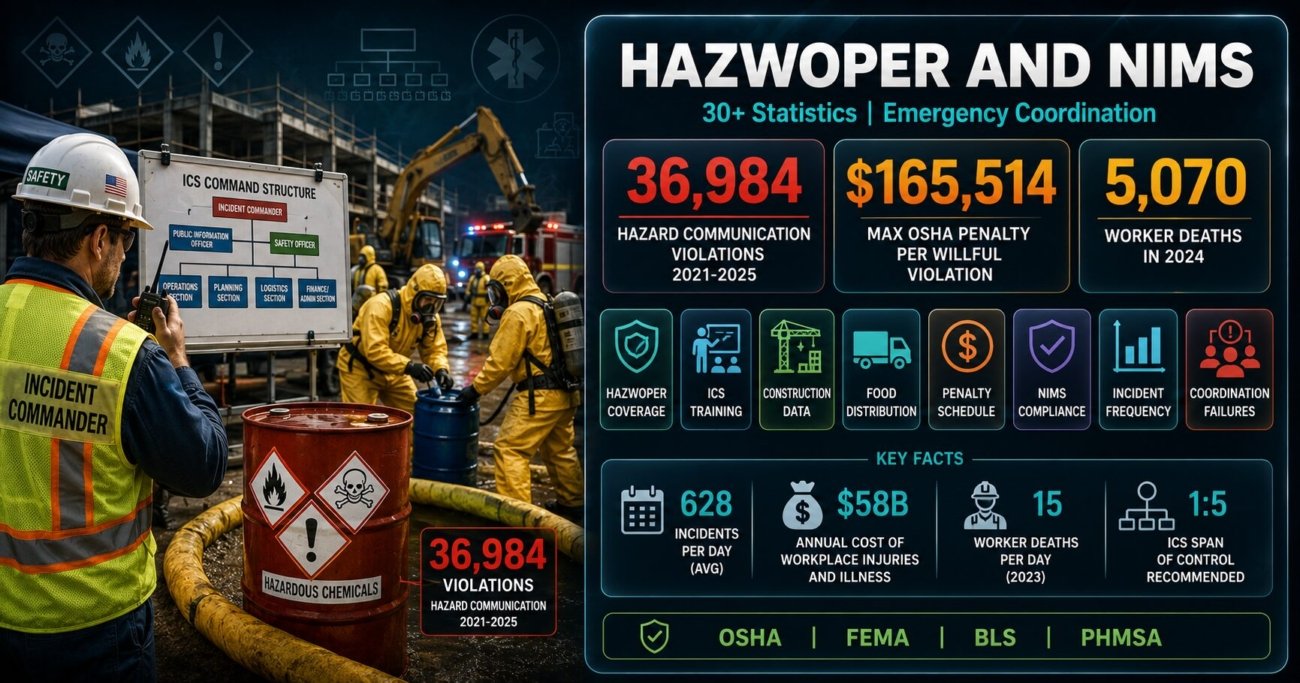
Infographic showing 30+ HAZWOPER and NIMS statistics including 36,984 hazard communication violations (2021-2025), $165,514 maximum OSHA penalty per willful violation, 5,070 worker deaths in 2024, and ICS training requirements under 29 CFR 1910.120. Data covers construction, food distribution, and general manufacturing emergency response coordination.

NIMS and HAZWOPER: 30+ Statistics on Workplace Emergency Coordination

HAZWOPER – National Incident Management System
NIMS and HAZWOPER:
30+ Data Points on Workplace Emergency Coordination
36,984 hazard communication violations recorded 2021-2025. 5,070 workers died from occupational incidents in 2024. OSHA penalties for willful HAZWOPER violations now reach $165,514 per citation.
36,984
Hazard Communication Violations
Recorded across U.S. workplaces over a five-year period (2021-2025)
OSHA / TraceOne Analysis, 2026
$165,514
Maximum HAZWOPER Penalty
Per willful or repeated violation under 2025 OSHA penalty schedule
OSHA Penalty Schedule, 2025
5,070
Worker Deaths in 2024
Fatal occupational injuries across all U.S. industries, many involving hazardous materials or emergency response failures
Bureau of Labor Statistics, 2024

When a hazardous materials release occurs at a construction site, a food distribution warehouse, or a general manufacturing facility, the first minutes determine everything. Workers who do not know their role escalate incidents. Response teams that lack a shared command structure waste precious time. Agencies that cannot communicate with each other allow containment failures that compound injury and environmental damage.

The National Incident Management System (NIMS) exists precisely to prevent those failures. Established by the Department of Homeland Security in 2004, NIMS provides a standardized framework that allows every responding entity – whether a plant safety officer, a municipal fire department, or a federal environmental regulator – to work from the same organizational structure and speak the same operational language. Under HAZWOPER (29 CFR 1910.120), OSHA explicitly requires employers engaged in emergency response to hazardous substance releases to implement an Incident Command System (ICS) that is consistent with NIMS. That requirement connects thousands of private-sector workplaces to the same coordination doctrine used for national disasters.

Below we have compiled 30+ statistics and data points on HAZWOPER and NIMS, covering hazardous materials incident frequency, regulatory penalties and compliance rates, ICS training requirements, industry-specific exposure risks in construction and food distribution, and coordination failures that drive the ongoing need for NIMS adoption across the private sector.

Editor’s Choice – Key Statistics
1,075
Fatal injuries in construction in 2024 – the highest of any industry sector in the U.S.
OSHA / Bureau of Labor Statistics, 2024
628+
Average pipeline and hazardous materials incidents per year in the U.S. since 2010, averaging 1.7 per day
PHMSA / FracTracker Analysis, 2025
$2.25M
FEMA funding allocated for NIMS implementation in fiscal year 2025, emphasizing compliance as a federal preparedness condition
FEMA / Grants.gov, July 2025
$58B
Annual cost of serious workplace injuries to U.S. businesses, with overexertion, falls, and struck-by incidents driving the majority
Liberty Mutual Workplace Safety Index, 2024
$16,550
Penalty per serious HAZWOPER violation under the 2025 OSHA penalty schedule – up from $16,131 in 2024
OSHA Penalty Adjustments, 2025
187,160
ICS-209 incident status reports filed under the NIMS system for 35,170 incidents between 1999 and 2020
Nature Scientific Data / NIMS Dataset, 2023

1. HAZWOPER Scope: How Many Workers and Workplaces Are Covered

HAZWOPER Operations Coverage – Five Work Categories (29 CFR 1910.120)
Hazardous waste cleanup at uncontrolled sites Broadest coverage
RCRA corrective action cleanup sites High coverage
TSD facility operations under RCRA Parts 264/265 Medium coverage
Hazardous waste generating operations (non-TSD) Selected coverage
Emergency response to uncontrolled hazardous releases All responding employers
Source: OSHA 29 CFR 1910.120 / 1926.65 – Scope and Application
  • HAZWOPER applies to five distinct categories of operations under 29 CFR 1910.120, covering everything from initial hazardous waste site cleanup to ongoing emergency response at manufacturing facilities. (OSHA HAZWOPER Background, 2024)
  • The standard covers both general industry (29 CFR 1910.120) and construction (29 CFR 1926.65) with identical requirements – construction site emergency responses involving hazardous releases carry the same ICS mandate as factory floor incidents. (OSHA HAZWOPER Standards, 2024)
  • Employers who choose to evacuate all workers rather than conduct on-site emergency response are exempt from emergency response plan requirements, but must still maintain an Emergency Action Plan under 29 CFR 1910.38(a). (OSHA HAZWOPER Preparedness, 2024)
  • The Superfund Amendments Reauthorization Act (SARA) of 1986 originally required OSHA to create HAZWOPER – making this one of the longest-standing hazardous materials regulatory frameworks in U.S. workplace safety law. (OSHA HAZWOPER Overview, 2024)
  • EPA regulations under 40 CFR Part 311 extend equivalent HAZWOPER protections to state and local government workers, including volunteers, closing a coverage gap that originally left public-sector responders unprotected. (EPA HAZWOPER Framework)

2. NIMS Framework: The Architecture Behind Emergency Coordination

2004
Year Established
NIMS formally established by DHS under Homeland Security Presidential Directive-5 (HSPD-5)
3-7
ICS Span of Control
Effective supervisor-to-worker ratio under ICS – with 1:5 as the optimal target
5
NIMS Core Functions
Preparedness, Communication, Resource Management, Command and Management, Ongoing Maintenance
$2.25M
FY2025 Funding
FEMA funding opportunity for NIMS implementation published July 2025
  • NIMS provides shared vocabulary, systems and processes that allow personnel from every level of government, nongovernmental organizations, and the private sector to work from the same incident management structure – making it the foundational coordination tool for HAZWOPER emergency responses. (FEMA NIMS, 2025)
  • The Incident Command System (ICS) was originally developed in the 1970s by the FIRESCOPE task force following California wildfire disasters where poor inter-agency coordination led to preventable casualties – it was later incorporated into NIMS as the national standard. (NCBI / StatPearls, 2024)
  • HSPD-5 makes NIMS adoption a condition for federal preparedness assistance – meaning organizations seeking federal emergency grants must demonstrate NIMS compliance, creating a direct financial incentive for private-sector workplaces to align. (DHS HSPD-5 / FEMA)
  • NIMS is more than just ICS – it covers Emergency Operations Centers (EOCs), Multi-Agency Coordination Systems (MACS), and the relationship between field command posts and senior policy leadership, addressing coordination failures at every level. (NIMS 2017 Update, DHS/FEMA)
  • The five NIMS core principles – scalability, interoperability, reliability, portability, and communications redundancy – are precisely what makes it applicable to workplace emergency response, not just government disaster management. (NCBI EMS ICS Review, 2024)

3. Hazardous Materials Incidents: Frequency, Scale, and Industry Impact

Top Industries by Hazard Communication Violations (OSHA 2021-2025)
Manufacturing 10,021 violations
Construction 8,678 violations
Accommodation and Food Services Significant presence
Retail Trade Notable presence
Source: TraceOne OSHA Enforcement Analysis, March 2026
  • Between 2021 and 2025, OSHA recorded 36,984 hazard communication violations across U.S. workplaces – equivalent to 5.6 violations per 100,000 workers – confirming that chemical safety gaps remain widespread despite decades of regulatory oversight. (TraceOne OSHA Analysis, 2026)
  • Hazardous materials pipeline incidents in the U.S. have averaged 628 incidents per year since 2010, representing approximately 1.7 incidents every single day – each of which may trigger HAZWOPER emergency response requirements. (PHMSA / FracTracker, 2025)
  • Construction sites produced 8,678 hazard communication violations over five years despite representing 42.8% of OSHA inspections – indicating that construction hazmat compliance remains a systemic challenge, not an outlier problem. (TraceOne / OSHA, 2026)
  • The NIMS ICS-209 dataset, covering incidents from 1999 to 2020, captured 187,160 status reports for 35,170 incidents including hazardous materials releases, floods, hurricanes, and civil unrest – demonstrating the breadth of situations requiring coordinated emergency management. (Nature Scientific Data, 2023)
  • Nearly 37,000 workers were denied access to proper chemical safety information over the five-year OSHA study period – underscoring that hazmat risk is not just about physical releases but also about preparedness failures before any incident occurs. (TraceOne, March 2026)

4. ICS Training Requirements: What NIMS and HAZWOPER Mandate

FEMA Course
Target Audience
Application Level
IS-100 / ICS-100
All personnel involved in incident response
Foundation – ICS concepts and structure
IS-200 / ICS-200
Initial response personnel and supervisors
Single-resource and initial action incidents
IS-700 / NIMS Overview
All emergency management personnel
Comprehensive NIMS framework and principles
ICS-300 / ICS-400
Expanding incident managers and commanders
Advanced ICS application – coordinated locally
IS-703 Resource Management
Emergency managers and incident commanders
Resource tracking, typing and mobilization
Source: FEMA Emergency Management Institute – NIMS Training Program
  • The NIMS training program comprises ICS core courses (100-400), NIMS overview courses (IS-700 series), and All-Hazards Position Specific (AHPS) courses – together forming the national curriculum for emergency incident management personnel. (FEMA Emergency Management Institute)
  • HAZWOPER explicitly requires that emergency response personnel operate within an ICS structure that is consistent with NIMS compliance – making FEMA ICS training directly relevant to private-sector safety managers in construction and manufacturing. (OSHA HAZWOPER Publication 3114-07R, 2008)
  • The ICS span of control requirement – 3 to 7 subordinates per supervisor with an optimal ratio of 1:5 – is a core NIMS principle that determines how large-scale industrial emergency responses are organized and which positions require advance designation. (USDA NIMS Lesson Guide)
  • NIMS compliance is a federal requirement for Homeland Security grants and Emergency Management Performance grants – directly connecting private-sector workplace preparedness funding eligibility to ICS training compliance. (Maine EMA / FEMA Grant Conditions)
  • Position-specific ICS training includes All-Hazards Incident Commander (E/L 950), Safety Officer (E/L 954), and Liaison Officer (E/L 956) – roles that translate directly to workplace emergency response teams required under HAZWOPER. (FEMA ICS Resource Center)

5. Construction Industry: Hazmat Exposure and Emergency Response Data

Construction Industry Fatal Four – Share of Annual Deaths
Falls from Height Leading cause – 33%+
Struck-by Objects Second most frequent
Electrocution Third most frequent
Caught-in/Between (including trench cave-ins) Fourth – completes 60%+ total
Source: OSHA Fatal Four / OccuPros Workplace Safety Statistics 2026
  • The construction industry recorded 1,075 fatalities in 2024 – the highest of any U.S. industry sector – with the Fatal Four (falls, struck-by, electrocution, caught-in) responsible for more than 60% of all construction deaths annually. (BLS / OSHA, 2024)
  • Despite representing 42.8% of all OSHA inspections, construction sites showed relatively lower rates of hazard communication violations compared to manufacturing – suggesting inspection focus on physical hazards may create blind spots in chemical and hazmat preparedness auditing. (TraceOne OSHA Analysis, 2026)
  • Construction sites frequently encounter soil contamination, buried utilities, underground storage tanks, and hazardous demolition materials including asbestos, lead-based paint and silica – all of which can trigger HAZWOPER emergency response obligations when uncontrolled releases occur. (OSHA HAZWOPER Background)
  • Eliminating the Fatal Four alone would save over 500 construction worker lives per year – and integrating NIMS-based emergency response planning directly supports two of the four (electrocution response and trench collapse rescue coordination). (OSHA Fatal Four Initiative)
  • Construction HAZWOPER obligations under 29 CFR 1926.65 are identical to general industry requirements, meaning construction project managers must plan for and train their emergency response teams using the same NIMS ICS framework as chemical plant operators. (OSHA HAZWOPER Standards, 2024)

6. Food Distribution and General Manufacturing: Hazmat Risks Often Overlooked

78,200
Food Store Injuries (2024)
Up 6.5% from prior year – the food and beverage sector shows rising injury rates despite being underregarded for hazmat risk
BLS / OSHA Industry Data, 2024
2.3/100
National Injury Rate
Injuries per 100 full-time equivalent workers – the national average against which construction and food distribution must be benchmarked
BLS, 2024
3.6/100
Healthcare Injury Rate
Healthcare and social assistance – even sectors not seen as hazmat-intensive carry elevated injury rates that benefit from NIMS coordination
BLS / OccuPros, 2026
  • Food distribution facilities regularly store ammonia refrigerants, cleaning chemicals, CO2 systems, and fumigation agents – any uncontrolled release of which constitutes a HAZWOPER emergency response situation requiring ICS activation and NIMS coordination with external emergency services. (OSHA General Business HAZWOPER, 2024)
  • Retail trade recorded 195,000 injuries in 2024 at a rate of 3.1 per 100 FTE workers, with food and beverage stores particularly vulnerable – yet chemical emergency preparedness in retail food distribution often receives less training investment than physical hazard prevention. (BLS / OSHA Industry Data, 2024)
  • General manufacturing faces machine guarding violations and lockout/tagout failures that cause approximately 120 fatalities annually – many of these energy isolation failures also involve hydraulic fluid, chemical coolants, or pressurized systems that trigger HAZWOPER response requirements upon release. (OccuPros Safety Statistics, 2026)
  • Under HAZWOPER, manufacturing facilities with potential for uncontrolled hazardous substance releases must comply with 29 CFR 1910.120(q) – the emergency response paragraph – requiring an Emergency Response Plan, designated incident commander, and ICS-trained response team. (OSHA HAZWOPER Preparedness, 2024)
  • The food services and distribution sector appears in OSHA violation records alongside construction and manufacturing for hazard communication failures – confirming that chemical safety training gaps in food distribution are a compliance issue, not merely an operational one. (TraceOne Analysis, 2026)

7. OSHA Penalties and Compliance: The Regulatory Cost of HAZWOPER Failures

OSHA HAZWOPER Penalty Schedule – 2024 vs 2025
Willful/Repeated Violations (2025) $165,514
Willful/Repeated Violations (2024) $161,323
Serious Violations (2025) $16,550
Serious Violations (2024) $16,131
Source: OSHA Penalty Adjustments, 2025 / OSHACode EHS Training Analysis
  • OSHA penalty adjustments in 2025 raised the maximum penalty for a single willful or repeated HAZWOPER violation to $165,514 – an increase from $161,323 in 2024, reflecting OSHA continued commitment to escalating consequences for repeat non-compliance. (OSHACode EHS Training, 2025)
  • Serious and other-than-serious HAZWOPER violations now carry a per-violation penalty of up to $16,550 in 2025 – and given that HAZWOPER inspections frequently uncover multiple simultaneous violations, total penalty exposure at a single site can rapidly reach six figures. (OSHA Penalty Schedule, 2025)
  • Beyond financial penalties, HAZWOPER violations that result in fatalities or serious injuries can trigger criminal referrals under Section 17(e) of the OSH Act – a provision that applies when willful violations cause worker deaths, exposing individual managers to personal legal liability. (OSH Act Section 17(e))
  • NIMS compliance is directly linked to penalty exposure reduction – workplaces that maintain documented ICS training, emergency response plans, and HAZWOPER programs demonstrate good-faith compliance efforts that OSHA considers in penalty determination. (OSHA HAZWOPER Compliance Guidelines, CPL 02-02-071)
  • The 2024 OSHA revision to the Hazard Communication Standard, aligning with GHS Revision 7 and effective July 19, 2024, introduced updated labeling and SDS requirements – adding another layer of HAZWOPER-adjacent compliance that workplaces must integrate into their training and emergency planning. (OSHACode, 2025)

8. When Coordination Fails: The Evidence for NIMS in the Private Sector

Communication Failure
The original ICS review from 1970s California wildfires found that most incident failures were caused by coordination and organizational problems rather than inadequate equipment or personnel
NCBI EMS ICS Review, 2024
Interoperability Gap
Without NIMS common terminology, responding agencies use different codes, titles, and organizational structures – causing critical delays when municipal fire, hazmat teams, and plant emergency responders must coordinate at the same scene
USDA NIMS Lesson Guide / FEMA NIMS
Resource Mismanagement
NIMS Resource Management (IS-703) exists because hazmat responses without systematic resource tracking cause under-deployment, duplication, and safety gaps – the same patterns visible in industrial incidents where multiple contractors respond without command structure
FEMA NIMS IS-703
  • The foundational ICS research from FIRESCOPE identified that casualty escalation in multi-agency incidents was primarily an organizational failure, not a resource shortage – a finding that applies directly to industrial hazmat responses where plant teams, municipal emergency services, and environmental regulators must work together. (NCBI StatPearls, 2024)
  • NIMS requires common terminology as an absolute baseline – the system prohibits 10-codes, agency-specific language, and ambiguous position titles during incidents, because a HAZWOPER site where plant responders and firefighters cannot clearly communicate creates compounding hazards. (USDA NIMS Lesson Guide)
  • The ICS common operating picture – where all responding entities share the same situational awareness – directly addresses the pattern seen in industrial chemical releases where the plant team, external responders, and environmental agencies each hold different information and make conflicting decisions. (FEMA NIMS 2017)
  • NIMS implementation has expanded beyond traditional emergency management into hospital preparedness, school safety, and private-sector industrial response – reflecting regulatory recognition that complex multi-agency coordination challenges are not limited to government disaster response. (FEMA / OJP NIMS Literature)
  • Under HAZWOPER, the senior official at the emergency scene holds ultimate authority over all ICS decisions with all site communications routed through that position – a structure that directly prevents the multiple-command confusion documented in pre-ICS hazmat responses. (OSHA HAZWOPER Publication 3114-07R, 2008)

9. National Preparedness Landscape: NIMS Compliance and Federal Requirements

U.S. Worker Safety Progress – Deaths Per Day (1970 vs 2023)
38/day
1970
25/day
1990
15/day
2023
Source: OSHA Commonly Used Statistics, 2024
  • Worker deaths in the United States declined from an average of 38 per day in 1970 to 15 per day in 2023 – a 60% reduction driven by OSHA standards, employer safety programs, and coordinated emergency response frameworks including HAZWOPER and NIMS. (OSHA Commonly Used Statistics, 2024)
  • Worker injuries and illnesses have fallen from 10.9 incidents per 100 workers in 1972 to 2.4 per 100 in 2023 – the data confirms that structured regulatory frameworks deliver measurable safety outcomes when consistently implemented. (OSHA, 2024)
  • The 2025 NIMS Implementation Assessment was submitted to FEMA by December 31, 2025 deadline – with California alone using a Microsoft Excel-based NIMS Data Collection Tool developed by FEMA to evaluate jurisdiction compliance across all implementation activities since 2004. (CalOES NIMS, 2025)
  • FEMA allocated $2.25 million in FY2025 NIMS funding (published July 28, 2025) to support national compliance – a relatively modest investment compared to the potential cost of poorly coordinated hazmat incidents, which routinely produce multi-million dollar environmental and liability consequences. (FEMA / Grants.gov, 2025)
  • The 2.5 million nonfatal workplace injuries recorded in 2024 – roughly 6,800 injuries every single day – represent the baseline demand that HAZWOPER preparedness and NIMS coordination is designed to reduce through faster, better-organized emergency response. (BLS, 2024)

Key Takeaways for Safety Managers, EHS Professionals, and Emergency Response Coordinators

HAZWOPER Requires ICS – Not Just Training
The OSHA standard mandates an Incident Command System consistent with NIMS for all emergency responses to hazardous releases. Having trained responders is not enough – the organizational structure must also be in place before an incident occurs.
$165,514 Maximum Penalty Per Violation in 2025
Willful or repeated HAZWOPER violations now carry maximum penalties exceeding $165,000. A single unannounced OSHA inspection at a site with multiple training, ERP, or ICS failures can generate six-figure total penalty exposure.
Construction and Food Distribution Are Both Covered
Both construction sites (29 CFR 1926.65) and food distribution facilities face HAZWOPER obligations when chemical releases occur. Ammonia refrigerant leaks, cleaning agent spills, and contaminated soil encounters all trigger ICS requirements many managers do not anticipate.
36,984 Violations Show the Compliance Gap Is Real
Five years of OSHA data from 2021-2025 documented nearly 37,000 hazard communication violations – confirming that chemical safety compliance remains a widespread failure area across industries where NIMS and HAZWOPER training would directly address the root causes.
NIMS Training Is Free Through FEMA EMI
ICS-100, IS-200, and IS-700 are available at no cost through FEMA Emergency Management Institute. For workplaces with HAZWOPER obligations, starting all emergency response team members with these courses is the most cost-effective baseline preparedness action available.
Span of Control Determines Your Team Structure
The NIMS optimal supervisor-to-responder ratio is 1:5 (maximum 1:7). Safety managers planning HAZWOPER emergency response teams should use this ICS span of control principle to determine how many positions need designated personnel and backup assignments.

Sources

Government and Regulatory Sources

Industry and Research Sources

Add a Comment

Your email address will not be published. Required fields are marked *