

What to Do Before, During, and After a Chemical Spill
The Situation: A Chemical Spill at a HAZWOPER-Covered Site
A storage drum of a chlorinated solvent fails during routine material handling at an industrial facility. Within seconds, liquid spreads across the concrete floor and vapors begin building in the enclosed space. Workers in the immediate area evacuate. The facility’s emergency response coordinator activates the alarm and takes command of the scene.
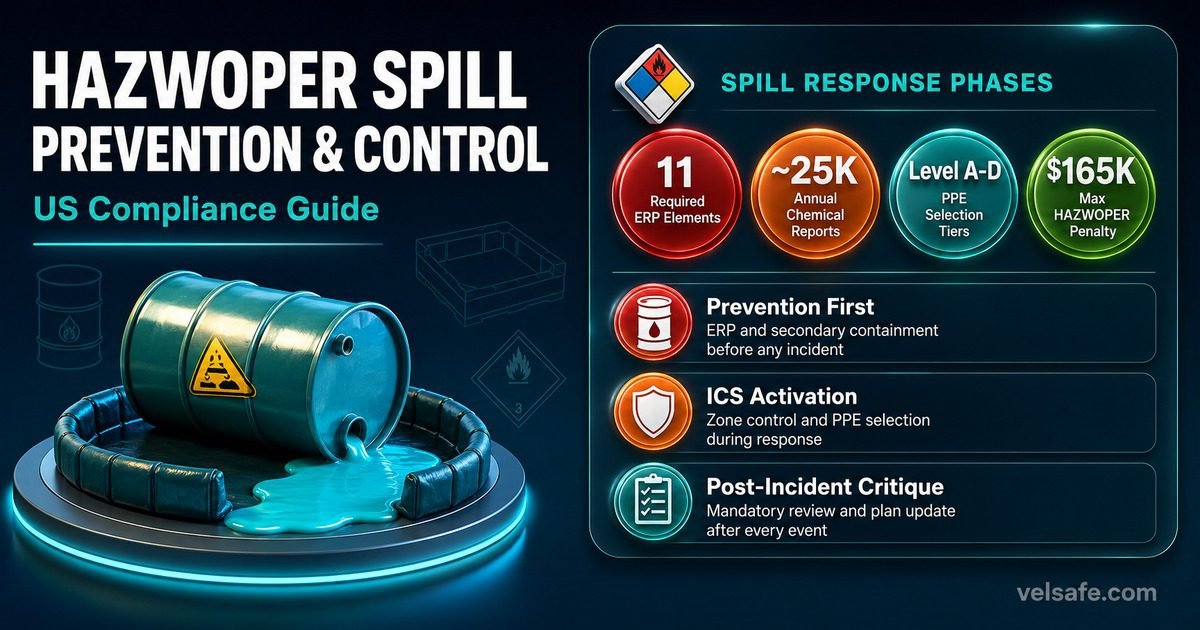
What happens next depends entirely on what the employer built before that moment. Under OSHA’s HAZWOPER standard (29 CFR 1910.120), the employer must have an Emergency Response Plan in place before any incident occurs, trained responders at levels matching their actual duties, written spill containment and decontamination procedures specific to the chemicals on site, and a formal Incident Command System structure. The spill itself is not the compliance event: the absence of a plan is. This guide walks through every phase of HAZWOPER-compliant spill prevention and response.
Phase 1: Spill Prevention Before an Incident Occurs
HAZWOPER’s approach to spill prevention begins long before any chemical is released. Under 29 CFR 1910.120(b), employers at uncontrolled hazardous waste sites must develop and implement a written Safety and Health Program that addresses site evaluation, hazard identification, engineering controls, and emergency response procedures. For facilities that generate or handle hazardous substances, this program must account for the realistic spill scenarios the site faces.
Effective spill prevention requires three things compliance programs often miss: a current chemical inventory reflecting what is actually on site, a site-specific hazard assessment identifying the highest-risk storage and transfer points, and engineering controls designed around those specific scenarios rather than generic best practices.
Phase 2: First Response : Recognition and Notification
When a release occurs, the first minutes determine whether the incident remains manageable or escalates to a major emergency. OSHA draws a critical distinction between an incidental release and an emergency response situation, and that distinction determines which regulatory obligations apply.
An incidental release is one that workers can safely address with standard PPE and routine procedures without activating a formal emergency response. A small solvent spill that a trained worker can absorb and dispose of using normal procedures, with no threat of exposure above permissible limits and no need for evacuation, may qualify as incidental. Everything else is an emergency response, and once a situation crosses that threshold, the full HAZWOPER emergency response requirements apply: ICS activation, trained responders at appropriate levels, formal decontamination, and post-incident critique.
Workers who identify a release and are not trained as emergency responders have one duty: notify the designated emergency contact and evacuate the area. They must not attempt to assess, contain, or respond to the release. Awareness Level training under 29 CFR 1910.120(q)(6)(i) is specifically scoped to recognition and notification, not action.
Phase 3: ICS Activation and Scene Control
Once a release is classified as an emergency response, the Incident Command System activates. The Incident Commander assumes authority over all response operations. Workers and outside agencies operate through the ICS structure, not around it. OSHA requires that the Incident Commander be a person with demonstrated ICS competency, not just someone who has completed an online course.
Zone establishment happens immediately after ICS activation. Hot, warm, and cold zones define access restrictions and the flow of personnel and equipment through decontamination. The table below defines each zone and its HAZWOPER obligations.
Phase 4: Spill Containment and PPE Selection
Containment is the active phase: trained responders enter the hot zone to stop the source of the release, contain the spill from spreading, or both. PPE selection for this phase must be based on the actual hazard profile of the released substance, not on convenience or what happens to be available. HAZWOPER’s non-mandatory Appendix B defines four PPE protection levels, and the selection must be defensible based on air monitoring data and SDS information.
In unknown or IDLH conditions, start at Level A or Level B. Downgrade only after air monitoring data confirms the lower level is protective. Selecting lighter PPE for comfort or convenience is not defensible under OSHA enforcement or in litigation following a responder injury.
Phase 5: Decontamination
Every person and piece of equipment that exits the hot zone must pass through formal decontamination before PPE is removed. This is not optional and it is not abbreviated because the spill appears minor. OSHA requires written decontamination procedures under 29 CFR 1910.120(k) that are established before workers enter any potentially contaminated area.
Decontamination procedures must be chemical-specific. The method used to decontaminate workers exposed to a corrosive acid is different from the method used after exposure to a chlorinated solvent. Generic “wash with soap and water” procedures do not meet OSHA’s requirement for written, chemical-appropriate procedures. The SDS for each chemical on site provides the recommended decontamination approach in Section 4 (first aid) and Section 6 (accidental release measures). These must be incorporated into the site’s written decon plan before operations begin, not looked up during an incident.
Phase 6: Regulatory Reporting Obligations
A chemical release at a HAZWOPER-covered site may trigger reporting obligations under multiple federal statutes simultaneously. Employers must understand which thresholds apply to their specific chemicals and quantities, because failures to report are cited as independent violations with their own penalty exposure.
Phase 7: Post-Incident Critique and Program Update
HAZWOPER requires a post-emergency critique after every response under 29 CFR 1910.120(q)(2)(x). The critique is not a blame session; it is a structured review of what the plan called for, what responders actually did, where the gaps were, and what needs to change. Critiques that produce no corrective actions provide no protection. Every finding must generate an assigned action, a responsible person, and a completion deadline.
The Emergency Response Plan must be updated based on what the critique reveals. Outdated chemical inventories, inadequate decon setups, and training level mismatches are common findings. Each must generate a corrective action with a responsible person and a completion deadline before the next incident occurs. Skipping that step leaves the same vulnerabilities in place for the next event.
Key Takeaways
Frequently Asked Questions
What makes a chemical release an “emergency response” rather than an “incidental release” under HAZWOPER?
OSHA defines an incidental release as one that does not pose a significant safety or health hazard, can be absorbed or neutralized with standard PPE, and is handled by workers in the immediate area without activating a formal emergency response. If any of those conditions are not met, including the need to evacuate, the presence of an IDLH atmosphere, or exposure above permissible limits, the situation requires a full HAZWOPER emergency response. When the classification is unclear, treat it as an emergency response and activate the plan.
Must decontamination procedures be chemical-specific?
Yes. OSHA requires written decontamination procedures under 29 CFR 1910.120(k) that address the specific chemicals present on site. Generic wash-down procedures do not satisfy this requirement. The SDS for each chemical provides guidance on appropriate decontamination methods in Sections 4 and 6. Those procedures must be incorporated into the site’s written decon plan before any worker enters a potentially contaminated area.
What is the NRC and when must a facility call it after a spill?
The National Response Center (NRC) is the federal reporting center for chemical releases. Under CERCLA Section 103, any release of a listed hazardous substance at or above its reportable quantity must be reported to the NRC immediately at 1-800-424-8802. Reportable quantities vary by substance from 1 to 5,000 pounds. Failure to report is an independent violation with its own penalty exposure, separate from any HAZWOPER citation.
Is a post-incident critique mandatory under HAZWOPER?
Yes. A post-emergency critique and follow-up are required elements of every HAZWOPER Emergency Response Plan under 29 CFR 1910.120(q)(2)(x). The critique must identify what worked, what did not, and what changes are required to the plan, procedures, or training. It must produce documented corrective actions. A critique with no follow-through actions does not satisfy the requirement.
Government and Regulatory Sources
- OSHA – 29 CFR 1910.120 (HAZWOPER)
- EPA – Emergency Planning and Community Right-to-Know Act (EPCRA)
- US Coast Guard – National Response Center (NRC)
- EPA – CERCLA Overview and Reportable Quantity Information
- OSHA – Injury and Illness Recordkeeping and Reporting Requirements
- OSHA – Penalty Schedule
Related VelSafe Articles
- HAZWOPER Emergency Response: Complete Step-by-Step Guide
- HAZWOPER: Incident Command System (ICS) Overview
- HAZWOPER: Monitoring and Medical Surveillance
Spill Preparedness Is a Compliance Obligation, Not a Choice
Every chemical spill at a HAZWOPER-covered facility is a foreseeable event. OSHA does not accept unpreparedness as a defense, and the data on chemical release frequency confirms that employers who handle hazardous substances will face a spill event over the life of their operations. The question is whether the Emergency Response Plan, the trained responders, the written decon procedures, and the ICS structure will be in place when it happens. Find more HAZWOPER spill prevention and emergency response resources at velsafe.com.