LAW: HAZWOPER Toxicology and Chemical Exposure Compliance
HAZWOPER Toxicology: What the Law Requires When Workers Are Exposed to Hazardous Substances
HAZWOPER’s toxicology requirements govern how employers must identify, assess, and control chemical hazards at covered sites. This legal guide covers exposure routes, action levels, permissible exposure limits, biological monitoring, medical surveillance obligations, and the legal consequences of non-compliance under 29 CFR 1910.120.
Legal Disclaimer
This article provides educational information about OSHA HAZWOPER toxicology requirements. It is not legal advice. Employers should consult qualified legal counsel and certified industrial hygienists to ensure their programs meet all applicable federal, state, and local requirements.
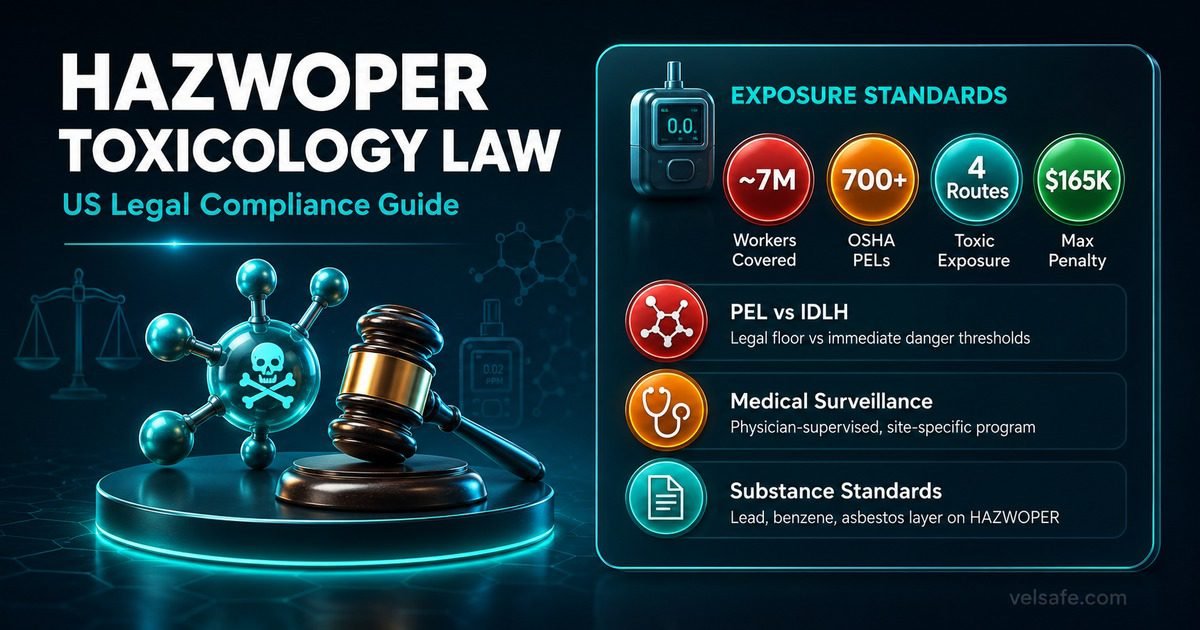
~7M
Workers Covered by HAZWOPER
OSHA estimates approximately 7 million US workers fall under HAZWOPER coverage across hazardous waste cleanup, TSD facilities, hazardous waste generators, and emergency response operations where toxicological hazard assessment is mandatory.
700+
OSHA PELs for Hazardous Substances
OSHA has established permissible exposure limits for over 700 substances in Tables Z-1, Z-2, and Z-3 of 29 CFR 1910.1000. HAZWOPER employers must assess worker exposures against these limits as part of their site characterization and ongoing air monitoring obligations.
$165K
Max Willful Violation Penalty
OSHA’s maximum penalty for a willful or repeat HAZWOPER violation is $165,514 per citation as of the current penalty schedule. Failure to implement toxicological hazard controls or medical surveillance programs generates some of the largest HAZWOPER penalty amounts on record.
Why Toxicology Is a Legal Obligation Under HAZWOPER
HAZWOPER’s toxicology requirements exist because hazardous substance sites expose workers to chemicals that cause harm through mechanisms that are not always visible, immediate, or intuitive. A worker can absorb a lethal dose of an organophosphate pesticide through intact skin without knowing it is happening. Another worker can inhale benzene vapor in concentrations that cause leukemia years later without any immediate symptoms. OSHA built toxicological assessment into HAZWOPER because the hazard profile of a site cannot be managed without understanding how each chemical present can enter the body, at what exposure levels harm begins, and what biological evidence of exposure looks like.
Under 29 CFR 1910.120(c), employers must conduct a preliminary evaluation of a site’s characteristics before any work begins. This evaluation must identify hazardous substances, health hazards, and the potential for worker exposure. The toxicological profile of each substance present determines which engineering controls, PPE, air monitoring protocols, and medical surveillance requirements apply. An employer who skips this step does not simply have a compliance gap: every subsequent decision about worker protection is made without the information required to make it correctly.
The Four Routes of Toxic Exposure
HAZWOPER training at all five responder levels includes instruction on the routes by which hazardous substances enter the body. Understanding exposure routes matters legally because the engineering controls, PPE selection, and medical surveillance required under HAZWOPER differ depending on which routes are relevant for each substance on site.
Route
Risk Level
How Exposure Occurs
Primary Control Required
Inhalation
Highest
Breathing vapors, gases, dusts, mists, or fumes generated during site activities. The fastest route to systemic toxicity for volatile substances.
Engineering controls (ventilation, enclosure), respiratory protection at or above action level, continuous air monitoring
Skin Absorption
High
Direct contact with liquids or contaminated surfaces. Many organophosphates, phenols, and aromatic amines penetrate intact skin rapidly and in amounts sufficient to cause systemic toxicity.
Chemical-resistant gloves and suit selected specifically for the substance; Level A encapsulating suit where skin absorption risk is highest
Ingestion
Moderate
Swallowing contaminated material, hand-to-mouth contact with contaminated gloves or skin, or consuming food and drink in contaminated areas.
Hygiene program: no eating, drinking, smoking in contaminated zones; decontamination before eating; handwashing facilities at site perimeter
Injection
Lower
Puncture by contaminated sharps, needles, or pressurized equipment at hazardous waste sites. Less common than other routes but carries high per-incident toxicity risk.
Puncture-resistant outer gloves, proper sharps handling procedures, site characterization to identify buried sharps hazards before excavation
Exposure Limits: PELs, TLVs, RELs, and IDLHs
HAZWOPER employers must assess worker exposures against multiple exposure standards simultaneously. Each standard represents a different regulatory or technical authority, and each carries different legal weight under OSHA enforcement.
Standard
Set By
What It Means
Legal Status
PEL (Permissible Exposure Limit)
OSHA
Maximum airborne concentration a worker may be exposed to over an 8-hour time-weighted average. Exceeding a PEL is a direct OSHA violation. Many OSHA PELs have not been updated since 1971 and are considered by NIOSH and ACGIH to be inadequately protective.
Enforceable by law
REL (Recommended Exposure Limit)
NIOSH
NIOSH’s recommended maximum exposure based on current health evidence. RELs are generally more protective than OSHA PELs. Employers who comply with the PEL but not the REL may still face General Duty Clause citations if NIOSH evidence shows the PEL is inadequate.
Not directly enforceable, but cited in GDC actions
TLV (Threshold Limit Value)
ACGIH
Occupational exposure guidelines published by the American Conference of Governmental Industrial Hygienists. Updated annually. TLVs are used by industrial hygienists and referenced in OSHA General Duty Clause enforcement when no PEL exists for a substance.
Not directly enforceable, but cited in GDC actions
IDLH (Immediately Dangerous to Life or Health)
NIOSH
The maximum concentration from which a worker could escape within 30 minutes without impairing escape ability or causing irreversible health effects. IDLH conditions require SCBA or supplied-air respirators. Air monitoring at HAZWOPER sites must identify whether IDLH conditions exist before entry.
Triggers mandatory SCBA requirement
The practical implication for HAZWOPER employers is that PEL compliance is a legal floor, not a safety ceiling. An employer who keeps workers at exactly the PEL for a substance where NIOSH’s REL is significantly lower may still face a General Duty Clause citation if OSHA enforcement officers apply NIOSH evidence showing harm at PEL-compliant exposure levels. The best-practice standard for HAZWOPER toxicology programs is to work toward the most protective applicable limit, which is usually the NIOSH REL or ACGIH TLV.
Air Monitoring: The Legal Backbone of HAZWOPER Toxicology Compliance
Air monitoring is what converts toxicological knowledge into legal compliance. Under 29 CFR 1910.120(h), HAZWOPER employers must perform air monitoring to identify and quantify airborne hazardous substances, oxygen deficiency, and combustible conditions. The monitoring program must cover initial site entry, periodic monitoring during operations, and any conditions that could indicate a change in site hazards.
Monitoring Phase
What Must Be Assessed
Regulatory Basis
Initial site entry
Oxygen content, flammable/combustible atmosphere, potential IDLH conditions, and airborne toxic substances. Results determine PPE level for initial entry team.
29 CFR 1910.120(h)(1)
Periodic monitoring
Ongoing assessment during site operations to detect changes in airborne concentrations as excavation, demolition, or material handling disturbs previously stable areas.
29 CFR 1910.120(h)(2)
Action level trigger
When monitoring indicates exposure at or above the action level for a substance with its own OSHA standard (e.g. lead, benzene, asbestos), that substance’s specific standard requirements activate in addition to HAZWOPER obligations.
Substance-specific standards 29 CFR 1910.1001 et seq.
Changed conditions
Any condition indicating possible IDLH, oxygen deficiency, or flammable atmosphere, including worker complaints, odors, visible vapors, or changes in site conditions, requires immediate additional monitoring before work continues.
29 CFR 1910.120(h)(3)
Medical Surveillance: The Employer’s Legal Obligation
Medical surveillance under HAZWOPER serves a function that air monitoring cannot: it detects biological evidence of chemical absorption that has already occurred, regardless of whether air monitoring indicated a problem. Under 29 CFR 1910.120(f), employers must implement a medical surveillance program for workers exposed or potentially exposed to hazardous substances or health hazards above established action levels for 30 or more days per year, workers who wear respirators for 30 or more days per year, and workers who are injured or develop signs or symptoms of exposure following an incident.
Requirement
What the Law Requires and Why
Licensed physician oversight
All medical surveillance examinations must be performed by or under the supervision of a licensed physician. OSHA requires this because interpreting biological monitoring results and determining fitness for duty at hazardous waste sites requires clinical judgment that cannot be delegated to a nurse practitioner or occupational health aide.
Pre-assignment examination
Establishes a baseline against which subsequent biological monitoring results are compared. Without a baseline, it is impossible to determine whether an elevated result reflects occupational exposure or pre-existing condition. The baseline examination is the foundation of the entire surveillance program.
Annual examination
Annual medical examinations detect progressive biological changes from chronic low-level exposure that may not produce immediate symptoms. The examination frequency reflects the fact that cumulative toxicological damage builds over time, not just in response to acute high-level exposure events.
Termination examination
A final examination upon leaving a HAZWOPER-covered job documents the worker’s health status at separation and provides legally critical evidence if an occupational disease claim arises months or years later.
Post-exposure or emergency examination
Any worker who develops signs or symptoms consistent with chemical exposure, or who is involved in a spill, release, or other emergency incident, must receive an examination as soon as possible. Delaying this examination is an independent OSHA violation regardless of whether the worker appears symptomatic.
Written physician opinion
The examining physician must provide a written opinion to the employer stating any medical conditions that increase the worker’s risk from HAZWOPER exposure, whether PPE can be used safely, and any recommended limitations. This document is the legal record that the employer acted on medical findings.
Substance-Specific Standards That Layer on Top of HAZWOPER
HAZWOPER is not the only standard that applies when specific toxic substances are present at a covered site. When air monitoring identifies exposures at or above the action level for substances with their own OSHA standards, those standards impose additional requirements on top of HAZWOPER’s baseline obligations. The most common examples at hazardous waste and construction sites include lead (29 CFR 1926.62), asbestos (29 CFR 1926.1101), benzene (29 CFR 1910.1028), and silica (29 CFR 1926.1153).
Each substance-specific standard adds its own action level, PEL, medical surveillance protocol, biological exposure index, and engineering control requirements. A HAZWOPER employer conducting demolition at a site with lead-painted steel structures and asbestos insulation is simultaneously subject to HAZWOPER’s general hazardous substance requirements, the OSHA lead standard, and the OSHA asbestos standard. Compliance with each is independent: satisfying HAZWOPER does not satisfy the lead standard, and satisfying the lead standard does not satisfy HAZWOPER.
Toxicological Information Requirements: Labels, SDS, and Training
HAZWOPER employers must ensure workers have access to toxicological information about every substance present on site. This obligation operates through three overlapping systems: OSHA’s Hazard Communication Standard (HazCom, 29 CFR 1910.1200), HAZWOPER’s own information and training requirements, and the site-specific chemical information program required under 29 CFR 1910.120(i).
System
Standard
Toxicological Information Required
Safety Data Sheet (SDS)
29 CFR 1910.1200
Section 2 (hazard identification), Section 8 (exposure controls and PELs), Section 11 (toxicological information including routes of exposure, acute and chronic effects, carcinogenicity, and target organ effects) must be accessible to workers at the point of use during their shifts.
HAZWOPER Site Information Program
29 CFR 1910.120(i)
Employers must make available to workers all information concerning the nature of the hazardous substances and health hazards associated with site work, including the results of air monitoring and biological monitoring, NIOSH pocket guides, and relevant OSHA standards.
HAZWOPER Training Content
29 CFR 1910.120(e)
Initial training at all applicable levels must include toxicological and health hazard information specific to the substances at the site, routes of exposure, symptoms of exposure, biological monitoring procedures, and how to interpret air monitoring data. Generic training that does not cover site-specific toxicological hazards does not satisfy this requirement.
Common HAZWOPER Toxicology Compliance Failures
OSHA enforcement data and civil litigation records point to a consistent set of toxicology-related failures at HAZWOPER-covered sites. Most reflect the same underlying problem: employers treat toxicological hazard assessment as a one-time documentation exercise rather than an ongoing operational program.
Most Cited Toxicology-Related HAZWOPER Compliance Failures
Outdated or incomplete site characterization
The initial site evaluation required under 29 CFR 1910.120(c) is conducted once and never updated as site conditions change. Excavation, demolition, or weather events can expose previously undisturbed contamination and create new exposure risks that the original characterization did not capture.
Air monitoring gaps during active operations
Initial entry monitoring is conducted but periodic monitoring during operations is not maintained. Exposure concentrations can change significantly as site work progresses, and monitoring that covers only the beginning of a shift does not satisfy OSHA’s ongoing monitoring requirements.
Medical surveillance not linked to exposure data
The medical surveillance program operates independently from the air monitoring program. Examining physicians are not provided with site-specific chemical exposure data, air monitoring results, or SDS information, which means the surveillance is generic rather than targeted to the actual toxicological hazards on site.
Failure to activate substance-specific standards
Air monitoring identifies lead or benzene at action level concentrations, but the employer continues under HAZWOPER’s general requirements only. The substance-specific standards for lead, benzene, or asbestos are not activated, resulting in missing biological monitoring, medical removal protection, and engineering control requirements.
Generic training without site-specific toxicological content
Workers complete a generic HAZWOPER initial training course that covers toxicology in general terms but does not address the specific substances present at their actual work site. OSHA’s training standard requires site-specific content, not just completion of a general-topic curriculum.
Key Takeaways
PEL Compliance Is a Legal Floor, Not a Safety Standard
Many OSHA PELs have not been updated since 1971 and are considered inadequately protective by NIOSH and ACGIH. Employers who keep workers at exactly the PEL for substances where RELs or TLVs are significantly lower may face General Duty Clause citations. Best practice is to target the most protective applicable limit.
Medical Surveillance Must Be Linked to Site-Specific Exposure Data
A medical surveillance program that operates independently of air monitoring and site characterization data is not compliant with 29 CFR 1910.120(f). The examining physician must receive actual exposure data, not just a description of job duties, to conduct meaningful biological monitoring and render a legally adequate written opinion.
Multiple Standards Apply Simultaneously
HAZWOPER, HazCom, and substance-specific standards (lead, asbestos, benzene, silica) all apply independently. Meeting one does not satisfy the others. Employers must identify every substance above action level concentrations and apply that substance’s specific standard on top of HAZWOPER’s baseline requirements.
Frequently Asked Questions
What is the difference between a PEL and an IDLH under HAZWOPER?
A permissible exposure limit (PEL) is the maximum airborne concentration allowed over an 8-hour work shift, set by OSHA as an enforceable regulatory limit. An immediately dangerous to life or health (IDLH) concentration is a much higher level representing conditions from which a worker could not escape without impairing escape ability or suffering irreversible health effects within 30 minutes. HAZWOPER air monitoring must check for both: PEL compliance governs routine operations, while IDLH detection triggers immediate mandatory use of SCBA and potential evacuation.
Does HAZWOPER medical surveillance apply to emergency responders as well as cleanup workers?
Yes, with some differences in trigger conditions. Under 29 CFR 1910.120(f), medical surveillance applies to workers exposed above action levels for 30 or more days per year, workers wearing respirators for 30 or more days per year, and workers injured or symptomatic following an incident. Emergency responders who respond infrequently may not reach the 30-day threshold, but any responder who develops symptoms or is involved in a significant exposure incident must receive a post-exposure medical examination regardless of total days worked.
Must HAZWOPER employers provide workers with air monitoring results?
Yes. Under 29 CFR 1910.120(i), employers must make air monitoring results available to workers upon request. Workers have the legal right to know their exposure levels. This includes not just summary information but actual measurement data from personal or area sampling conducted during their work activities. Withholding this information is an independent violation of HAZWOPER’s information program requirements.
What happens when a HAZWOPER site contains a substance with its own OSHA standard?
Both standards apply simultaneously and independently. For example, if air monitoring at a HAZWOPER site identifies benzene at or above 0.1 ppm (the benzene action level under 29 CFR 1910.1028), the employer must comply with all of HAZWOPER’s general requirements and all of the benzene standard’s additional requirements: exposure monitoring, medical surveillance specific to benzene, biological exposure index monitoring, engineering controls, and regulated area designation. Compliance with HAZWOPER alone does not satisfy the benzene standard.
Government and Regulatory Sources
Related VelSafe Articles
Toxicology Compliance Protects Workers and Limits Employer Liability
HAZWOPER’s toxicology requirements exist because chemical harm is cumulative, often invisible, and legally attributable to the employer who failed to assess, monitor, and control it. The site characterization, air monitoring, medical surveillance, and substance-specific standard requirements all work together to create a defensible record that the employer took every reasonable step to identify and control chemical exposure. Employers who maintain these programs protect their workers and limit their legal exposure. Those who treat them as paperwork obligations rather than operational necessities face both OSHA citations and civil liability when workers are harmed. Find more HAZWOPER compliance resources at velsafe.com.