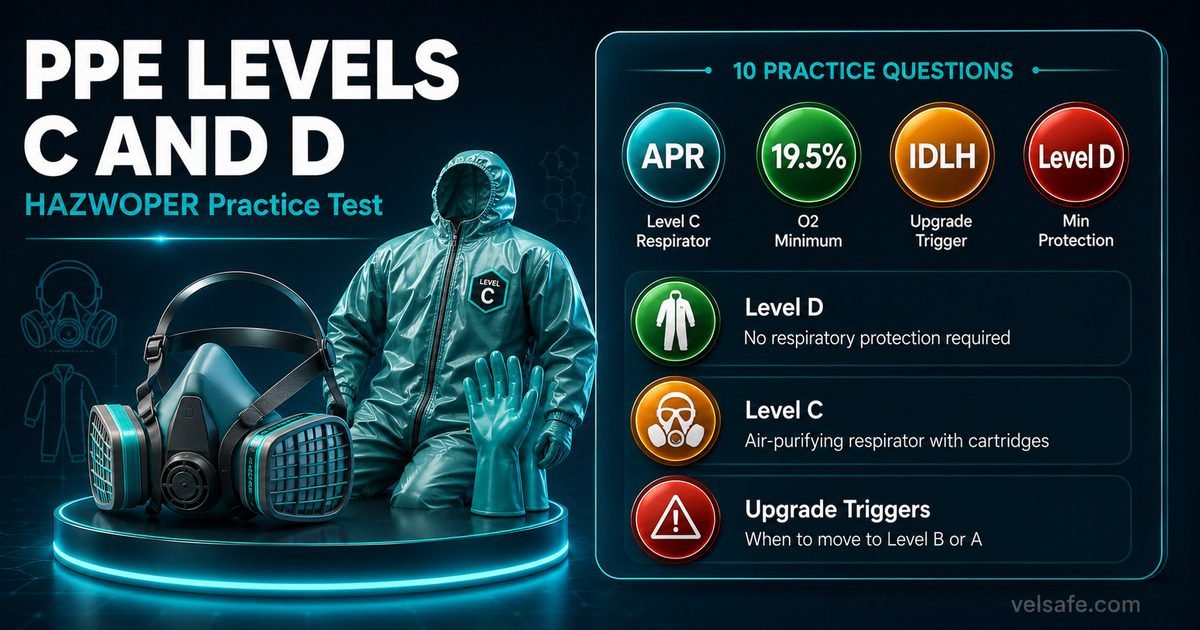
PRACTICE TEST: HAZWOPER PPE Levels C and D
HAZWOPER PPE Levels C and D: Practice Test and Knowledge Review
Test your understanding of HAZWOPER PPE Level C and Level D requirements: when each level applies, what equipment is required, the limitations of air-purifying respirators, and the conditions that require upgrading to a higher protection level. Questions reflect HAZWOPER certification examination content and OSHA site safety officer competencies under 29 CFR 1910.120.
How to Use This Practice Test
Read each question and select your answer before checking the explanation. Pay particular attention to the conditions that trigger PPE level upgrades and the specific limitations of Level C respiratory protection. These distinctions are heavily tested in HAZWOPER certification examinations.
Section 1: Level D – Minimum Protection
Level D is the minimum PPE level used at HAZWOPER sites. It provides no respiratory protection and minimal skin protection. Understanding exactly when Level D is appropriate, and when it is definitively not appropriate, is one of the most commonly tested distinctions in HAZWOPER examinations.
Question 1: Level D PPE is appropriate when:
A. The atmosphere is immediately dangerous to life or health (IDLH)
B. Skin and eye hazards are present but respiratory hazards are not
C. No respiratory hazard exists and skin and eye contact with hazardous substances is unlikely
D. The site contains unknown hazardous substances
Correct Answer: C
Level D is appropriate only when there is no respiratory hazard and skin and eye contact with hazardous substances is not anticipated. It is the equivalent of standard work clothing with basic safety gear. Level D is never appropriate in IDLH atmospheres (A), when skin or eye hazards are present (B), or when substances are unknown (D), because unknown hazards require at minimum Level B until the site can be characterized.
Question 2: Which of the following is included in Level D PPE?
A. Full-face air-purifying respirator
B. Chemical-resistant coveralls
C. Safety boots, hard hat, safety glasses, and work gloves
D. Self-contained breathing apparatus (SCBA)
Correct Answer: C
Level D consists of standard work clothing and basic safety equipment: safety boots (steel-toed), hard hat, safety glasses or chemical splash goggles, and work gloves. It includes no respiratory protection of any kind. Chemical-resistant coveralls (B) are a Level C component. Air-purifying respirators (A) are Level C. SCBA (D) is Level A or B.
Question 3: Workers are performing administrative tasks in a site office trailer in a cleared area where air monitoring shows no detectable contaminants. The appropriate PPE level is:
A. Level A
B. Level B
C. Level C
D. Level D
Correct Answer: D
When air monitoring confirms no detectable contaminants and workers face no anticipated skin or respiratory hazards, Level D is appropriate. PPE level is determined by actual hazard conditions, not by the general designation of a site as a HAZWOPER site. All HAZWOPER sites require appropriate PPE, not necessarily maximum PPE.
Section 2: Level C – Air-Purifying Respirator
Level C is the most commonly used respiratory protection level at HAZWOPER sites where the contaminant type and concentration are known, the atmosphere is not IDLH, and oxygen content is adequate. The defining feature of Level C is the air-purifying respirator (APR), which filters or adsorbs contaminants from ambient air rather than supplying clean air from an independent source.
Question 4: The critical difference between Level B and Level C PPE is:
A. Level B uses a full-face respirator; Level C uses a half-face respirator
B. Level B provides supplied-air or SCBA respiratory protection; Level C uses an air-purifying respirator
C. Level B requires a chemical-resistant suit; Level C does not
D. Level B is used indoors; Level C is used outdoors only
Correct Answer: B
The defining distinction is the type of respiratory protection. Level B requires supplied-air respirators or SCBA that provide air from an independent source. Level C uses air-purifying respirators that filter ambient air. Both levels use chemical-resistant protective clothing, so answer C is incorrect. Both may use full-face or half-face respirators depending on configuration, so answer A is misleading. Answer D has no regulatory basis.
Question 5: Level C PPE must NOT be used when:
A. The contaminant identity is known and its concentration is below IDLH
B. Atmospheric oxygen content is below 19.5%
C. Workers are performing soil sampling in a well-ventilated outdoor area
D. The contaminant has a detectable odor at concentrations below the PEL
Correct Answer: B
Air-purifying respirators cannot be used in oxygen-deficient atmospheres (below 19.5% oxygen) because they filter ambient air but do not supply additional oxygen. Supplied-air or SCBA is required in oxygen-deficient conditions. Level C is appropriate in scenario A (known contaminant below IDLH is the correct condition for Level C). Scenario C describes appropriate Level C conditions. Scenario D does not by itself prohibit Level C use.
Question 6: Which condition requires a responder at Level C to immediately upgrade to Level B?
A. Temperature rises above 85 degrees Fahrenheit
B. Air monitoring detects a contaminant for which no cartridge in the APR provides adequate protection
C. A second shift of workers arrives on site
D. The worker detects a faint odor of the known contaminant
Correct Answer: B
If air monitoring identifies a substance for which the installed APR cartridges provide no protection, or concentrations approaching cartridge service life end point, Level C is no longer adequate and upgrading to Level B or A is required. Temperature (A) affects heat stress management but does not require a PPE upgrade. A shift change (C) is not a PPE trigger. Detecting a faint odor (D) of a known contaminant should prompt cartridge review but does not automatically require upgrade.
Question 7: The correct cartridge for a Level C air-purifying respirator must be selected based on:
A. The color of the cartridge housing
B. The specific contaminant, its concentration, and the cartridge manufacturer’s service life data
C. Worker preference and comfort
D. The number of hours worked per shift
Correct Answer: B
APR cartridge selection requires knowing the specific contaminant, its airborne concentration, and the cartridge’s rated service life. Different cartridges protect against different chemical classes: organic vapor cartridges do not protect against acid gases, and neither protects against particulates without an additional filter. Selecting the wrong cartridge provides no protection. Answer A confuses NIOSH color-coding (which identifies cartridge type) with the selection process itself.
Section 3: Application Scenarios
These questions present realistic HAZWOPER field scenarios requiring you to apply PPE level selection criteria. Each scenario mirrors the type of site characterization data available to a site safety officer making real-time decisions in the field.
Question 8: Workers are sampling groundwater at a remediation site. Air monitoring shows oxygen at 20.9%, no detectable vapors above background, and the site characterization identified low concentrations of petroleum hydrocarbons in soil. What PPE level is most appropriate?
A. Level A
B. Level B
C. Level C or D depending on skin contact risk
D. No PPE required
Correct Answer: C
Normal oxygen, no detectable vapors, and known low-level petroleum contamination indicate no respiratory hazard. If groundwater sampling involves potential skin contact with contaminated water, Level C with chemical-resistant gloves and splash protection is appropriate. If skin contact is unlikely, Level D may suffice. PPE level is task-specific, not site-specific. Levels A and B would be over-protection based on the monitoring data provided. No PPE (D) is never appropriate at an active hazardous waste remediation site.
Question 9: A first responder at Operations Level arrives at a transportation incident involving a tanker placarded UN 1017 (Chlorine). Airborne concentrations have not yet been measured. The minimum PPE for initial approach is:
A. Level D
B. Level C with chlorine cartridges
C. Level B with SCBA
D. No PPE required until concentrations are measured
Correct Answer: C
Chlorine (UN 1017) is a toxic inhalation hazard with an IDLH of 10 ppm. Before airborne concentrations are known, IDLH conditions cannot be ruled out. Level C with APR cartridges (B) is not appropriate when IDLH conditions are possible because APRs cannot be used in IDLH atmospheres. The correct initial approach requires SCBA (Level B minimum) until air monitoring establishes conditions are below IDLH. Level D (A) and no PPE (D) are clearly inappropriate for a TIH release.
Question 10: A worker wearing Level C reports smelling the contaminant strongly inside their facepiece. The site safety officer’s immediate response should be:
A. Tell the worker to continue and replace cartridges at end of shift
B. Evacuate the worker immediately, replace cartridges, and reassess before re-entry
C. Instruct the worker to breathe more shallowly
D. Upgrade all site workers to Level A immediately
Correct Answer: B
Strong odor inside the facepiece indicates cartridge breakthrough, facepiece seal failure, or concentrations exceeding cartridge capacity. Any of these means Level C protection is compromised. The worker must be evacuated immediately, cartridges replaced, facepiece fit rechecked, and air monitoring must reassess conditions before re-entry. Answer A delays response to an active protection failure. Answer C is not a recognized safety measure. Answer D may be an overreaction depending on reassessment findings.
Answer Key Summary
Q
Topic
Answer
1
When Level D is appropriate
C
2
Level D equipment components
C
3
PPE level for cleared site office workers
D
4
Critical difference between Level B and Level C
B
5
When Level C must not be used
B
6
Condition requiring upgrade from Level C to B
B
7
APR cartridge selection basis
B
8
PPE for low-level petroleum groundwater sampling
C
9
Minimum PPE for unknown chlorine concentrations
C
10
Response to odor detected inside Level C facepiece
B
Score Interpretation
9-10
Strong Understanding
Solid grasp of Level C and D selection criteria and limitations. Review any missed questions against Appendix B of 29 CFR 1910.120.
6-8
Review Recommended
Review the oxygen-deficiency restrictions on APR use and cartridge breakthrough recognition before your certification examination.
0-5
Additional Training Needed
PPE level selection is a core HAZWOPER competency. Study 29 CFR 1910.120 Appendix B and complete additional respiratory protection training before site duties.
Government and Regulatory Sources
Related VelSafe Articles
Continue Your HAZWOPER PPE Preparation
PPE level selection is tested at every level of HAZWOPER certification and is one of the most frequently applied skills in the field. Knowing not just which level to select but why, and knowing the conditions that require an immediate upgrade, is what separates competent HAZWOPER responders from those who create liability for their employers. Find more HAZWOPER practice tests and PPE resources at velsafe.com.