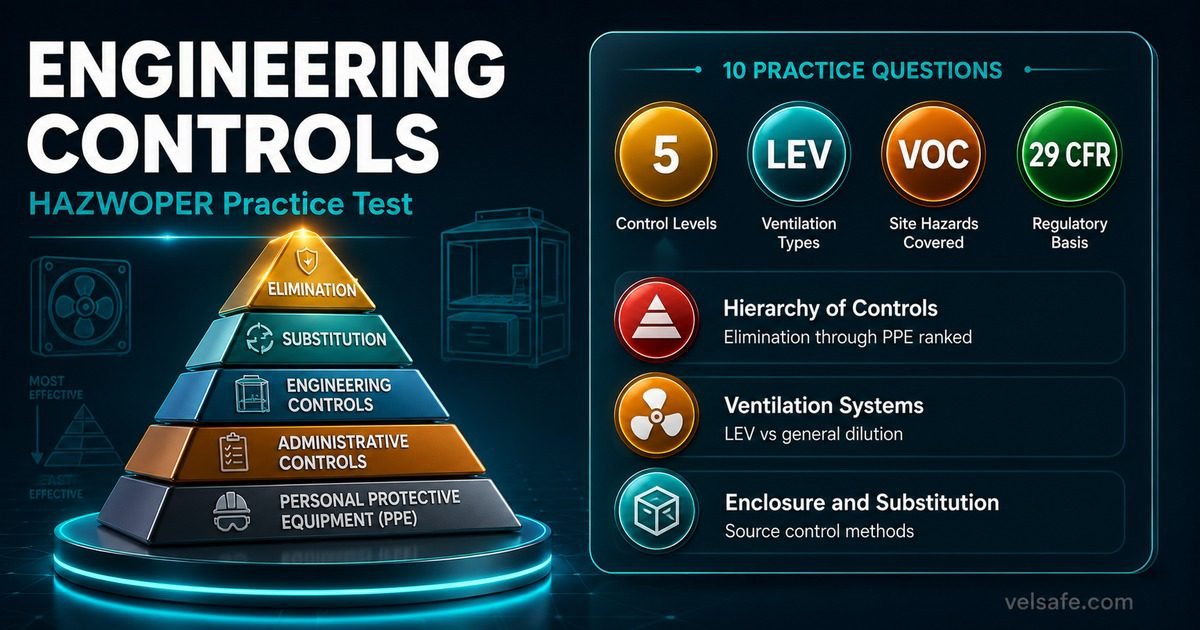
PRACTICE TEST: HAZWOPER Engineering Controls
HAZWOPER Engineering Controls: Practice Test and Knowledge Review
Test your understanding of HAZWOPER engineering controls, the hierarchy of controls, ventilation systems, substitution, isolation, and enclosure requirements under 29 CFR 1910.120. Questions cover both conceptual knowledge and practical application scenarios encountered at hazardous waste sites and emergency response operations.
How to Use This Practice Test
Read each question carefully, select your answer, then check the explanation below. These questions reflect the types of knowledge tested in HAZWOPER certification examinations and OSHA compliance audits. Review the cited regulatory sections for any questions you answer incorrectly.
Section 1: Hierarchy of Controls Fundamentals
Engineering controls are the third tier in the hierarchy of controls, ranked below elimination and substitution but above administrative controls and personal protective equipment. Understanding where engineering controls sit in this hierarchy, and why, is foundational to HAZWOPER compliance.
Question 1: According to OSHA’s hierarchy of controls, which control method provides the greatest long-term worker protection?
A. Personal protective equipment (PPE)
B. Administrative controls
C. Engineering controls
D. Elimination of the hazard
Correct Answer: D. Elimination of the hazard
Elimination physically removes the hazard from the workplace entirely and is the most effective control because it provides permanent protection without relying on worker behavior, equipment maintenance, or PPE compliance. Engineering controls (C) are highly effective but do not remove the hazard itself. Administrative controls and PPE depend on ongoing human compliance and are therefore less reliable as standalone measures.
Question 2: At a HAZWOPER site, engineering controls are preferred over PPE as the primary means of worker protection because:
A. Engineering controls are always less expensive to implement
B. PPE is not permitted at hazardous waste sites
C. Engineering controls reduce or eliminate exposure at the source rather than relying on worker compliance
D. OSHA prohibits PPE use when engineering controls are available
Correct Answer: C
Engineering controls act on the hazard itself, reducing or eliminating worker exposure without depending on the worker to correctly don, maintain, or use protective equipment. PPE is the last line of defense, not a substitute for engineering controls. OSHA requires engineering controls to be implemented to the extent feasible before relying on PPE. Answer A is incorrect because engineering controls often have higher upfront costs; answer B is false; answer D misstates OSHA’s position.
Question 3: Which of the following correctly ranks control methods from MOST to LEAST effective according to OSHA’s hierarchy?
A. PPE, Administrative controls, Engineering controls, Substitution, Elimination
B. Elimination, Substitution, Engineering controls, Administrative controls, PPE
C. Engineering controls, Elimination, PPE, Administrative controls, Substitution
D. Substitution, Elimination, Administrative controls, Engineering controls, PPE
Correct Answer: B
The correct hierarchy from most to least effective is: Elimination (removes the hazard), Substitution (replaces with less hazardous material or process), Engineering controls (isolate or reduce the hazard), Administrative controls (change how work is done), and PPE (protect the worker from the hazard). This ranking reflects the degree to which each method relies on ongoing worker compliance: elimination requires none, while PPE requires constant correct use.
Section 2: Ventilation Systems
Ventilation is the most commonly used engineering control for airborne chemical hazards at HAZWOPER sites. Understanding the difference between general dilution ventilation and local exhaust ventilation, and when each is appropriate, is a core competency for site safety officers and HAZWOPER-trained workers.
Question 4: Local exhaust ventilation (LEV) is preferred over general dilution ventilation at hazardous waste sites primarily because:
A. LEV is less expensive to install
B. LEV captures contaminants at or near the source before they disperse into the work environment
C. General dilution ventilation is prohibited by OSHA at hazardous waste sites
D. LEV eliminates the need for air monitoring
Correct Answer: B
Local exhaust ventilation captures airborne contaminants at or near the point of generation, before they can disperse into the breathing zone of workers. General dilution ventilation dilutes contaminated air with clean air across the entire workspace, which is less effective for highly toxic substances because it allows some worker exposure before dilution occurs. LEV is not always less expensive (A is false), is not uniquely required by OSHA (C is false), and does not replace air monitoring (D is false).
Question 5: General dilution ventilation is most appropriate when:
A. Workers are handling highly toxic substances with very low TLVs
B. The contaminant is generated at a uniform, low rate and has a relatively high TLV
C. The source of contamination is unknown
D. Workers are in an enclosed space with no air supply
Correct Answer: B
General dilution ventilation works acceptably when contaminants are generated at a predictable, low rate, the substance has a relatively high TLV (meaning moderate concentrations are tolerable), and workers are not immediately adjacent to the source. It is not appropriate for highly toxic substances (A), unknown sources (C), or confined spaces without supplied air (D), where the design assumptions that make dilution ventilation effective cannot be met.
Section 3: Isolation, Enclosure, and Substitution
Beyond ventilation, HAZWOPER sites use isolation, enclosure, and substitution to reduce worker exposure to hazardous substances. Each control method addresses the hazard differently, and selecting the correct method for a given situation requires understanding both the nature of the hazard and the operational constraints of the site.
Question 6: At a HAZWOPER remediation site, workers are excavating soil contaminated with a volatile organic compound (VOC). Which engineering control most directly reduces inhalation exposure during excavation?
A. Substituting the excavation equipment with a less powerful model
B. Wet suppression methods to reduce VOC vapors from disturbed soil
C. Posting warning signs around the excavation perimeter
D. Requiring workers to hold their breath during excavation
Correct Answer: B
Wet suppression applies water or foam to disturbed soil, reducing the rate at which VOC vapors volatilize into the air column above the excavation. This is an engineering control because it acts on the source of vapor generation. Answer A is not an engineering control for vapor exposure. Answer C is an administrative control (signage). Answer D is not a recognized control method and would create additional health risks.
Question 7: Substitution as an engineering control means:
A. Replacing one worker with another to reduce individual exposure time
B. Replacing a hazardous chemical or process with a less hazardous one
C. Substituting PPE for engineering controls when engineering controls are not feasible
D. Switching from day shift to night shift work to reduce heat exposure
Correct Answer: B
Substitution involves replacing a hazardous material, chemical, or process with one that poses less risk to workers. For example, replacing a solvent with high vapor toxicity with one that has a higher TLV, or replacing a manual grinding process that generates silica dust with a wet cutting method. Answer A describes job rotation, which is an administrative control. Answer C describes a fallback strategy, not substitution. Answer D is an administrative scheduling control.
Question 8: Process enclosure as an engineering control is most effective when:
A. The hazardous process can be completely contained so that workers have no contact with the substance during normal operations
B. The enclosure is used to store PPE near the work area
C. Workers enter the enclosure regularly to perform tasks
D. The enclosure is used to contain waste after a spill has already occurred
Correct Answer: A
Process enclosure is most effective when it completely isolates the hazardous process from the worker so that normal operations involve no direct contact with the substance. A fully enclosed automated drum filling system where operators monitor from outside is an example. When workers must enter the enclosure to perform tasks (C), the enclosure’s protection is compromised during those entries and additional controls such as respiratory protection are required.
Section 4: Engineering Controls at HAZWOPER Sites
Applying engineering controls at hazardous waste and emergency response sites presents unique challenges compared to fixed industrial settings. Site conditions change as remediation progresses, the identity and concentration of hazardous substances may not be fully known, and temporary structures must often serve the function of permanent engineering controls in industrial facilities.
Question 9: Under 29 CFR 1910.120, when engineering controls alone cannot keep worker exposures below permissible exposure limits, the employer must:
A. Halt all site operations until engineering controls can be upgraded
B. Use engineering controls to reduce exposures to the lowest feasible level and supplement with appropriate PPE and work practices
C. Rely solely on PPE and discontinue engineering controls
D. Apply for an OSHA variance before allowing workers to continue
Correct Answer: B
OSHA’s standard approach where engineering controls cannot achieve compliance alone is to implement engineering controls to reduce exposures to the lowest feasible level, then supplement with administrative controls and PPE to achieve full compliance. Engineering controls are not abandoned in favor of PPE (C). Work does not automatically halt (A) unless conditions are immediately dangerous. An OSHA variance (D) is a separate process not required in this scenario.
Question 10: A site safety officer at a HAZWOPER remediation site observes that the local exhaust ventilation system in a drum staging area has stopped functioning. The correct immediate action is:
A. Allow workers to continue operations while wearing higher-level PPE until the system is repaired
B. Stop operations in the affected area, evacuate workers, and restore or replace the engineering control before resuming work
C. Document the failure and report it at the next weekly safety meeting
D. Increase the frequency of air monitoring and continue operations
Correct Answer: B
When a required engineering control fails, operations that depend on that control for worker protection must stop until the control is restored or an equivalent alternative is in place. Relying on elevated PPE as a substitute for a failed engineering control (A) is not appropriate as a long-term measure and may not adequately protect workers during the transition period. Deferring the response (C) creates a documented liability. Increased air monitoring (D) detects exposure but does not prevent it.
Section 5: Knowledge Check Summary
Q
Topic
Answer
1
Most effective control in the hierarchy
D
2
Why engineering controls are preferred over PPE
C
3
Correct hierarchy ranking most to least effective
B
4
Why LEV is preferred over general dilution ventilation
B
5
When general dilution ventilation is appropriate
B
6
Engineering control for VOC vapors during excavation
B
7
Definition of substitution as a control method
B
8
When process enclosure is most effective
A
9
OSHA requirement when engineering controls cannot meet PELs
B
10
Response when a required engineering control fails on site
B
Score Interpretation
9-10
Strong Understanding
You have a solid grasp of engineering controls and their application under HAZWOPER. Review any missed questions and their cited regulatory sections.
6-8
Review Recommended
You understand the core concepts but have gaps in specific application areas. Review the ventilation and enclosure sections and re-read 29 CFR 1910.120(h).
0-5
Additional Training Needed
Foundational gaps in engineering controls knowledge require additional training before HAZWOPER site duties. Review the full hierarchy of controls and ventilation principles.
Government and Regulatory Sources
Related VelSafe Articles
Continue Preparing for Your HAZWOPER Certification
Engineering controls are one component of the broader hazard control framework tested in HAZWOPER certification examinations. Understanding how engineering controls interact with administrative controls, PPE selection, air monitoring, and site characterization requirements gives you a complete picture of how OSHA expects hazardous sites to be managed. Find more HAZWOPER practice tests and compliance resources at velsafe.com.