
Tip 1: Start with a Building Water System Inventory
Before any water quality assessment can be meaningful, you need a complete inventory of every water system component in the building. This includes all hot and cold water distribution lines, storage tanks, water heaters, cooling towers, decorative fountains, ice machines, eye wash stations, hose bibs, and any water-using equipment that may generate aerosols. Legionella and other waterborne pathogens colonize specific system components, and you cannot assess risk you have not documented.
The inventory should map water flow paths from the municipal connection to every point of use, identify dead legs (pipe sections where water sits stagnant), low-use outlets, and components where water temperature falls into the Legionella growth range of 25 to 45 degrees C. This inventory becomes the foundation of the Water Management Plan required under ASHRAE Standard 188.
Tip 2: Develop and Implement a Water Management Plan
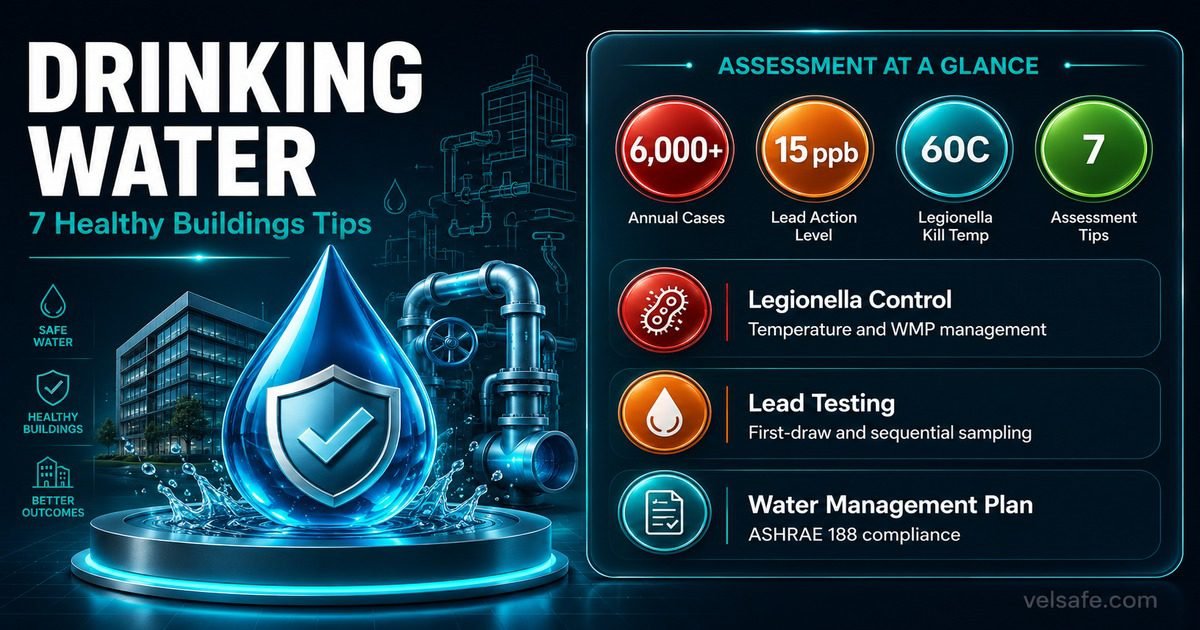
ASHRAE Standard 188 requires buildings above defined thresholds to develop a Water Management Plan (WMP) that identifies hazardous conditions, establishes control measures, sets monitoring and testing frequencies, and defines corrective actions when limits are exceeded. A WMP is not a one-time document: it is an operational program with assigned responsibilities, defined limits, and documented results.
Tip 3: Monitor Water Temperatures Throughout the System
Temperature is the most practical and continuously controllable Legionella prevention measure. Hot water must be stored at or above 60 degrees C and delivered to all outlets at or above 51 degrees C. Cold water must be maintained below 20 degrees C throughout distribution. Temperatures between 25 and 45 degrees C represent the Legionella growth zone and must be avoided wherever water is stored or moves slowly.
Temperature monitoring must cover the full distribution system, not just the heater outlet. Long hot water runs, distant fixtures, recirculation loop returns, and sentinel taps should all be included in a representative monitoring program. A heater set to 60 degrees C that delivers 38-degree water at a distant tap due to heat loss along an uninsulated pipe represents a compliance gap that the heater thermostat reading alone will not reveal.
Tip 4: Implement a Flushing Program for Low-Use Outlets
Stagnant water in low-use outlets, dead-end pipe sections, and infrequently used fixtures is one of the primary conditions that enables Legionella colonization and lead release. Buildings with vacant floors, seasonal closures, or newly reoccupied spaces after periods of low use face elevated risk. A systematic flushing program addresses stagnation at the point of use.
Tip 5: Test for Lead at the Tap
Lead in building drinking water comes from lead service lines, lead solder in older plumbing, brass fittings, and lead-lined tanks, not from the municipal treatment plant. Buildings constructed before 1986 are at highest risk. Schools, childcare facilities, and healthcare buildings face heightened obligations given the vulnerability of their occupants to lead neurotoxicity.
First-draw sampling identifies lead from the immediate fixture and nearby plumbing. Sequential sampling identifies where in the plumbing system lead is entering the water. Both methods are needed for a complete lead assessment. Results above 1 ppb in schools and childcare facilities, or 15 ppb at any tap, require immediate remediation including fixture replacement and communication to building occupants.
Tip 6: Verify Disinfectant Residuals at Points of Use
Municipal water suppliers maintain disinfectant residuals to prevent microbial contamination during distribution. However, residuals dissipate as water travels through building plumbing, particularly in long runs, low-use areas, and sections with high organic load from biofilm or scale. Testing disinfectant residuals at points of use, not just at the building entry, reveals where protection has been lost.
Free chlorine residuals below 0.2 mg/L or total chlorine residuals below 0.5 mg/L at points of use indicate inadequate protection and increased Legionella risk. Buildings that rely on supplemental disinfection systems must verify that these systems are performing as designed at all protected outlets.
Tip 7: Manage Cooling Towers and Decorative Water Features Separately
Cooling towers and decorative water features are among the highest-risk Legionella amplification sites in buildings because they generate aerosols that can transmit Legionella directly to nearby occupants and to the building’s air intake system. They require separate management programs from the domestic water system, with their own monitoring and corrective action procedures within the building’s Water Management Plan.
Cooling tower management must include regular physical cleaning and disinfection, biocide treatment programs with documented efficacy, drift eliminators to reduce aerosol generation, and shutdown and startup procedures that prevent Legionella from proliferating during periods of inactivity. Decorative features that cannot be maintained at protective temperatures must use appropriate biocide treatment and regular drain-down and cleaning schedules.
Key Takeaways
Government and Regulatory Sources
- CDC – Legionellosis Surveillance and Prevention
- CDC – Water Management Programs for Building Water Systems
- EPA – Lead and Copper Rule
- EPA – Lead in Drinking Water
- ASHRAE – Standard 188 Legionellosis Risk Management for Building Water Systems
Related VelSafe Articles
- Healthy Buildings Suite: Practice Test and Review
- Lead in Buildings: Exposure Trends and Compliance Analysis
- Construction Health Hazards: Silica, Lead and Noise Analysis
Start with the Water System You Can See
Building water quality assessment begins with documentation of every system component, followed by systematic testing at the tap. The gap between municipal supply compliance and actual occupant exposure at the fixture is where Legionella outbreaks, lead poisoning cases, and building-related illness clusters originate. Operators who implement a Water Management Plan, maintain temperature control, flush low-use outlets, and test at representative points of use close that gap systematically rather than reactively. Find more healthy buildings water quality resources at velsafe.com.