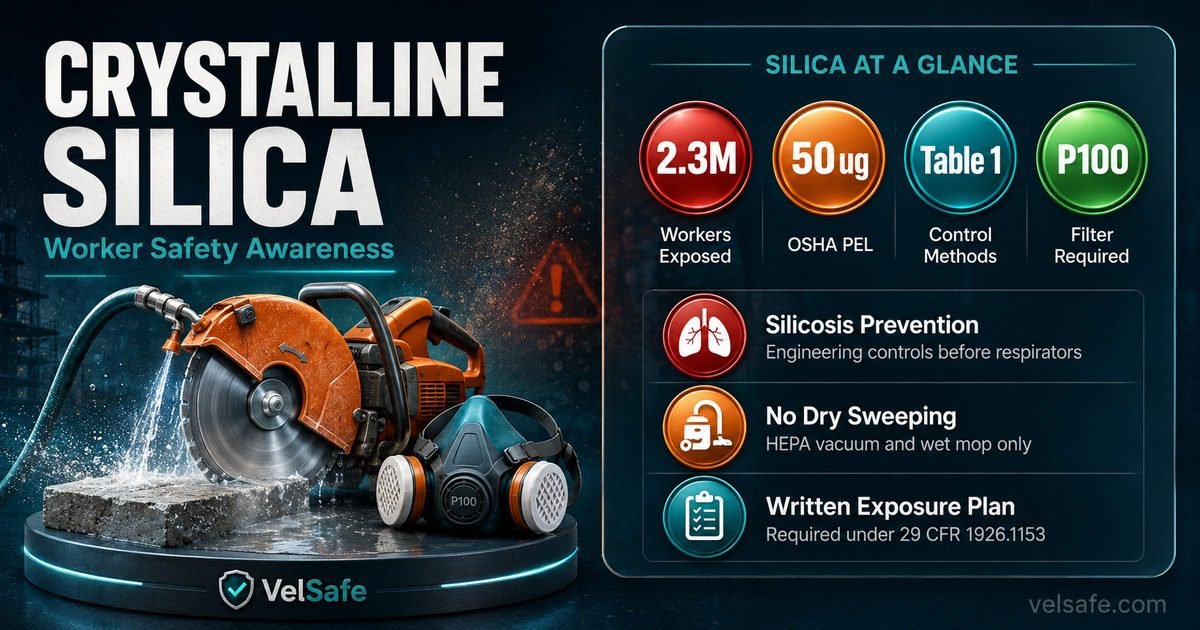
WORKER SAFETY: Crystalline Silica in Healthy Buildings
Crystalline Silica Awareness for Healthy Buildings Workers
Healthy buildings renovation and assessment work exposes workers to crystalline silica from concrete, drywall, mortar, tile, and stone. Silica causes silicosis, lung cancer, and COPD. This guide explains where silica hazards arise, what OSHA requires, and how to protect yourself and building occupants under 29 CFR 1926.1153.
2.3M
Workers Exposed to Silica
OSHA estimates 2.3 million US workers are exposed to occupational silica dust. Construction workers face the highest exposure from concrete, masonry, stone, and drywall cutting, grinding, and demolition.
50 ug
OSHA PEL per m3 (8-hr TWA)
OSHA’s permissible exposure limit for respirable crystalline silica is 50 micrograms per cubic meter as an 8-hour time-weighted average under both 29 CFR 1926.1153 (construction) and 29 CFR 1910.1053 (general industry).
100x
More Hazardous Than Visible Dust
Respirable silica particles are smaller than 10 microns and invisible to the naked eye. Workers can be exposed to dangerous concentrations while seeing little or no visible dust, making air monitoring essential.
Crystalline silica is a mineral compound found in concrete, brick, mortar, stone, tile, and drywall compound. When these materials are cut, ground, drilled, or demolished, they generate fine dust particles small enough to reach deep into the lungs. Once deposited, the immune system cannot remove them. Over years, they trigger progressive lung scarring that results in silicosis, a permanently disabling and incurable occupational disease. Healthy buildings work that involves renovation, maintenance, or assessment during construction activities creates real silica exposure risk for workers at every level.
WHY THIS MATTERS: Silicosis Has No Cure
Irreversible Lung Damage
Once silica particles scar lung tissue, the process continues even after exposure ends. There is no treatment that reverses silicosis. Prevention is the only protection.
Group 1 Carcinogen
IARC classifies inhaled crystalline silica from occupational sources as a Group 1 carcinogen (carcinogenic to humans). Silica-exposed workers who smoke face multiplicative lung cancer risk.
Invisible Hazard
Respirable silica dust is invisible. Workers feel no immediate symptoms during exposure. By the time silicosis is diagnosed, significant permanent lung damage has already occurred.
Hazard Overview: Silica Exposure Risk by Task
Not all building tasks generate the same silica concentration. Understanding relative risk by task type is the first step in applying the hierarchy of controls correctly. Tasks that generate the highest concentrations require the most robust engineering controls and must never rely on respiratory protection alone.
Crystalline Silica Exposure Risk by Task Type
Concrete grinding or coring
Very High
Dry concrete grinding generates concentrations many times above the OSHA PEL within seconds. Table 1 requires integrated water delivery or HEPA vacuum on the grinder.
Tile and stone cutting
Very High
Dry cutting ceramic, porcelain, or natural stone generates high silica dust. Wet saw with continuous water flow is the Table 1 required control.
Drywall cutting or sanding
High
Drywall joint compound contains crystalline silica. Cutting and sanding without dust collection generates significant airborne concentrations, particularly in enclosed spaces.
Tuck-pointing or mortar mixing
High
Sand in mortar is predominantly silica. Dry mixing and hand tuck-pointing without water or vacuum control creates sustained high exposures over a shift.
HVAC core drilling in concrete
Moderate
Drilling penetrations through concrete ceilings or walls for duct and pipe installation generates localized silica. Assessors nearby are in the exposure zone.
IAQ assessment during renovation
Variable
Assessors present during high-risk tasks receive the same airborne exposure as workers performing those tasks. Distance from the source and duration are the key variables.
Signs That Silica Controls Are Inadequate
Workers cannot detect respirable silica by sight, smell, or feel. Instead, look for operational and environmental indicators that controls are failing before exposure accumulates to harmful levels.
No Wet Suppression or Vacuum on Power Tools
If a worker is dry cutting concrete, tile, or stone without integrated water delivery or a HEPA vacuum attached to the tool, Table 1 engineering controls are not being applied. This is a direct OSHA violation regardless of what PPE the worker is wearing.
Visible Dust Cloud During Cutting or Grinding
A visible dust cloud does not mean respirable silica is present, but it does mean engineering controls are not capturing particles generated by the task. If you can see the dust, the control system is not working and respirable fractions are escaping into the breathing zone.
Dry Sweeping of Fine White or Gray Dust
Any worker sweeping fine white or gray dust with a broom in an area where concrete, drywall, mortar, or stone work occurred is resuspending settled silica particles. Dry sweeping is prohibited. HEPA vacuum followed by wet mopping is required for cleanup in silica work areas.
The Five Controls: What Each One Looks Like at Your Site
OSHA’s hierarchy of controls applies directly to silica work. Each level reduces exposure differently. The numbered cards below show what each control actually looks like in a healthy buildings renovation or assessment context.
What It Looks Like at Your Site
Replacing a concrete floor slab requiring grinding with a prefabricated raised access floor system eliminates the grinding task entirely. No grinding means no silica generation.
Why It Is the Strongest Control
If the silica-generating task does not exist, no amount of PPE failure, human error, or equipment malfunction can create an exposure. Elimination is always worth exploring first.
What It Looks Like at Your Site
Replacing a high-silica drywall compound with a low-silica or silica-free alternative product reduces exposure at the source. Some tile adhesives and grouts are also available in lower-silica formulations.
Important Caution
Always verify that a substitute product does not create a different hazard. Check the SDS for the replacement material before assuming it is a net safety improvement.
What It Looks Like at Your Site
Wet cutting with continuous water flow to the blade, HEPA vacuum shrouds attached to angle grinders, local exhaust ventilation on enclosed work areas. These are the Table 1 controls specified by OSHA for each silica-generating task.
Why These Matter to You
Engineering controls work without relying on you to do anything extra. If the vacuum is attached and functioning, every particle generated is captured before it reaches your lungs. Report any damaged or bypassed engineering controls immediately.
4
Administrative Controls
What It Looks Like at Your Site
Scheduling silica-generating work when fewer people are present, rotating workers to limit individual exposure duration, restricting access to the work zone so only essential personnel enter, and requiring the Written Exposure Control Plan to be posted at the worksite.
Your Responsibility
Administrative controls only work if everyone follows them consistently. Skipping a rotation break, entering a restricted area without PPE, or allowing non-essential personnel into the zone during work defeats the control entirely.
5
Personal Protective Equipment
What It Looks Like at Your Site
When engineering controls cannot keep exposures below the PEL, a half-face APR with P100 filter or a supplied-air respirator is required depending on exposure level. Respirator selection must follow 29 CFR 1910.134 and requires a written program, medical evaluation, and fit testing.
Critical Reminder
A respirator protects only you, and only when worn correctly. It does not reduce the airborne concentration for anyone else nearby. It does not protect you if it does not fit, if the wrong cartridge is selected, or if it is worn incorrectly. Engineering controls come first.
Do and Do Not: Silica Safety on the Job
DO
DO NOT
Ask your supervisor what Table 1 engineering controls are in place for each silica-generating task
Start cutting, grinding, or drilling concrete, tile, or stone without water suppression or HEPA vacuum attached to the tool
Use HEPA vacuum and wet mopping for cleanup in areas where silica-generating work occurred
Sweep fine concrete, drywall, or stone dust with a broom; this resuspends silica particles directly into the breathing zone
Stay outside the restricted area boundary during high-risk silica work unless you are essential to the task and properly equipped
Enter a regulated area during silica-generating work without a properly fitted and selected respirator
Report damaged, missing, or bypassed engineering controls such as a vacuum shroud that has been removed from a grinder
Remove or bypass engineering controls to make a task faster or easier; this is an OSHA violation and removes protection from every person in the area
Participate in medical surveillance if you work with silica-generating tasks 30 or more days per year
Ignore early respiratory symptoms such as persistent cough or shortness of breath after working in areas with concrete, stone, or drywall dust
Medical Surveillance: What You Are Entitled To
Workers exposed to respirable crystalline silica above the action level of 25 micrograms per cubic meter for 30 or more days per year are entitled to medical surveillance at no cost to them. Medical surveillance includes a chest X-ray read by a NIOSH-certified B reader, pulmonary function testing, and a symptom questionnaire. These examinations are offered every three years. A baseline examination is conducted when the surveillance obligation first applies.
Medical surveillance does not prevent silicosis, but it detects early lung changes that may allow workers to reduce their exposure before damage progresses further. Workers who develop silicosis may be entitled to medical removal protection under some state workers’ compensation programs. If your employer conducts silica work and has never offered you a medical evaluation, ask your safety officer about your rights under 29 CFR 1926.1153(h).
Key Takeaways
Start from the Top of the Hierarchy, Every Time
For every silica-generating task, begin control selection at elimination. Only move down the hierarchy when a higher-level control is genuinely not feasible. A respirator should never be the first and only control applied to a task that generates silica concentrations above the PEL.
No Dry Sweeping, Ever
Dry sweeping of concrete, drywall, stone, or mortar dust is prohibited wherever HEPA vacuuming or wet mopping can be used. This applies to post-renovation cleaning by building staff as well as construction workers. It is one of the most commonly violated and most preventable silica exposure sources in buildings work.
Assessors Are Not Exempt
Being a healthy buildings assessor rather than a construction worker does not exempt you from silica exposure during renovation activities. If you are in the breathing zone of silica-generating work, you are being exposed. Establish exclusion zones, schedule visits during non-active periods, or wear appropriate respiratory protection when present during high-risk tasks.
Frequently Asked Questions
What is the difference between OSHA’s action level and the PEL for silica?
The action level for respirable crystalline silica is 25 micrograms per cubic meter as an 8-hour TWA. Workers exposed at or above the action level for 30 or more days per year must be offered medical surveillance. The permissible exposure limit (PEL) is 50 micrograms per cubic meter. Exposures above the PEL require implementation of additional engineering controls, respiratory protection, and regulated area establishment. The action level triggers medical surveillance before exposures reach the PEL.
Does OSHA’s Table 1 approach eliminate the need for air monitoring?
Yes, with one condition. Employers who fully implement the Table 1 engineering controls, work practices, and respiratory protection specified for each task are presumed compliant with the PEL and are not required to perform air monitoring, unless they have reason to believe exposures may exceed the PEL despite Table 1 compliance. If an employer modifies a Table 1 task or uses different equipment than specified, they must perform air monitoring to verify compliance.
Can building occupants be exposed to silica from renovation work occurring in their building?
Yes. Silica dust generated during renovation can migrate through HVAC systems, open doors, and unsealed penetrations to areas occupied by building workers and residents who are not in the construction zone. OSHA’s standards protect construction workers, but building operators have an independent obligation under the General Duty Clause to protect occupants. Proper containment, negative pressure in work areas, and reoccupancy protocols after adequate HEPA cleaning are essential healthy buildings practices.
How long does a silica respirator cartridge last?
Respirator filters for silica (P100 particulate filters) do not have a fixed service life based on time. They should be replaced when breathing resistance increases noticeably, when the filter becomes physically damaged, or according to the employer’s written respiratory protection program. Unlike chemical cartridges, P100 filters do not have a breakthrough concern for silica; they trap particles mechanically. However, a dirty, damaged, or poorly fitting filter provides no protection regardless of its age.
Government and Regulatory Sources
Related VelSafe Articles
Silica Awareness Is Part of Healthy Buildings Competency
A healthy buildings framework that improves IAQ, water quality, and occupant wellness while ignoring the silica hazards generated during renovation and construction activities is incomplete. Workers and practitioners who understand where silica comes from, what OSHA requires, and how to protect themselves and building occupants deliver healthy buildings outcomes without creating occupational health liabilities in the process. Find more worker safety and healthy buildings resources at velsafe.com.