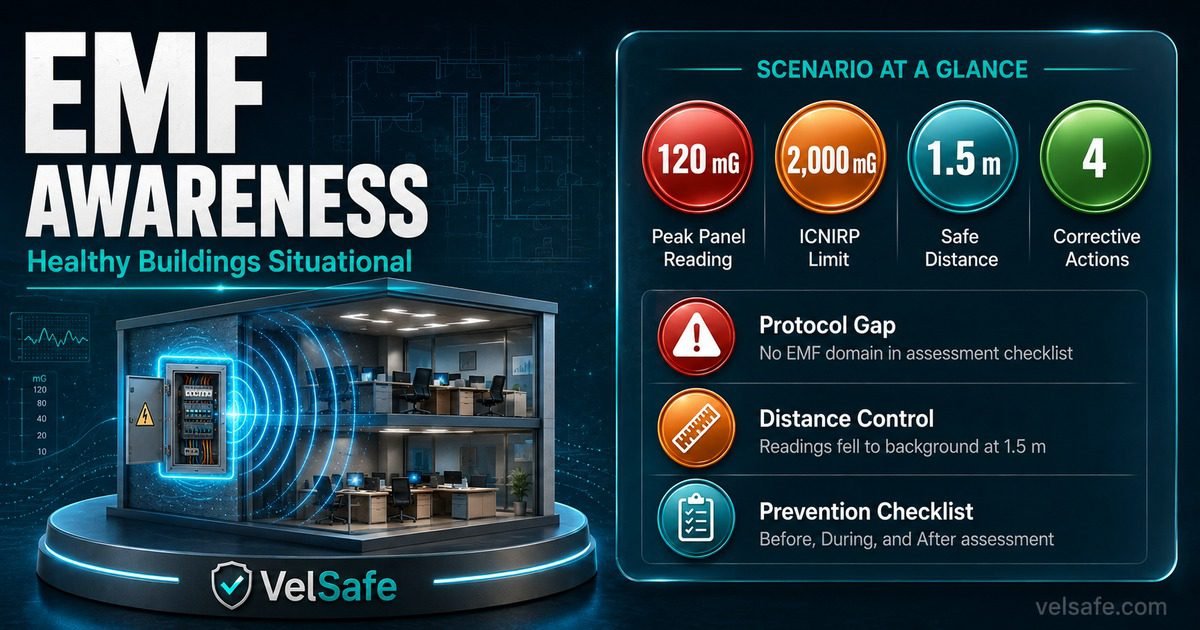
SITUATIONAL: Healthy Buildings EMF Awareness
EMF Awareness in Healthy Buildings: A Scenario-Based Assessment Guide
A healthy buildings assessment team completing a post-renovation survey of a corporate office discovers that six workstations near a relocated electrical panel show EMF readings significantly above background. No one on the team knows whether this is a problem, who to notify, or what to do next. This scenario-based guide walks through what EMF is, what the limits mean, and how a competent team must respond.
Important Note
This article presents an illustrative scenario to support EMF awareness training. It does not describe a specific real-world incident. EMF guidance is based on WHO, ICNIRP, and FCC published standards.
3-5 mG
Typical Office ELF-EMF Level
Most office environments have background ELF-EMF of 3 to 5 milligauss from building wiring, lighting, and equipment. Levels near electrical panels can be 10 to 50 times higher.
2,000 mG
ICNIRP General Public Limit
ICNIRP sets a reference level of 2,000 milligauss for general public ELF magnetic field exposure at 50/60 Hz. Typical office EMF levels are a small fraction of this limit, but healthy buildings practice applies the precautionary principle below it.
1/f
Exposure Drops with Distance
EMF intensity decreases rapidly with distance from the source. Readings elevated at a panel drop to background within 1 to 2 meters. Distance is the most effective and low-cost EMF mitigation strategy available to building operators.
Situation Overview
The scenario involves a healthy buildings assessment team conducting post-renovation certification measurements in a newly fitted open-plan office. The renovation included relocation of the floor’s electrical distribution panel, installation of LED task lighting, and placement of sit-stand workstations along the north wall adjacent to the panel.
Location
4th Floor Open-Plan Office
Post-renovation corporate space. New electrical distribution panel on north wall. 24 workstations, 60 occupants planned. LED lighting, multiple sit-stand desk power units clustered near the panel.
Finding
Elevated ELF-EMF at 6 Workstations
Spot measurements at desk height showed 40 to 120 milligauss at six positions adjacent to the north wall panel. All other workstations showed 3 to 8 milligauss.
Occupant Status
Not Yet Occupied
The space had not been occupied at time of assessment. Two of the six affected workstations were designated for pregnant employees under the company’s ergonomics program, planned for 8-hour daily occupancy.
Regulatory Context
No OSHA-Specific EMF Standard
No specific OSHA standard governs workplace ELF-EMF exposure in offices. ICNIRP and FCC guidelines exist but are not directly enforceable OSHA standards. The General Duty Clause applies where recognized hazards exist.
Workplace Background: EMF Sources in Healthy Buildings
Electromagnetic fields in buildings arise from two primary categories: extremely low frequency (ELF) fields from electrical power infrastructure, and radiofrequency (RF) fields from wireless communication equipment. Healthy buildings assessments address both, but with different frameworks and risk profiles.
ELF-EMF at 50/60 Hz comes from building wiring, distribution panels, transformers, electric motors, fluorescent and LED ballasts, and powered equipment including computers and HVAC units. Field strength is highest immediately adjacent to the source and drops rapidly with distance. RF fields come from Wi-Fi access points, cellular repeaters, DECT phones, and smart building systems. In the scenario above, the elevated readings at the north wall workstations are ELF fields from the relocated distribution panel and sit-stand desk power converters clustered near it. This is a common finding in renovated buildings where panel location is determined by electrical engineering considerations rather than occupant proximity.
Assessment Timeline: What the Team Did and Should Have Done
Day 1 AM
Initial walkaround and instrument setup
Assessment team conducted visual inspection and established measurement grid. Gaussmeter and RF analyzer deployed. Background readings taken at 12 reference points throughout the space.
Day 1 PM
Elevated ELF readings identified at north wall
Spot measurements at workstation desk height showed 40 to 120 mG at six positions adjacent to the distribution panel. Team lead was uncertain whether readings were reportable. No protocol existed for EMF findings in the team’s checklist.
Day 1 EOD
Decision point: report or not?
Some team members felt readings were far below ICNIRP limits and not worth raising. The team lead noted the two affected workstations designated for pregnant employees and decided to escalate to the client’s facilities manager before occupancy clearance.
Day 2 AM
Source identification with electrical contractor
Team returned with the electrical contractor to identify contributing sources. Measurements at different distances confirmed the distribution panel and three sit-stand desk power converters as primary contributors. Readings fell to background at 1.5 meters from the panel.
Day 2 PM
Corrective action agreed and space cleared
Sit-stand desk units relocated away from the panel. A 1-meter workstation exclusion zone established. Pregnant employee workstations reassigned to low-field positions. Post-mitigation measurements confirmed all workstation readings below 10 mG. Space cleared for occupancy.
What Went Wrong and What Went Right
What Went Wrong
No EMF Protocol in Assessment Checklist
The team’s standard checklist did not include EMF measurement as a routine item. Without a protocol, the team had no agreed threshold for action or reporting. The outcome depended entirely on individual initiative.
What Nearly Went Wrong
Pressure Not to Delay Occupancy
Some team members felt raising an EMF finding would delay clearance and create friction. The instinct to not report findings below regulatory limits is understandable but incorrect. Healthy buildings practitioners must report what they measure, not only what exceeds published limits.
What Went Right
Team Lead Escalated Despite Uncertainty
The team lead’s decision to escalate was correct. The presence of designated workstations for pregnant employees made the precautionary principle clearly applicable. Escalation cost one additional day. Not escalating would have exposed vulnerable occupants to preventable elevated field levels for months or years.
Investigation Findings: EMF Sources and Levels
Source
Location
Peak Reading
Action Taken
Electrical distribution panel
North wall, behind workstations W1-W6
120 mG at 30 cm
1-meter exclusion zone; workstations relocated 1.5 m from panel
Sit-stand desk power converters (3 units)
Under desks W2, W4, W6
35 mG at desk surface
Converters repositioned away from seating; routed through cable management
LED task lighting transformers
Underside of all desks
8 mG at desk surface
Within acceptable range; noted for review if occupant concerns arise
Wi-Fi access points (RF)
Ceiling-mounted, 4 units
0.02 V/m at desk
Well within ICNIRP RF reference levels (61 V/m); no action required
Root Cause Analysis
Root Causes Ranked by Systemic Significance
No EMF domain in assessment protocol
Primary
The assessment program had no defined procedure for EMF measurement, reporting thresholds, or corrective action triggers. The outcome depended entirely on individual team member judgment, which is not a reliable quality control mechanism.
Panel location not reviewed during renovation design
Contributing
The electrical panel was relocated during renovation without a healthy buildings review of its proximity to planned workstation positions. A pre-renovation EMF impact review would have identified the layout conflict before construction began.
Vulnerable occupant workstations not cross-referenced with electrical layout
Contributing
The ergonomics program designated north wall workstations for pregnant employees before the panel relocation was finalized. The two programs were not coordinated, creating an avoidable vulnerability.
Sit-stand converter placement not addressed in fit-out spec
Equipment
Power converters were positioned under the seated work position because cable management had not been specified. Repositioning them away from the occupant reduced local field exposure significantly.
Corrective Actions
1
Establish 1-meter panel exclusion zone
A 1-meter clear zone was marked around the distribution panel using floor tape. No permanent workstations within this zone. Readings at the boundary confirmed levels at or below 15 mG.
2
Relocate sit-stand power converters
Power converters repositioned to the rear of the desk frame, secured away from the seated occupant position. Cable management trays installed to maintain the new positions permanently.
3
Reassign vulnerable occupant workstations
Workstations designated for pregnant employees moved to low-field positions on the south wall, confirmed at 3 to 5 mG. The ergonomics program updated to cross-reference EMF assessment data before all future workstation assignments.
4
Add EMF domain to assessment protocol
Assessment checklist updated to include ELF-EMF and RF measurements as standard items with defined reporting thresholds and escalation procedures. Panel proximity checks added to pre-renovation healthy buildings design review.
Lessons Learned
Healthy buildings assessments must include EMF as a standard domain
EMF is recognized in WELL Building Standard Feature 09 and RESET standards. An assessment program that does not measure and report ELF-EMF and RF levels is incomplete. Protocol gaps create inconsistent outcomes that depend on individual judgment rather than defined process.
WELL Building Standard, ICNIRP 2010
Report findings even when below published limits
ICNIRP’s 2,000 mG reference level is based on acute effects research. It does not define a “safe” threshold below which no precautionary action is warranted. Healthy buildings practice applies the precautionary principle, especially for vulnerable occupants and long-duration daily exposures.
WHO Environmental Health Criteria 238
EMF mitigation is usually simple and low-cost
The corrective actions in this scenario cost less than one additional day of contractor time with no structural changes. Distance is the most effective EMF control available. Most building layouts can accommodate workstation repositioning and equipment placement adjustments at minimal cost.
WHO Precautionary Principle Guidance
Prevention Checklist for Healthy Buildings EMF Assessments
Before Renovation
Include EMF domain in healthy buildings design review
Review panel and transformer locations relative to planned workstation positions
Identify vulnerable occupant workstations and cross-reference with electrical layout
Specify cable management for sit-stand desks and power-intensive equipment
During Assessment
Measure ELF-EMF at all workstation positions at 30 cm above desk surface
Measure at multiple distances from all panels and transformers
Measure RF levels from all wireless infrastructure at representative positions
Document all readings, instrument type, calibration date, and conditions
After Mitigation
Confirm post-mitigation measurements at all previously elevated positions
Document exclusion zones on floor plan and retain in building records
Update workstation assignments to reflect EMF mapping results
Include EMF results in healthy buildings assessment report with methodology section
Key Takeaways
EMF Is a Standard Healthy Buildings Domain
Any healthy buildings assessment program that omits ELF-EMF and RF measurement is operating with an incomplete protocol. EMF is recognized in WELL, RESET, and WHO guidance. Practitioners who skip it are not completing a full assessment.
Below Limits Does Not Mean No Action
Findings below ICNIRP limits still warrant documentation, client notification, and precautionary consideration for vulnerable occupants and long-duration exposures. Healthy buildings practice aims for the highest achievable protection, not the lowest regulatory bar.
Distance Is the Most Effective Control
EMF drops rapidly with distance from the source. Workstation repositioning, equipment placement adjustments, and exclusion zone establishment can reduce occupant exposure to background levels without structural changes or significant cost in most building scenarios.
Frequently Asked Questions
Are there OSHA standards for workplace EMF exposure?
No specific OSHA standard governs occupational ELF-EMF or RF exposure in typical office and building environments. OSHA’s General Duty Clause requires employers to protect workers from recognized hazards, which could apply in situations of very high EMF exposure. For healthy buildings assessment purposes, ICNIRP and FCC guidelines provide the primary reference framework alongside WHO guidance documents.
What is the difference between ELF-EMF and RF fields in buildings?
ELF-EMF at 50/60 Hz comes from electrical power infrastructure: wiring, panels, transformers, motors, and powered equipment. RF fields come from wireless communications equipment at much higher frequencies: Wi-Fi, cellular, DECT phones, and smart building systems. Both are assessed in healthy buildings programs under different standards, with different measurement instruments, and different risk considerations. The scenario in this article involves ELF-EMF from power infrastructure.
Should pregnant employees be assigned to low-EMF workstations?
WHO and ICNIRP have reviewed the evidence on ELF-EMF and pregnancy outcomes and have not established a causal link between typical building ELF-EMF levels and adverse pregnancy outcomes. However, the precautionary principle supports minimizing occupant exposure where doing so is feasible and low-cost. If low-field workstations are available and reassignment involves no operational burden, providing pregnant employees with that option is consistent with healthy buildings practice and demonstrates duty of care.
How do I measure EMF in a building?
ELF magnetic fields are measured with a gaussmeter calibrated for 50/60 Hz fields. Measure at workstation desk height (approximately 30 cm above the work surface), at multiple distances from identified sources, and at representative positions throughout the occupied space. RF fields require a separate broadband RF meter or spectrum analyzer. All instruments should be calibrated and the calibration date documented in the assessment report.
Government and Regulatory Sources
Related VelSafe Articles
What This Scenario Teaches Every Healthy Buildings Team
The right outcome here was not automatic. It depended on one team lead choosing to escalate a finding that was technically below published limits. Healthy buildings practice should not depend on individual heroism. Protocol gaps produce inconsistent outcomes. Build EMF measurement, reporting thresholds, escalation procedures, and pre-renovation design review into every healthy buildings assessment program before the next project begins. Find more healthy buildings assessment resources at velsafe.com.