
The Compliance Gap the Standard Cannot Close
OSHA’s hearing conservation standard, 29 CFR 1910.95, is specific about what employers must do: monitor noise, enroll workers above 85 dBA, provide baseline and annual audiograms, supply hearing protection, and train workers on its use every year. A facility that checks all of those boxes is in compliance. What compliance does not require is verification that the hearing protection is actually working for the workers who are wearing it.
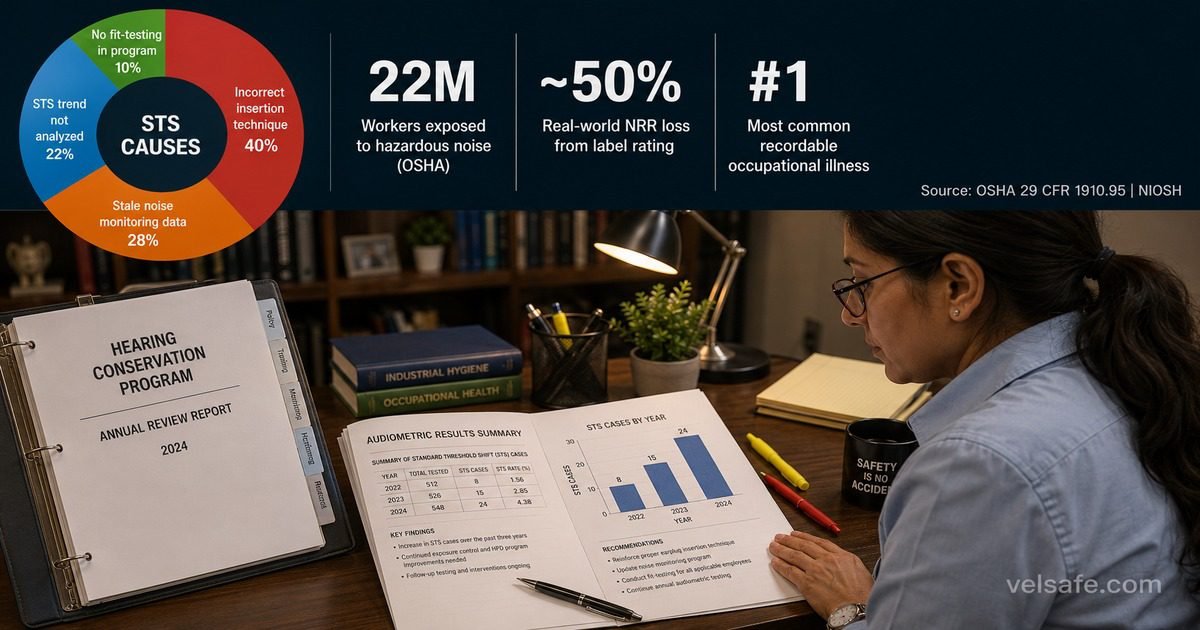
NIOSH field studies on hearing protector attenuation have consistently found that real-world attenuation falls well below labeled NRR values, often by 15 to 25 dB for foam earplugs. The main reason is insertion technique. Workers who receive a box of earplugs and a training presentation but have never had anyone watch them insert a plug and confirm the technique are, in many cases, receiving substantially less protection than the NRR label suggests. A program can complete 100 percent of its required activities and still not catch this.
Annual audiometric testing is where the gap eventually shows up. An STS, a standard threshold shift of 10 dB or more averaged at 2,000, 3,000, and 4,000 Hz compared to the baseline, is the signal. OSHA requires that confirmed STS cases be reported to workers within 21 days and that hearing protection be reviewed. What OSHA does not require is that the program investigate why the STS occurred. That investigation is left to the employer’s judgment, and published research on hearing conservation program effectiveness suggests it often does not happen.
What NIOSH Research Shows About Program Failure Patterns
NIOSH has published extensively on the gap between hearing conservation program compliance and hearing conservation program effectiveness. A 2011 NIOSH report on mining industry hearing loss found that workers in hearing conservation programs with high training completion rates and audiogram completion rates continued to show progressive hearing loss at rates inconsistent with adequate protection. The investigators found three common factors: noise monitoring that had not been updated after equipment changes, hearing protectors selected on labeled NRR without field verification of attenuation, and training that addressed program requirements without assessing whether workers could insert earplugs correctly.
Those three factors appear across industries. The pattern is not specific to mining. A 2014 study in the Journal of Occupational and Environmental Hygiene examined hearing conservation programs in manufacturing facilities and found that even in programs with full regulatory compliance, a substantial proportion of workers achieved personal attenuation ratings well below the levels needed to reduce their exposure to safe levels. The study concluded that fit-testing, which verifies the attenuation a specific worker achieves with a specific device, was the most reliable way to identify which workers were inadequately protected.
A labeled NRR of 33 on a foam earplug represents attenuation measured in a laboratory with trained subjects achieving a perfect seal. OSHA’s recommended derating method divides the result by two after subtracting seven, giving an estimated real-world attenuation of roughly 13 dB. Field attenuation estimation systems measure the actual attenuation a specific worker achieves in real time, accounting for their ear canal anatomy, their insertion technique, and the specific device they are using.
In facilities where fit-testing has been introduced following STS investigations, it frequently identifies workers achieving personal attenuation ratings of 10 to 15 dB from earplugs rated at NRR 33. At noise exposures in the 95 to 100 dBA range, 10 to 15 dB of actual attenuation means the worker’s effective dose remains above the permissible exposure limit regardless of whether the program’s paperwork shows them as protected.
The STS Trend Problem
OSHA requires STS cases to be reviewed for recordability each year. It does not require employers to compare STS rates across years or investigate whether the rate is increasing. Most programs review each year’s audiogram results independently, identify cases above the threshold, complete the required notifications and log entries, and file the results. The data that would reveal a worsening trend sits in three separate annual folders.
When OSHA inspects following a serious injury or illness, investigators frequently request multiple years of audiometric records and plot STS rates over time. What they find, according to OSHA enforcement summaries and industrial hygiene case literature, is that rising STS rates are common in facilities where the underlying causes have not been addressed. The year-over-year increase is visible in the data. It was never analyzed.
The implication for program management is practical: STS rate should be tracked as a rolling metric across years, broken down by work area and job classification. A single year’s rate has limited diagnostic value. Three years on one chart shows whether controls are working or whether something is eroding.
When Noise Monitoring Goes Stale
The standard requires re-monitoring when there is reason to believe exposure levels have changed. In practice, the trigger for re-monitoring is often the EHS manager’s memory of what changed, and that memory degrades over time. New equipment gets installed. A production shift gets added. A wall gets moved. The noise survey from four years ago no longer reflects what workers are exposed to.
OSHA enforcement records include numerous cases where the noise monitoring on file was several years old and the facility had made equipment changes since the survey. In those cases, workers were enrolled in the program based on exposure levels that no longer matched their actual work conditions, and their hearing protection was selected based on exposures that may have been significantly lower than what they were actually receiving. The program was compliant with the monitoring that existed. It was not protective against the noise that currently existed.
A practical approach: any time new noise-generating equipment is installed, treat that as a trigger for re-monitoring in the affected area before workers return to full production. Waiting for the next scheduled review cycle means operating with an unknown exposure for however long that cycle runs.
What Corrective Programs Actually Change
NIOSH guidance on restoring effectiveness to underperforming hearing conservation programs identifies several interventions that have demonstrated results in published follow-up studies. None of them are new requirements. They are existing program elements implemented with more rigor than the standard requires.
Three Questions to Ask Your Own Program
Rather than running through a generic checklist, the following three questions tend to reveal whether a hearing conservation program is actually protecting workers or primarily generating documentation.
When was the last time anyone watched your workers insert earplugs, not to observe whether they were wearing them, but to confirm they were inserting them correctly? Annual training sign-in sheets do not answer this question. Fit-testing or observed insertion competency checks do.
If you plotted your STS cases from the past three years on a single chart, would the line be flat, declining, or rising? If the answer is rising, that trajectory is the finding that warrants investigation, not the individual cases that crossed a recordability threshold.
Has any noise-generating equipment been added or changed since the last noise monitoring survey? If the survey is more than two or three years old and the facility has changed, the exposure data the program is operating on may not reflect what workers are actually receiving.
Lessons from the Published Record
Prevention Checklist
Key Takeaways
Frequently Asked Questions
What triggers OSHA’s STS recordability requirement?
An STS becomes recordable on the OSHA 300 log when it is work-related and the worker’s total hearing level is 25 dB HL or more above audiometric zero in the same ear. Not every STS that shows up on an annual audiogram meets both criteria. The employer, with input from a reviewing professional, determines work-relatedness based on exposure history, non-occupational factors, and the pattern of the shift. OSHA provides guidance on the work-relatedness determination in its recordkeeping standard at 29 CFR 1904.10.
How does NIOSH’s recommended NRR derating work, and why does it matter for program management?
OSHA recommends subtracting 7 from the labeled NRR and dividing the result by 2 to estimate real-world attenuation. For a foam earplug rated NRR 33, this yields an estimated 13 dB of actual protection. Whether a worker achieves even 13 dB depends on insertion technique. Workers who cannot demonstrate correct insertion may be achieving considerably less. At exposures in the mid- to high-90 dBA range, the difference between 13 dB and 8 dB of actual attenuation is the difference between an effective dose that approaches or exceeds the permissible exposure limit and one that does not.
Is fit-testing worth implementing if it is not required by the standard?
For workers at high noise exposures, it is. The primary question fit-testing answers is whether a specific worker is actually achieving adequate attenuation from the device they are using, which the NRR label and the training sign-in sheet cannot answer. NIOSH recommends fit-testing for all workers enrolled in hearing conservation programs. Programs that have introduced fit-testing following STS investigations have consistently found workers whose actual attenuation fell well short of what their exposure required, in some cases across years of program participation.
What should happen when an investigation after a confirmed STS finds that noise levels increased after the last monitoring survey?
The immediate response is re-monitoring to establish current exposure levels, followed by a review of whether the hearing protection being used by affected workers is adequate for the actual current exposure. If current exposure levels require higher attenuation than the devices in use can reliably provide, engineering controls should be evaluated. OSHA requires feasible engineering or administrative controls to be used before relying solely on hearing protection equipment. A noise level increase caused by new equipment is exactly the type of change that should trigger both re-monitoring and a control hierarchy review.
Government and Regulatory Sources
- OSHA – 29 CFR 1910.95 Occupational Noise Exposure Standard
- OSHA – 29 CFR 1904.10 Recording Criteria for Occupational Hearing Loss
- OSHA – Occupational Noise Exposure Overview
- NIOSH – Noise and Hearing Loss Prevention
Related VelSafe Articles
- Hearing Conservation: What Every Worker Needs to Know
- Hearing Conservation at Work: 10 Practical Tips
- HAZWOPER: Hierarchy of Controls Overview
Using This in Your Program Review
The patterns described here, outdated noise monitoring, unverified hearing protector attenuation, STS data reviewed year by year without trend analysis, appear across industries and facility sizes in the published occupational health literature. They are not unusual. They persist because the standard does not require the practices that would catch them. Fit-testing, observed insertion training, and multi-year STS tracking are each straightforward to implement and well-supported by NIOSH guidance. None of them require a program overhaul. They require adding verification steps to activities the program is already running. Find more hearing conservation and worker safety resources at velsafe.com.