WORKER SAFETY: Hearing Conservation (US)
Hearing Conservation: What Every Worker Needs to Know
Noise-induced hearing loss is the most common occupational injury in the United States and one of the most preventable. This guide covers what loud noise actually does to your ears, how to recognize when your hearing is at risk, how to use hearing protection correctly, and what your employer is required to provide under OSHA 29 CFR 1910.95.
WHY THIS MATTERS: Hearing Loss Cannot Be Reversed
No surgery can restore it
Once the tiny hair cells in your inner ear are destroyed by loud sound, they do not grow back. Hearing aids amplify what remains, but they cannot replace what is gone. Workers who lose significant hearing in their forties often do not understand it happened at work until years later.
It builds up without warning
Noise-induced hearing loss develops slowly, usually over years. There is no pain, no moment when it suddenly gets worse. Most workers notice it when conversations start becoming difficult to follow, or when they realise they have been turning the TV up more than they used to. By that point, the damage from years of unprotected exposure has already accumulated.
The scale of the problem
OSHA estimates 22 million US workers face hazardous noise exposure at work each year. Occupational hearing loss accounts for more than $240 million in workers compensation annually. Your employer is required by law to protect you from hazardous noise, and that requirement has teeth: OSHA actively cites employers who fail to implement programs.
How Loud Is the Noise Where You Work?
Sound is measured in decibels (dBA). The number that matters most for your protection is 85 dBA. At or above that level over an 8-hour shift, OSHA requires your employer to enroll you in a hearing conservation program, provide hearing protection, and give you annual hearing tests at no cost to you.
A useful field test: if you have to raise your voice to be heard by someone standing an arm’s length away, the background noise is probably at or above 85 dBA. That is not a precise measurement, but it is a reasonable indicator that you are in a noise hazard area and should be wearing protection.
Common Workplace Noise Levels and Damage Risk
Jackhammer, grinding, impact wrench (100+ dBA)
Damage risk in under 2 hours
OSHA’s permissible exposure limit at 100 dBA is 2 hours per day without protection. At 110 dBA, it drops to 30 minutes. At extreme levels, a few minutes of unprotected exposure is enough to cause measurable temporary shifts in hearing threshold.
Metal press, chain saw, loud machinery (95 dBA)
Damage risk in 4 hours
Many manufacturing and construction jobs routinely hit 95 dBA or above. A full 8-hour shift at this level without adequate hearing protection will cause damage over time.
Heavy equipment, loud factory floor (90 dBA)
OSHA permissible limit: 8 hours
90 dBA is OSHA’s 8-hour permissible exposure limit. Regular exposure at this level without protection causes cumulative hearing loss over a working career.
Busy factory, loud HVAC (85 dBA)
OSHA Action Level
At 85 dBA, your employer must enroll you in a hearing conservation program and make protection available. This is the trigger point for all program requirements under 29 CFR 1910.95.
Normal conversation, office (60-70 dBA)
No occupational risk
Noise below 85 dBA over a full shift is not generally considered hazardous for occupational hearing at the workplace, though off-shift exposures like concerts or power tools add to your total daily dose.
Warning Signs That Noise Is Affecting Your Hearing
Your body gives early warning signals when noise is causing stress to your hearing. The problem is that most workers either do not recognise them, or dismiss them as temporary when they may not be.
Ringing or buzzing after a loud shift
A ringing, buzzing, or hissing sound in your ears after work is called tinnitus. If it clears up after a quiet night, your hearing may have temporarily recovered. If it lingers into the next day, or keeps coming back after repeated shifts, that pattern is a sign that damage is accumulating. Tell your supervisor and ask for a hearing test.
Muffled hearing or trouble following conversations
When voices sound muffled or you find yourself asking people to repeat themselves more than usual after a noisy shift, your hearing has been temporarily reduced. One episode is not necessarily cause for alarm. A pattern across multiple shifts suggests your current protection level is not sufficient for your exposure.
You have to shout to be heard at arm’s length
This is a practical field indicator that noise in your area is at or above 85 dBA. It is not a medical test, but it is a reliable enough signal to warrant either wearing protection if you are not already, or reporting the noise level to your supervisor if you are in an area without posted hazard signage.
How to Use Hearing Protection Correctly
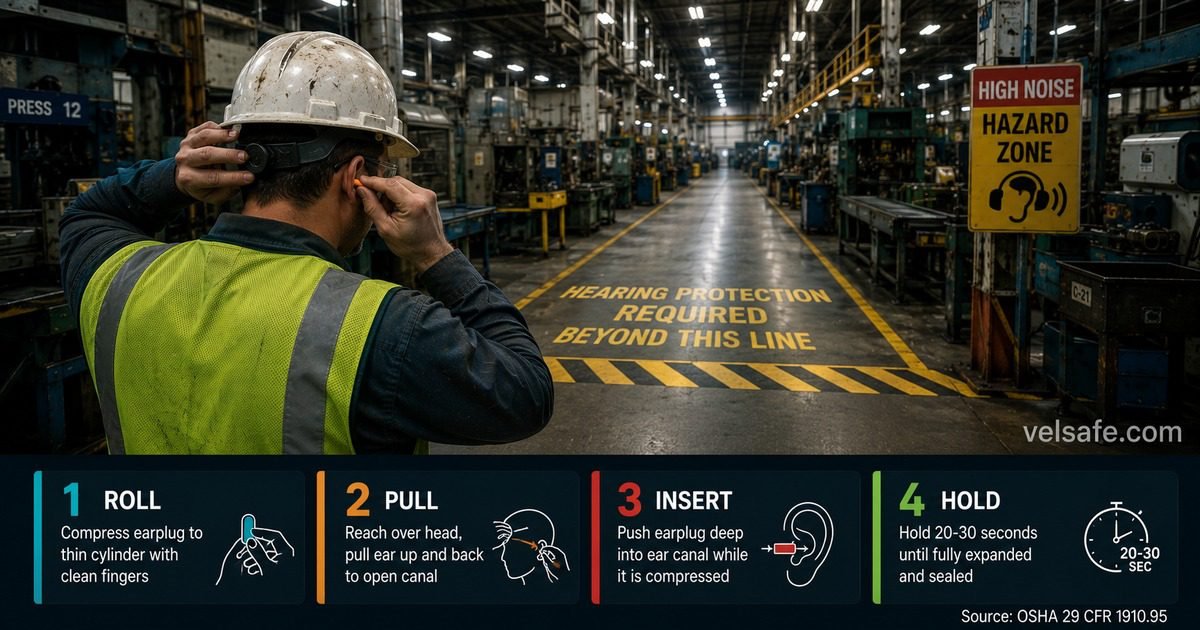
Most workers who experience noise-induced hearing loss were wearing earplugs. The issue is not whether they wore them. It is whether they wore them correctly. A foam earplug pushed in without being rolled down first provides a fraction of its rated protection. NIOSH research has consistently found that real-world attenuation from foam earplugs falls well below the labeled NRR, mainly because of insertion technique errors.
1
Roll the earplug before inserting it
With clean, dry fingers, roll the foam earplug down into a thin cylinder. The tighter the roll, the better it inserts. Trying to push in an unrolled earplug just compresses it against the ear canal opening without seating it properly. Workers who skip this step often believe they are protected when they are not.
2
Pull your ear back before inserting
Reach over your head with the opposite hand and gently pull your ear upward and back. This straightens the ear canal and makes it possible for the earplug to seat deep enough to seal. Inserting into an unsupported ear canal is one of the most common reasons earplugs under-perform in real conditions.
3
Hold it in place until fully expanded
Push the rolled earplug in while holding your ear back, then hold it gently in position for about 20 to 30 seconds while the foam expands and fills the canal. When it has expanded properly, ambient noise drops noticeably. If you can still hear your environment clearly, the earplug is not sealing and needs to be reinserted.
4
Keep it in for the entire time you are in the noise area
Removing earplugs briefly in a loud area eliminates most of the protection for that period. If you need to communicate with a colleague, step out of the noise zone to talk. Earmuffs, which can be pushed on and off more quickly, may be a better option for tasks that involve frequent short conversations in noisy environments.
What Type of Hearing Protection to Choose
Your employer is required to provide hearing protection at no cost. Most facilities offer foam earplugs, earmuffs, or both. Neither type is automatically better. The right choice depends on the noise level you are working in, how long you are in the area, and whether you can realistically achieve a good seal with the type you are using.
Type
Works Best When
Watch Out For
Foam earplugs (disposable)
Extended wear in consistent noise; high NRR when inserted correctly; comfortable for most workers in hot environments
Insertion technique errors are common and hard to self-detect; dirty hands contaminate the earplug; replace daily
Earmuffs (over-ear)
Jobs that require frequent entry and exit from noise zones; easier to verify they are being worn correctly
Glasses, beard stubble, or hair under the cushion break the seal significantly; inspect cushions for cracks
Earplugs and earmuffs together
Very high noise environments above 100 dBA where single protection does not bring exposure below the permissible limit
Adds approximately 5 dB beyond the higher-rated device; not a substitute for engineering controls at extreme levels
What Your Employer Must Provide
Your employer must
Your employer cannot
Provide hearing protection at no cost to you
Charge you for required hearing protection
Enroll you in a hearing conservation program if your exposure is at or above 85 dBA
Exclude you from the hearing conservation program if your measured exposure meets the threshold
Provide a baseline hearing test within 6 months of your first noise exposure and annually after that
Charge you for required hearing tests
Notify you in writing within 21 days if your annual hearing test shows a standard threshold shift
Retaliate against you for reporting a noise hazard or filing a complaint with OSHA
Train you on noise hazards and hearing protection use at least once per year
Require you to work in hazardous noise without adequate hearing protection
If You Think Your Hearing Has Been Affected
Report these symptoms to your supervisor:
Ringing or buzzing in your ears that has not resolved by the next morning. Noticeably muffled hearing that persists into the following day. Ear pain or pressure that developed during or after a noisy shift.
Your employer must offer a follow-up hearing test if you report symptoms consistent with noise exposure. Document the date, the location where you were working, and the conditions. If your employer does not respond to your report, you have the right to file a complaint with OSHA confidentially, at no cost, and without your employer knowing who made the report.
Supervisor Tips: What to Do on Your End
Wear protection every time you enter a noise area
Workers notice when supervisors bypass the rules they enforce. If you walk through a noise zone without hearing protection, you have communicated that the rule is optional. There is no faster way to undermine a hearing conservation program than a supervisor who does not follow it.
Stock earplugs at the point of entry
Place earplug dispensers at the boundary of every noise hazard zone so workers can access protection without returning to a locker or storage room. Friction in the process of getting protection is friction in actually using it.
Address non-compliance as soon as you see it
Non-compliance that is observed and not addressed tells everyone present that the rule does not apply consistently. A brief, non-punitive correction in the moment is more effective than a formal disciplinary process later for something that has now become a pattern.
Worker Checklist: Before and During Each Shift
Before Starting Work
Identify which areas on your route today are noise hazard zones
Pick up clean, undamaged hearing protection before approaching those areas
If using earmuffs, check that cushions are not cracked or hardened
Know where spare protection is if yours is damaged during the shift
During and After the Shift
Put hearing protection on before entering any noise hazard area, not once you are already inside
Keep it on the entire time you are in the noise zone
Report any ringing or muffled hearing that persists after the shift to your supervisor
Attend your annual hearing test when scheduled, and ask about your results
Key Takeaways
Hearing loss from noise accumulates across your working life
Every shift worked in excessive noise without adequate protection contributes to a total cumulative dose. The effects are not always apparent from one shift to the next, but they add up. Workers who retire after decades in high-noise environments without consistent protection often have significant permanent loss that affects their quality of life long after they leave the job.
Inserting an earplug correctly is a skill, not just a habit
The gap between what a foam earplug is rated to provide and what it actually provides for a given worker comes down almost entirely to technique. Roll, pull, insert, hold. If you have never had anyone watch you do this and confirm you are doing it right, ask your supervisor or safety manager to check. It takes under a minute and makes a real difference.
Your annual hearing test is an early warning system
The audiogram catches threshold shifts before you notice them in daily life. A shift detected early, while you are still working in the same environment, gives you and your employer an opportunity to adjust controls before more loss occurs. Skipping the test removes that opportunity. It is provided at no cost specifically so that you use it.
Frequently Asked Questions
Does my employer have to provide hearing protection for free?
Yes. Under 29 CFR 1910.95, employers must provide hearing protection at no cost to workers at or above the 85 dBA action level. If you are being asked to purchase your own earplugs or earmuffs for required use at work, that is not compliant with the standard.
What should I do if the noise at my worksite is hazardous but no hearing conservation program is in place?
Start by talking to your supervisor. If that does not produce a response, you can file a confidential complaint with OSHA using the online complaint form or by calling 1-800-321-OSHA. OSHA does not reveal the identity of complainants to employers. The agency investigates complaints from current and former employees, and you cannot be disciplined or terminated for filing in good faith. Employers who fail to implement required programs when noise levels meet the threshold are subject to citations and penalties.
Can I use music earbuds instead of earplugs for hearing protection?
No. Consumer earbuds, including noise-cancelling models, are not tested or rated as hearing protective devices under ANSI standards. They do not carry a Noise Reduction Rating and cannot be used to satisfy OSHA hearing protection requirements. Some workers have found that listening to music at high volume through earbuds while working in noisy environments actually increased their total daily noise dose rather than reducing it. Only devices with a published NRR qualify as hearing protection under the standard.
I already have some hearing loss. Is hearing protection still worth wearing?
More so than for workers without existing loss. Someone with existing hearing loss has less functional reserve to absorb additional damage. The same amount of additional noise-induced loss that causes minor inconvenience for a worker with normal hearing can be significantly more disabling for someone who starts from a reduced baseline. Hearing protection does not restore lost hearing, but it can slow or prevent further loss. That matters for quality of life well beyond retirement.
Government and Regulatory Sources
Related VelSafe Articles
Using This Information at Your Worksite
The information in this article reflects what OSHA requires and what NIOSH research shows about how hearing loss occurs and how it can be prevented. Your employer has legal obligations under 29 CFR 1910.95 to implement controls, provide protection, and conduct testing. Knowing those obligations helps you advocate for yourself and your colleagues when something is not right. If you are unsure whether your current protection is working, ask your safety manager or supervisor for a fit-test. It takes a few minutes and gives you an actual measurement of whether your earplug insertion is achieving adequate attenuation for your exposure. Find more worker safety resources at velsafe.com.