TIPS: Workplace Hearing Conservation
10 Hearing Conservation Tips That Actually Protect Workers
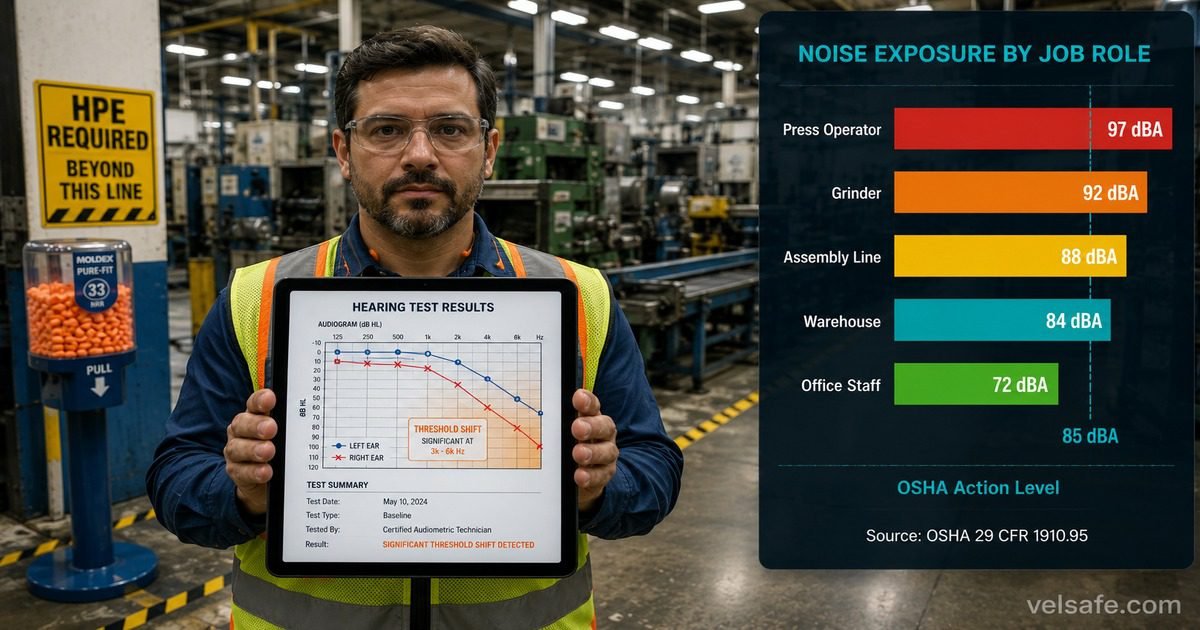
Occupational hearing loss is permanent and almost entirely preventable. OSHA estimates 22 million US workers face hazardous noise at work each year. These ten tips cover what safety managers and supervisors need to do differently to build programs that produce results, not just paperwork, under 29 CFR 1910.95.
Quick Tip Summary
1. Measure with dosimeters, not area meters
2. Evaluate engineering controls before issuing earplugs
3. Use derated NRR, not the label figure, when selecting HPE
4. Schedule audiograms Monday mornings, not mid-week
5. Train on insertion technique with observed competency checks
6. Fit-test workers at high-noise exposures
7. Treat every STS as a controls failure signal, not paperwork
8. Specify noise levels on hazard signs, not just “HPE Required”
9. Cover off-shift noise sources in training
10. Review STS rates across years, not just the current year
What You Will Learn
Why personal dosimetry matters more than area meters. How to calculate derated NRR. What fit-testing reveals that sign-in sheets cannot. How to use STS data as a diagnostic tool rather than a recordkeeping obligation.
10 Hearing Conservation Tips
1
Measure Noise with Personal Dosimeters, Not Area Meters
Why It Matters
A sound level meter placed at a fixed point measures ambient noise at that location. It does not measure what a worker receives as they move through different noise environments across an 8-hour shift. OSHA requires personal dosimetry for exactly this reason.
What To Do
Use a calibrated dosimeter worn in the worker’s breathing zone for a full representative shift. Measure all job classifications, including those that seem obviously safe. Equipment that sounds loud from across the room may be below 85 dBA at the operator’s position, and vice versa.
Common Mistake
Using a single sound level meter reading from one location to determine whether a job classification meets the 85 dBA action level. Workers in the same classification may have dramatically different exposures depending on where they stand and what tasks they perform during a shift.
Pro Tip
Monitor at least two workers per job classification. If results differ by more than 5 dBA, investigate the reason before deciding which result represents that classification’s exposure for program purposes.
2
Evaluate Engineering Controls Before Defaulting to Earplugs
Why It Matters
Hearing protection equipment is the last control in the hierarchy, not the first. An engineering control that reduces noise at the source protects every worker in the area on every shift, without depending on correct insertion technique or consistent compliance.
What To Do
Before issuing HPE, assess whether the source noise can be reduced through quieter equipment, vibration dampening, acoustic barriers, or process enclosures. The feasibility study does not need to be long. Even a documented one-page assessment shows OSHA that higher controls were considered.
Common Mistake
Treating the hearing conservation program as a PPE distribution system. Programs that consist primarily of earplug dispensers and annual sign-in sheets consistently underperform on STS rates because they place the entire burden of protection on individual worker behavior.
Pro Tip
Document engineering control feasibility even when controls are not implemented. “Not feasible at this time” with a documented reason is a defensible position. No documentation is not.
3
Calculate Derated NRR Before Selecting Hearing Protection
The NRR printed on an earplug package was measured in a laboratory with trained subjects achieving a perfect seal. Neither of those conditions applies in a working facility. OSHA recommends derating the labeled NRR by 50 percent to estimate real-world attenuation: subtract 7, then divide by 2.
The Calculation
NRR-33 earplug at 90 dBA exposure: (33 – 7) / 2 = 13 dB of estimated real-world protection. Effective exposure: approximately 77 dBA. At 95 dBA, the same earplug gives about 82 dBA at the ear. Whether that is sufficient depends on your specific exposure level and how long the worker is in the noise area each shift.
Workers who cannot insert foam earplugs correctly receive even less than the derated estimate, which is why insertion technique training and fit-testing matter. The derated NRR assumes at least adequate insertion. Without it, the calculation starts from a figure that already does not reflect real-world conditions.
4
Schedule Audiograms Strategically, Not Just Annually
Why It Matters
Annual audiograms are the program’s outcome measurement. A confirmed standard threshold shift of 10 dB or more at 2,000, 3,000, and 4,000 Hz averaged together is OSHA-recordable when work-related and signals that existing controls are not working for that worker. The results are only valid when testing conditions are clean.
What To Do
Establish the baseline audiogram within 6 months of first noise exposure, and require 14 hours of quiet time before the baseline. For annual tests, schedule workers on Monday mornings after a weekend away from the facility. They get natural quiet time without requiring you to manage pre-test HPE restrictions.
Common Mistake
Testing workers mid-week after regular noise exposure shifts, without enforcing quiet time beforehand. Temporary threshold shifts from noise exposure contaminate the results, making the audiogram appear worse than it is and potentially triggering STS investigations for what is actually a testing condition problem.
Pro Tip
Track audiogram completion rates by department. Consistent non-completion in a specific area often means scheduling is competing with production demands. Solve the scheduling problem at the supervisory level before the audit cycle, not after.
5
Train Workers on Insertion Technique, Not Just Earplug Awareness
What To Do Instead
Make every annual training session include hands-on practice. Workers roll, pull, insert, and hold an earplug while a trainer observes. No one is marked complete until they have demonstrated the technique correctly. Offer training in workers’ primary languages where the facility is multilingual.
What Completion Rates Actually Measure
A training completion rate of 100 percent tells you that workers attended and signed a form. It does not tell you whether any of them can insert an earplug correctly. These are different things, and programs that track only the former while using it as a proxy for the latter consistently produce poor STS outcomes.
6
Fit-Test Workers at High Noise Exposures
Why It Matters
A personal attenuation rating from fit-testing measures what a specific worker actually achieves with a specific device at the time of the test. That is different from the derated NRR, which estimates what an average worker might achieve. At exposures above 90 dBA, the margin between adequate and inadequate protection is narrow enough that the difference matters.
What To Do
Prioritise fit-testing for workers at 90 dBA TWA and above. Re-test when a worker switches HPE type or reports discomfort. Offer at least two HPE options, since ear canal anatomy varies significantly between individuals and a single earplug type will not achieve adequate attenuation for everyone.
Common Mistake
Issuing the same foam earplug model to every worker in the program regardless of noise level or anatomy. The worker at 95 dBA who happens to have an ear canal that does not seal well with your standard earplug receives inadequate protection. Fit-testing finds that worker before their audiogram does.
Pro Tip
Keep fit-test records linked to each worker’s audiometric file. If an STS is confirmed, you can immediately check whether their PAR was adequate for their measured exposure at the time of the last test.
7
Treat a Confirmed STS as a Controls Failure, Not a Paperwork Task
OSHA requires that when a work-related STS is confirmed, the employer notify the worker within 21 days and review the adequacy of their hearing protection. That is the compliance floor. What distinguishes effective programs from compliant ones is what happens next.
When an STS is confirmed, investigate:
Has noise monitoring in that area been updated recently? Is the worker’s HPE adequate for their actual measured exposure, using derated NRR? Has the worker’s insertion technique been observed and verified? Are there other workers in the same area or job classification who have not yet been tested? Is this a pattern, or a single case?
8
Specify the Noise Level on Hazard Signs, Not Just “HPE Required”
Why It Matters
A sign that says “Hearing Protection Required” tells a worker to put on earplugs. It does not tell them what noise level they are entering or what NRR they need. A worker entering a 95 dBA area with a low-attenuation earplug is technically complying with a generic sign while receiving inadequate protection.
What To Do
Post ANSI-compliant noise warning signs that include the measured noise level and the minimum required NRR for the area. Mount an earplug dispenser directly below or beside the sign so workers have no reason to proceed without protection.
Common Mistake
Using the same generic sign in every noise area regardless of actual noise level. A 90 dBA press room and a 100 dBA stamping area have very different protection requirements, and a single generic sign does not communicate that distinction to workers or visitors who may be in those areas briefly.
Pro Tip
Update signs whenever noise monitoring shows a level change in that area. A sign showing 88 dBA when the area is now running at 96 dBA following equipment changes is not just inaccurate. It may influence workers toward inadequate protection selection.
9
Cover Off-Shift Noise Sources in Annual Training
Why It Matters
Hearing loss accumulates from all noise sources, not just occupational ones. Workers who attend a concert on Saturday, mow the lawn Sunday morning, and return to a noisy factory on Monday arrive with a noise dose that has already begun before the shift starts. The total daily dose is what matters for cumulative damage.
What To Do
Include recreational noise sources in training materials. Provide take-home earplugs so workers have protection available for concerts, motorsports, lawn equipment, and power tools. It costs almost nothing and demonstrates that the program takes hearing protection seriously beyond compliance.
Common Mistake
Limiting the training scope to what OSHA requires without explaining why. Workers who understand that hearing loss is cumulative and permanent are more likely to protect themselves outside of work, which reduces the total dose coming back into Monday morning shifts.
Pro Tip
When an STS investigation cannot identify a clear workplace cause, include questions about recreational noise in the follow-up health interview. Off-shift exposure is a legitimate factor and sometimes the primary one.
10
Review STS Rates Across Multiple Years, Not Just the Current One
The annual review should include a rolling chart of STS cases by department and job classification across three to five years. A flat or falling line means controls are working. A rising line means something has changed, and that question should be answered before the next audiogram cycle.
What to include in the annual review
STS rate by department and classification over 3 to 5 years. Noise monitoring data currency (when was each area last surveyed?). HPE adequacy for current measured exposures. Training completion and competency verification rates. Status of any engineering control assessments.
Key Takeaways
STS rate is the outcome metric
Programs can achieve perfect scores on every compliance metric while workers steadily accumulate hearing loss. STS rate is the only number that tells you whether protection is working. Track it by department and plot it across years.
Frequently Asked Questions
At what noise level does OSHA require a hearing conservation program?
The action level is 85 dBA as an 8-hour TWA. At or above this level, employers must implement a hearing conservation program covering noise monitoring, audiometric testing, hearing protection, training, and recordkeeping. The PEL is 90 dBA. Engineering controls must reduce exposures below the PEL where feasible.
How long must audiometric testing records be retained?
Audiometric test records must be retained for the duration of the affected worker’s employment. Noise exposure measurement records must be retained for two years. These are separate retention requirements. OSHA 300 log entries for recordable STS cases have their own five-year retention requirement under the recordkeeping standard at 29 CFR 1904.
Does OSHA require fit-testing for hearing protection?
No, not currently. The 1910.95 standard requires that HPE be adequate to reduce worker exposure to acceptable levels, but it does not mandate individual fit-testing as the method for verifying that adequacy. NIOSH recommends fit-testing as a best practice, particularly for workers at high noise exposures. Several state OSHA plans and sector-specific standards (notably MSHA for mining) have moved toward requiring it. Where STS cases are occurring despite HPE use, fit-testing is the most efficient way to determine whether the HPE is the problem.
What should the annual program review include beyond checking completion rates?
A multi-year STS rate chart by department and classification, a currency check on noise monitoring against facility changes, a review of whether HPE selection still matches current measured exposures, and a check that hazard signage reflects current levels. Completion rate checks measure program inputs. The review should also measure program results.
Government and Regulatory Sources
Related VelSafe Articles
Applying These Tips to Your Program
Most of these tips require changing how existing resources are used: dosimeters instead of area meters, observed insertion practice instead of sign-in sheets, multi-year STS trend charts instead of annual count reviews. Find more hearing conservation resources at velsafe.com.