GUIDE: Hexavalent Chromium Safety
Hexavalent Chromium Safety: A Complete Step-by-Step Compliance Guide
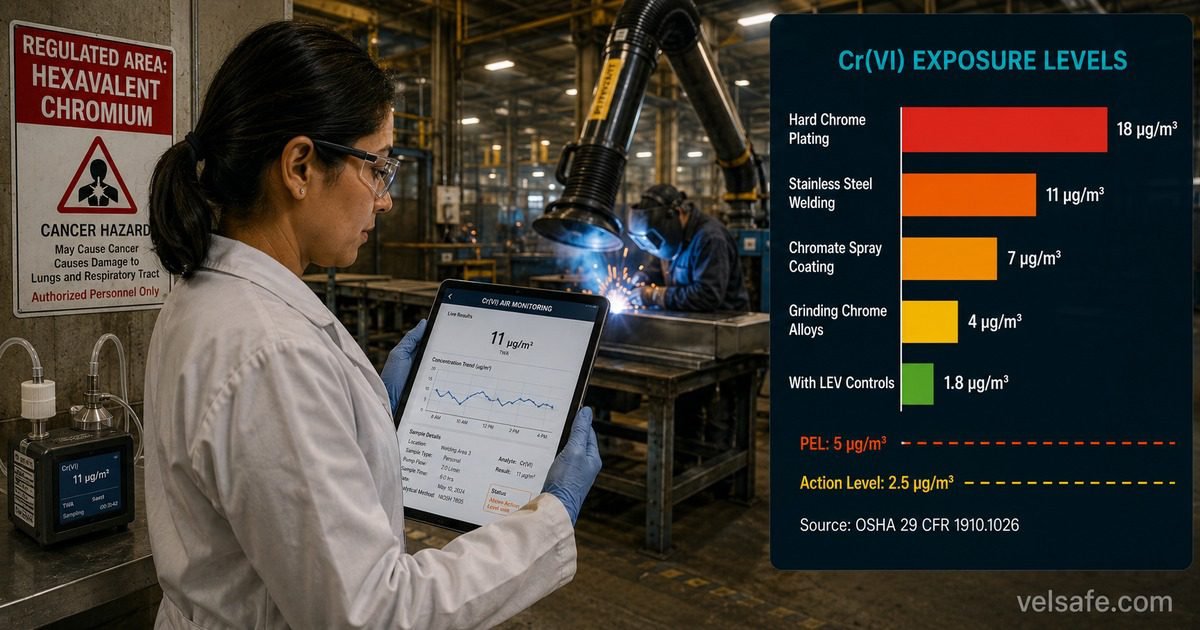
Hexavalent chromium (Cr(VI)) is one of the most tightly regulated occupational carcinogens in the US workplace. OSHA’s hexavalent chromium standards (29 CFR 1910.1026 for general industry and 29 CFR 1926.1126 for construction) set a permissible exposure limit of 5 micrograms per cubic metre as an 8-hour TWA, with a lower action level of 2.5 micrograms. This guide walks through every compliance requirement, from initial exposure assessment to medical surveillance, so safety managers and EHS professionals can build and maintain a program that meets the standard.
Quick Overview
What This Guide Covers
Initial exposure determination, engineering controls, respiratory protection, housekeeping, hygiene, medical surveillance, regulated area requirements, and recordkeeping under OSHA 29 CFR 1910.1026 and 1926.1126.
Who This Is For
EHS managers, safety officers, industrial hygienists, and supervisors in industries where Cr(VI) exposure occurs: welding, chromate coating, chrome plating, stainless steel manufacturing, pigment production, and construction involving chrome-containing materials.
Primary Standards
29 CFR 1910.1026 (General Industry), 29 CFR 1926.1126 (Construction), 29 CFR 1915.1026 (Shipyards). PEL: 5 micrograms/m3 as 8-hour TWA. Action Level: 2.5 micrograms/m3.
Time to Implement
Initial exposure determination: 30 days of new operations. Engineering controls: as soon as feasible. Medical surveillance enrollment: 30 days after exposure at or above the action level for 30 or more days per year.
What You Will Learn
How to determine whether your operations trigger Cr(VI) standard requirements
How to conduct initial and periodic exposure assessments
Which engineering controls OSHA expects before respiratory protection
How to set up and maintain regulated areas
What the medical surveillance program must include and when to enroll workers
Housekeeping, hygiene, and change area requirements
Recordkeeping obligations and retention periods
Common compliance gaps that generate OSHA citations
Prerequisites
Before beginning program development, confirm the following are in place. A Cr(VI) compliance program built without this foundation will have gaps that surface during an OSHA inspection or, worse, during a worker’s medical evaluation years later.
Operations Inventory
A complete list of all processes, materials, and tasks that may generate Cr(VI) exposure. Common sources include welding or cutting stainless steel or chrome-coated metals, spray painting with chromate-containing primers, hard chrome plating baths, and working with chrome pigments or chromate chemicals.
SDS Review for All Cr(VI)-Containing Materials
Safety Data Sheets for all products used in relevant operations, reviewed for Cr(VI) content. Not all chromium compounds are hexavalent. Trivalent chromium (Cr(III)) is not covered by the 1910.1026 standard. SDS review establishes which operations are in scope.
Designated Responsible Person
A named person responsible for the Cr(VI) compliance program who has authority to implement controls, coordinate medical surveillance, and maintain records. This person does not need to be a certified industrial hygienist, but should have direct access to one for exposure assessment work.
Accredited Laboratory Identified
A laboratory accredited for Cr(VI) air sampling analysis under NIOSH method 7703 or OSHA method ID-215. Identify the lab and confirm turnaround times and sample handling requirements before beginning air monitoring. Air samples that are handled incorrectly after collection are not recoverable.
Required Equipment and Documents
Item
Purpose
Required For
Personal air sampling pump and filter cassettes (37mm PVC or MCE)
Collecting personal breathing zone air samples for Cr(VI) analysis
Initial exposure determination
29 CFR 1910.1026 standard text and compliance guidance
Reference document for all compliance requirements
All steps
Written Cr(VI) exposure control plan
Documents controls, regulated areas, hygiene requirements, and emergency procedures for each job classification
Steps 2 through 5
Half-face or full-face APF respirators as required by exposure level
Respiratory protection when engineering controls cannot reduce exposure below the PEL
Step 4
Medical surveillance enrollment forms and occupational physician contract
Enrolling eligible workers in required medical surveillance program
Step 6
Step-by-Step Instructions
1
Determine Whether Your Operations Trigger Cr(VI) Standard Requirements
Objective
Establish whether any operations, materials, or tasks in your facility generate employee exposure to Cr(VI) at any level, and whether that exposure is likely to be at or above the action level of 2.5 micrograms per cubic metre.
Why It Matters
The standard applies to any workplace where employees may be exposed to Cr(VI) in any form. Many employers in welding, painting, and plating operations do not realise they have a Cr(VI) exposure until an OSHA inspection or a worker’s medical evaluation raises the issue. Early determination allows you to manage the program proactively.
Actions
Review SDS for all materials used in welding, cutting, grinding, painting, plating, and surface treatment operations. Any product containing chromate compounds, stainless steel alloys, or chrome-containing pigments may generate Cr(VI) when processed. Common exposure-generating operations include: welding or plasma cutting on stainless steel or chrome-alloy metals, thermal spray coating with chrome-containing materials, spray application of chromate primers, and hard chrome electroplating.
Expected Outcome
A written list of all operations potentially generating Cr(VI) exposure, the materials involved, the job classifications affected, and a preliminary assessment of whether measured air monitoring is needed or whether objective data (published exposure data, prior monitoring results) can support the initial determination.
Tip
OSHA allows employers to use historical monitoring data, industry monitoring databases, or objective data from similar operations to satisfy the initial exposure determination without new air monitoring. If your welding operations and materials are identical to those documented in published Cr(VI) exposure studies, you may be able to use that data. Document the basis for your determination in writing.
2
Conduct Initial and Periodic Air Monitoring
Objective
Quantify Cr(VI) exposure for each job classification through personal breathing zone air sampling, and use the results to determine which regulatory requirements apply and which controls are needed.
Why It Matters
Cr(VI) is a known human carcinogen (IARC Group 1). There is no safe level of exposure, but the regulatory framework draws hard lines at the action level (2.5 micrograms) and the PEL (5 micrograms). Monitoring results determine which obligations apply. Without valid air monitoring data, OSHA may cite you for failure to determine exposure and require monitoring anyway.
Actions
Collect personal breathing zone samples representing the full shift exposure for each job classification with potential Cr(VI) exposure. Samples must be collected and analysed using OSHA method ID-215 or NIOSH method 7703. Use an industrial hygienist for sampling design. If initial results show exposure below the action level, you may use objective data to demonstrate continued compliance without regular monitoring. If results are at or above the action level, monitoring must be repeated every six months. If results are at or above the PEL, monitoring must be repeated every three months.
Expected Outcome
Documented air monitoring results for each job classification, with laboratory reports, chain-of-custody forms, and a written determination of which exposure tier each classification falls in: below action level, at or above action level, or at or above PEL.
Warning
Notify affected employees and their designated representatives of air monitoring results within 15 working days of receiving them. This is a specific requirement of the standard, not a general best practice. Failure to notify is a citable violation independent of the exposure level itself.
3
Implement Engineering and Work Practice Controls
Objective
Reduce Cr(VI) airborne concentrations to or below the PEL through engineering controls and work practice changes before considering respiratory protection as the primary control strategy.
Why It Matters
OSHA requires employers to use engineering and work practice controls to the extent feasible before relying on respiratory protection. This mirrors the hierarchy of controls. Employers who jump straight to respiratory protection without documenting that engineering controls were evaluated and either implemented or found infeasible are vulnerable to citations even if workers are wearing respirators.
Actions
Engineering controls for Cr(VI) include: local exhaust ventilation (LEV) at welding and cutting operations with a capture velocity adequate for the application, enclosed spray booths for chromate coating operations, substitution of less hazardous alternatives where technically feasible, and process enclosure or isolation for plating operations. Work practice controls include: using lower-emission welding processes where feasible (MIG over TIG for some stainless applications), wet methods for cleanup rather than dry sweeping, and minimising the number of workers in the exposure area during peak-generating tasks.
Expected Outcome
A documented engineering controls assessment for each Cr(VI)-generating operation, with installed controls verified effective through post-control air monitoring, or a documented feasibility determination explaining why specific controls could not be implemented.
Tip
In welding operations, the position of the LEV capture hood relative to the welding arc matters enormously. A hood positioned 12 inches from the arc at the right angle can achieve 90 percent or better capture efficiency. The same hood positioned 24 inches away or at the wrong angle may capture less than 50 percent. Have a qualified industrial hygienist verify hood placement and airflow, not just confirm that LEV is present.
4
Establish Respiratory Protection When Engineering Controls Are Insufficient
Objective
Select, fit-test, and maintain respiratory protection adequate to reduce exposures below the PEL when engineering controls cannot achieve compliance on their own, or during non-routine tasks where engineering controls are not feasible.
Why It Matters
Respiratory protection for Cr(VI) must be selected based on the measured exposure level and the assigned protection factor (APF) of the respirator class. A half-face air-purifying respirator with a P100 filter has an APF of 10, meaning it can reduce exposure by a factor of 10. At an exposure of 40 micrograms, that brings the worker to 4 micrograms, still below the PEL but above the action level. The selection must be based on the actual exposure, not guesswork.
Actions
Select respirators based on the ratio of measured Cr(VI) exposure to the PEL (5 micrograms). Half-face APR with P100 (APF 10) is appropriate for exposures up to 50 micrograms. Full-face APR with P100 (APF 50) is appropriate for exposures up to 250 micrograms. PAPR with P100 (APF 25 to 1,000 depending on type) for higher exposures or workers who cannot achieve an adequate seal with a tight-fitting respirator. All tight-fitting respirators require annual fit-testing and a medical evaluation before use. Implement a full written respiratory protection program per 29 CFR 1910.134.
Expected Outcome
Written respirator selection justification for each job classification requiring RPE, with documented fit-test records and medical evaluations for all workers using tight-fitting respirators.
5
Establish Regulated Areas and Hazard Communication
Objective
Demarcate areas where airborne Cr(VI) concentrations exceed or are reasonably expected to exceed the PEL, restrict entry to authorised workers wearing required PPE, and ensure workers understand the hazards they face.
Why It Matters
Regulated areas serve two functions: they prevent unprotected workers from inadvertently entering high-exposure zones, and they document that the employer recognised and bounded the hazard. An uncontrolled Cr(VI) area where workers from adjacent tasks enter without protection is both a compliance failure and an exposure event that does not appear in air monitoring records.
Actions
Post “Regulated Area – Hexavalent Chromium” signs at all entry points to areas where Cr(VI) exceeds or is expected to exceed the PEL. Signs must include a cancer hazard warning and list required PPE. Restrict access to authorised personnel. Maintain a roster of authorised workers for each regulated area. Post SDS or the relevant Cr(VI) hazard information at or near the regulated area. Ensure all Cr(VI)-containing products are labelled per the Hazard Communication Standard (29 CFR 1910.1200).
Expected Outcome
Posted regulated area boundaries with compliant signage, a written authorised worker list, and complete HazCom documentation for all Cr(VI) materials in the facility.
6
Enrol Eligible Workers in Medical Surveillance
Objective
Provide required medical examinations and consultations to workers who are exposed to Cr(VI) at or above the action level for 30 or more days per year, and to workers who show signs or symptoms that may be related to Cr(VI) exposure regardless of measured exposure level.
Why It Matters
Cr(VI) is associated with lung cancer, nasal and sinus cancers, skin and nasal septum ulceration, and sensitisation dermatitis. Medical surveillance is designed to detect early health effects before they progress. Workers who develop Cr(VI)-related illness years after exposure may have a workers compensation or liability claim. An employer with documented surveillance records in place has significantly better legal standing than one who did not run the program.
Actions
Medical surveillance must be provided within 30 days of initial assignment and annually thereafter for eligible workers. Each examination must be performed by or under the supervision of a licensed physician and must include: a medical and work history with specific focus on Cr(VI) exposure, a physical examination with emphasis on the pulmonary, skin, and nasal mucosa, a chest X-ray at the physician’s discretion, pulmonary function tests at the physician’s discretion, and any additional tests the physician considers appropriate. The physician must provide a written opinion that states any occupational restrictions and any conditions that may place the worker at increased risk.
Expected Outcome
Documented medical surveillance records for each eligible worker, including the physician’s written opinion, retained for the duration of employment plus 30 years per OSHA’s retention requirements for medical records.
Warning
Medical surveillance records for Cr(VI)-exposed workers must be retained for the duration of employment plus 30 years. This is one of OSHA’s longest retention requirements and applies regardless of whether the worker develops any health condition. Ensure your records management system can accommodate this timeline, including for workers who leave the company.
7
Implement Housekeeping, Hygiene, and Change Area Requirements
Objective
Prevent ingestion and secondary exposure pathways by controlling Cr(VI) surface contamination and ensuring workers cannot carry contamination home or to eating areas.
Why It Matters
Cr(VI) on surfaces, clothing, and skin creates ingestion exposure pathways separate from airborne inhalation. Workers who eat lunch in the work area, handle food without washing, or wear contaminated clothing home expose themselves and potentially their families. The standard addresses this with specific hygiene and change area requirements that are frequently overlooked in programs focused primarily on air monitoring.
Actions
Use HEPA-filtered vacuuming or wet methods for housekeeping in areas with Cr(VI) surface contamination. Never use dry sweeping or compressed air to clean up Cr(VI)-containing dust or residue. Provide workers with adequate washing facilities and ensure they are used before eating, drinking, or using tobacco. Prohibit eating, drinking, and tobacco use in regulated areas. Provide change rooms and separate storage for contaminated work clothing and street clothing. Provide or arrange for laundering of contaminated clothing at no cost to workers. Workers must not remove contaminated clothing from the workplace except to send it to a laundry that handles contaminated garments.
Expected Outcome
Documented housekeeping procedures for each Cr(VI) work area, operational change rooms with separate contaminated and clean clothing storage, and a laundering arrangement for contaminated work clothing.
Best Practices
Substitute Before You Control
Where technically feasible, substitute non-chromate alternatives for chromate-containing primers, conversion coatings, and pigments before building engineering controls around the Cr(VI)-generating process. Substitution eliminates the hazard rather than managing it. In aerospace finishing, for example, trivalent chromium conversion coatings have replaced hexavalent chromate in many applications with comparable corrosion performance.
Verify LEV Performance Annually
Local exhaust ventilation systems degrade over time. Dampers shift, ductwork develops leaks, and fan performance declines. An LEV system that was providing adequate capture velocity when installed may not be doing so two years later. Annual airflow verification using a velometer or pitot tube measurement, with results compared to the original design specification, catches performance degradation before it results in overexposure.
Train on the Specific Cr(VI) Health Hazards, Not Just General Chemical Safety
Workers who understand that Cr(VI) causes lung cancer and that symptoms may not appear for decades are more motivated to follow hygiene procedures than workers told only that it is a regulated substance. The standard requires training to include specific health effects. Make that training concrete: what the cancer risk looks like, how the ingestion pathway works, and why the change room and washing requirements exist.
Common Mistakes
Common Mistake
Why It Fails and What to Do Instead
Treating all stainless steel welding as low-risk
Cr(VI) concentrations from stainless steel welding vary significantly by process, base metal alloy, consumable, and ventilation conditions. Published data shows a wide range. Without site-specific monitoring, assuming low risk is not defensible. Conduct personal breathing zone sampling before drawing conclusions about exposure level.
Providing respiratory protection without implementing the 29 CFR 1910.134 program
Cr(VI) respiratory protection triggers the full requirements of OSHA’s respiratory protection standard, including a written program, medical evaluations, fit-testing, and user training. Handing out respirators without these elements in place violates both 1910.1026 and 1910.134.
Using dry sweeping to clean up Cr(VI) dust
Dry sweeping resuspends Cr(VI) particles into the breathing zone of the worker doing the cleaning and anyone else in the area. The standard explicitly prohibits this. Use HEPA-equipped vacuums or wet methods for all Cr(VI) surface contamination.
Missing the 30-year medical records retention requirement
Many facilities retain medical records for the duration of employment plus five years, which is insufficient for Cr(VI). The standard requires duration of employment plus 30 years. This is particularly problematic for small employers who may not have records systems designed for this timeline, and for facilities that change ownership.
Compliance Notes
The Cr(VI) standard applies to any occupation where employees may be occupationally exposed, with a small exception for exposures resulting from Portland cement. The standard covers three separate CFR sections: 29 CFR 1910.1026 for general industry, 29 CFR 1926.1126 for construction, and 29 CFR 1915.1026 for shipyards. The PEL and action level are identical across all three: 5 micrograms per cubic metre and 2.5 micrograms per cubic metre as 8-hour TWAs respectively.
State Plan states may have adopted Cr(VI) standards that are at least as effective as the federal standard. California’s Cr(VI) regulation under Title 8 of the California Code of Regulations may include additional requirements. Employers operating in State Plan states should verify compliance against both federal and state requirements.
Troubleshooting
Air monitoring results remain above the PEL after LEV installation
First verify LEV system performance: measure capture velocity at the hood face and compare to design specification. Check for ductwork leaks, damper positions, and fan operation. If the system is performing to specification and exposure still exceeds the PEL, re-evaluate the hood design and placement with a ventilation engineer. In the interim, escalate respiratory protection to a higher APF device and document that engineering controls are being improved.
Workers refuse to wear respirators due to discomfort
Investigate whether the selected respirator is appropriate for the worker’s facial characteristics. Workers who cannot achieve a satisfactory fit with a half-face APR may need a full-face unit or a PAPR. If medical restrictions prevent tight-fitting respirator use, a PAPR with a loose-fitting hood is an option. The solution is not to document refusal and move on. An unprotected worker in a Cr(VI)-exposed environment is an ongoing health risk and a significant liability.
Worker presents with nasal symptoms or skin ulceration
Nasal septal perforation, nasal ulceration, and chrome holes (skin ulcers at points of contact with Cr(VI)) are occupational disease signals. Refer the worker immediately to the occupational medicine physician for evaluation outside the normal surveillance cycle. Review air monitoring data for the worker’s classification and re-evaluate exposure controls. Document the referral, the clinical findings, and the control review as part of the exposure control program records.
Quick Checklist
Exposure Assessment
All Cr(VI)-generating operations identified and documented
Personal breathing zone air monitoring completed for each job classification
Results reviewed and tiered: below AL, at/above AL, at/above PEL
Monitoring results communicated to workers within 15 working days
Controls and Protection
Engineering controls implemented and verified effective by post-control monitoring
Respirators selected based on measured exposure and APF
All respirator users medically cleared and fit-tested annually
Regulated areas posted and access restricted
Medical and Records
All eligible workers enrolled in medical surveillance within 30 days
Annual medical examinations scheduled and completed
Medical records retained: duration of employment plus 30 years
Air monitoring records retained: 30 years from date of collection
Key Takeaways
The Action Level Triggers Most of the Standard’s Requirements
Many employers focus on the PEL of 5 micrograms as the relevant threshold, but most of the Cr(VI) standard’s requirements, including periodic monitoring, medical surveillance enrollment, and regulated area establishment, are triggered at the action level of 2.5 micrograms. An operation that measures at 3 micrograms is in compliance with the PEL but must still have a medical surveillance program and periodic monitoring in place.
Engineering Controls Come Before Respiratory Protection
OSHA expects employers to implement feasible engineering controls before relying on respirators. A program that uses respirators as the primary means of compliance without a documented assessment of why engineering controls are not feasible is not compliant with the standard’s intent. Local exhaust ventilation at welding and spray operations, process enclosure for plating, and wet methods for cleanup are all expected first steps.
Ingestion and Skin Contact Are Exposure Pathways, Not Just Inhalation
Programs that monitor air and provide respirators but neglect housekeeping, hygiene practices, and change room requirements are controlling only one of the three Cr(VI) exposure pathways. Ingestion from contaminated hands, eating surfaces, and clothing contributes to total body burden. Skin contact with Cr(VI) solutions and dust causes chrome holes and sensitisation dermatitis. The hygiene requirements in the standard address real health risks, not administrative formalities.
Frequently Asked Questions
Does the Cr(VI) standard apply to occasional or short-duration welding on stainless steel?
Yes, the standard applies whenever employees may be occupationally exposed to Cr(VI) in any form. However, the frequency and duration of exposure determine which specific requirements are triggered. Medical surveillance, for example, is required for workers exposed at or above the action level for 30 or more days per year. A worker who welds stainless steel for two days per year does not meet that threshold, though initial exposure determination and appropriate controls still apply.
Can we use existing air monitoring data from a similar facility to satisfy the initial determination requirement?
OSHA allows employers to use objective data, including exposure measurements from operations that are substantially similar, to satisfy the initial exposure determination without new air monitoring. The key requirement is that the operations, materials, equipment, and environmental conditions be substantially similar, and that this determination be documented in writing with the data referenced. If conditions differ in ways that could affect exposure, new site-specific monitoring is required.
What does the physician’s written opinion have to include for Cr(VI) medical surveillance?
The written opinion must include: any medical conditions that place the employee at increased risk from Cr(VI) exposure, any recommended limitations on the worker’s Cr(VI) exposure or use of PPE, a statement that the worker has been informed of the results and any conditions requiring further evaluation, and a statement that the worker has been notified of the need for additional medical examinations if indicated. The opinion must not reveal specific diagnoses unless the worker consents.
How do we handle Cr(VI) waste and contaminated materials?
Cr(VI)-containing waste is subject to EPA regulations under the Resource Conservation and Recovery Act (RCRA) as a listed hazardous waste (F006 for electroplating wastewater treatment sludge, among others) and potentially as a characteristic hazardous waste for toxicity. Contaminated PPE, wipes, and other materials may also be classified as hazardous waste depending on Cr(VI) concentration. Consult your environmental compliance team and local EPA region for disposal requirements applicable to your specific waste streams.
Government and Regulatory Sources
Related VelSafe Articles
Building a Cr(VI) Program That Holds Up to Inspection
OSHA’s Cr(VI) standard is specific, detailed, and regularly enforced. The citations that appear in OSHA inspection records after Cr(VI) incidents follow predictable patterns: missing air monitoring, respirators without a written program, medical surveillance not initiated within the required timeframe, and records that do not meet the 30-year retention requirement. A program built on the seven steps in this guide addresses each of those gaps directly. The standard exists because Cr(VI) causes cancer. Building the program is the work. Find more hazardous substance compliance resources at velsafe.com.