PRACTICE TEST: High Purity Water Systems
High Purity Water Systems: Practice Test and Knowledge Review
Test your knowledge of high purity water system types, water quality standards, contamination control, system maintenance, and regulatory requirements for pharmaceutical, semiconductor, and healthcare applications. Questions reflect core competencies required for facilities, engineering, and compliance professionals working with purified and highly purified water systems.
How to Use This Practice Test
Read each question and consider your answer before reviewing the explanation. Questions span four areas: water quality specifications, system design and types, contamination prevention, and regulatory framework. For any question you answer incorrectly, review the referenced standard or guidance document before moving on.
Section 1: Water Quality Standards and Specifications
High purity water systems are defined by what they remove, measured against tiered quality specifications. The United States Pharmacopeia (USP), the European Pharmacopoeia (EP), and ASTM International each publish standards that set conductivity, total organic carbon (TOC), microbial, and endotoxin limits for different grades of purified water used in pharmaceutical manufacturing, laboratory settings, and healthcare applications.
Question 1: According to USP standards, what is the maximum conductivity limit for Purified Water (PW) at 25 degrees Celsius?
A. 0.1 microsiemens per centimetre
B. 1.3 microsiemens per centimetre
C. 5.1 microsiemens per centimetre
D. 10.0 microsiemens per centimetre
Correct Answer: B
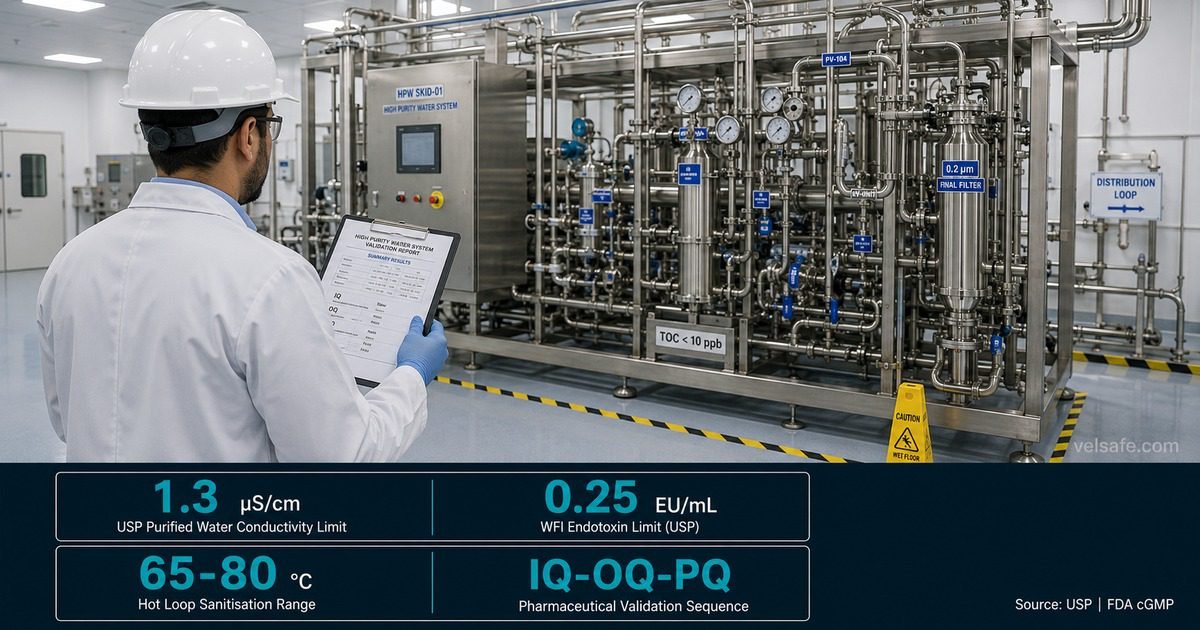
USP Purified Water has a conductivity limit of 1.3 microsiemens per centimetre at 25 degrees Celsius, as specified in USP monograph. This conductivity requirement reflects the expected ionic purity of water that has been processed through reverse osmosis, ion exchange, or distillation. Water for Injection (WFI) has the same conductivity limit but adds endotoxin and sterility requirements that Purified Water does not carry. Conductivity is used as a surrogate for ionic contamination because it is continuous, real-time, and does not require sampling.
Question 2: Which water quality parameter is specifically required for Water for Injection (WFI) but NOT for USP Purified Water?
A. Total Organic Carbon (TOC) limit
B. Conductivity limit
C. Bacterial Endotoxin limit
D. pH requirement
Correct Answer: C
Bacterial endotoxin testing is required for Water for Injection (WFI) but not for USP Purified Water. WFI must not contain more than 0.25 Endotoxin Units (EU) per millilitre, measured by the Limulus Amebocyte Lysate (LAL) test. This requirement reflects WFI’s intended use in parenteral drug preparation and medical device rinsing, where endotoxins entering the bloodstream can cause severe fever responses (pyrogenic reactions). Both PW and WFI share the same TOC limit (500 ppb or less) and conductivity limit.
Question 3: ASTM Type I reagent water is primarily specified for which type of application?
A. General laboratory washing and rinsing
B. Preparation of buffers and reagent solutions
C. Trace metal analysis, HPLC, and critical analytical procedures
D. Steam sterilisation and autoclave operations
Correct Answer: C
ASTM Type I reagent water, with a resistivity of at least 18.2 megohm-centimetres and TOC below 10 ppb, is specified for the most critical analytical applications where trace contaminants would interfere with results: trace metal analysis by ICP-MS, HPLC mobile phase preparation, and molecular biology procedures such as PCR. ASTM Type II (resistivity 1 megohm-cm or greater) is used for general analytical procedures and reagent preparation. Type III is suitable for washing glassware and general laboratory use. The ASTM grades are independent of the USP pharmaceutical grades.
Section 2: System Design and Technology
High purity water systems combine multiple treatment technologies in sequence to achieve the required water quality grade. The selection and sequencing of these technologies depends on the quality of the incoming feed water, the required output quality, the volume requirements, and whether the system must meet pharmaceutical GMP or other regulatory standards.
Question 4: In a pharmaceutical water purification system, what is the primary purpose of the pre-treatment stage that uses activated carbon?
A. Removing dissolved salts and ionic contamination
B. Removing chlorine and chloramine residuals that would damage downstream RO membranes
C. Removing bacterial endotoxins
D. Removing particulates larger than 0.2 microns
Correct Answer: B
Activated carbon in the pre-treatment stage primarily removes free chlorine and chloramines from municipal water supplies. This is critical because chlorine and chloramine rapidly degrade reverse osmosis (RO) membranes, reducing their rejection efficiency and shortening their service life. Activated carbon also removes some organic compounds and improves taste and odour, but its primary protective function in pharmaceutical pre-treatment is dechlorination. Ion exchange resins handle dissolved salt removal downstream. Absolute filters address particulate removal. Endotoxin reduction is achieved by ultrafiltration or the RO membrane itself.
Question 5: Why are pharmaceutical-grade high purity water distribution loops typically operated at elevated temperatures (65 to 80 degrees Celsius) or designed to circulate continuously?
A. To maintain the required conductivity level
B. To prevent biofilm formation and microbial colonisation in the distribution piping
C. To reduce TOC levels in the stored water
D. To meet the endotoxin specification during storage
Correct Answer: B
Hot looped systems (65 to 80 degrees C) and continuously circulating ambient loops are both designed to prevent biofilm formation in distribution piping. Biofilm is a particular problem in high purity water systems because the water itself provides no antimicrobial residual (unlike chlorinated potable water), and any stagnant section becomes a rapid colonisation point. At temperatures above 65 degrees C, most water-borne microorganisms cannot survive. In ambient circulating loops, the constant flow prevents the stagnation that allows biofilm to establish. Dead legs, infrequently used use points, and improperly sloped sections are the most common biofilm initiation sites in pharmaceutical water systems.
Question 6: What is a “dead leg” in a high purity water distribution system, and why is it problematic?
A. A section of piping where water pressure drops below the minimum specification, reducing flow rate at use points
B. A length of piping beyond a use point or branch connection where water can stagnate, promoting microbial growth and contamination
C. A pipe section that cannot be sanitised by steam or hot water due to its position in the system
D. The section of piping between the storage tank and the distribution pump
Correct Answer: B
A dead leg is a section of piping beyond a use point connection, valve, or branch where water sits without flowing during normal loop circulation. The ISPE (International Society for Pharmaceutical Engineering) guideline recommends that dead legs not exceed a length-to-diameter ratio of 6:1 for ambient loops and 3:1 for hot loops. Stagnant water in dead legs supports rapid microbial colonisation because it is outside the flow path, does not receive the benefit of the circulating system’s velocity or temperature, and accumulates nutrients over time. Regular flushing of infrequently used use points is a critical operational requirement.
Section 3: Contamination Control and System Maintenance
High purity water quality degrades through multiple mechanisms: microbial contamination from biofilm, chemical re-contamination from piping materials and gaskets, and physical contamination from particulates. Effective contamination control requires both correct system design and disciplined operational and maintenance practices.
Question 7: Which sanitisation method is considered the most effective for pharmaceutical Water for Injection distribution systems?
A. Chemical sanitisation with ozone followed by UV irradiation
B. Periodic flush with high-concentration sodium hypochlorite solution
C. Continuous hot water circulation at 65 to 80 degrees Celsius or periodic steam sanitisation
D. UV irradiation at 254 nanometres at each use point
Correct Answer: C
Hot water sanitisation, either continuous circulation at 65 to 80 degrees C or periodic steam sanitisation, is considered the most effective method for WFI distribution systems. Heat eliminates biofilm without introducing chemical residuals that would need to be removed before use. Chemical sanitisation (ozone, hydrogen peroxide, peracetic acid) can be effective for ambient PW systems but requires a subsequent flush and residual monitoring step to confirm the chemical has been removed before production use. UV irradiation kills planktonic bacteria in the water stream but does not penetrate established biofilm and is therefore a supplemental measure rather than a primary sanitisation method.
Question 8: What is the primary reason pharmaceutical high purity water systems use electropolished stainless steel (316L) piping rather than standard 304 stainless steel or thermoplastic piping?
A. 316L has better resistance to the higher temperatures used in hot looped systems
B. Electropolished 316L provides an ultra-smooth interior surface that resists microbial adhesion and is easier to clean and sanitise
C. 316L is the only material approved by FDA for pharmaceutical water systems
D. Electropolishing removes iron from the surface, preventing ionic leaching into the water
Correct Answer: B
Electropolishing creates an ultra-smooth inner surface finish (typically Ra 0.5 micrometres or less) that reduces the surface area available for microbial adhesion and biofilm formation, and is significantly easier to clean and sanitise than mechanically polished or unfinished surfaces. The 316L grade (low carbon) is preferred over 304 because its molybdenum content provides better resistance to pitting corrosion, particularly in environments with chloride ions. The electropolishing process also enriches the chromium oxide passive layer on the surface, improving corrosion resistance. Thermoplastic piping may leach plasticisers and is more difficult to inspect and validate for pharmaceutical applications.
Section 4: Regulatory Framework and Compliance
Question 9: Under FDA’s cGMP regulations, a pharmaceutical water system must be validated. What are the three qualification phases typically completed as part of this validation?
A. Design Qualification (DQ), Installation Qualification (IQ), and Operational Qualification (OQ)
B. Installation Qualification (IQ), Operational Qualification (OQ), and Performance Qualification (PQ)
C. Design Qualification (DQ), Installation Qualification (IQ), and Performance Qualification (PQ)
D. Process Validation (PV), Cleaning Validation (CV), and Analytical Method Validation (AMV)
Correct Answer: B
The standard three-phase qualification approach for pharmaceutical water systems consists of Installation Qualification (IQ), Operational Qualification (OQ), and Performance Qualification (PQ). IQ verifies that the system was installed according to the approved design and specifications. OQ verifies that the system operates within defined parameters across its intended operating range. PQ, typically conducted over three phases of progressive water sampling intensity, demonstrates that the system consistently produces water meeting all quality specifications under routine operating conditions over an extended period. Design Qualification (DQ) is often completed before installation but is separate from the IQ-OQ-PQ sequence.
Question 10: An alert limit exceedance in a pharmaceutical water system monitoring programme requires which response from the quality or facilities team?
A. Immediate shutdown of the water system and product quarantine
B. Investigation to determine the root cause and increased sampling frequency, but water use may continue while the investigation is underway
C. Repeat testing using an alternative method to confirm the result before any action is taken
D. Immediate sanitisation of the entire distribution loop before any further water use
Correct Answer: B
Alert limits are early warning thresholds set below action limits. An alert limit exceedance signals that the system may be trending toward a condition that could compromise water quality, but does not by itself indicate that the water is out of specification. The appropriate response is investigation and increased monitoring, not automatic shutdown or quarantine. Action limits, set at or near the specification limit, trigger a stronger response that may include temporary suspension of water use pending investigation and remediation. Alert and action limits are established during validation and documented in the water system monitoring plan. The specific response to each level must be defined in standard operating procedures before monitoring begins.
Answer Key Summary
Q
Topic
Answer
1
USP Purified Water conductivity limit at 25 degrees C
B
2
Parameter required for WFI but not USP Purified Water
C
3
ASTM Type I reagent water primary application
C
4
Purpose of activated carbon in pharmaceutical pre-treatment
B
5
Why hot loops and circulating systems prevent contamination
B
6
Definition and hazard of a dead leg in distribution piping
B
7
Most effective sanitisation method for WFI distribution
C
8
Why electropolished 316L stainless steel is specified
B
9
Three qualification phases for pharmaceutical water system validation
B
10
Appropriate response to alert limit exceedance in monitoring
B
Score Interpretation
9-10
Strong Understanding
Solid grasp of water quality specifications, system design principles, contamination control, and pharmaceutical regulatory requirements for high purity water systems.
6-8
Review Recommended
Review USP and ASTM water quality grades, dead leg definition and limits, hot loop sanitisation rationale, and the alert limit vs action limit response framework before your next assessment.
0-5
Additional Study Needed
Review USP water monographs, FDA guidance on high purity water systems, ISPE water baseline guide, and ASTM reagent water specifications before your next study session.
Government and Regulatory Sources
Related VelSafe Articles
Continue Preparing for Your Certification Assessment
High purity water system knowledge spans water chemistry, mechanical engineering, microbiology, and pharmaceutical regulatory compliance. Practitioners who understand how water quality grades are defined, why specific system design choices exist, and what FDA and USP require for validation and monitoring are better prepared for both compliance audits and day-to-day system management. Find more practice tests and compliance study resources at velsafe.com.