

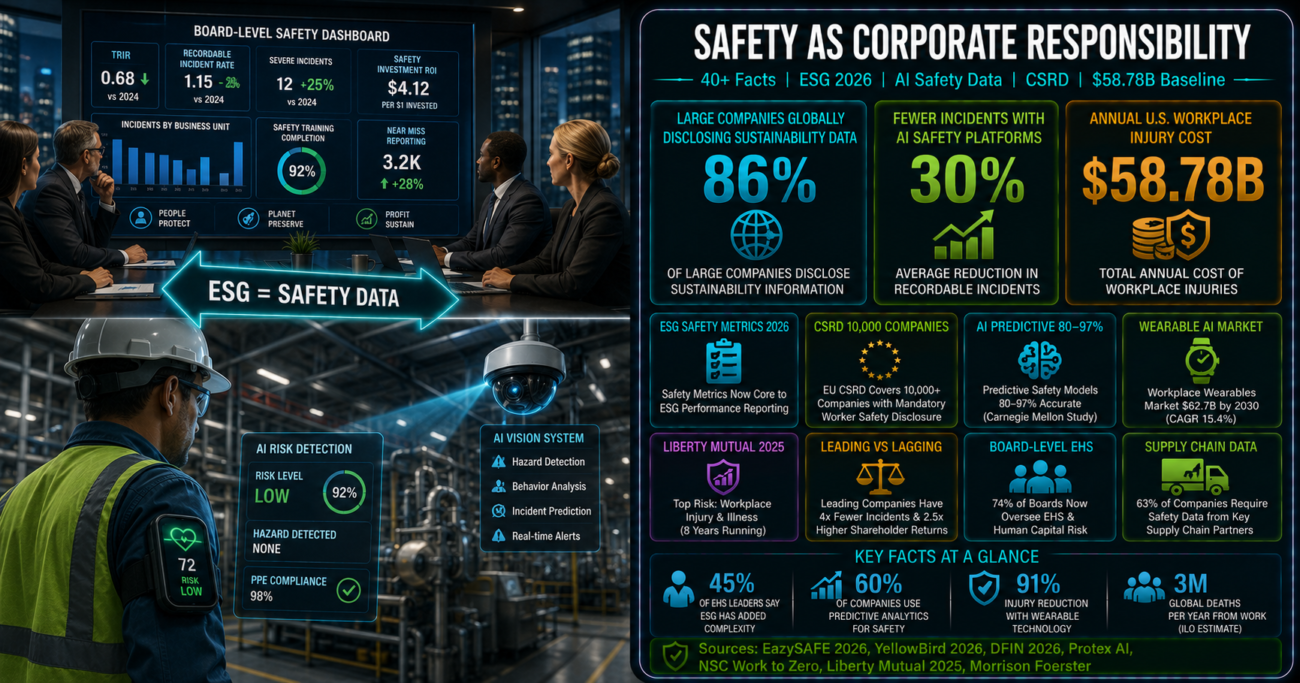
Workplace safety has crossed a threshold. It is no longer managed solely within EHS departments and reviewed quarterly by operations leadership. It now appears on board-level dashboards as an enterprise risk management indicator, in ESG disclosure filings reviewed by institutional investors, and in supply chain audit questionnaires sent from large multinationals to their tier-one suppliers. The shift from compliance checkbox to corporate governance indicator has accelerated significantly between 2024 and 2026 – driven by regulatory pressure, investor sophistication, and the technological capability to prove safety performance with data rather than assert it with narrative.
At the same time, the technology available to safety programs has reached a capabilities threshold that was not accessible five years ago. AI-powered computer vision, wearable biometric monitors, predictive analytics platforms, and digital twin simulations are shifting safety management from reactive to genuinely predictive – from counting incidents after they happen to modeling which workers, processes, and environments are most likely to produce harm in the next shift. This article compiles 40+ statistics on the ESG-safety intersection, the technology transformation, the regulatory framework driving disclosure, and what the 2026 landscape requires of organizations that want safety to function as a strategic asset rather than a compliance cost center.
Editor's Choice: Key Safety, ESG, and Corporate Responsibility Statistics for 2025-26
1. Safety as the 'S' in ESG: Why Investors Are Watching Workplace Data in 2026
- For several years, the ESG conversation was dominated by the “E” pillar: carbon footprints, renewable energy targets, and net-zero roadmaps. As those metrics have become highly standardized, institutional investors and private equity firms have shifted their lens to the “S” pillar – specifically how organizations manage their most volatile risk asset: human capital. Workplace health and safety is the most measurable and auditable component of human capital management. (EazySAFE, May 2026)
- DFIN’s April 2026 ESG trends analysis identified that ESG considerations are expanding beyond environmental topics to explicitly include workforce stability, safety, and board oversight as top investor focuses for 2026. Governance quality tied to worker safety is now central to how long-term value is evaluated by institutional analysts. (DFIN, April 2026)
- The auditor’s perspective, as articulated by EazySAFE (May 2026): “A high safety training deficit or a fragmented, paper-based compliance system is treated as a hidden debt.” When equity analysts evaluate businesses that rely on physical operations, inadequate safety infrastructure is modeled as future liability – potential litigation, regulatory enforcement, and operational disruption – that depresses valuation. (EazySAFE, May 2026)
- YellowBird’s 2026 EHS Trend Report found that 45% of EHS leaders say ESG and sustainability mandates have increased the complexity of their roles, often at the cost of attention to core safety functions. The risk of ESG integration without adequate resourcing is that safety professionals spend more time on reporting frameworks and less time on the field-level hazard management that prevents incidents. (YellowBird, December 2025)
- Gable.to’s April 2026 ESG reporting guide states plainly: “Even if your company isn’t subject to mandatory reporting yet, your board, your investors, or your largest customers are probably asking for this data.” The practical implication is that safety data systems that were built for internal tracking are now under external disclosure pressure regardless of regulatory scope. (Gable.to, April 2026)
2. The Regulatory Landscape: CSRD, OSHA, ISO 45001, and the U.S.-Europe Divergence
- Morrison Foerster’s February 2026 analysis of corporate sustainability trends describes a clear geographic split: in the U.S., federal ESG disclosure is stalling or reversing; outside the U.S., more than 30 jurisdictions – including major Asian markets – are advancing mandatory disclosure regimes across climate, human capital, and governance. For multinational companies, compliance strategy must now differ by jurisdiction. (Morrison Foerster, February 2026)
- The EU CSRD scope was significantly narrowed in 2025 – from an initial target of 45,000 companies to approximately 10,000 companies with over 1,000 employees and over 450 million EUR in revenue. However, supply chain pressure means that tier-two and tier-three suppliers to these 10,000 companies will be asked for safety and sustainability data as part of their customers’ disclosure obligations. (Gable.to, April 2026)
- ComplianceQuest’s March 2026 EHS trends report identifies that EHS teams are entering a new era where more contractors on site, evolving OSHA and ISO requirements, pressure to report ESG metrics, climate-related risks, and new forms of workplace hazards are reshaping how safety programs must operate. Traditional EHS management systems cannot keep pace with this convergence of demands. (ComplianceQuest, March 2026)
- Climate-related physical risks are a new regulatory driver for safety programs. CC-Global’s January 2026 EHS regulations analysis notes that governments and regulators increasingly expect organizations to integrate climate resilience into their operational and safety planning – covering extreme heat exposure for outdoor workers, flood risk for manufacturing sites, and wildfire smoke for field operations. (CC-Global, January 2026)
3. AI in Workplace Safety: Predictive Analytics, Computer Vision, and Wearable Intelligence
- Organizations using AI safety platforms report up to 30% fewer workplace incidents and 40% faster audit preparation, per Protex AI’s analysis cited in the 2026 Verdantix Video Analytics Report. Computer vision AI is being deployed to detect PPE non-compliance, slip and fall risks, and collision hazards in real time across manufacturing and logistics sites. (Protex AI, February 2026)
- Predictive safety models using inspection and observation data have demonstrated 80-97% accuracy in predicting incidents, per a white paper by Predictive Solutions in collaboration with Carnegie Mellon University. This accuracy range enables pre-emptive intervention: stopping a sequence of conditions that historically precede incidents rather than responding after harm occurs. (Predictive Solutions / CMU; CorSafety, 2026)
- The wearable AI device market was valued at approximately $62.7 billion in 2024 and is projected to reach $138.5 billion – reflecting both rapid growth and increasing deployment in occupational safety contexts. Devices now monitor location, fatigue, posture, heart rate, heat stress, and environmental conditions. A 2025 systematic review confirmed the feasibility of using wearables combined with AI to classify fatigue states from physiological signals including ECG and EMG biomarkers. (WorkCare, February 2026; Arinite, March 2026)
- Case study data on wearable effectiveness: United Farmers of Alberta achieved an 86% reduction in ergonomic injuries after introducing wearable technology (Soter Analytics case study); Latham Pools achieved a 91% decrease in sprains and strains using AI-driven ergonomic tools (TuMeke Ergonomics case study); wearable tech has been shown to lower workers’ compensation claims costs by up to 50% in high-risk environments. (WorkCare, February 2026)
- Technology adoption rates in 2025-26 EHS programs: risk management software approximately 38%, proximity sensors approximately 31%, AI-powered monitoring systems approximately 20%, wearable safety devices approximately 17%, and drones approximately 20%. Among safety hazards, fatigue is cited as the top risk by both workers (81%) and employers (78%) – the hazard most directly addressable by wearable biometric monitoring. (CorSafety citing Editorialge data, 2026)
- The NSC Work to Zero initiative, which supports the deployment of safety technology specifically to eliminate fatalities, identifies AI and advanced analytics, digital safety management systems, immersive training (VR/AR), and industrial wearables as the four technology categories with the strongest evidence base for serious injury and fatality reduction. The NSC emphasizes that technology must be paired with strong leadership and worker involvement to achieve impact. (NSC / Work to Zero, February 2026)
4. Safety Culture as Corporate Governance: Board-Level Accountability in 2026
- YellowBird’s 2026 EHS Trend Report identifies that those that treat EHS as an isolated function will not only fall behind on compliance, they will also lose ground in terms of investor confidence, stakeholder trust, and overall resilience. EHS is being woven into corporate goals, sustainability agendas, and business continuity planning across the organizations running ahead of the field. (YellowBird, December 2025)
- CC-Global’s January 2026 EHS regulations analysis states: “In 2026, companies are not only being held accountable for safety performance internally, but also for how EHS outcomes align with broader ESG reporting standards and investor expectations.” The internal-external accountability split is narrowing; what was once a management-to-operations chain of accountability now runs from the board to the investor community. (CC-Global, January 2026)
- The mental health dimension of safety culture has become a board-level topic. AlertMedia’s 2025 State of Employee Safety Report found that 83% of UK employees and 80% of U.S. employees have experienced emergencies at work, but 35% feel unprepared to handle such events. Emergency preparedness at the individual level is now treated as a leadership accountability indicator, not just a training program metric. (AlertMedia 2025; StartUs Insights, 2025)
- Workforce retention is emerging as a business case accelerant for safety investment. Organizations in which safety culture is genuinely embedded – where workers see visible leadership engagement in safety, not just posted signs – report measurably lower voluntary turnover in safety-critical roles. In a labor market where skilled trades and specialized industrial workers are increasingly scarce, safety culture has direct workforce planning implications. (EHS leadership research; general workforce data)
5. The Financial Case: $58.78 Billion in Annual Injury Costs and the Safety Investment ROI
- The 2025 Liberty Mutual Workplace Safety Index quantifies the U.S. workplace injury burden at $58.78 billion annually – the baseline financial figure against which all safety technology investment, training programs, and EHS infrastructure costs must be measured. This figure covers only direct workers’ compensation costs for disabling non-fatal injuries; total workplace injury costs including productivity, turnover, and litigation substantially exceed this. (Liberty Mutual 2025 WSI; Arinite, March 2026)
- The ROI framework for safety investment is well-documented at the federal level. OSHA’s own business case states that for every $1 invested in safety programs, employers see $4 back in productivity gains – the same ratio cited for mental health investment, establishing safety as one of the highest-ROI categories of operating expenditure available to employers. (OSHA Business Case for Safety; OSHA.gov)
- For organizations evaluating AI safety technology specifically: 30% incident reduction and 40% audit preparation acceleration are the headline quantified outcomes from deployed AI safety platforms. At $58.78 billion in baseline annual injury costs, a 30% reduction at scale would represent over $17 billion in avoided costs annually across the U.S. economy – a figure that dwarfs the current investment in AI safety technology. (Protex AI; Liberty Mutual, 2025)
- Beyond direct incident costs, organizations with strong safety programs benefit from lower experience modification rate (EMR) factors, reduced workers’ compensation premiums, lower litigation exposure, and improved employer branding in competitive talent markets. The EMR impact alone can reduce insurance costs by 10-25% for organizations that sustain strong safety performance over consecutive years. (industry insurance data; EHS leadership research)
6. Contractor Safety and Supply Chain Risk: The Expanding EHS Perimeter
- ComplianceQuest’s March 2026 EHS trends report explicitly identifies more contractors on site as a leading challenge reshaping how safety programs must operate. Contractor workforces – particularly in construction, energy, manufacturing, and logistics – change composition frequently, lack deep familiarity with specific site hazards, and often have lower-quality orientation and training records than direct employees. (ComplianceQuest, March 2026)
- YellowBird identifies that in 2026, organizations must strengthen contractor safety and manage high-risk work more consistently as a core EHS challenge alongside AI adoption and ESG reporting. Contractor incidents often generate higher regulatory scrutiny because they expose the host employer to citation under OSHA’s multi-employer worksite policy and attract more litigation due to questions of shared liability. (YellowBird, December 2025)
- The CSRD supply chain effect creates a new contractor safety dynamic: large companies subject to CSRD will pass safety data requests down their supply chains, effectively requiring tier-two and tier-three contractors to maintain auditable safety records even if they are not independently subject to any mandatory disclosure regulation. Organizations that cannot produce clean safety data on demand will lose commercial relationships with CSRD-covered customers. (Gable.to, April 2026)
- AI-powered contractor prequalification is an emerging application area: platforms that can automatically verify contractor safety records, training certificates, and EMR history before awarding work are entering EHS software ecosystems. This application directly addresses the highest-risk period of contractor engagement – the period before work begins, when qualification gaps are most dangerous and most correctable. (EHS technology market analysis, 2026)
7. What Separates Leading Safety Organizations in 2026: Six Defining Characteristics
- EazySAFE’s May 2026 analysis is direct about what best practice looks like in the ESG context: leading organizations showcase leading indicators and proactive metrics that prove the organization is actively preventing harm, rather than just reacting to it. The shift from outcome reporting to process reporting is the defining characteristic of organizations that are credible in ESG safety disclosure. (EazySAFE, May 2026)
- NSC’s Work to Zero initiative, presented at the 2025 NSC Safety Congress and Expo, emphasizes that safety technology is not a silver bullet – when it is paired with strong leadership, worker involvement, and evidence-based practices, it can significantly reduce exposure to the hazards most likely to cause serious incidents and fatalities. Technology without culture change generates data without behavior change. (NSC / Work to Zero, February 2026; EHSLeaders, October 2025)
- The convergence of AI capability and safety management creates a new accountability model: organizations that have deployed predictive safety analytics can no longer credibly claim they “did not see it coming” for incident categories their models identify as elevated risk. The very capability that enables proactive prevention also creates new dimensions of organizational liability when the capability is available but not acted upon. (EHS leadership analysis, 2026)
Key Takeaways for EHS Leaders, Board Directors, and Corporate Responsibility Teams
Sources
ESG, Corporate Responsibility, and Regulatory Sources
- Morrison Foerster (February 2026) – 2026 Trends in Sustainability and Corporate Responsibility: U.S. ESG disclosure stalling; 30+ jurisdictions advancing mandatory disclosure; CSRD slowing but not abandoning; materiality principles persist
- DFIN Solutions (April 2026) – ESG Trends 2025 and What to Expect in 2026: workforce stability and safety as ESG expansion; governance quality as investor focus; digitization of ESG data pipelines
- Gable.to (April 2026) – ESG Reporting for the Workplace: 86% of large companies disclosing sustainability; $35T ESG-mandated assets; CSRD narrowed to 10,000 companies; supply chain data pressure; California SB 253 and SB 261
- EazySAFE (May 2026) – Why Safety Is the ‘S’ Your Investors Are Watching: lagging vs leading indicator critique; safety as governance proxy; auditor’s view of safety training deficit as hidden debt
EHS Trends and Technology Sources
- YellowBird (December 2025) – 2026 EHS Trend Report: EHS in ERM frameworks; 45% EHS leaders say ESG mandates increased complexity; expanded safety mandate (mental health, remote work); contractor safety; board-level dashboards
- CC-Global (January 2026) – Emerging EHS Regulations 2026: companies held accountable externally for ESG safety alignment; climate risk in operational planning; cross-functional EHS
- ComplianceQuest (March 2026) – EHS Trends 2026: AI, Predictive Safety and Compliance: more contractors on site; evolving OSHA/ISO; ESG metric pressure; climate risk; traditional systems cannot keep pace
- StartUs Insights (July 2025) – Top 10 Workplace Safety Trends 2026: 39% improving AI EHS investments; predictive analytics 60%; AI video 50%; automated alerts 48%; CSRD and ISO 45001 context; AlertMedia 83%/80% emergency data
AI and Safety Technology Sources
- Protex AI (February 2026) – AI Workplace Safety Trends: 30% fewer incidents; 40% faster audit prep; computer vision PPE detection; Verdantix 2026 Video Analytics Report ranking; $58.78B Liberty Mutual baseline
- WorkCare (February 2026) – Predictive Safety and Wearable AI: $62.7B wearable AI market (2024) projected $138.5B; United Farmers of Alberta 86% ergonomic injury reduction; Latham Pools 91% sprain/strain decrease; 50% workers’ comp reduction
- NSC / Work to Zero (February 2026) – Emerging Workplace Safety Technologies 2026: four technology categories (AI analytics, digital EHS, immersive training, wearables); technology plus leadership and worker involvement imperative
- EHSLeaders (October 2025) – The Safety Revolution Arrives in 2026: shift from reactive to predictive; 2025 NSC Safety Congress findings; AI supported by data integration and automation
- Arinite (March 2026) – Emerging Workplace Safety Technology 2026: 3M global ILO deaths; $58B Liberty Mutual U.S. cost; wearable fatigue monitoring systematic review 2025; AI fatigue classification from ECG/EMG biomarkers
- CorSafety (2026) – Predictive Safety Technology: 80-97% accuracy (Predictive Solutions / CMU); $14.64B market 2024; technology adoption rates by category; fatigue as top risk (81% workers, 78% employers)