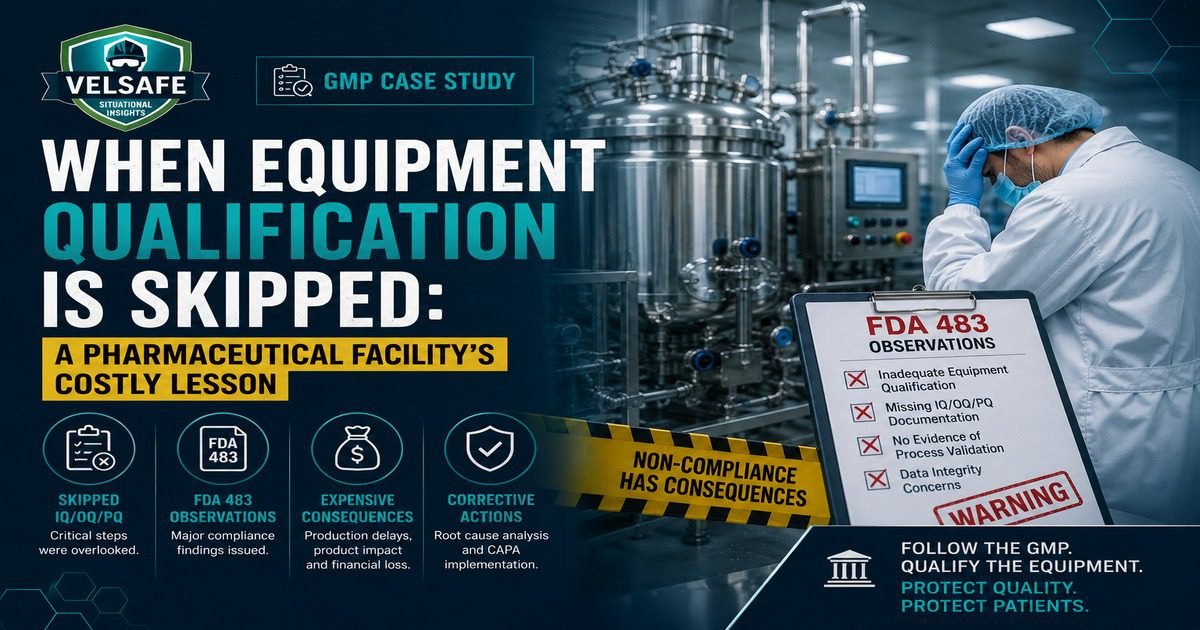
Equipment qualification programmes exist to confirm that manufacturing and laboratory equipment performs as intended within defined parameters before it is used to produce or test product. When qualification is treated as paperwork rather than a functional verification, the consequences range from batch failures and investigations to FDA Warning Letters and product recalls. This illustrative scenario follows a pharmaceutical intermediates manufacturer that compressed its equipment qualification timeline and the chain of events that followed.
Note: The organisation, individuals, and specific events described in this scenario are fictional and illustrative. The compliance failures, root causes, and corrective actions are based on patterns commonly identified in FDA Warning Letters, 483 observations, and industry incident investigations involving equipment qualification programmes.
Situation Overview
3
Batches Affected
Three production batches of a pharmaceutical intermediate were manufactured using an unqualified tablet press before the gap was identified during an internal audit.
6 Mo
Timeline Compressed
Planned 6-month equipment qualification programme was reduced to 6 weeks to meet a customer delivery commitment. IQ, OQ, and PQ were all compressed or partially omitted.
FDA
483 Observations
A subsequent FDA inspection issued four 483 observations directly related to the equipment qualification programme, including failure to qualify equipment before use and inadequate validation documentation.
The Decision That Started the Problem
Meridian Pharma Solutions, a contract manufacturer of pharmaceutical intermediates, had scheduled a six-month equipment qualification programme for a newly acquired tablet press. The programme was designed to run IQ in weeks one through three, OQ in weeks four through twelve, and PQ across weeks thirteen through twenty-four. Each phase had defined acceptance criteria, required documentation packages, and sign-off gates involving quality assurance, engineering, and production.
In the third week of the programme, Meridian received a contract amendment from its largest customer requesting an additional 40,000 units of a high-margin intermediate within nine weeks. The commercial team accepted the order. The production planning manager escalated to senior leadership: meeting the delivery commitment required the new tablet press to be in production within six weeks.
The site director approved a compressed qualification timeline. IQ was completed in four days rather than three weeks, with seven of the twenty-two IQ checklist items deferred as “to be completed during OQ.” OQ was condensed from eight weeks to two, with testing conducted at a single operating point rather than across the full specified range. PQ was redesigned as a concurrent exercise: production batches would be manufactured and PQ data collected simultaneously, with final PQ approval scheduled to follow batch release by two weeks.
The quality manager raised a written objection. She noted that concurrent PQ with batch release was not aligned with the site’s validation master plan or FDA guidance on process validation, which requires process capability to be demonstrated before routine commercial manufacture begins. Her objection was acknowledged, logged, and overridden. The tablet press went into production in week six.
Deviation 1: IQ Not Complete
Seven IQ checklist items were deferred. Instrument calibration records for two critical sensors were not obtained from the manufacturer before production began. The sensors measured compression force and tablet thickness, both critical quality attributes.
Deviation 2: OQ Range Incomplete
OQ was conducted at a single compression speed and force setting. The approved operating range specified three speed settings and two force ranges. Equipment performance at the upper and lower limits of the operating range was never tested.
Deviation 3: Concurrent PQ
PQ protocol was designed to run alongside commercial production rather than before it. Batches produced during PQ were released to the customer before PQ results were fully reviewed and the protocol was formally approved and closed.
What the Audit Found
Eight weeks after the tablet press entered production, Meridian’s internal audit team conducted a scheduled review of the manufacturing equipment qualification programme. The auditor reviewed the equipment qualification file, cross-referenced it against the site’s validation master plan, and identified that the IQ was incomplete, the OQ had not covered the full operating range, and three commercial batches had been released before PQ was complete and approved.
A deviation report was opened. The investigation identified that one of the two uncalibrated compression force sensors had been reading 4.2 percent below the actual applied force throughout the production run. This meant that three batches of product had been compressed at a higher force than the process specification allowed, and the out-of-specification compression was undetected because the sensor data used for real-time monitoring was inaccurate.
Laboratory testing of retained samples from all three batches found hardness values above the upper specification limit in 11 of 60 samples tested. The batches had already been released and delivered to the customer. A voluntary recall of the affected intermediate was initiated.
Impact Assessment: What the Qualification Failure Cost
Product Quality
Three batches recalled. Out-of-specification hardness in 18 percent of retention samples tested. Customer downstream manufacturing halted pending investigation.
Regulatory
FDA inspection triggered by the recall. Four 483 observations issued. Warning Letter placed on the facility inspection record, requiring CAPA responses within 15 business days.
Commercial
Customer invoked force majeure clause. Contract placed on hold pending quality system remediation audit. Estimated revenue loss exceeded the profit from the original expedited order by a factor of eight.
Operational
The tablet press was placed out of service pending complete re-qualification. All remaining production on that equipment was suspended for 11 weeks during the re-qualification and CAPA execution period.
FDA Process Validation Guidance, FDA.gov
The FDA Inspection and 483 Observations
The recall notification triggered an FDA inspection of the Meridian facility. The investigator focused specifically on the equipment qualification programme, the deviation investigation, and the CAPA system. Four 483 observations were issued.
483 Observation 1: Equipment Used Before Qualification Complete
The investigator noted that commercial production batches were manufactured using the tablet press before IQ was complete, before OQ covered the full operating range, and before PQ was approved. This directly violated 21 CFR 211.68, which requires that equipment used in the manufacture, processing, packing, or holding of a drug product be of appropriate design, adequate size, and suitably located to facilitate operations for its intended use and for cleaning and maintenance.
483 Observation 2: Inadequate Calibration Before Use
Calibration records for two critical process monitoring instruments were not obtained or verified before equipment entered service. The investigator referenced 21 CFR 211.68(a), which requires that automatic, mechanical, and electronic equipment used in manufacturing be routinely calibrated, inspected, or checked according to a written program designed to assure proper performance.
483 Observation 3: Written Quality Override Not Formally Reviewed
The quality manager’s written objection to the concurrent PQ approach was logged but was not formally reviewed through the site’s change control or quality risk management process. The investigator noted that the objection constituted a potential quality event that required formal evaluation before proceeding, consistent with ICH Q10 requirements for a pharmaceutical quality system.
483 Observation 4: Batches Released Without Completed PQ
Three batches were released to a customer before the PQ protocol was formally reviewed and approved. The investigator referenced the site’s own validation master plan, which stated that no commercial product would be released before all applicable qualification and validation activities were complete and documented.
The CAPA Programme That Followed
Meridian’s CAPA response addressed six root causes across the qualification failure, the calibration gap, and the quality oversight process. The CAPA plan was substantial and, notably, required changes to management governance as well as technical procedure.
Six Root Causes Identified and Corrected
Root Cause 1: Commercial pressure overrode quality gate process. No formal mechanism existed to escalate commercial-driven timeline changes to senior quality leadership for independent review. Corrective action: a written Quality Authority policy was established, giving the site quality director formal veto power over any timeline changes affecting equipment qualification, validation, or product release criteria.
Root Cause 2: IQ completion criteria were not enforced as a prerequisite for OQ. The validation master plan specified sequential phases but did not have an automated or procedural lock preventing OQ from beginning while IQ items remained open. Corrective action: IQ closure sign-off was made a system-level prerequisite in the electronic quality management system before OQ protocol activation was permitted.
Root Cause 3: Instrument calibration was not verified at goods receipt. The site’s incoming inspection procedure for equipment did not include a requirement to verify manufacturer calibration certificates before instruments were connected to production processes. Corrective action: the incoming inspection procedure was revised to require calibration certificate verification and internal calibration confirmation for all critical process instruments before installation qualification begins.
Root Cause 4: Concurrent PQ was treated as a validated strategy without regulatory review. The decision to run PQ concurrently with commercial production was made operationally without formal regulatory affairs review against FDA guidance. Corrective action: a written policy was established requiring regulatory affairs sign-off on any deviation from the sequential IQ-OQ-PQ approach.
Root Cause 5: Written quality objections lacked a formal escalation path. The quality manager’s written objection was logged in the change control system but was not routed through a defined resolution process. Corrective action: all written quality objections to proposed production or quality decisions must be resolved through a documented risk management process before work proceeds.
Root Cause 6: Batch release review did not verify qualification status. The batch record review and release checklist did not include a step confirming that all qualification activities for the manufacturing equipment were complete and approved. Corrective action: a qualification status field was added to the batch release checklist, requiring the reviewer to confirm equipment qualification closure before a release decision is made.
What a Complete Equipment Qualification Programme Looks Like
The Meridian scenario illustrates a common pattern: qualification compressed under commercial pressure, with each compromise appearing individually manageable until the cumulative effect produces a failure that costs far more than the original delivery commitment was worth. A properly structured equipment qualification programme does not need to be slow, but it must be complete at each phase before the next begins.
Installation Qualification (IQ)
Verify equipment is installed per manufacturer specifications. Confirm all utility connections are within specification. Obtain and verify all instrument calibration certificates. Confirm spare parts inventory is adequate. Document the as-built configuration. No deferred items permitted before IQ closure sign-off.
FDA Process Validation Guidance
Operational Qualification (OQ)
Test equipment across the full specified operating range: minimum, maximum, and nominal settings. Test each critical operating parameter independently and in combination where interactions are possible. Confirm alarm and interlock functions. Test under worst-case conditions. All acceptance criteria must be met before OQ is closed. No single-point testing accepted as a substitute for range testing.
FDA Process Validation Guidance
Performance Qualification (PQ)
Demonstrate that the equipment consistently performs within defined parameters during actual production using production materials and operators. PQ protocols must be reviewed and approved before PQ batches are manufactured. PQ data must be reviewed and the protocol formally closed before any PQ batch is considered for commercial release. PQ and commercial release are never concurrent activities.
FDA Process Validation Guidance
Key Takeaways
Qualification Phases Are Sequential, Not Concurrent
IQ must close before OQ begins. OQ must close before PQ begins. PQ must be approved before any PQ batch is released. Each phase gate is a regulatory requirement, not an administrative preference.
Deferred IQ Items Are Not a Permitted Strategy
Carrying IQ checklist items forward into OQ creates an incomplete qualification record from day one. If a critical instrument calibration certificate does not arrive before IQ closure is needed, IQ stays open until it does.
OQ Range Testing Cannot Be Shortcut to a Single Point
The purpose of OQ is to confirm performance across the approved operating range. Testing only at the nominal operating point tells you nothing about equipment behaviour at the limits where product quality risk is highest.
Quality Objections Require Formal Resolution
When a quality professional raises a written objection to a proposed approach, that objection must be resolved through the quality risk management process before work proceeds. Acknowledging and overriding it is not resolution.
Batch Release Must Confirm Qualification Status
Every batch release checklist should include a step that confirms all applicable equipment qualification activities are complete and approved. A batch released from an unqualified process is not releasable regardless of its test results.
CAPA Must Address Management Governance, Not Just Procedure
When commercial pressure successfully overrides a quality gate, the root cause is a governance failure, not a procedural one. Effective CAPA must give quality leadership formal authority that cannot be overridden without a risk management process, regardless of commercial urgency.
Frequently Asked Questions
What is the difference between IQ, OQ, and PQ in equipment qualification?
IQ (Installation Qualification) confirms equipment is installed correctly per manufacturer specifications and site requirements, including utility connections, instrument calibration, and documentation. OQ (Operational Qualification) confirms equipment operates correctly across its full specified operating range according to approved SOPs. PQ (Performance Qualification) confirms equipment consistently performs within defined parameters under actual production conditions using production materials and processes. Each phase builds on the previous one and must be fully completed and approved before the next begins.
Can production batches manufactured during PQ be released to customers?
This depends on how the facility’s qualification programme and regulatory strategy are structured. If batches produced during PQ are formally designated as PQ batches with defined acceptance criteria, those criteria must be met before the batches can be considered for release. A batch produced while PQ is ongoing but not formally treated as a PQ batch cannot be used to satisfy the PQ requirement. In either case, production batches should not be released before PQ is complete and approved unless the facility has a formal regulatory strategy addressing this scenario.
What should a facility do if it discovers that equipment was used before qualification was complete?
Stop production immediately and initiate a formal investigation and deviation record. Conduct a retrospective risk assessment of affected batches. Notify customers if product quality may be impacted. Complete the qualification, document corrective actions, and consider self-disclosure depending on the severity and regulatory framework.
How long does a standard equipment qualification programme typically take?
Timeline varies with equipment complexity, but a rigorous qualification for a critical piece of pharmaceutical manufacturing equipment commonly takes three to six months. IQ typically runs two to four weeks, OQ four to eight weeks depending on the number of operating parameters and test conditions, and PQ three to six weeks including data review and protocol closure. Facilities that consistently complete qualification faster than these ranges should audit whether their programmes are genuinely thorough or commercially compressed.
What regulations govern equipment qualification in pharmaceutical manufacturing?
In the US, 21 CFR Parts 210 and 211 establish GMP requirements for pharmaceutical manufacturing equipment, including requirements for design, installation, calibration, and maintenance. FDA’s 2011 Process Validation Guidance provides the framework for the Stage 1, 2, and 3 validation lifecycle approach that encompasses equipment qualification. ICH Q7 governs API manufacturing. EU GMP Annex 15 provides qualification and validation guidance for facilities supplying European markets.
Does equipment need to be re-qualified after maintenance or modification?
Yes, in most cases. Any modification to qualified equipment that could affect its performance or critical quality attributes requires a change control assessment and, depending on the scope of the change, partial or full re-qualification. Routine preventive maintenance typically does not trigger re-qualification, but replacement of critical components, software upgrades, or physical relocations usually do. The site’s change control procedure should define which changes trigger which re-qualification activities.
How should a CAPA address a root cause that is primarily a management governance failure?
A CAPA addressing a management governance failure must change the authority structure, not just the procedure. Updating an SOP that commercial pressure successfully overrode is insufficient: the CAPA must establish a formal mechanism giving quality authority that cannot be bypassed without a risk-managed escalation path. This typically means written policies giving the quality director formal veto power over decisions that affect product quality gates, independent of commercial hierarchy.
Government and Regulatory Sources
Government and Regulatory Sources
FDA: Process Validation: General Principles and Practices (2011)
21 CFR Part 211: Current Good Manufacturing Practice for Finished Pharmaceuticals, eCFR.gov
FDA: ICH Q7 GMP Guidance for Active Pharmaceutical Ingredients
ICH Q10: Pharmaceutical Quality System, International Council for Harmonisation
Equipment qualification failures and CAPA gaps are two of the most cited findings in FDA and EU GMP inspections. VelSafe covers qualification protocols, CAPA systems, and pharmaceutical GMP compliance with in-depth situational guides for quality professionals.
VelSafe Staff is the editorial team at VelSafe.com, a workplace safety and compliance content platform. Our team of safety professionals, regulatory specialists, and compliance writers produces guides, tips, and insights on OSHA regulations, pharmaceutical GMP, healthcare compliance, and occupational health across construction, manufacturing, oil and gas, and life sciences sectors..