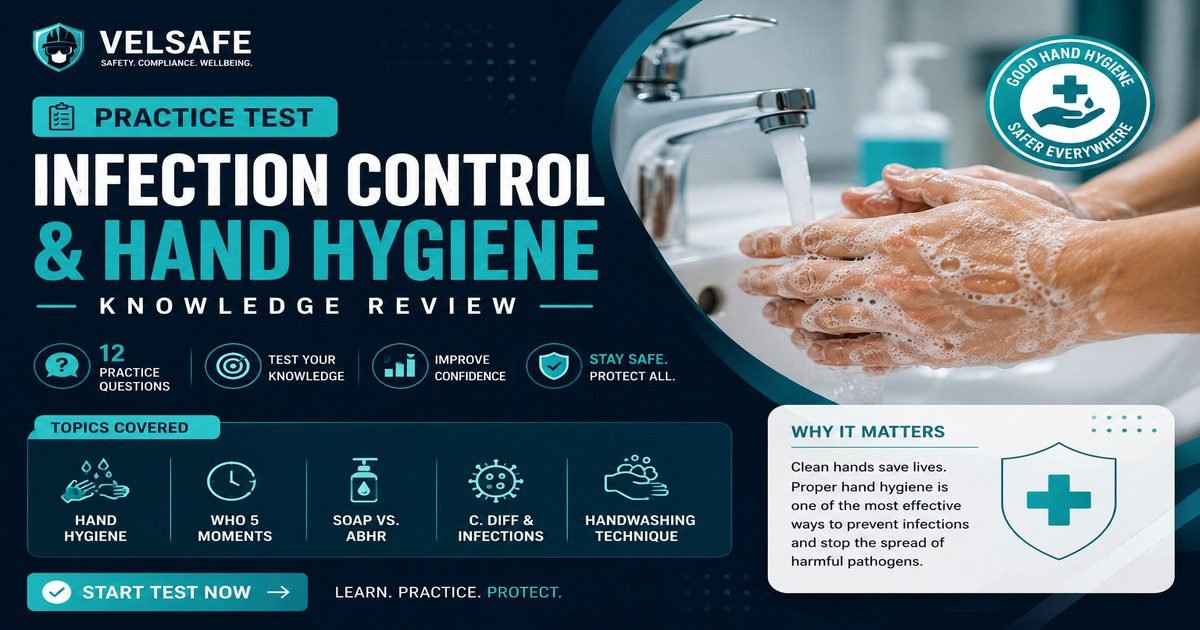
Test your knowledge of hand hygiene principles, correct handwashing technique, alcohol-based hand rub (ABHR) use, the WHO 5 Moments for Hand Hygiene, and the role of hand hygiene in infection prevention across healthcare and workplace settings.
How to Use This Practice Test
Read each question, select your answer, then check the Correct Answer and explanation below. Cover the explanation while answering to maximise learning. Use the Answer Key at the end to tally your score and consult the Score Interpretation section to identify gaps. Source links in each explanation point to CDC and WHO resources for further study.
Section 1: Why Hand Hygiene Matters
Hand hygiene is the single most important measure for preventing the spread of healthcare-associated infections (HAIs) and community-acquired infections. The CDC and WHO both identify hand hygiene as the cornerstone of infection prevention programmes. Hands are the primary vehicle for pathogen transmission in healthcare settings, food service, childcare, and general workplaces. Pathogens acquired from contaminated surfaces, patients, or environments are transferred to mucous membranes when workers touch their face, and to other patients and surfaces when workers move between activities without performing hand hygiene. Despite its importance, hand hygiene compliance in healthcare settings averages between 40 and 60 percent globally.
Question 1 of 12
According to CDC and WHO guidelines, what is the minimum recommended duration for effective handwashing with soap and water?
A. At least 10 seconds
B. At least 20 seconds
C. At least 30 seconds
D. At least 60 seconds
Correct Answer: B
CDC and WHO both recommend scrubbing hands with soap and water for at least 20 seconds. A commonly cited memory aid is to hum the Happy Birthday song twice. Studies show that fewer than 20 seconds of scrubbing leaves significantly more pathogens on hands than the 20-second benchmark. Ten seconds (A) is insufficient to mechanically remove most pathogens. Thirty seconds (C) is more effective but not the minimum standard, and 60 seconds (D) is not required for routine handwashing.
Which of the following is the most important reason hand hygiene compliance rates remain low in healthcare settings despite awareness of its importance?
A. Soap and water are not always available at the point of care
B. Time pressure, workload, and competing priorities in busy care environments
C. Workers do not believe hand hygiene is effective at preventing infection
D. Hand hygiene guidelines change too frequently for workers to follow
Correct Answer: B
Research consistently identifies time pressure, high workload, and competing priorities as the primary barriers to hand hygiene compliance in healthcare settings. This is why the WHO 5 Moments framework was designed to integrate hand hygiene into the natural workflow of care, reducing the perceived time cost. A (product availability) is a real but secondary barrier in most modern facilities where ABHR is widely distributed. C and D are not supported by the evidence base.
Healthcare-associated infections (HAIs) are primarily transmitted through which route in acute care settings?
A. Airborne droplet transmission from coughing patients
B. Contaminated medical equipment and devices
C. Contact transmission via the hands of healthcare workers
D. Environmental surface contamination from cleaning products
Correct Answer: C
Healthcare worker hands are the primary HAI transmission vehicle: pathogen on patient/environment, transfer to worker hands, transfer to next patient. Airborne transmission (A) applies to specific pathogens but is not the primary HAI route. Equipment (B) and surfaces (D) are secondary vectors, primarily contaminated by hands.
The WHO 5 Moments for Hand Hygiene is a framework developed to identify the specific points in patient care where hand hygiene must be performed to interrupt transmission. The five moments are: (1) Before touching a patient; (2) Before a clean or aseptic procedure; (3) After body fluid exposure risk; (4) After touching a patient; and (5) After touching patient surroundings. The framework is designed for healthcare settings but the underlying logic (perform hand hygiene before and after any activity that creates transmission risk) applies in food handling, childcare, and other workplace settings as well. The WHO 5 Moments is the basis for most structured hand hygiene compliance auditing programmes in healthcare.
Question 4 of 12
According to the WHO 5 Moments, a nurse who enters a patient room, adjusts the patient’s blanket without performing a clinical procedure, and then leaves without touching any medical equipment, must perform hand hygiene at which moment(s)?
A. Only after leaving the room (Moment 5)
B. Before touching the patient (Moment 1) and after touching the patient (Moment 4)
C. Only before entering the room (Moment 1)
D. No hand hygiene is required for non-clinical contact
Correct Answer: B
Any direct patient contact triggers Moment 1 and Moment 4, regardless of whether it is clinical or non-clinical. Adjusting a blanket is patient contact; both moments apply. A misses the before-contact moment; C misses the after-contact moment. D is incorrect; the WHO framework does not exempt non-clinical contact.
Which WHO 5 Moment takes the highest priority if a healthcare worker can only perform hand hygiene once due to an acute emergency situation?
A. Moment 5: After touching patient surroundings
B. Moment 4: After touching a patient
C. Moment 2: Before a clean or aseptic procedure
D. Moment 1: Before touching a patient
Correct Answer: C
Moment 2 (Before a clean or aseptic procedure) carries the highest priority because it directly protects the patient from a procedure-associated infection (the most serious and preventable consequence of hand hygiene failure. Aseptic procedures include inserting IV lines, urinary catheters, wound care, and other invasive activities where contamination can directly introduce pathogens into a sterile body site. The other moments protect against cross-transmission between patients and the environment, which is also important but produces less immediate harm than procedure-site infection.
A healthcare worker wearing gloves performs a wound dressing change. After completing the procedure and removing the gloves, what is the correct hand hygiene action?
A. No hand hygiene is required because gloves were worn throughout the procedure
B. Hand hygiene is only required if the gloves were visibly soiled
C. Hand hygiene must be performed after removing gloves
D. Hand hygiene is required before putting on gloves but not after removing them
Correct Answer: C
Hand hygiene must always be performed after glove removal. Gloves are not impermeable barriers; they can have microscopic defects, and hands can become contaminated during the process of glove removal. Gloves reduce but do not eliminate hand contamination during procedures. A, B, and D are all incorrect; gloves are an adjunct to hand hygiene, not a substitute for it. Both the WHO 5 Moments and CDC guidelines are explicit that glove use does not replace hand hygiene requirements.
Alcohol-based hand rub (ABHR) containing at least 60 percent alcohol is the WHO and CDC-preferred method of hand hygiene in most healthcare situations because it is faster, more accessible, and more effective at killing most pathogens than soap and water when hands are not visibly soiled. However, soap and water is required in specific situations: when hands are visibly soiled or contaminated with blood or body fluids; when there has been or is suspected exposure to Clostridioides difficile (C. diff) spores; and before eating or after using the restroom. ABHR does not remove physical soiling or inactivate C. diff spores. Understanding when to use each method is a core infection control competency.
Question 7 of 12
A healthcare worker has just cared for a patient with confirmed Clostridioides difficile (C. diff) infection. What is the correct hand hygiene method after this contact?
A. Alcohol-based hand rub (ABHR) at 70 percent alcohol concentration
B. Either soap and water or ABHR, as both are equally effective against C. diff
C. Soap and water
D. ABHR followed by a dry wipe
Correct Answer: C
Soap and water is required after contact with confirmed or suspected C. diff patients. C. difficile produces spores that are resistant to alcohol. ABHR does not inactivate C. diff spores; it may actually spread them if applied to contaminated hands. Only the mechanical action of soap and water removes spores from the hands. A, B, and D all involve ABHR and are incorrect in this situation. This is one of the most commonly tested infection control competencies and a high-stakes clinical decision.
What is the minimum alcohol concentration recommended by CDC and WHO for alcohol-based hand rubs to be effective against most pathogens?
A. 40 percent
B. 60 percent
C. 80 percent
D. 95 percent
Correct Answer: B
CDC recommends hand sanitisers containing at least 60 percent alcohol. Products below 60 percent may reduce pathogen growth but are not reliably effective at killing them. WHO formulations use 80 percent ethanol or 75 percent isopropyl alcohol, which provides additional margin but 60 percent is the accepted minimum for consumer and workplace products. Very high concentrations (D, 95 percent) are actually less effective than 70-80 percent because some water is needed to denature proteins.
When should a food service worker use soap and water rather than ABHR for hand hygiene?
A. Only when hands are visibly soiled with food particles
B. Before every food handling task
C. After using the restroom, after handling raw meat, when hands are visibly soiled, and before handling ready-to-eat food
D. ABHR is equally acceptable to soap and water in all food service situations
Correct Answer: C
Soap and water is required after using the restroom, after handling raw meat, when hands are visibly soiled, and before handling ready-to-eat food. FDA Food Code requires soap and water in these situations; ABHR is not a permitted substitute because it does not remove physical contaminants and has limited efficacy against norovirus. A is too narrow; B is aspirational but not specific; D is incorrect.
Correct technique is as important as the decision to wash hands. Studies show that fingertips, thumbs, and backs of hands are most commonly missed. Artificial nails harbour significantly higher pathogen counts than natural nails and are restricted in most healthcare settings. Jewellery increases pathogen counts under and around it. Damaged or dermatitic skin carries higher pathogen loads and is harder to decontaminate. Infection control programmes must address technique, skin care, and jewellery and nail policies alongside product choice and timing.
Question 10 of 12
Which areas of the hands are most commonly missed during routine handwashing?
A. The palms and wrists
B. The fingertips, thumbs, and backs of hands
C. Between the fingers and knuckles
D. The forearms and lower wrists
Correct Answer: B
Observational studies using fluorescent lotion techniques consistently identify the fingertips, thumbs, and backs of hands as the most commonly missed areas during handwashing. People instinctively rub their palms together but pay less attention to the surfaces that most frequently touch patients and environments. WHO’s six-step handwashing technique specifically addresses these areas. Infection control training should use demonstration and self-assessment with fluorescent lotion to make missed areas visible to learners.
Why are artificial fingernails restricted or prohibited for clinical healthcare workers in most infection control policies?
A. They are a physical hazard that can scratch patients during care
B. They harbour significantly higher pathogen counts than natural nails and cannot be adequately decontaminated
C. They interfere with glove donning and doffing
D. They are prohibited by OSHA’s bloodborne pathogens standard
Correct Answer: B
Studies have documented significantly higher gram-negative bacilli, yeasts, and other pathogens on and under artificial nails compared to natural nails, and these cannot be adequately removed by handwashing or ABHR. Several healthcare outbreaks have been linked to artificial nails on healthcare workers. CDC guidelines and most healthcare facility policies restrict artificial nails for this reason. A (physical hazard) is a secondary concern. C (glove interference) is true but not the primary infection control reason. D is incorrect; OSHA’s bloodborne pathogens standard does not specifically address artificial nails.
An infection prevention programme measures hand hygiene compliance at 45 percent. Which intervention has the strongest evidence base for sustained improvement in compliance rates?
A. Mandatory online training for all staff, repeated annually
B. Posters at all sinks and ABHR dispensers
C. Multimodal improvement strategies combining system change, training, monitoring and feedback, reminders, and safety climate
D. Disciplinary action for staff observed not performing hand hygiene
Correct Answer: C
The WHO Multimodal Strategy combines five components: system change (products at point of care), training and education, monitoring and feedback, reminders, and institutional safety climate. Single interventions such as annual training (A), posters (B), or disciplinary action (D) produce temporary improvements and do not address the systemic barriers driving non-compliance.
Strong knowledge of hand hygiene principles across all four topic areas. Review any incorrect answers using the linked CDC and WHO resources.
7-9 Correct
Developing
Good foundational knowledge with gaps. Review context paragraphs and explanations for incorrect answers. The soap vs. ABHR and WHO 5 Moments sections are the most commonly misunderstood areas.
0-6 Correct
Needs Review
Review CDC and WHO hand hygiene resources before retaking. Focus on when to use soap vs. ABHR, the WHO 5 Moments framework, and the 20-second handwashing standard.
Frequently Asked Questions
Is hand sanitiser effective against all pathogens?
No. ABHR at 60 percent or higher alcohol is effective against most bacteria, fungi, and enveloped viruses (including influenza and coronaviruses). It is not effective against non-enveloped viruses such as norovirus and hepatitis A in all concentrations, and is not effective against bacterial spores including Clostridioides difficile. Soap and water is required for these specific situations. In healthcare, the general principle is that ABHR is the preferred method unless the patient has a known or suspected C. diff infection, or hands are visibly soiled.
Does the order of the hand hygiene steps matter?
Yes. For soap and water: wet hands first, apply soap, scrub all surfaces for at least 20 seconds, rinse, dry with a single-use towel, and use the towel to turn off the faucet. For ABHR: apply the recommended volume and rub all surfaces including fingertips, thumbs, and backs of hands until completely dry, typically 20-30 seconds.
How does skin damage affect hand hygiene effectiveness?
Damaged, cracked, or dermatitic skin harbours significantly more pathogens than intact skin and cannot be adequately decontaminated with either soap or ABHR. Frequent handwashing without adequate moisturisation causes skin breakdown, which paradoxically increases infection risk. Infection control programmes must include access to skin care products (moisturisers compatible with the ABHR product in use) and should monitor for occupational dermatitis. Workers with active skin breakdown on their hands should be assessed by occupational health to determine whether modified duties are appropriate.
Proper hand hygiene and infection control technique are among the most evidence-based interventions in healthcare and food safety. Test your knowledge, explore best practices, and find more infection control resources across the VelSafe training library.
VelSafe Staff is the editorial team at VelSafe.com, a workplace safety and compliance content platform. Our team of safety professionals, regulatory specialists, and compliance writers produces guides, tips, and insights on OSHA regulations, pharmaceutical GMP, healthcare compliance, and occupational health across construction, manufacturing, oil and gas, and life sciences sectors..