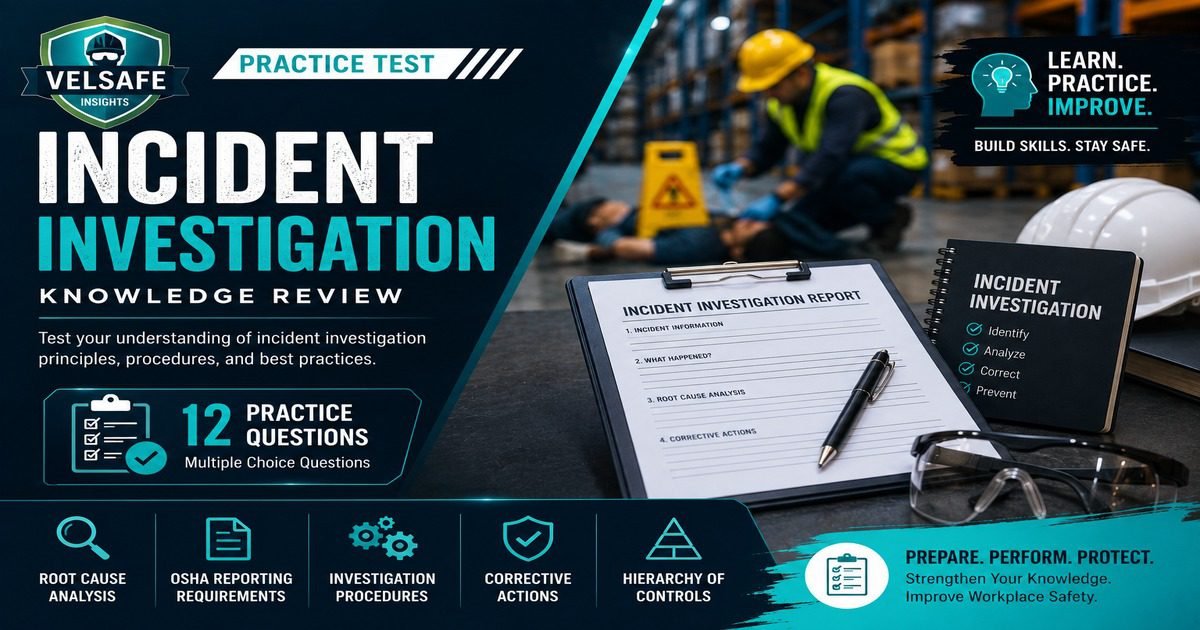
Test your knowledge of workplace incident investigation principles, including the purpose of investigations, root cause analysis, regulatory requirements, documentation, and corrective action. This practice test covers the core competencies required for safety professionals responsible for conducting, overseeing, or participating in workplace incident investigations.
How to Use This Practice Test
Read each question carefully. All questions are multiple choice with four options. Only one answer is correct for each question. Review the context paragraph before each section: it provides the factual background for the questions that follow.
Answer before reading the explanation. Cover the answer and explanation with your hand or a piece of paper, select your answer, then check. Reading the explanation after attempting the question reinforces learning better than reading it simultaneously.
Use the Answer Key at the end to tally your score. The Score Interpretation section will help you identify which topic areas need additional study.
Review the VelSafe links in each explanation to deepen your understanding of areas where you answered incorrectly.
Section 1: Purpose and Scope of Incident Investigations
Incident investigation is a systematic process for identifying root causes of workplace injuries, illnesses, near misses, or property damage and implementing corrective actions to prevent recurrence. The goal is not to assign blame but to identify and eliminate the systemic conditions that allowed the incident to occur. Near misses are particularly valuable because they reveal system failures before anyone is hurt.
Question 1 of 12
What is the primary purpose of a workplace incident investigation?
A. To determine which employee was at fault so that appropriate disciplinary action can be taken
B. To identify the root causes of the incident and implement corrective actions to prevent recurrence
C. To satisfy OSHA recordkeeping and reporting requirements
D. To document the incident for workers’ compensation and insurance purposes
Correct Answer: B
The primary purpose is to identify root causes and implement corrective actions that prevent recurrence. An investigation focused on assigning blame (A) or satisfying paperwork (C, D) fails to address the systemic factors that created the conditions for the incident.
Why should near-miss events be investigated with the same seriousness as incidents that result in injury?
A. OSHA requires near-miss investigations under 29 CFR 1904
B. Near misses reveal the same systemic failures as injury-producing incidents, allowing corrective action before harm occurs
C. Near misses must be reported to OSHA within 24 hours under the serious injury reporting rule
D. Investigating near misses allows the employer to avoid workers’ compensation claims
Correct Answer: B
Near misses reveal the same systemic failures as injury-producing incidents; only luck separates them from serious harm. Investigating near misses allows employers to correct systemic failures before anyone is hurt. OSHA does not require near-miss investigations under 29 CFR 1904 (A incorrect) and near misses are not reportable under the severe injury rule (C incorrect).
Under OSHA’s severe injury reporting rule (29 CFR 1904.39), which of the following must be reported to OSHA within 24 hours?
A. Any work-related injury that requires medical treatment beyond first aid
B. Any in-patient hospitalisation of one or more employees, any amputation, or any loss of an eye
C. Any recordable injury as defined under 29 CFR 1904.7
D. Any injury resulting in lost workdays beyond the day of the incident
Correct Answer: B
Under 29 CFR 1904.39: fatalities within 8 hours; in-patient hospitalisation, amputation, or eye loss within 24 hours. Medical treatment beyond first aid (A) triggers recordkeeping only. Recordable (C) and lost-time (D) injuries require recordkeeping but not reporting unless they also involve hospitalisation, amputation, or eye loss.
Root cause analysis identifies the underlying systemic causes of an incident, not just the immediate physical events. Direct causes are the physical exposures that produced harm; root causes are the systemic factors that allowed those exposures to exist: inadequate training, missing procedures, or management decisions that prioritised production over safety. RCA methods include the 5 Whys, fault tree analysis, and the fishbone diagram. Corrective actions addressing only direct causes typically result in recurrence.
Question 4 of 12
An investigation finds that a worker was injured when a machine guard was missing. The investigation concludes that the root cause was “missing machine guard.” What is the problem with this root cause determination?
A. The missing guard is the direct cause, not the root cause; the root cause must explain why the guard was missing
B. Nothing; identifying the direct physical cause of the incident is sufficient for a complete investigation
C. The investigation should have focused on the worker’s failure to report the missing guard
D. Machine guarding violations are OSHA’s responsibility to investigate, not the employer’s
Correct Answer: A
The missing guard is the direct cause, not the root cause. The root cause must answer why the guard was missing: removed for maintenance and never replaced? Inspection programme failed to catch it? Workers removed guards to speed production and management tolerated this? Without answering these questions, replacing the guard addresses the symptom but leaves the systemic cause untouched. B (direct causes alone are sufficient) and D (OSHA investigates) are both incorrect.
The “5 Whys” technique involves repeatedly asking “why” about each answer until no further “why” question is meaningful. In practice, what is the primary limitation of the 5 Whys technique?
A. It is limited to exactly five iterations and may not reach the root cause in complex incidents
B. Different investigators asking the same “why” questions may arrive at different root causes depending on their assumptions
C. The technique only works for equipment failures, not for human error incidents
D. OSHA does not accept the 5 Whys as a valid root cause analysis method
Correct Answer: B
The 5 Whys is investigator-dependent: different assumptions produce different root causes. It also identifies a single causal chain rather than multiple contributing causes, and may stop at a symptom rather than a true root cause. Five is a guideline, not a limit (A incorrect); it applies to any incident type (C incorrect); OSHA does not prescribe a specific RCA method (D incorrect).
Which of the following is an example of a root cause, rather than a direct cause or a contributing factor, in an incident where a worker fell from an unguarded elevated platform?
A. The platform had no guardrail
B. The worker slipped on a wet surface
C. The pre-construction safety review process did not include a fall protection assessment for elevated work surfaces
D. The worker was not wearing a fall arrest harness
Correct Answer: C
C is a root cause: a systemic failure in the management programme that allowed a fall hazard to go unidentified. A (no guardrail) is the direct cause. B (wet surface) is a contributing factor. D (no harness) is an immediate physical condition. Addressing A, B, and D without fixing C means future safety reviews will continue missing fall hazards.
Section 3: Investigation Procedures and Documentation
Effective investigations begin as soon as possible after the incident. Key steps: secure and document the scene, collect evidence and photographs, interview witnesses individually while memories are fresh, review relevant records, and prepare a written report. The investigation team should include the area supervisor, a safety professional, and where appropriate, worker representatives.
Question 7 of 12
Why should witness interviews in an incident investigation be conducted individually rather than as a group?
A. OSHA requires individual interviews under the incident investigation standard
B. Group interviews are more efficient but less legally defensible in workers’ compensation proceedings
C. Individual interviews prevent witnesses from influencing each other’s recollections and allow each person to speak without social pressure
D. Group interviews violate OSHA’s anti-discrimination provisions
Correct Answer: C
Individual interviews prevent witnesses from influencing each other’s recollections. Group interviews create conformity pressure where witnesses align with the most vocal person or suppress inconsistent information. Individual interviews allow genuine recollections and reveal discrepancies between accounts. A, B, and D are incorrect.
An investigation team arrives at an incident scene 30 minutes after a serious injury occurred. Which action should be the team’s immediate first priority?
A. Begin interviewing witnesses immediately before they leave the area
B. Secure and document the scene before any evidence is disturbed or removed
C. File the OSHA injury report before beginning any investigation activities
D. Determine whether workers’ compensation forms have been completed for the injured worker
Correct Answer: B
Scene preservation is the immediate first priority upon arrival. Physical evidence at the scene (equipment position, material location, surface conditions, tool placement) is perishable: it can be changed, cleaned up, repaired, or disturbed by people moving through the area. Photographs, measurements, and documentation of the scene as found must be completed before any evidence is moved or the scene is altered for any reason except immediate emergency response. While witness interviews (A) are also time-sensitive, they can occur after scene documentation. OSHA reporting (C) has defined timelines (8 hours for fatalities, 24 hours for hospitalisations) but is not the first investigation step. Workers’ compensation (D) is handled separately from the investigation.
Which of the following records should an investigation team review when investigating a chemical exposure incident?
A. The injured worker’s personnel file and performance reviews only
B. The SDS for the chemical, hazard communication training records, PPE inspection logs, and the safe work procedure for handling the chemical
C. OSHA 300 log entries for the past five years only
D. Workers’ compensation claim history for the injured worker
Correct Answer: B
A chemical exposure investigation reviews all records related to safe handling: SDS (chemical hazards and required PPE), hazard communication training records (was the worker trained?), PPE inspection logs (was PPE available and serviceable?), and the safe work procedure (did one exist and was it adequate?). Personnel files (A), the OSHA 300 log (C), and workers’ compensation history (D) do not address the root cause question.
Section 4: Corrective Actions and Incident Prevention
Corrective actions address root causes to prevent recurrence. They follow the hierarchy of controls: elimination is most effective, followed by substitution, engineering controls, administrative controls, and PPE. Each action must be assigned to a responsible person with a completion date and tracked to closure. Retraining the affected worker as the sole corrective action is rarely adequate for serious incidents.
Question 10 of 12
A worker is injured because they did not follow a written safe work procedure for a high-hazard task. Which corrective action best addresses the root cause of this incident?
A. Retrain the worker on the existing procedure and issue a written warning
B. Investigate why the worker did not follow the procedure: assess whether the procedure was adequate, accessible, taught, and reinforced, and whether the task could be redesigned to make safe performance easier
C. Post the written procedure at the workstation and require all workers in the area to sign acknowledging they have read it
D. Suspend the task until an OSHA compliance officer can review the procedure
Correct Answer: B
Not following the procedure explains what happened but not why. The investigation must ask: was the procedure technically correct, written clearly, taught, and practical given actual work conditions? Could the task be redesigned so the safe method is the easiest method? A (retrain and warn) treats the worker as the root cause. C (post and sign) is administrative only. D is not required by OSHA.
According to the hierarchy of controls, which corrective action is most effective for preventing recurrence of a fall from height incident?
A. Require all workers performing elevated work to wear personal fall arrest systems
B. Implement additional fall safety training for all affected workers
C. Redesign the work process so that the task can be completed from ground level, eliminating the need for elevated work
D. Increase the frequency of inspections of fall protection equipment
Correct Answer: C
Elimination is highest in the hierarchy; redesigning work to ground level eliminates the fall hazard entirely. PPE (A) is the lowest tier and last resort. Training (B) is an administrative control, less effective than engineering or elimination. Equipment inspections (D) improve a lower-order control but do not eliminate the hazard. If elimination is not feasible, work down the hierarchy.
After completing an incident investigation, what should the employer do with the findings to maximise the preventive value of the investigation?
A. File the investigation report in the incident file and retain it for OSHA recordkeeping purposes
B. Share the investigation findings with the affected work area only to avoid unnecessarily alarming other departments
C. Share findings and corrective actions across the organisation wherever similar hazards, processes, or conditions exist, while protecting the injured worker’s personal information
D. Share the complete investigation report including worker names with all employees as part of a safety briefing
Correct Answer: C
The preventive value of an investigation extends beyond the incident location when similar hazards, processes, or equipment exist elsewhere in the organisation. Sharing findings and corrective actions organisation-wide (with personal information protected) allows other areas to apply lessons learned before they experience the same incident. A (file only) is the minimum record-retention step, not a prevention strategy. B (affected work area only) limits the preventive reach of the investigation. D (share complete report with names) violates the injured worker’s privacy and may create legal exposure; investigation findings can be shared without identifying the individual involved.
Strong command of incident investigation principles across all four topic areas. Review incorrect answers using the linked OSHA resources.
7-9 Correct
Developing
Good foundational knowledge with gaps. Review context paragraphs and explanations for incorrect answers. Root cause analysis and the corrective action hierarchy are the most commonly misunderstood areas.
0-6 Correct
Needs Review
Review OSHA’s Incident Investigation resources linked in the explanations before retaking. Focus on the distinction between direct causes and root causes, and the hierarchy of controls for corrective actions.
Frequently Asked Questions
Is OSHA required to investigate all workplace incidents?
No. OSHA prioritises inspections based on reports, complaints, and programmed inspections, not all workplace incidents. Employers must report fatalities within 8 hours and certain severe injuries within 24 hours. Employers are responsible for investigating all significant incidents and near misses regardless of whether OSHA opens a formal inspection. The PSM standard (29 CFR 1910.119) specifically requires investigation for covered processes; the General Duty Clause implies investigation and corrective action as part of maintaining a safe workplace.
What is the difference between an incident investigation and a safety audit?
An incident investigation is reactive: conducted after a specific event to determine causes and corrective actions. A safety audit is proactive: a scheduled review of safety programme elements or compliance before incidents occur. Both serve different functions but feed the same corrective action system. High-performing safety programmes use both.
How long should incident investigation records be retained?
OSHA 300, 300A, and 301 forms require five-year retention under 29 CFR 1904. Investigation reports should be retained at minimum for five years; many organisations retain them for seven to ten years for trend analysis and litigation defence. The PSM standard (29 CFR 1910.119) specifically requires investigation reports to be retained for five years from the date of the incident.
Government and Regulatory Sources
OSHA – Incident Investigation
OSHA – Recordkeeping Rule (29 CFR 1904)
OSHA – Process Safety Management (29 CFR 1910.119)
Incident investigation is a skill that improves with practice. VelSafe covers investigation techniques, root cause analysis, and OSHA compliance across guides, tips, and practice tests built for safety professionals.
VelSafe Staff is the editorial team at VelSafe.com, a workplace safety and compliance content platform. Our team of safety professionals, regulatory specialists, and compliance writers produces guides, tips, and insights on OSHA regulations, pharmaceutical GMP, healthcare compliance, and occupational health across construction, manufacturing, oil and gas, and life sciences sectors..