

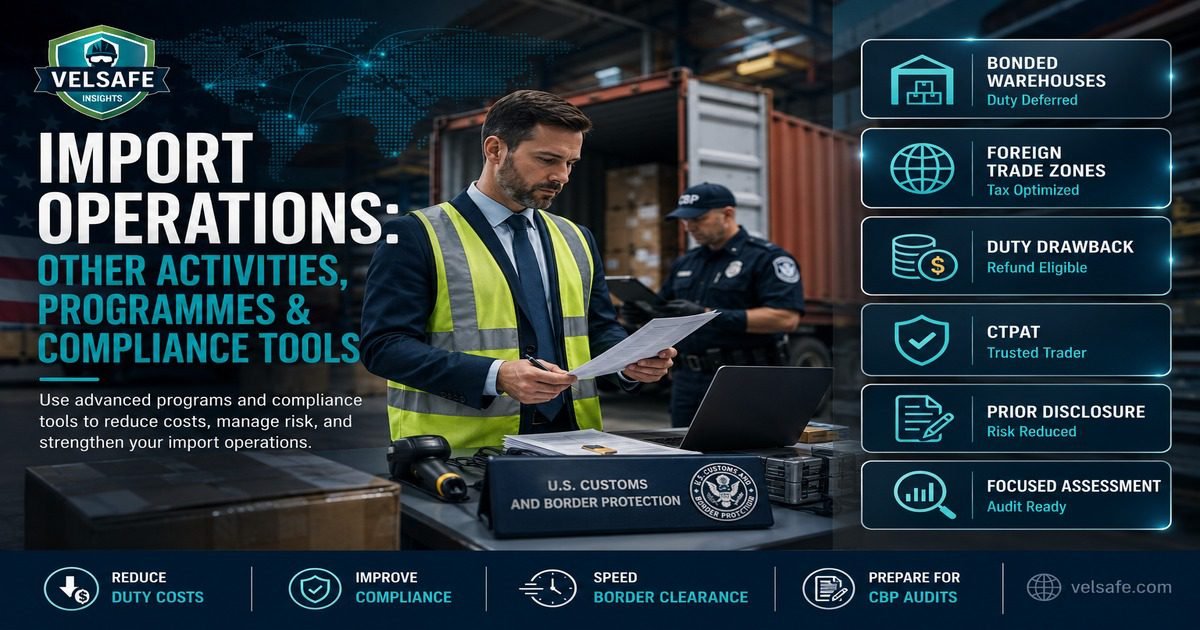
GUIDE: Import Operations
Beyond the basic customs entry process, US import operations involve a range of specialist programmes, legal tools, and compliance activities that can reduce costs, manage risk, and build stronger relationships with regulatory agencies. Understanding these other activities gives importers, compliance officers, and safety professionals the full picture of what an effective import programme looks like.
Quick Overview
What This Guide Covers
The specialist import activities that sit alongside the core entry process: bonded warehouses and foreign trade zones for duty deferral, duty drawback for recovering paid duties, customs broker relationships, the CTPAT trusted trader programme, prior disclosure for self-correcting errors, and the CBP focused assessment audit process.
Who Should Use This Guide
Import managers, trade compliance officers, logistics professionals, safety managers responsible for imported equipment and materials, finance teams managing landed cost and duty spend, and any compliance professional whose company imports goods into the United States regularly or at significant volume.
Why These Activities Matter
Many importers pay duties they do not owe, miss cost reduction opportunities, and carry compliance risk that structured programmes can eliminate or reduce. These activities are not optional extras for large multinationals; they are practical tools available to any importer willing to invest time in understanding how the customs system works beyond the entry form.
What You Will Need
A basic understanding of US customs entry procedures (covered in the Import Operations Part 1 and Part 2 guides), access to your import entry history and HTS classifications, and in most cases a working relationship with a licensed customs broker who can implement many of these programmes on your behalf.
What You Will Learn
How bonded warehouses defer duty payment and when they make financial sense
What foreign trade zones offer that bonded warehouses do not
How to identify and claim duty drawback on re-exported goods
What a licensed customs broker does and how to manage the relationship effectively
How CTPAT membership reduces examination rates and improves supply chain security
When and how to file a prior disclosure to reduce penalty exposure
What CBP looks for during a focused assessment audit and how to prepare
How binding rulings eliminate classification uncertainty before goods arrive
Prerequisites
Understanding of core customs entry procedures
The programmes covered in this guide build on the basic import entry process. You should be familiar with HTS classification, customs entry types, CBP Form 7501, and partner government agency requirements before implementing the advanced programmes described here.
Access to historical import entry data
Several activities in this guide (duty drawback, focused assessment preparation, prior disclosure) require access to your company’s historical entry data. Your customs broker should be able to provide entry reports covering the past three to five years. If you do not have a broker relationship, request entry data directly from CBP through an Importer Trade Activity (ITRAC) request.
Relationship with a licensed customs broker
Most of the specialist programmes in this guide are managed through or with the assistance of a licensed customs broker. If your company does not have a broker relationship, engaging one is a prerequisite for most of the activities described here. CBP maintains a list of licensed customs brokers by port.
Required Documents and Tools
Document / Tool
Used For
Where to Obtain
Import entry history (3-5 years)
Drawback analysis, prior disclosure, focused assessment preparation
Customs broker or CBP ITRAC request
HTS classification matrix for your product categories
Binding ruling applications, classification reviews, drawback
Internal records plus USITC HTS database
Supply chain security programme documentation
CTPAT application and minimum security criteria compliance
Internal development using CBP’s CTPAT minimum security criteria
Import compliance programme (written)
Focused assessment preparation, CTPAT application, reasonable care demonstration
Internal development; trade counsel can assist
Export documentation for drawback claims
Duty drawback claims linking imports to subsequent exports
Internal records; AES (Automated Export System) filing data
Step-by-Step: Import Operations Other Activities
1
Using Bonded Warehouses for Duty Deferral
Objective: Defer duty payment on imported goods until they are withdrawn for US consumption
Why It Matters
A bonded warehouse is a CBP-licensed facility where imported goods can be stored for up to five years without paying duties. Duties are only owed when goods are withdrawn for consumption in the United States. If goods are re-exported from a bonded warehouse, no duties are ever paid. For importers managing uncertain demand, goods subject to high duty rates, or goods that may be re-exported, bonded warehouses provide significant cash flow and duty cost advantages.
Actions
Identify whether your goods are eligible for bonded warehouse storage (most merchandise qualifies; some goods like fresh produce have limitations). Locate a CBP-licensed bonded warehouse near your port of entry or distribution point. File a warehouse entry (CBP Form 7501, Type 21) instead of a consumption entry. Maintain a withdrawal record for each lot of goods removed from the warehouse. If goods will be re-exported, file a transportation and exportation (T&E) entry to move goods under bond to the port of export.
Expected Outcome
Duty payment deferred until goods are withdrawn for US consumption. Goods that are re-exported from the warehouse generate zero duty liability. Working capital preserved for the duty deferral period, which can extend up to five years.
Tip
Bonded warehouses can also manipulate goods (sorting, repacking, cleaning, and labelling) without triggering duty payment. These manipulations are defined under 19 U.S.C. 1562. Manipulation that changes the character of the goods requires a CBP permit.
Warning
Goods cannot remain in a bonded warehouse beyond five years. If they are not withdrawn or exported by the five-year deadline, CBP will treat them as abandoned and the importer may face duty liability plus abandonment fees.
2
Using Foreign Trade Zones for Manufacturing and Distribution
Objective: Use FTZ status to reduce duty costs on goods that will be manufactured or significantly processed before entering US commerce
Why It Matters
Foreign trade zones are secure areas considered outside US customs territory for duty purposes, even though they are physically located in the United States. Goods admitted to an FTZ are not subject to customs duties until they leave the zone for US consumption. Unlike bonded warehouses, FTZs allow significant manufacturing, assembly, and processing operations. Manufacturers who import components, assemble them in an FTZ, and sell the finished product into US commerce may pay duty on the finished product rate rather than the (potentially higher) component rates.
Actions
Locate an FTZ near your manufacturing or distribution facility using the Foreign-Trade Zones Board’s directory. Apply for FTZ user status (subzone or general purpose zone usage). Conduct an inverted tariff analysis: if your finished product has a lower duty rate than your imported components, FTZ manufacturing will reduce your total duty liability. Work with your customs broker to establish FTZ admission procedures and weekly entry filing under the FTZ weekly entry system.
Expected Outcome
Duty savings through inverted tariff benefit where applicable. Duty deferral on all goods in the zone. Potential elimination of duty on goods re-exported from the zone. Simplified weekly entry filing rather than entry-by-entry filing for high-volume importers.
Tip
The inverted tariff analysis is the most important step in evaluating FTZ viability. If the duty rate on your imported components exceeds the duty rate on your finished product, FTZ manufacturing generates direct duty savings. Many manufacturers overlook this analysis and pay higher duties than they need to.
3
Claiming Duty Drawback on Re-Exported Goods
Objective: Recover up to 99 percent of duties paid on imported goods that are subsequently exported
Why It Matters
Duty drawback is one of the most underutilised cost recovery tools in US trade. Under 19 U.S.C. 1313, importers who pay duties on goods that are subsequently exported (or used in the manufacture of goods that are exported) can recover up to 99 percent of those duties. Drawback applies to manufacturing drawback, unused merchandise drawback, and rejected merchandise drawback. Companies that export significant volumes of previously imported goods or products made from imported materials regularly recover substantial duty amounts through drawback claims.
Actions
Conduct a drawback opportunity analysis by reviewing your import entry history and matching it against your export history. Identify which drawback type applies: manufacturing drawback (goods used to produce exported products), unused merchandise drawback (goods exported in the same condition as imported), or rejected merchandise drawback (goods not conforming to sample or specifications). File drawback claims through CBP’s Automated Commercial Environment (ACE) within five years of the import date. A specialist drawback broker can identify opportunities and manage filing.
Expected Outcome
Recovery of up to 99 percent of duties paid on eligible imported goods, plus interest on delayed payment of drawback claims. For companies with significant import and export activity, drawback claims can represent material financial recoveries.
Tip
The TFTEA (Trade Facilitation and Trade Enforcement Act of 2015) simplified drawback rules and extended the filing deadline to five years. If your company has never filed drawback claims, a retroactive analysis covering the past five years may identify significant unclaimed recoveries.
Warning
Drawback claims are subject to CBP audit. Maintain all supporting documentation (import entries, export filings, manufacturing records, and substitution documentation where applicable) for a minimum of three years after the drawback claim is paid.
4
Managing the Customs Broker Relationship
Objective: Use your customs broker as a compliance partner, not just a form-filing service
Why It Matters
A licensed customs broker is the importer’s primary interface with CBP. However, the broker relationship is mismanaged by most importers: they treat the broker as a form-filing service rather than a compliance resource. The broker files entries based on information the importer provides. If the importer provides incorrect classifications, inaccurate values, or wrong country of origin information, the broker files those errors and the importer bears full legal liability. A well-managed broker relationship involves clear written instructions, regular classification reviews, and periodic performance audits.
Actions
Issue written instructions to your broker covering your product classifications, valuation methodology, country of origin determination procedures, and PGA requirements for each product category. Review the broker’s entry filings periodically (at minimum annually) to verify accuracy. Establish a communication protocol for new products, changes in sourcing country, or changes in product specifications that may affect classification. Review the broker’s power of attorney annually and confirm the broker’s licence is current via CBP’s broker lookup tool.
Expected Outcome
Accurate entry filings that reflect the importer’s actual merchandise and compliance position. Early identification of classification issues before they accumulate into significant penalty exposure. A broker who understands your business well enough to flag regulatory changes that affect your imports.
Tip
Issue a written customs compliance manual to your broker annually. This document should specify your product classification decisions, your valuation methodology, your origin determination approach, and the specific PGA requirements for each product category you import. The existence of a written compliance manual is itself evidence of reasonable care in a CBP audit.
5
Joining the CTPAT Trusted Trader Programme
Objective: Reduce examination rates and strengthen supply chain security through CBP’s Customs-Trade Partnership Against Terrorism
Why It Matters
CTPAT is CBP’s trusted trader programme. Certified CTPAT members receive significantly reduced examination rates, expedited processing, and access to CBP’s supply chain security resources. CTPAT certification demonstrates to CBP that the importer has implemented robust supply chain security measures and is a lower-risk partner. For companies importing significant volumes, the reduction in examination-related delays and costs justifies the investment in CTPAT certification many times over.
Actions
Review CBP’s CTPAT minimum security criteria for your entity type (importer, manufacturer, carrier, broker). Conduct a gap assessment against the minimum security criteria. Implement the required security measures: physical security for facilities, personnel security procedures, access controls, conveyance security, and cybersecurity practices. Submit a CTPAT application through the ACE portal. After approval, a CBP supply chain security specialist will conduct a validation visit within a set timeframe to confirm compliance with the minimum criteria.
Expected Outcome
Significant reduction in CBP examination rates. Expedited cargo release. Access to the CTPAT portal and CBP intelligence resources. Recognition as a trusted trader by CBP, which influences the Automated Targeting System risk scoring for all your shipments.
Tip
CTPAT membership requires annual self-assessment and periodic CBP validation. Treat the minimum security criteria as a living compliance obligation, not a one-time certification exercise. CBP de-certifies members whose security practices fall below the minimum criteria between validation cycles.
Warning
CTPAT membership does not guarantee exemption from examination. CBP may still examine any shipment for cause, including intelligence-driven holds, random sampling, or partner government agency requirements. CTPAT reduces examination probability; it does not eliminate it.
6
Obtaining CBP Binding Rulings
Objective: Eliminate classification, origin, and valuation uncertainty before goods arrive at the border
Why It Matters
A binding ruling is CBP’s written determination on the classification, country of origin, or valuation of a specific product before it is imported. Binding rulings are legally binding on CBP and provide certainty for the importer’s compliance programme. When an importer follows a binding ruling in good faith, CBP cannot assess penalties for the classification or origin position taken, even if it later determines the ruling was incorrect (CBP must prospectively revoke the ruling and give notice before changing its position). Binding rulings are particularly valuable for new product categories, unusual classifications, and goods subject to ADD/CVD orders where classification determines duty liability.
Actions
Identify products in your import programme where classification, origin, or valuation is uncertain or contested. Submit a binding ruling request to CBP’s National Commodity Specialist Division through the CBP Rulings Online Search System (CROSS) portal or by letter to the appropriate CBP Center of Excellence and Expertise. Include a detailed product description, samples if required, technical specifications, and your proposed classification with supporting reasoning. CBP typically responds within 30 days for classification rulings.
Expected Outcome
A legally binding written determination from CBP that provides certainty for your import compliance programme. Protection from penalty for the position taken in good faith reliance on the ruling. Published ruling that can be used for future imports of the same product.
Tip
All CBP binding rulings are published in the CROSS database and are publicly searchable. Before submitting a ruling request, search CROSS for rulings on similar products; a published ruling on a nearly identical product can serve as strong support for your classification position without the 30-day wait.
7
Filing a Prior Disclosure to Reduce Penalty Exposure
Objective: Voluntarily disclose past import errors to CBP before formal inquiry, dramatically reducing penalty liability
Why It Matters
Under 19 CFR 162.74, an importer who voluntarily discloses a violation to CBP before CBP has formally initiated a penalty inquiry receives dramatically reduced penalties. For negligent violations, a prior disclosure limits the penalty to the unpaid duties plus interest, compared to up to four times the unpaid duties for violations discovered by CBP. For fraudulent violations, prior disclosure can reduce penalties from up to four times the value of the merchandise to unpaid duties plus interest only. Prior disclosure also demonstrates good faith, which influences CBP’s assessment of the importer’s overall compliance posture.
Actions
When your import compliance review identifies errors on prior entries, immediately consult with trade counsel to determine whether prior disclosure is appropriate. The prior disclosure must be filed before CBP has formally initiated a penalty action on the specific entries. The disclosure must identify the violative transactions, explain the nature of the violation, tender the unpaid duties plus interest, and include a corrective action plan. Work with counsel and your customs broker to prepare the disclosure; incorrect or incomplete disclosures can create additional problems.
Expected Outcome
Penalty exposure reduced to unpaid duties plus interest rather than multiples of that amount. Demonstrated good faith that influences CBP’s overall assessment of the importer. Resolution of the compliance issue before it becomes an enforcement action.
Warning
Prior disclosure timing is critical. Once CBP has sent a formal inquiry (CF-28 or notice of investigation) on the specific entries, the prior disclosure benefit may no longer be available. If you discover errors, act quickly and consult counsel before CBP contacts you about those entries.
8
Preparing for a CBP Focused Assessment Audit
Objective: Ensure your import compliance programme and internal controls are audit-ready before CBP contacts you
A focused assessment is CBP’s primary audit programme for importers. CBP auditors review the importer’s internal controls and a sample of entries over a defined period, typically covering two to three years. The FA evaluates whether the importer has adequate controls over classification, valuation, country of origin determination, PGA compliance, and record retention. A poor FA result leads to penalty proceedings, enhanced scrutiny, and potentially a compliance improvement plan imposed by CBP.
What CBP Reviews
Classification accuracy, valuation methodology, country of origin documentation, preferential tariff claim support, ADD/CVD compliance, PGA requirements, record retention, and the importer’s written compliance programme.
How to Prepare
Conduct an annual self-audit of a sample of your entries before CBP does. Review classifications against the current HTS. Verify origin documentation is on file for all preferential tariff claims. Confirm ADD/CVD compliance. Ensure records are accessible and complete.
The Written Programme
A written import compliance programme is the single most important document in an FA. It demonstrates reasonable care and shows CBP that internal controls exist. Without it, CBP’s default assumption is that controls are inadequate. Create one before you are contacted for an FA, not after.
Source: CBP | CBP Focused Assessment Program
Best Practices
Conduct an annual import compliance self-audit
Sample 50 to 100 entries per year across your product categories and review them for classification accuracy, valuation correctness, origin documentation, and PGA compliance. Document the review and its findings. Address any identified errors through prior disclosure or entry amendment before they accumulate.
Build a landed cost model that includes all import compliance costs
Many finance teams calculate landed cost using only freight and the stated duty rate. A complete landed cost model includes ADD/CVD deposits, Section 301 tariffs, ISF penalties if applicable, examination costs, broker fees, and the cost of compliance activities. Accurate landed cost models surface opportunities for bonded warehouses, FTZs, and drawback that may not be visible in simplified models.
Monitor ADD/CVD orders and scope rulings for your product categories
Antidumping and countervailing duty orders change frequently. New orders are issued by the Department of Commerce; scope rulings determine whether specific products fall within existing orders. Subscribe to Federal Register notices for ADD/CVD orders in your product categories. A product that was not subject to an ADD/CVD order last year may be subject to one now, and the resulting duty liability can be retroactive to the date of the order.
Common Mistakes
Mistake
Consequence and Correction
Treating the customs broker as fully responsible for compliance
The IOR bears full legal liability for every entry the broker files. The broker files what the importer instructs. Establish written instructions, conduct periodic entry audits, and treat the broker as a filing agent who needs direction, not an independent compliance authority.
Not filing drawback claims because the process seems complex
Complexity is not a reason to leave recoverable duties unclaimed. Specialist drawback brokers manage the entire process on a contingency or flat fee basis. An initial analysis costs nothing but reveals whether significant recoveries are available.
Waiting to address discovered errors until CBP contacts you
Prior disclosure requires acting before formal CBP inquiry. Once CBP initiates a penalty proceeding on specific entries, the reduced penalty benefit disappears. Annual self-audits that identify and disclose errors promptly are far less costly than enforcement-driven remediation.
Assuming CE marking satisfies OSHA requirements for imported equipment
CE marking demonstrates European conformity, not OSHA compliance. Imported machinery must be reviewed against applicable OSHA standards (29 CFR 1910 Subpart O for machine guarding, Subpart S for electrical) before it enters US workplaces. Conduct a pre-deployment OSHA review for all imported equipment.
Compliance Notes
Key Regulatory References for Import Other Activities
19 U.S.C. 1313: Duty drawback authority. Covers manufacturing drawback, unused merchandise drawback, and rejected merchandise drawback. Filing deadline: five years from the date of importation.
19 U.S.C. 1562: Manipulation of goods in bonded warehouses. Defines what operations may be performed on goods in bonded storage without triggering duty liability.
19 CFR 162.74: Prior disclosure. Defines the requirements and benefits of voluntary disclosure of customs violations before formal inquiry. Penalty reduction to unpaid duties plus interest for negligent violations.
19 CFR Part 177: Binding rulings. Procedures for requesting and receiving binding written decisions from CBP on classification, origin, and valuation questions.
19 CFR Part 146: Foreign trade zones. Governing regulations for FTZ admission, manipulation, manufacturing, and withdrawal procedures.
Troubleshooting
CBP revokes a binding ruling you have been relying on
CBP must publish notice of a ruling revocation before it takes effect. Check the Federal Register and CBP’s CROSS database weekly for rulings on your product categories. When a revocation notice is published, you typically have 30 days before the new ruling takes effect. Use that window to reassess your entry strategy and reclassify ongoing shipments.
CTPAT validation identifies gaps in your security programme
If a CBP supply chain security specialist identifies gaps during validation, you will receive a corrective action plan with a deadline. Address each finding before the deadline and document the corrective actions taken. Failure to remediate validation findings within the required period can result in CTPAT suspension, which removes the examination rate benefits and requires a reapplication process.
CBP focused assessment finds systemic classification errors
If the FA identifies systemic errors, cooperate fully with the audit process. Provide all requested documentation promptly. Engage trade counsel to manage the penalty proceedings and negotiate the remedy. Implement a corrective action plan addressing the root cause of the classification errors; the plan itself is part of demonstrating good faith in the penalty negotiation.
Quick Checklist: Import Other Activities
Cost Reduction
Drawback opportunity analysis completed for re-exported goods
Bonded warehouse feasibility assessed for high-duty goods
FTZ inverted tariff analysis completed for manufacturing operations
Landed cost model includes all duty and compliance costs
Compliance Programme
Written import compliance programme in place and current
Written instructions issued to customs broker annually
Annual self-audit of entry sample completed
Binding rulings obtained for uncertain classifications
Risk Management
CTPAT membership applied for or under evaluation
ADD/CVD order monitoring in place for product categories
Prior disclosure filed for any discovered entry errors
Imported equipment reviewed against OSHA standards before deployment
Key Takeaways
Most importers leave significant duty savings unclaimed
Duty drawback, bonded warehouses, and foreign trade zones are legitimate, legal cost reduction tools that most importers either do not use or underuse. An annual cost reduction analysis looking at these three tools, applied to actual entry data, typically identifies opportunities that pay back their implementation costs many times over within the first year.
Self-auditing annually is the most effective risk management action
CBP’s penalty structure rewards importers who find their own errors through annual self-audits and disclose them via prior disclosure. The same error that costs unpaid duties plus interest under a prior disclosure costs up to four times the unpaid duties when CBP finds it first. The annual self-audit is not optional; it is the primary tool for managing the penalty exposure that every import programme carries.
OSHA compliance for imported goods is the safety professional’s direct responsibility
No customs programme (not CTPAT, not a binding ruling, not CBP release) validates that imported equipment meets OSHA workplace safety standards. That review is the safety professional’s job, and it happens after the goods clear customs. Imported machinery, chemicals, and PPE all require a pre-deployment compliance check against applicable OSHA standards before they reach workers. The country of manufacture is irrelevant to this obligation; the US workplace standard applies in the US workplace.
Frequently Asked Questions
What is the difference between a bonded warehouse and a foreign trade zone?
Both defer duty payment, but they serve different purposes and operate under different rules. A bonded warehouse is licensed by CBP for storage of imported goods for up to five years; limited manipulation is permitted. A foreign trade zone is a secured area considered outside US customs territory where goods can be stored, manufactured, assembled, and processed without time limits on storage. The key operational difference is that FTZs allow full manufacturing operations and offer the inverted tariff benefit (paying duty on the finished product rate rather than component rates), while bonded warehouses are primarily storage facilities. FTZs also permit weekly entry filing, which simplifies administration for high-volume operations.
How long does a CTPAT application take and what does it cost?
There is no direct CBP fee. After submitting through ACE, CBP typically completes initial review within 90 days and schedules a validation visit after approval. The real cost is internal: implementing minimum security criteria, conducting a gap assessment, and maintaining the programme annually. Most importers recover implementation costs within one to two years through reduced examination and faster release.
Can a prior disclosure be filed after CBP has already sent a CF-28 Request for Information?
It depends on the scope of the CF-28. A CF-28 is a general request for information and does not necessarily constitute a formal penalty inquiry on specific entries. However, if the CF-28 relates specifically to the entries you are considering for prior disclosure, the window may have closed. This is a fact-specific determination that requires immediate consultation with trade counsel. The timing window is narrow and the financial difference between a timely prior disclosure and a post-inquiry penalty proceeding is substantial, so treat any CBP contact as a trigger to immediately assess your prior disclosure options.
Government and Regulatory Sources
- CBP – Bonded Warehouse Programme
- CBP – Foreign Trade Zones
- CBP – Duty Drawback
- CBP – Customs-Trade Partnership Against Terrorism (CTPAT)
- CBP – Focused Assessment Program
Related VelSafe Articles
- Import Operations: Legal Background and Regulatory Framework
- The US Import Process: How Goods Move from Foreign Supplier to US Commerce
- How FDA Inspects Computerized Systems Under cGMP
VelSafe Compliance Guides
From prior notice to detained shipments, FDA import compliance spans a wide range of activities beyond the initial entry process. VelSafe’s guides library covers import operations, FDA inspections, and regulatory compliance in depth for compliance teams.
Browse Compliance Guides