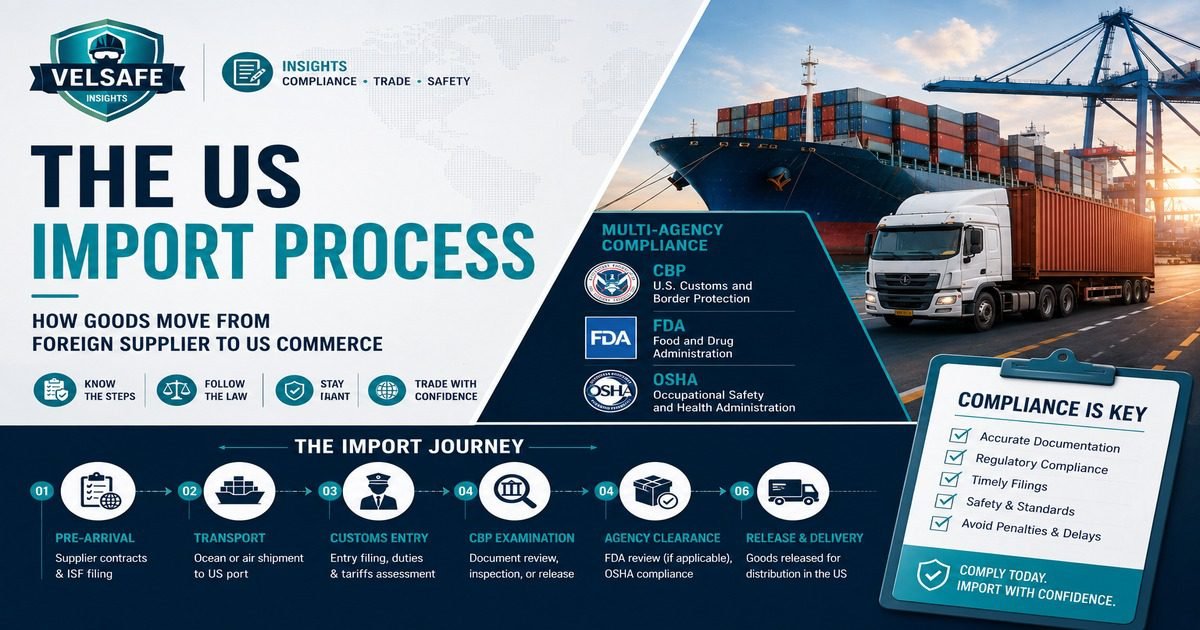
Understanding the import process means understanding a sequence of regulatory checkpoints, documentation requirements, and agency interactions that occur before any foreign product can legally enter US commerce. For safety professionals, procurement teams, and compliance officers, knowing where each checkpoint sits and what it involves is the foundation of effective import risk management.
Executive Summary
The US import process is not a single transaction. It is a multi-stage regulatory workflow involving Customs and Border Protection as the primary gatekeeper, plus up to 40 partner government agencies whose requirements must be satisfied before CBP releases a shipment. Each stage has defined timelines, documentation standards, and compliance obligations. Failures at any stage create holds, penalties, and potential refusal of goods.
For safety and compliance professionals, the most consequential stages are those where product safety, labelling, and workplace equipment standards are verified. These are not customs formalities. They are the regulatory gates through which the safety profile of imported goods is established before those goods reach US workers and consumers.
Key Statistics: Scale and Risk of US Import Operations
11.6M
Import Entries Per Year
CBP processes approximately 11.6 million formal import entries annually, each requiring classification, valuation, and admissibility review.
Source: CBP Trade Statistics
3%
Physical Examination Rate
CBP physically examines less than 3 percent of all import entries, relying on risk-based targeting through the Automated Targeting System to prioritize examination.
Source: CBP
$40B+
Duties Collected Annually
CBP collects over $40 billion in customs duties, taxes, and fees annually, making it one of the largest revenue collection agencies in the federal government.
Source: CBP Annual Report
Expert Insight
“The import process is where product safety standards either take hold or fail. A shipment that clears CBP without a thorough PGA review is not a compliance success; it is a deferred risk. The question is not whether non-compliant imported goods enter the market, but when their non-compliance is discovered and who bears the consequences.”
Import Compliance and Trade Safety Perspective, VelSafe Editorial
Stage 1: Pre-Shipment Preparation and Supplier Due Diligence
Effective import compliance starts before goods leave the foreign supplier’s facility. The pre-shipment stage is where classification decisions are made, supplier qualifications are verified, and required certifications are obtained. Importers who treat pre-shipment preparation as a formality consistently accumulate the compliance problems that surface at the border.
HTS Classification
Every imported product must be assigned an HTS code before shipment. The HTS code determines the duty rate, identifies which PGA requirements apply, and establishes whether the product is subject to any quota, antidumping, or countervailing duty order. Classification errors made at this stage cascade through every subsequent step. Importers with significant import volumes should consider obtaining CBP binding rulings on classification for new product categories before the first shipment arrives.
Supplier Qualification and Documentation
For regulated products, the supplier’s documentation is as important as the goods themselves. FDA-regulated food facilities must be registered. Foreign drug manufacturers must be registered. Consumer product suppliers must provide test reports. Importers who cannot produce supplier qualification documentation when CBP or a PGA requests it face holds and potential seizure. Supplier qualification is not a one-time exercise; it requires annual review as registrations expire and product specifications change.
Trade Agreement Eligibility Review
Products eligible for preferential duty treatment under trade agreements such as USMCA (US-Mexico-Canada Agreement), DR-CAFTA, or various bilateral FTAs must satisfy specific rules of origin. The importer is responsible for obtaining and retaining supporting documentation from the supplier before making a preferential tariff claim. CBP may audit these claims years after entry; importers who cannot substantiate origin claims face duty liability plus interest.
Pre-Shipment Red Flags
Supplier cannot provide FDA registration number for food or drug products
No test reports available for consumer products subject to CPSC standards
Country of origin is unclear or has recently changed without documented reason
HTS code cannot be confirmed without seeing the physical product or detailed spec sheet
Product is subject to an ADD/CVD order and supplier denies coverage
Safety Data Sheet for a chemical product is not available in English
Stage 2: Transportation, Arrival, and Advance Notification
Before goods physically arrive at a US port of entry, several regulatory requirements must be satisfied. The advance information requirements that now apply to most modes of transport were significantly strengthened after 2001 and represent a shift from post-arrival review to pre-arrival risk assessment.
Importer Security Filing (ISF / 10+2)
For ocean shipments, importers must file an Importer Security Filing with CBP at least 24 hours before goods are loaded at the foreign port. The ISF requires 10 data elements from the importer (including HTS classification, country of origin, and manufacturer identification) plus 2 elements from the carrier. Late, inaccurate, or missing ISF filings result in liquidated damages of $5,000 per violation and may result in a “do not load” instruction from CBP.
Air Cargo Advance Screening (ACAS)
For air shipments, CBP’s ACAS programme requires advance electronic data submission before loading at the foreign airport. The advance data allows CBP’s Automated Targeting System to assess risk before the aircraft departs. High-risk shipments may be subject to pre-departure examination at the foreign airport or expedited examination upon arrival at the US airport of entry.
FDA Prior Notice for Food Imports
Food shipments require prior notice to FDA before arrival: at least 2 hours by road, 4 hours by air, and 8 hours by sea. Prior notice must include the article of food, the manufacturer, grower, and shipper, and the anticipated arrival information. Shipments arriving without prior notice may be held by CBP until FDA reviews the submission. FDA refusal based on prior notice issues subjects the goods to hold and potential destruction.
Automated Manifest System (AMS)
Ocean carriers must transmit cargo manifests to CBP at least 24 hours before loading (for most cargo) via the Automated Manifest System. Air carriers must transmit cargo manifests before departure. The AMS data feeds into CBP’s Automated Targeting System, which assigns risk scores to shipments and determines whether a shipment will be flagged for examination, document review, or release without intervention.
Stage 3: Customs Entry Filing
Entry filing is the formal legal process by which the importer presents the shipment to CBP and declares its contents, value, origin, and classification. It is the step at which the importer’s legal obligations crystallise: once an entry is filed, the importer has made legal representations to the US government about the goods.
Entry Type
Value Threshold
Bond Required
Key Features
De Minimis (Section 321)
Under $800
No
Duty-free; no formal entry; limited to one per person per day; does not exempt from PGA requirements
Informal Entry
$800 to $2,500
Generally No
Simplified documentation; duties paid; PGA requirements still apply
Formal Consumption Entry
Over $2,500
Yes
Full CBP Form 7501; HTS classification; duties paid; 5-year record retention
Warehouse Entry
Any value
Yes
Duties deferred; goods stored in bonded warehouse; must be withdrawn within 5 years
Temporary Importation under Bond (TIB)
Any value
Yes (double duties)
Duty-free temporary import for specific purposes; must be re-exported within 1-3 years
The entry summary (CBP Form 7501) is the core document for formal entries. It must accurately state the entered value (the transaction value under 19 CFR Part 152), the HTS classification, the country of origin, the quantity, and any applicable trade agreement claims. Entry summaries must be filed and duties paid within 10 working days of the date of entry. CBP reviews entry summaries through its post-entry audit process and may liquidate entries differently from how they were filed if discrepancies are found.
Stage 4: CBP Examination, PGA Holds, and Release
Most shipments are released by CBP without physical examination. The Automated Targeting System assigns a risk score to each entry, and the vast majority receive an automated “May Proceed” status that allows release with minimal human review. But when a shipment is flagged, the examination and hold process can significantly extend the time goods are held at the port at the importer’s expense.
Document Review (CF-28)
CBP issues a CF-28 Request for Information when it needs additional documentation to verify classification, valuation, or country of origin. Importers typically have 30 days to respond. Failure to respond satisfactorily can result in a CF-29 Notice of Action, through which CBP assesses additional duties or penalties.
Physical Examination (X-Ray or Intensive)
Physical examinations range from non-intrusive imaging (X-ray or gamma-ray scanning) to intensive examinations where containers are fully unloaded and goods are inspected individually. The importer pays examination costs for intensive exams. An intensive examination of a 40-foot container can cost thousands of dollars and delay release by several days.
FDA Detention (Import Alert)
When FDA has a basis for believing a shipment violates the FD&C Act, it issues a detention notice. Products on FDA Import Alerts are detained automatically upon arrival (“detained without physical examination”). The importer has an opportunity to present evidence before a refusal decision, but the burden is on the importer to demonstrate compliance, not on FDA to demonstrate violation.
CPSC Hold
CPSC may place a hold on consumer products that it believes violate applicable safety standards. CPSC works with CBP to intercept non-compliant products at the border. Importers of children’s products must have a Children’s Product Certificate available for inspection; absence of required certification is grounds for CBP to hold or refuse the shipment.
What Triggers CBP to Select a Shipment for Examination
High-risk country of origin for the product category, based on CBP’s targeting intelligence
Prior violations by the same importer, exporter, or carrier
Anomalous declared value significantly below market price for the product type
Random selection as part of CBP’s sampling programme to verify cargo manifest accuracy
Specific intelligence from law enforcement, partner agencies, or trade tips
Product category subject to active ADD/CVD orders or known evasion patterns
Stage 5: Release, Liquidation, and Post-Entry Obligations
CBP release means the goods may enter US commerce. It does not mean compliance review is complete. The liquidation process, which can occur up to one year after entry, represents CBP’s final determination of the duties, taxes, and fees owed. Post-entry obligations continue for five years from the date of entry.
Liquidation
CBP’s final duty computation. Most entries liquidate as entered, but CBP may liquidate at a higher duty rate if it finds the original classification, valuation, or origin claim was incorrect. Importers receive a bulletin notice of liquidation and have 180 days to protest. Unliquidated entries earn interest on the duty balance outstanding.
Focused Assessment (FA)
CBP’s primary import audit programme. In a focused assessment, CBP auditors review the importer’s internal controls and a sample of entries over a defined period. FA auditors assess classification accuracy, valuation methodology, origin determination, and PGA compliance. A poor FA result can lead to penalty proceedings and enhanced scrutiny of future imports.
Prior Disclosure
If an importer discovers it made errors on prior entries, voluntarily disclosing those errors to CBP before CBP initiates a formal inquiry significantly reduces penalty exposure. Under 19 CFR 162.74, penalties for negligent violations disclosed before formal inquiry are capped at unpaid duties plus interest, rather than the standard four times the unpaid duties for negligent violations.
Record Retention
All import records must be retained for five years from the date of entry under 19 U.S.C. 1508. This includes entry documents, commercial invoices, packing lists, supplier certifications, and any PGA permits. Records must be available for CBP inspection upon request and must be maintained in a retrievable format.
Stage 6: OSHA and Workplace Safety Compliance After Importation
CBP release does not end the compliance chain for safety professionals. Imported goods that enter the workplace are subject to OSHA’s standards regardless of their customs entry status. This intersection between import law and workplace safety is where compliance gaps are most likely to cause actual harm to workers.
Imported Machinery and Equipment
Imported machinery must comply with OSHA’s machine guarding standards (29 CFR 1910.212 through 1910.219), electrical safety standards (29 CFR 1910 Subpart S), and any other applicable OSHA standards for the equipment type before it is placed into service. CE marking and compliance with European machinery directives does not satisfy US OSHA requirements. Employers must conduct a pre-deployment review of imported equipment against applicable OSHA standards.
Imported Chemicals and Hazardous Materials
Imported chemicals introduced into US workplaces must have Safety Data Sheets in English meeting OSHA’s Hazard Communication Standard format (29 CFR 1910.1200). SDS documents from the country of manufacture in a foreign language or in a non-GHS format are not acceptable substitutes. Employers who receive imported chemicals without compliant SDS documents must obtain them before the chemical enters the workplace.
Labelling Requirements
Hazardous chemicals imported for workplace use must be labelled in accordance with OSHA’s HazCom labelling requirements, including the signal word, hazard statements, precautionary statements, and GHS pictograms. Labels in a foreign language or following a non-GHS format must be replaced or supplemented with compliant labels before distribution into the workplace. OSHA enforces labelling requirements on employers, not on customs entries.
Importing PPE and Safety Equipment
Personal protective equipment imported for workplace use must meet the applicable OSHA and ANSI standards. Respirators used for respiratory protection in OSHA-regulated workplaces must be NIOSH-approved under 42 CFR Part 84. Counterfeit or non-approved PPE has entered the US market through both legitimate and illicit import channels; employers must verify PPE approval status before issuing imported safety equipment to workers.
Industry Trends Shaping the Import Process
Forced Labour Enforcement (UFLPA)
The Uyghur Forced Labor Prevention Act (UFLPA), effective June 2022, creates a rebuttable presumption that goods produced in whole or in part in the Xinjiang Uyghur Autonomous Region of China were made with forced labour and are therefore prohibited from import. Importers of goods with any supply chain connection to Xinjiang must maintain documented evidence sufficient to rebut this presumption. CBP UFLPA enforcement has expanded significantly year over year since implementation.
Section 301 Tariffs and ADD/CVD Complexity
Section 301 tariffs on Chinese-origin goods, combined with a growing number of antidumping and countervailing duty orders, have made duty liability calculation significantly more complex for importers sourcing from Asia. Many importers have shifted supply chains to third countries, creating new country of origin questions and potential circumvention risks. CBP has increased enforcement of circumvention schemes involving transshipment through third countries.
De Minimis Threshold Scrutiny
The $800 de minimis threshold that exempts low-value shipments from duty and formal entry has come under increasing regulatory scrutiny as e-commerce importers use it at scale to avoid duties and PGA review. Legislative proposals to lower the threshold or exclude goods subject to Section 301 tariffs from de minimis eligibility have been introduced in Congress. Importers relying on de minimis shipping models face potential regulatory changes to this threshold.
Regulatory Perspective: How CBP and PGAs View Import Compliance
CBP’s enforcement philosophy has shifted over the past decade from reactive border interdiction to proactive compliance facilitation combined with targeted enforcement against high-risk importers. The Customs-Trade Partnership Against Terrorism (CTPAT) programme exemplifies this approach: certified members receive expedited processing and reduced examination rates in exchange for demonstrating robust supply chain security programmes. From CBP’s perspective, importers who invest in compliance systems are lower-risk partners; those who do not are higher-risk targets for enforcement.
What Regulatory Agencies Expect of Importers
Documented compliance programmes with written procedures for classification, valuation, and PGA compliance, reviewed at least annually
Supplier qualification records maintained and available for inspection, including factory audits for high-risk sourcing regions
Training for import staff on classification, valuation, and PGA requirements relevant to the importer’s product categories
Internal audit of import entries at least annually to verify classification accuracy and identify systemic errors before CBP does
Proactive disclosure of discovered errors to CBP before formal inquiry, taking advantage of reduced penalty exposure
OSHA pre-deployment review of imported equipment and chemicals before they enter US workplaces
Key Takeaways
CBP release is not the end of the compliance process
A shipment released by CBP has cleared the customs entry gate. It has not necessarily satisfied OSHA requirements for workplace safety, CPSC requirements for consumer product safety, or FDA requirements for product integrity. Safety professionals must treat CBP release as the beginning of workplace-level compliance review, not the end of the import compliance process.
The pre-shipment stage determines most post-arrival outcomes
Classification errors, missing PGA documentation, and supplier qualification gaps that are not addressed before shipment cannot be reliably corrected at the border. The import process rewards preparation: importers who invest in pre-shipment due diligence have fewer holds, fewer examinations, and lower penalty exposure than those who rely on post-arrival correction.
Forced labour compliance is now a core import risk
The UFLPA has added supply chain provenance as a mandatory element of import compliance for any company sourcing goods with potential connections to Xinjiang. The rebuttable presumption standard means that CBP will detain goods first and ask questions later; the burden of proving compliant supply chains is entirely on the importer. Companies that have not audited their supply chains for Xinjiang exposure face a risk that was not a significant compliance factor before 2022.
Frequently Asked Questions
What is the Automated Targeting System and how does it decide which shipments to examine?
The Automated Targeting System (ATS) is CBP’s risk-scoring engine that analyses every inbound shipment using hundreds of data elements: the importer’s prior compliance history, country of origin, product category, declared value, carrier and route, and intelligence from law enforcement and partner agencies. ATS assigns a risk score determining whether the shipment receives automated release, a document review, or a physical examination referral. Importers with clean compliance records and participation in trusted trader programmes like CTPAT receive lower risk scores, resulting in fewer examination referrals and faster release. The specific targeting criteria are not publicly disclosed, as transparency would allow bad actors to structure shipments to evade detection.
How long can CBP hold a shipment, and who pays the storage costs?
CBP has no statutory maximum hold period; most examinations complete within days to two weeks, but FDA detentions can extend significantly longer during laboratory testing or contested proceedings. Storage costs accrue from arrival and are the importer’s responsibility regardless of outcome. Extended holds on time-sensitive goods can generate port storage costs that exceed the goods’ value.
What should a safety manager do when newly arrived imported equipment fails an OSHA compliance review?
Do not put the equipment into service. Tag it out of service and document the specific OSHA standards it fails to meet. Contact the supplier with a formal non-conformance notice specifying the required modifications and requesting a corrective action plan with a timeline. If the equipment cannot be economically modified to meet OSHA requirements, initiate a return to supplier or negotiate a replacement. Keep a written record of the entire process. If the equipment was imported using an HTS code that implied OSHA compliance (for example, as safety equipment), review whether the entry was accurately described and whether a PGA hold should have caught the issue.
Government and Regulatory Sources
Government and Regulatory Sources
CBP – Basic Importing and Exporting
CBP – Automated Manifest System (AMS)
CBP – Focused Assessment Program
DHS – Uyghur Forced Labor Prevention Act (UFLPA)
OSHA – Hazard Communication Standard (29 CFR 1910.1200)
FDA import operations move fast and the consequences of errors are immediate. VelSafe covers FDA enforcement trends, import compliance processes, and regulatory insights for pharmaceutical, food, and device companies operating in US markets.
VelSafe Staff is the editorial team at VelSafe.com, a workplace safety and compliance content platform. Our team of safety professionals, regulatory specialists, and compliance writers produces guides, tips, and insights on OSHA regulations, pharmaceutical GMP, healthcare compliance, and occupational health across construction, manufacturing, oil and gas, and life sciences sectors..