

SITUATIONAL: Industrial Ergonomics
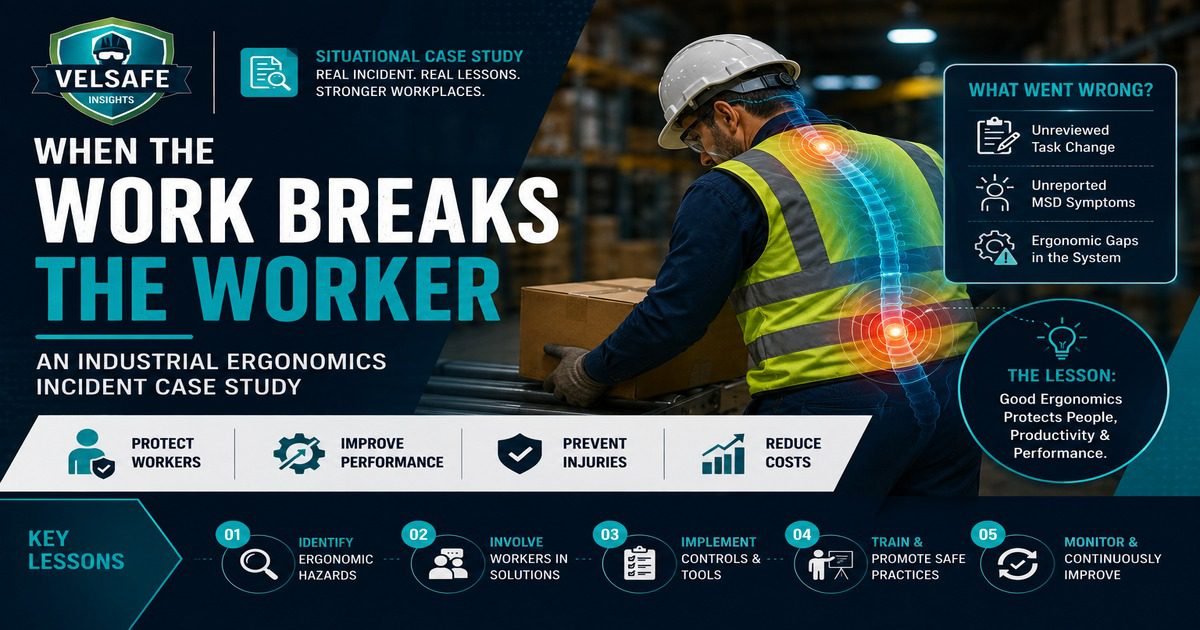
When the Work Breaks the Worker: An Industrial Ergonomics Incident Case Study
Note: The following scenario is fictional and created for educational purposes. It is designed to illustrate common ergonomic hazard patterns, investigation findings, and corrective actions that are applicable to real industrial workplaces. Any resemblance to specific incidents or facilities is coincidental.
33%
of All Workplace Injuries
Musculoskeletal disorders account for roughly one-third of all US worker injury and illness cases each year
Source: Bureau of Labor Statistics
$20B+
Annual MSD Cost to US Employers
Direct workers’ compensation costs for MSD claims exceed $20 billion annually, not including indirect costs
Source: OSHA Ergonomics
38 Days
Median Days Away From Work
The median time away from work for MSD cases is significantly higher than for most other injury categories
Source: Bureau of Labor Statistics
Situation Overview
Location
Mid-sized automotive parts assembly facility. Final assembly line, Station 7 (door panel sub-assembly). Approximately 240 production workers across three shifts.
Workers Involved
One experienced assembly technician (7 years on the line) with no prior reported injuries. Three other workers on Station 7 later reported similar developing symptoms during the investigation.
Outcome
Rotator cuff tear requiring surgical repair and four months of recovery. Worker unable to return to original position; permanent job transfer required. Three other workers identified with early-stage shoulder and wrist MSDs during subsequent ergonomic assessment.
Primary Cause
Sustained overhead reaching and repetitive arm elevation in a fixed-height workstation that had not been ergonomically assessed for the revised assembly task introduced eighteen months earlier.
Workplace Background
The facility had been assembling door panel sub-assemblies on Station 7 for several years without significant MSD-related incidents. Eighteen months before the incident, the product design was updated to include an additional wiring harness clip that required workers to reach approximately 12 inches above shoulder height to access the upper door frame attachment point. The engineering change was approved and implemented through the production engineering team, but no formal ergonomic assessment was conducted for the updated task. The existing workstation height, designed for the previous assembly configuration, was not adjusted to accommodate the new reach requirement.
Station 7 ran at a cycle time of approximately 45 seconds per unit, with each worker performing the same sequence of motions 400 to 480 times per shift. The overhead clip task was performed on each unit, meaning the shoulder elevation movement was repeated 400 to 480 times daily. Workers on Station 7 rotated only within the station (between two similar tasks) rather than rotating to stations with substantially different physical demands. The facility had an ergonomics programme on paper, but the last formal workstation assessment at Station 7 had been conducted three years before the incident.
Incident Timeline
18 months prior
Product Design Change Implemented
New wiring harness clip added to door panel design. Engineering change approved and production begins with updated assembly sequence. No ergonomic assessment of the new overhead reach task conducted.
6 months prior
First Worker Mentions Shoulder Discomfort
The affected worker mentions right shoulder soreness to a co-worker during a break. Does not report it formally because “it’s just muscle soreness” and because no formal reporting channel for early symptoms is clearly communicated on the line. Co-worker reports similar occasional discomfort.
3 months prior
Symptoms Worsen; Still Not Reported
Shoulder pain becomes present at the start of shifts, not just at the end. Worker begins compensating by using the left arm for some tasks. Still does not formally report because no one on the line has been injured “officially” and there is an informal culture of pushing through discomfort.
Incident day
Acute Injury During Standard Task
During the overhead clip task early in the second shift, the worker feels sharp pain in the right shoulder and is unable to continue working. Supervisor called; worker transported to occupational health clinic. Rotator cuff tear confirmed by imaging the following day.
Days 1-3
Investigation Initiated
EHS team and supervisor conduct initial investigation. Station 7 workstation photographed and measured. Ergonomic assessment of the overhead reach task conducted for the first time. Three additional workers interviewed; all report shoulder or wrist symptoms they had not formally reported.
Week 2-4
Corrective Actions Implemented
Workstation height adjusted. Tilt table and positioning fixture added to reduce overhead reach. Rotation programme expanded to include ergonomically distinct stations. Three additional workers referred to occupational health for assessment and early intervention.
What Went Wrong
No ergonomic review when the task changed
The engineering change that introduced the overhead reach requirement was processed entirely through the production engineering workflow, which had no formal trigger for ergonomic review. The EHS team was not notified of the change. Eighteen months of daily overhead reaching at 400-plus repetitions per shift occurred without anyone formally assessing whether the task was safe.
No early symptom reporting pathway
Workers on Station 7 experienced symptoms for months before the acute injury but did not report them. The facility had no clearly communicated pathway for early symptom reporting, no visible posters or toolbox talks that explained early reporting was expected and protected, and a shop floor culture that normalised working through physical discomfort.
Ergonomics programme existed but was not active
The facility had written ergonomics policies and a workstation assessment template. The last documented assessment of Station 7 was three years old. The programme had no schedule for re-assessing workstations after task changes, no trigger system for requesting new assessments, and no regular review of MSD-related near-miss or symptom reports that could have flagged the developing problem.
Investigation Findings
Finding
Detail
Risk Level
Overhead reach height
Clip attachment point 11-13 inches above shoulder height of all Station 7 workers assessed. Sustained shoulder elevation required for each attachment cycle.
HIGH
Repetition rate
400-480 overhead arm elevation cycles per shift. No recovery time between cycles; 45-second cycle time with clip task comprising approximately 8 seconds per cycle.
HIGH
Job rotation scope
Rotation between two tasks within Station 7, both involving similar overhead reach postures. No meaningful ergonomic relief from the rotation.
MEDIUM
Symptom reporting culture
Three of four workers on Station 7 reported symptoms they had not formally disclosed. No documented early symptom programme. Workers reported informal pressure to maintain output.
HIGH
Management of change for ergonomics
No MOC procedure existed that required ergonomic review of engineering design changes affecting assembly tasks. Engineering team had no awareness this was required.
HIGH
Root Cause Analysis
Contributing Factors by Systemic Level
No ergonomic review in management of change process
Root Cause
The absence of an ergonomic trigger in the engineering change process is the primary systemic failure. It allowed a high-risk task change to be implemented without safety review.
No early symptom reporting programme
Root Cause
Workers experienced symptoms for months without a clear pathway or cultural expectation to report them. Early reporting would have triggered an assessment and intervention long before the acute injury.
Inactive ergonomics programme (outdated assessments)
Contributing
A programme that exists on paper but is not actively maintained provides no protection. A current workstation assessment would have identified the overhead reach hazard.
Job rotation not providing ergonomic relief
Contributing
Rotation between tasks with similar physical demands does not reduce cumulative ergonomic exposure. Effective rotation requires genuine differences in muscle groups used.
Workstation height not adjusted for task change
Direct Cause
The fixed workstation height created the overhead reach hazard. Adjusting the height or the product fixture would have reduced or eliminated the reach requirement.
Corrective Actions Implemented
1
Workstation Modification
Adjustable-height tilt table and product positioning fixture installed at Station 7 to bring the clip attachment point to within-shoulder reach. Overhead reach eliminated for all workers on the station. Engineering verified the modification did not affect product quality.
Management of change procedure updated to require EHS sign-off (including ergonomic assessment) for all engineering changes that affect assembly task motions, reach distances, force requirements, or repetition rates. Engineering team trained on the new requirement.
3
Early Symptom Reporting Programme
Formal early symptom reporting system launched with posters at all workstations, toolbox talk training on why early reporting matters, and a simple reporting card workers can give to supervisors. Supervisors trained to treat symptom reports as ergonomic hazard reports requiring assessment, not as performance issues.
4
Rotation Programme Redesigned
Job rotation schedule revised to rotate workers between stations with meaningfully different physical demands (upper body, lower body, sedentary tasks) rather than within the same station. Rotation occurs every 90 minutes. Schedule designed with input from occupational health and the floor team.
5
Ergonomics Programme Reactivated
All assembly workstations scheduled for ergonomic reassessment within 90 days. Ongoing assessment schedule established: annual reassessment of all stations, plus triggered reassessment within 30 days of any engineering change. Three Station 7 workers with identified early symptoms referred to occupational health for intervention.
Lessons Learned
Engineering change processes must include ergonomics
A product or process change that modifies the physical demands of any task is an ergonomic change, even when no one in the engineering team thinks of it that way. Every facility needs a MOC procedure that triggers ergonomic review whenever assembly task motions, reach requirements, or force demands change.
Months of early warning signals were available and missed
This injury did not happen suddenly. Workers experienced symptoms for six months before the acute injury. A functioning early symptom reporting system would have triggered an investigation long before anyone reached the point of surgical injury. The cost of that intervention is a fraction of the cost of the outcome.
Job rotation only works when tasks are genuinely different
Rotating between tasks that use the same muscle groups provides no ergonomic relief. Effective rotation requires deliberate planning: identify which body regions each task loads, and rotate workers through sequences that genuinely distribute physical demand across different muscle groups.
An ergonomics programme that is not maintained is not a programme
Three years between workstation assessments, no trigger system for change-related reviews, and no active symptom tracking meant the facility’s ergonomics programme provided no actual protection. The paperwork existed; the programme did not. Maintaining an ergonomics programme requires scheduled activity, not just documented intent.
Prevention Checklist: Ergonomics Programme Essentials
Engineering and Design
Ergonomic review required in MOC process for all task-affecting changes
Work surfaces adjustable to fit the range of workers performing the task
Overhead reach tasks eliminated or minimised through fixture design
Mechanical aids available for repetitive or high-force tasks
Reporting and Assessment
Early symptom reporting system in place and actively communicated
All workstations assessed within 12 months and after any task change
Symptom reports trigger ergonomic assessment within 5 working days
Supervisors trained to respond to symptom reports as hazard reports
Work Organisation
Job rotation schedule designed to provide genuine ergonomic variety
Micro-break schedule in place for high-repetition tasks
No informal pressure to work through discomfort or skip rotation
MSD rate and symptom reports reviewed monthly by EHS and management
Key Takeaways
MSDs are predictable and preventable when the triggers are known
This injury was not a freak event. Every contributing factor was visible and known to ergonomics professionals: high repetition, overhead reach, no recovery time, no symptom reporting, no task change review. Recognising these factors early allows intervention before injury occurs. The goal of an ergonomics programme is to identify and address these patterns before they accumulate into injury.
The cost of prevention is always less than the cost of the injury
Adjusting a workstation height costs hundreds or a few thousand dollars. Installing a positioning fixture costs a few thousand. Redesigning a job rotation schedule costs time and planning. A rotator cuff surgery, four months of lost time, permanent job transfer, workers’ compensation claim, and three additional workers with developing MSDs costs orders of magnitude more. The economics of ergonomic prevention are straightforward.
Culture determines whether early warning signals reach the people who can act
Workers in this scenario experienced symptoms for six months and said nothing. The investigation revealed they did not report because they did not know they should, because there was no clear pathway, and because the shop floor culture normalised pain as part of the job. Changing that culture requires explicit communication, visible reporting channels, and supervisor behaviour that treats symptom reports as valuable information rather than inconveniences.
Frequently Asked Questions
Does OSHA have a specific ergonomics standard for manufacturing?
OSHA does not currently have a general industry ergonomics standard. A proposed standard was withdrawn in 2001. However, OSHA can and does cite ergonomic hazards under the General Duty Clause (Section 5(a)(1) of the OSH Act), which requires employers to provide a workplace free from recognised hazards likely to cause serious harm. OSHA also publishes ergonomics guidelines for specific industries including meatpacking, shipyards, and retail grocery. The absence of a specific standard does not relieve employers of the obligation to address recognised ergonomic hazards.
How often should workstation ergonomic assessments be conducted?
Best practice is to assess all workstations at least annually and conduct a triggered reassessment within 30 days of any engineering change, new task introduction, or worker symptom report. High-risk workstations involving overhead reach, high repetition, significant force, or vibration may warrant more frequent review. The specific interval matters less than ensuring assessments actually occur on schedule.
What is the difference between a management of change (MOC) review and an ergonomic assessment?
A management of change review is a systematic process for evaluating the safety implications of any proposed change before that change is implemented. An ergonomic assessment evaluates the physical demands of a specific task or workstation against ergonomic risk criteria. In a well-designed safety programme, the MOC process includes a trigger that requires an ergonomic assessment whenever a proposed change will affect the physical demands of any task. The two processes are complementary: MOC determines when an assessment is needed; the assessment determines whether the change is ergonomically acceptable.
Government and Regulatory Sources
Related VelSafe Articles
From Pattern to Prevention
The injury in this scenario was not random and was not inevitable. It was the predictable result of a known set of conditions: high repetition, overhead reach, no ergonomic review, no early reporting, and an inactive assessment programme. Every one of those conditions is identifiable and correctable before an injury occurs. The tools are available. The ergonomic risk assessors, workstation checklists, MOC procedures, and early symptom programmes that would have prevented this injury are documented, proven, and accessible. The question is whether they are actively used. Find more workplace safety resources at velsafe.com.