

30+ Statistics Every Organization Must Know (2025)
Fifteen-passenger vans are widely used by churches, schools, universities, nonprofit organisations, and employers to transport groups at lower cost than chartered buses. They are spacious, affordable, and widely available. They are also the highest-rollover-risk vehicle configuration in common civilian use. NHTSA research spanning three decades documents a consistent and unremediated safety pattern: 15-passenger vans in fully loaded configuration roll over at five times the rate of the same vehicles with only a driver, and occupants killed in these rollovers are ejected at rates that reflect near-universal seat belt non-compliance among van passengers.
The core safety problem has not changed between NHTSA’s initial 1990s research and 2025 data: the vehicle’s high centre of gravity, rearward weight shift under full load, and the occupant behaviour patterns of the populations that use these vehicles most frequently (school groups, faith communities, volunteer organisations) produce a combination that continues to generate preventable fatalities every year.
Below we have compiled 30+ statistics and data points on 15-passenger van safety, covering rollover risk, occupant ejection, tire failure, speed and road condition interactions, organisational liability exposure, NHTSA and FMCSA regulatory context, and the specific operational controls that reduce risk for organisations that continue to operate these vehicles through 2025.
1. Rollover Risk: The Central Safety Problem of 15-Passenger Vans
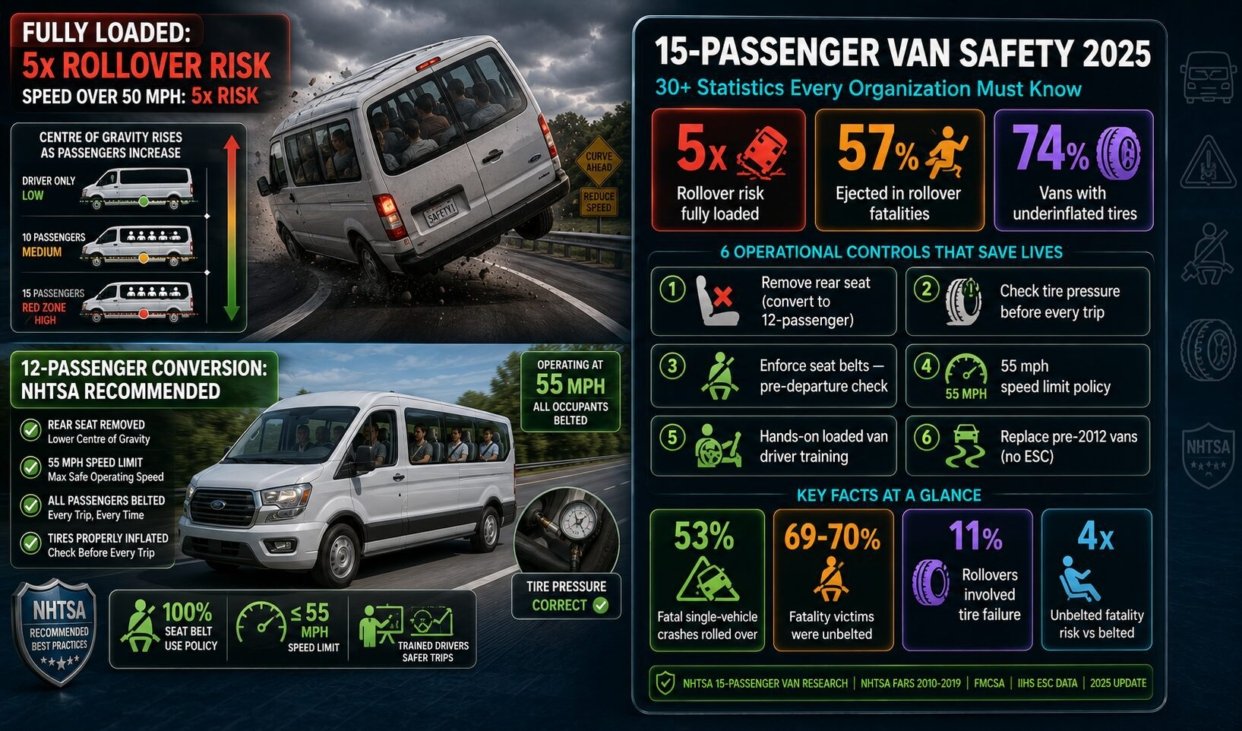
- From 1990 to 2002, 53% of 15-passenger vans involved in fatal single-vehicle crashes rolled over, peaking at 65% in 2000. This rollover rate is substantially higher than that of other vehicle types, making rollover the defining safety challenge of this vehicle class. NHTSA 15-Passenger Van Safety Research
- The rollover risk increase under full load reflects a fundamental physics problem: adding passengers to the rear seats raises the van’s centre of gravity and shifts weight rearward, reducing the stability margin during turning, lane changes, and emergency manoeuvres. The vehicle’s chassis was originally designed for cargo, not people. NHTSA
- Fully loaded 15-passenger vans have a Static Stability Factor (SSF) comparable to the least stable SUVs of the 1990s and early 2000s. SSF – a measure of how top-heavy a vehicle is – is the primary NHTSA metric for rollover propensity, and 15-passenger vans in full load configuration score poorly. NHTSA Vehicle Ratings
- The compounding effect of full load, speed above 50 mph, and curved road conditions creates a worst-case scenario that is approximately 10 times more likely to result in rollover than the same van driven slowly with only a driver on a straight road. This combination is common on highway trips to sports events, church retreats, and school field trips. NHTSA
- Electronic Stability Control (ESC), now mandatory on all new light vehicles since 2012, reduces rollover risk significantly for equipped vehicles by automatically applying brakes to individual wheels when the vehicle begins to slide. Organisations should verify whether their van fleet includes ESC before assuming it provides this protection. Older models do not. NHTSA ESC Mandate; IIHS
2. Occupant Ejection and Seat Belt Non-Compliance: The Fatality Driver
- Between 2010 and 2019, 235 occupants of 15-passenger vans were killed in rollover crashes. Of these, 57% (approximately 135 people) were ejected from the vehicle – a pattern that directly reflects seat belt non-compliance among rear-seat passengers. NHTSA FARS 2010-2019
- Ejection from a vehicle during a rollover is associated with catastrophically higher fatality rates than remaining inside the vehicle. The vehicle structure provides significant occupant protection during a rollover; ejected occupants lose this protection entirely and are at risk of being struck by the vehicle or ground impact at high velocity. NHTSA Rollover Research
- The 69-70% seat belt non-compliance rate among 15-passenger van fatality victims is dramatically higher than the overall US seat belt use rate of approximately 91.6% as of 2023. The gap reflects the social dynamics of group van travel: peer pressure, short trips, back-row informality, and the absence of a consistent enforcement mechanism by drivers who are focused on the road. NHTSA; NHTSA Seat Belt Use Survey 2023
- Federal law requires seat belts in all seating positions of 15-passenger vans manufactured after 1989. However, federal law does not require adult passengers to wear them in many states – making organisational policy the primary enforcement mechanism for organisations using these vehicles. NHTSA; State Seat Belt Laws
- Organisations that implement and enforce a mandatory seat belt policy with a pre-departure check – where the driver or a designated trip leader confirms all passengers are belted before the vehicle moves – directly address the primary fatality driver in 15-passenger van crashes. NHTSA; NSC
3. Tire Condition and Inflation: The Underinflation Crisis
- NHTSA surveys found that 74% of 15-passenger vans had improperly inflated tires – nearly double the 39% rate for regular passenger vehicles. This finding reflects the maintenance neglect common in shared fleet vehicles where no individual owner takes personal responsibility for tire condition. NHTSA Vehicle Survey Data
- Tire failure contributed to 11% of fatal rollover crashes involving 15-passenger vans. Rear tire failures are particularly dangerous because rear tires bear the highest load in a fully loaded van and a rear tire failure at highway speed can trigger the vehicle dynamics that lead to rollover. NHTSA Tire Safety Data
- A 15-passenger van fully loaded to its gross vehicle weight rating (GVWR) places significantly higher loads on rear tires than the same tires would experience in a lightly loaded vehicle. Underinflated tires under high load are at elevated risk of heat buildup, tread separation, and blowout – each of which can trigger loss of control. NHTSA; Tire Rack
- The tires installed on some 15-passenger vans are rated for the vehicle’s GVWR only when properly inflated. Operating with underinflated tires on a fully loaded van means the tires are operating outside their rated load capacity, which significantly increases failure risk. NHTSA Tire Safety; Vehicle Owner’s Manual
- NHTSA recommends checking 15-passenger van tire pressure before every trip, using the cold inflation pressure listed on the vehicle placard inside the driver’s door frame – not the maximum pressure listed on the tire sidewall. The door placard reflects the manufacturer’s optimal pressure for that vehicle’s load characteristics. NHTSA 15-Passenger Van Safety Tips
- Tire Pressure Monitoring Systems (TPMS) have been required on all new US light vehicles since 2008 and provide a dashboard warning when tire pressure falls significantly below the recommended level. However, TPMS only warns of significant underinflation – it does not provide real-time pressure readings and does not replace physical pressure checks before trips. NHTSA TPMS Rule
4. Speed, Road Conditions, and Crash Dynamics
- The combination of full loading, speed above 50 mph, and a curved road creates a compounding risk scenario that is responsible for a disproportionate share of serious 15-passenger van crashes. Many organisations use these vehicles for interstate highway trips to sporting events, retreats, and field trips – precisely the scenario where all three risk factors apply simultaneously. NHTSA
- Overcorrection – a driver’s instinctive response to an initial loss of directional control – is a significant contributor to rollover initiation in 15-passenger vans. Because the van’s handling response to steering inputs is different from a passenger car, drivers accustomed to cars may overcorrect and trigger a rollover that a more calibrated response would have avoided. NHTSA Research
- Roof racks and rooftop cargo carriers raise the van’s centre of gravity further above the fully-loaded passenger baseline. NHTSA explicitly recommends against roof racks on 15-passenger vans and advises that luggage be stored inside the vehicle or in a towable trailer rather than on the roof. NHTSA 15-Passenger Van Safety Advisory
5. Driver Requirements and Regulatory Context (2025)
The regulatory status of 15-passenger van drivers as of 2025 reflects a persistent gap between the vehicle’s risk profile and the licensing requirements applied to those who drive it.
- Most 15-passenger vans operated by nonprofits, churches, and universities do not require a CDL because the vehicles are used for not-for-hire transport of the organisation’s own members. The standard passenger car licence is typically sufficient, creating a situation where a driver with no large vehicle training may legally operate a top-heavy van carrying 14 people at highway speeds. FMCSA; State Licensing Authorities
- FMCSA requires a CDL with Passenger (P) endorsement for for-hire transport of 16 or more persons including the driver – meaning a 15-passenger van carrying 14 passengers plus a driver operates just below the CDL threshold for commercial for-hire use, even though the vehicle dynamics are the same. 49 CFR 383.91
- Several US states have enacted more stringent requirements for 15-passenger van drivers following fatality incidents. As of 2025, some states require additional training or endorsements for drivers of these vehicles regardless of hire status when used for school-related or youth transport. Organisations should verify their state’s current requirements. State Motor Vehicle Laws
- NHTSA and FMCSA recommend – even where not legally required – that organisations ensure 15-passenger van drivers have completed a specific 15-passenger van driver training programme that covers the vehicle’s unique handling characteristics, loading effects, and emergency procedures. NHTSA; FMCSA Safety Advisory
6. Alternatives and Comparative Safety Data
- School buses are the safest form of ground transportation for groups of students and passengers, with a fatality rate approximately 50-70 times lower per mile than passenger cars and substantially lower than 15-passenger vans. The safety differential reflects compartmentalisation (high-backed padded seats that provide protection without belts), structural protection, and driver training requirements. NHTSA; School Bus Safety Data
- Chartered motor coaches (large buses operated by licensed commercial carriers) are also substantially safer than 15-passenger vans for group transport. They are subject to FMCSA safety oversight, mandatory driver CDL with P endorsement, and regular vehicle inspections. For organisations making cost-based transportation decisions, the liability exposure differential between a 15-passenger van crash and a motor coach crash is a relevant financial consideration. FMCSA; IIHS
- Sprinter-style and Transit-style vans configured for 12-passenger transport have lower centres of gravity than 15-passenger vans due to different body-on-frame configurations and lower seating height. However, they are not without rollover risk under full load and high-speed conditions and should be operated with the same driver training and operational controls as 15-passenger vans. IIHS; NSC
- The financial case for 15-passenger vans – lower acquisition cost and no CDL requirement for drivers – must be evaluated against the liability exposure of a multi-fatality rollover. Several US organisations have faced multi-million dollar civil judgments following 15-passenger van crashes, with courts scrutinising driver training, maintenance records, and trip planning practices. Case Law; Insurance Industry Data
7. Organisational Risk Management: What the Data Recommends
- Removing the rearmost seat in the 15-passenger van – effectively converting it to a 12-passenger configuration – reduces the maximum passenger load and significantly limits the rearward weight shift that elevates rollover risk. NHTSA explicitly recommends this modification as the primary structural risk mitigation for organisations that must continue using these vehicles. NHTSA 15-Passenger Van Safety Advisory
- Organisations that implement a written 15-passenger van policy covering driver qualifications, pre-trip inspection requirements, mandatory seat belt use, speed limits, and trip approval procedures demonstrate due diligence in the event of a crash. The absence of a written policy is a significant liability factor in litigation following 15-passenger van incidents. NSC; Risk Management Best Practices
- Pre-trip inspections specifically for 15-passenger vans should cover six key areas: tire pressure and condition on all six tires (including spare), fluid levels, brake function, lighting, cargo loading and tie-down, and seat belt functionality for all seating positions. A signed pre-trip checklist creates a documentation record and builds inspection habits. NHTSA; NSC
- Driver training specific to 15-passenger van handling should include hands-on experience with the loaded vehicle’s turn radius, stopping distance, and lane change dynamics – all of which differ materially from a passenger car. Organisations relying on drivers whose only large vehicle experience is the training drive are accepting an avoidable risk. NHTSA; NETS
- Speed governors or telematics systems that limit speed to 55 mph or less for 15-passenger van operations directly address the speed-over-50-mph risk multiplier. Several universities and nonprofits have implemented these limits in response to NHTSA safety recommendations, with documented reduction in high-speed incident exposure. University Fleet Safety Programmes; NETS
- Insurance carriers that cover organisational 15-passenger van fleets as of 2025 increasingly require documented driver training, pre-trip inspection records, and written safety policies as underwriting conditions. Organisations that cannot document these controls may face coverage restrictions or premium surcharges following a claim. Insurance Industry Requirements 2024-2025
8. 2025 Update: ESC, TPMS, and the Modern 15-Passenger Van Fleet
- All new 15-passenger vans manufactured since model year 2012 are required to include Electronic Stability Control (ESC) under NHTSA’s ESC mandate. ESC detects and helps correct vehicle instability during turns and emergency manoeuvres by automatically applying individual wheel brakes. IIHS research shows ESC reduces single-vehicle crash risk by approximately 49% for cars and SUVs and is expected to provide similar benefit for 15-passenger vans. NHTSA ESC Rule; IIHS ESC Research
- Organisations operating pre-2012 15-passenger vans are operating vehicles without ESC. NHTSA recommends that organisations replace pre-ESC vans as a priority action. The age and ESC status of each vehicle in the fleet should be documented in the organisation’s vehicle safety programme. NHTSA
- Tire Pressure Monitoring Systems have been required since 2008. In practice, TPMS warns of significant underinflation (typically 25% below recommended) but does not replace the pre-trip pressure check. Organisations should treat the TPMS warning light as an urgent safety alert, not a routine maintenance indicator – driving a 15-passenger van at highway speed with a TPMS warning active under full load is a serious safety failure. NHTSA TPMS Rule
- As of 2025, NHTSA has not issued a recall or mandatory modification for 15-passenger vans based on rollover risk, maintaining the position that the primary risk factor is operational rather than design – the vehicle’s risk is manageable through driver training, loading practices, speed management, and tire maintenance. This position has been maintained consistently since the 1990s and has drawn criticism from safety advocates. NHTSA; Consumer safety advocates
- The 15-passenger van market as of 2025 is dominated by the Ford Transit and Ram ProMaster in configurations supporting up to 15 passengers. Both vehicles include ESC and TPMS as standard. Ford and Ram publish specific loading and handling guidance for high-occupancy configurations that organisations should review and implement. Ford Motor Company; Stellantis / Ram 2025
Key Takeaways for Organisations Operating 15-Passenger Vans in 2025
Frequently Asked Questions
Sources
Government and Regulatory Sources
- NHTSA. 15-Passenger Van Safety Research and Consumer Advisory: rollover statistics, ejection rates, tire and seat belt data.
- NHTSA. (2022). 15-Passenger Van Safety: Key Facts: rollover rate, occupant ejection, and seat belt compliance data.
- FMCSA. 15-Passenger Van Safety Resources: CDL exemption boundaries, FMCSA regulatory requirements for commercial operators.
- FMCSA. 49 CFR Part 392.71: Driver qualifications and pre-trip inspection requirements for passenger-carrying vehicles.
- NIOSH / CDC. Motor Vehicle Safety at Work: occupational fatality data for van-related crashes and fleet safety guidance.
- NTSB. Highway Accident Investigation Reports: 15-passenger van crash investigations and safety recommendations.
Research and Industry Sources
- IIHS. Van and SUV Rollover: comparative rollover data, ESC effectiveness studies, and safety ratings.
- GHSA. Governors Highway Safety Association: state-level seat belt enforcement data and zero-tolerance compliance programmes.
- AAA Foundation for Traffic Safety: tire safety research, TPMS effectiveness data, and fleet inspection recommendations.
- NSC Injury Facts: occupational motor vehicle fatality statistics and van-related crash cost estimates.