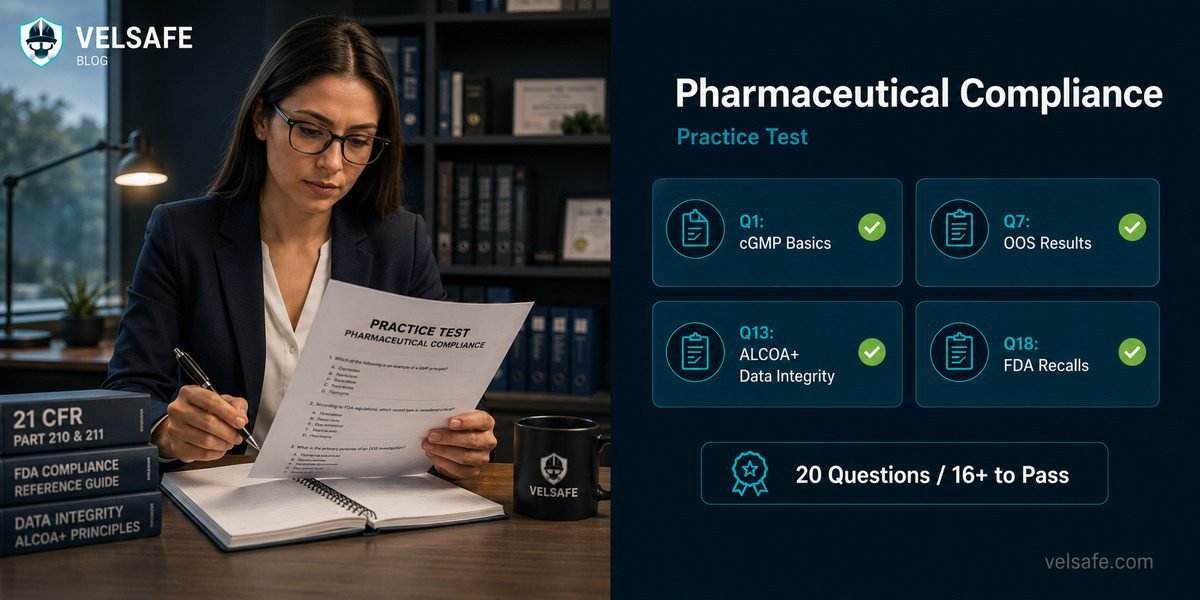
PRACTICE TEST: Pharmaceutical Compliance
Introduction to Pharmaceutical Compliance: Knowledge Review Practice Test
Test your understanding of US pharmaceutical compliance essentials: CGMP regulations, FDA authority, quality system requirements, adverse event reporting, and enforcement mechanisms. This practice test is designed for regulatory affairs, quality, manufacturing, and sales professionals working in or entering the pharmaceutical industry.
20
Questions
Covering CGMP regulations, FDA authority, quality systems, recordkeeping, enforcement, and post-market obligations.
4
Topic Sections
FDA Authority and CGMP Framework, Quality System Essentials, Recordkeeping and Data Integrity, Enforcement and Post-Market Obligations.
16+
Passing Score
A score of 16 or more out of 20 indicates a solid foundation in pharmaceutical compliance. Each question includes the correct answer and explanation.
Pharmaceutical compliance in the United States is governed by FDA’s Current Good Manufacturing Practice (CGMP) regulations under Title 21 of the Code of Federal Regulations, primarily Parts 210 and 211. These regulations establish the minimum requirements for the manufacture, processing, packing, and holding of finished pharmaceutical products. Understanding this framework is essential for anyone working in pharmaceutical manufacturing, quality, regulatory affairs, or sales roles.
This practice test covers four core areas of pharmaceutical compliance knowledge: FDA authority and the CGMP regulatory framework, quality system requirements, recordkeeping and data integrity obligations, and enforcement mechanisms including Warning Letters, recalls, and criminal liability. Each question reflects content relevant to FDA inspections, internal audits, and compliance training programmes.
How to Use This Practice Test
Read each question and select the best answer before reviewing the explanation. Questions are based on 21 CFR Parts 210 and 211, FDA guidance documents, and CGMP enforcement practice. A score of 16 or more out of 20 indicates a solid grasp of pharmaceutical compliance foundations. Use the explanations to reinforce understanding of areas where your answer was incorrect.
Section 1 of 4: FDA Authority and CGMP Framework (Questions 1-5)
1. What does the “c” in cGMP stand for and what does it require manufacturers to do?
A. Certified: manufacturers must obtain ISO certification before producing pharmaceuticals
B. Current: manufacturers must use up-to-date technologies and methods, not just the minimum standards written at the time the regulation was issued
C. Compliant: manufacturers must self-certify compliance before each batch release
D. Controlled: manufacturers must control all variables in the production environment
Correct Answer: B
“Current” means FDA expects manufacturers to use the most up-to-date scientifically sound methods available. Compliance with the literal text of a regulation written decades ago is insufficient if modern science and industry practice have advanced. This is why CGMPs evolve through guidance documents, FDA observations, and industry standards even when the regulatory text itself does not change.
2. Which federal law established FDA’s authority to regulate pharmaceutical manufacturing through CGMP requirements?
A. The Drug Enforcement Administration Act of 1973
B. The Federal Food, Drug, and Cosmetic Act (FD&C Act) of 1938
C. The Patient Protection and Affordable Care Act of 2010
D. The Biologics Control Act of 1902
Correct Answer: B
The Federal Food, Drug, and Cosmetic Act of 1938 is the foundational law governing FDA’s authority over pharmaceuticals. It was enacted in response to the Sulfanilamide Disaster of 1937, in which an untested solvent killed over 100 people. The FD&C Act authorized FDA to require pre-market safety review of drugs and established the framework for manufacturing standards. The Kefauver-Harris Amendment of 1962 subsequently added the requirement for demonstrated effectiveness.
3. Which CFR parts contain FDA’s primary CGMP regulations for finished pharmaceutical products?
A. 21 CFR Parts 50 and 56
B. 21 CFR Parts 210 and 211
C. 21 CFR Parts 312 and 314
D. 21 CFR Parts 820 and 803
Correct Answer: B
21 CFR Part 210 establishes general CGMP definitions and scope. 21 CFR Part 211 contains the specific requirements for finished pharmaceutical products, covering personnel, buildings and facilities, equipment, control of components and drug product containers, production and process controls, laboratory controls, records and reports, and returned and salvaged drug products. Parts 820 and 803 apply to medical devices; Parts 312 and 314 govern clinical trials and NDA submissions; Parts 50 and 56 govern informed consent and IRBs.
4. Under FDA’s CGMP framework, who bears the burden of proof regarding product safety and purity?
A. FDA, through batch-by-batch testing of commercially distributed products
B. The patient or healthcare provider who reports an adverse event
C. The manufacturer, through validated processes, testing, and documented quality systems
D. The wholesale distributor who releases the product into commerce
Correct Answer: C
CGMP places the burden of proof entirely on the manufacturer. FDA does not test every batch before it is distributed. The manufacturer must demonstrate, through validated processes, in-process controls, finished product testing, and comprehensive documentation, that each batch meets its specifications. This is why CGMP documentation requirements are so extensive: the records are the evidence that the system worked as intended for every production batch.
5. Which CGMP subpart of 21 CFR Part 211 governs the qualifications and responsibilities of personnel involved in drug manufacturing?
A. Subpart F: Production and Process Controls
B. Subpart J: Records and Reports
C. Subpart B: Organization and Personnel
D. Subpart D: Equipment
Correct Answer: C
Subpart B (21 CFR 211.22 through 211.68) covers organizational and personnel requirements. It establishes that there must be an adequate number of qualified personnel, that responsibilities must be clearly defined, that the quality control unit must have the authority to approve or reject all components and drug products, and that all personnel must receive appropriate training. Subpart F covers manufacturing processes; Subpart J covers documentation; Subpart D covers equipment qualification and maintenance.
Section 2 of 4: Quality System Essentials (Questions 6-10)
6. Under 21 CFR Part 211, which unit has the authority to approve or reject all components, drug product containers, closures, labelling, and drug products?
A. The manufacturing department supervisor
B. The Quality Control unit
C. The regulatory affairs department
D. The facility general manager
Correct Answer: B
21 CFR 211.22 vests release authority exclusively in the Quality Control unit, which must be independent of production. This independence is a foundational CGMP principle: the unit responsible for evaluating quality cannot also be responsible for production output. FDA inspectors routinely assess whether QC independence is genuine or nominal, looking for evidence that production pressure influences QC release decisions.
7. What is required when a manufacturing employee discovers that a production step deviated from the written procedure?
A. Complete the step using best professional judgment and note the deviation in personal records
B. Immediately report the deviation to a supervisor or quality team, document it formally, and initiate investigation before releasing the affected batch
C. Repeat the step from the beginning and document only the correct execution in the batch record
D. Contact the customer to determine whether the deviation will affect their acceptance criteria
Correct Answer: B
Deviations from written procedures must be documented and investigated under CGMP. Option A describes an undocumented deviation, which is a data integrity violation. Option C describes falsification of records, which is a criminal matter under the FD&C Act. Option D is not part of the CGMP deviation handling process. The correct action is immediate reporting, contemporaneous documentation, and investigation to determine whether the deviation affects product quality before any release decision is made.
8. What does process validation demonstrate under 21 CFR Part 211?
A. That the manufacturing equipment has passed its annual preventive maintenance schedule
B. That a manufacturing process consistently produces a product meeting its predetermined specifications and quality attributes
C. That the facility layout complies with building codes for pharmaceutical manufacturing
D. That each individual batch has been tested and found to meet release specifications
Correct Answer: B
Process validation, as defined in FDA’s 2011 Process Validation Guidance, establishes scientific evidence that a process consistently delivers a quality product. Validation covers the full product lifecycle: process design, process qualification, and continued process verification. It is distinct from individual batch testing (Option D), which verifies a specific batch meets specifications. Validation demonstrates the process itself is capable of consistently meeting those specifications across multiple batches and under varying conditions within defined parameters.
9. Under 21 CFR 211, what must happen before any component (raw material or excipient) is used in drug product manufacturing?
A. The supplier must provide a certificate of analysis and the manufacturer may rely on it without additional testing
B. The component must be tested or examined against established specifications and approved for release by the Quality Control unit
C. The component must be quarantined for at least 30 days regardless of test results
D. The component must receive written approval from FDA’s district office before use
Correct Answer: B
21 CFR 211.84 requires that each lot of component be tested for conformity with written specifications. A supplier’s certificate of analysis alone does not satisfy this requirement unless the manufacturer has established the reliability of the supplier’s test results through periodic validation. Components that have not been approved by QC must not be used in production. FDA does not approve individual component lots before use; that is the manufacturer’s responsibility.
10. What is an Out-of-Specification (OOS) result and what does 21 CFR Part 211 require when one is identified?
A. A result that falls outside the equipment’s operating range; the equipment must be immediately taken out of service
B. A laboratory result that does not conform to established acceptance criteria; it must be investigated thoroughly before the result is invalidated or the batch is rejected
C. A production yield result below target; the batch may be released if the yield deficiency is documented
D. A stability result that falls outside trend analysis limits; a new stability study must begin within 30 days
Correct Answer: B
An OOS result is any laboratory test result that falls outside the specifications established in the approved method or product specification. FDA’s 2006 OOS guidance requires a thorough two-phase investigation: Phase I (laboratory investigation to identify assignable laboratory error) and Phase II (full-scale manufacturing investigation if no laboratory error is identified). An OOS result cannot be dismissed, averaged out, or overridden without a scientifically sound investigation. Invalidating an OOS result without adequate investigation is a major data integrity finding.
Section 3 of 4: Recordkeeping and Data Integrity (Questions 11-15)
11. What does “contemporaneous documentation” mean in the context of CGMP batch records?
A. Records that are reviewed and approved by a supervisor within 24 hours of completion
B. Records completed at the time the activity occurs, not from memory after the fact
C. Records that have been transcribed from paper to an electronic system within the same shift
D. Records that are dated within the same calendar month as the manufacturing activity
Correct Answer: B
Contemporaneous documentation means recording each step at the time it is performed, not reconstructing records from memory later. This requirement exists because memory is unreliable and reconstruction creates the opportunity for intentional or unintentional falsification. Batch records completed after the fact, even if accurate, violate CGMP documentation standards and constitute a data integrity finding. FDA inspectors look for evidence of contemporaneous recording through timestamps, ink type analysis, and consistency of record entries.
12. An employee realizes they wrote the wrong batch number in a CGMP record. What is the correct way to make this correction?
A. Use correction fluid (white-out) to cover the error and write the correct information on top
B. Draw a single line through the error, write the correct information, and add initials, date, and reason for the correction
C. Request a new batch record form and discard the one with the error
D. Cross out the entire line with multiple strokes so it is unreadable, then enter the correct information
Correct Answer: B
The CGMP correction standard requires that the original entry remain legible (so the error is traceable), and that the correction be attributed to a specific person at a specific time with a reason. Options A and D involve obscuring original entries, which is a data integrity violation. Option C discards a CGMP document, which violates record retention requirements. The single-line correction with initials, date, and reason is the universal CGMP correction standard for paper records.
13. FDA’s data integrity guidance identifies the ALCOA+ principles for CGMP records. What does the acronym ALCOA stand for?
A. Accurate, Legible, Complete, Original, Auditable
B. Attributable, Legible, Contemporaneous, Original, Accurate
C. Approved, Locked, Controlled, Organized, Accessible
D. Audited, Legible, Complete, Original, Attributed
Correct Answer: B
ALCOA stands for Attributable (who performed the action and when), Legible (readable throughout the retention period), Contemporaneous (recorded at the time of the activity), Original (the first record or a certified true copy), and Accurate (truthful, complete, and without errors). ALCOA+ adds Complete, Consistent, Enduring, and Available. These principles apply to both paper and electronic records and form the basis of FDA’s data integrity inspection approach across pharmaceutical and medical device regulated industries.
14. Under 21 CFR 211.180, how long must manufacturers retain batch production records?
A. One year after the batch expiration date
B. At least one year after the batch distribution date
C. At least one year after the expiration date of the batch, or one year after the distribution of the last lot of drug product made from a given master batch record, whichever is longer
D. Three years from the manufacturing date regardless of expiration
Correct Answer: C
21 CFR 211.180(a) requires batch records to be retained for at least one year after the expiration date, or one year after distribution of the last lot from the associated master batch record, whichever is longer. This retention period ensures that records are available during the product’s shelf life and for post-market investigations. For annual product reviews, records must also be available for review of the prior year’s production, which is an additional retention driver. Records retrieved for inspection must be readily available within the facility.
15. Which of the following is an example of a data integrity violation that could result in criminal charges against an individual under the FD&C Act?
A. Completing a batch record entry in pencil rather than pen
B. Backdating a batch record to make it appear that a step was performed on a different date than it actually occurred
C. Storing batch records in a binder rather than an electronic document management system
D. Using a photocopy of a signed SOP as the production reference copy
Correct Answer: B
Backdating records is falsification of a CGMP document, which constitutes fraud under the FD&C Act. Individuals who knowingly falsify pharmaceutical records face criminal prosecution including fines and imprisonment. Several individuals have been criminally convicted for backdating batch records, pre-signing blank forms, and creating records for steps that were never performed. Option A is a procedure issue but not falsification. Option C is a format issue that may require corrective action but is not criminal. Option D may be a document control gap but is not record falsification.
Section 4 of 4: Enforcement and Post-Market Obligations (Questions 16-20)
16. What is a Form FDA 483 and what obligation does it create for the facility?
A. A pre-inspection notification that FDA sends to schedule a facility inspection
B. A written list of inspectional observations that appear to be CGMP violations, presented at the end of an inspection; the facility should respond in writing within 15 business days with a corrective action plan
C. A formal Warning Letter that triggers mandatory product recall
D. A consent decree requiring the facility to cease manufacturing operations
Correct Answer: B
A Form 483 is issued by an FDA investigator at the close of an inspection and lists conditions that appear to violate CGMP regulations. It is not a Warning Letter or final enforcement action; it is an observation document. The facility is not legally required to respond, but best practice is to provide a comprehensive written response within 15 business days addressing each observation with specific corrective actions, timelines, and evidence of implementation. A 483 that is not adequately addressed can escalate to a Warning Letter.
17. When FDA determines that CGMP violations represent significant and unremedied compliance failures, it issues a Warning Letter. What is the primary commercial consequence of receiving a Warning Letter?
A. The facility is immediately required to halt all manufacturing operations
B. FDA places a hold on approval of new drug applications (NDAs, ANDAs) associated with the facility until the violations are resolved
C. The facility must pay a fixed penalty of $1 million per cited violation within 30 days
D. The facility’s manufacturing license is automatically suspended
Correct Answer: B
An FDA Warning Letter does not immediately shut down a facility (Option A) or trigger automatic penalties (Option C). There is no pharmaceutical manufacturing “license” in the US that FDA suspends (Option D). The primary immediate commercial consequence is that FDA places new drug application approvals associated with the cited facility on hold. Pending NDAs, ANDAs, and supplemental applications cannot be approved while the Warning Letter issues remain unresolved, which creates significant commercial pressure for resolution. Warning Letters are also published publicly and permanently on FDA’s website.
18. Under what circumstances must a manufacturer initiate a drug product recall?
A. Only when FDA issues a mandatory recall order
B. Whenever a single consumer complaint about a product is received
C. When the manufacturer becomes aware that a distributed drug product violates FDA regulations or presents a risk to public health, regardless of whether FDA has requested a recall
D. Only when the product fails a stability test during its shelf life
Correct Answer: C
Most pharmaceutical recalls are voluntary, initiated by the manufacturer before any FDA mandatory order. Under 21 CFR Part 7, manufacturers are expected to initiate recalls when they determine a product in commerce is violative or poses a health risk. FDA can request a recall and, for certain product categories, issue mandatory recall orders. Waiting for FDA to order a recall rather than self-initiating a known safety issue is viewed as an aggravating factor in enforcement. The absence of a consumer complaint or FDA request does not delay the obligation to recall a product the manufacturer knows is defective or violative.
19. Under CGMP regulations, what must a manufacturer do when a drug product is returned from the field?
A. Reprocess and re-release the returned product if it passes visual inspection
B. Destroy all returned goods immediately without testing
C. Quarantine, investigate the reason for return, evaluate safety and quality, and document the disposition; returned goods may only be salvaged if testing confirms they meet specifications and the integrity of the product has been maintained
D. Notify FDA within 24 hours of receiving any returned product
Correct Answer: C
21 CFR 211.204 requires that returned drug products be held and thoroughly evaluated. The manufacturer must determine the reason for return and assess whether the product has been properly stored, handled, and transported. Returned goods may only be salvaged if their quality and identity have been evaluated and they meet applicable standards. They cannot be reprocessed simply based on visual inspection (Option A). Not all returns require immediate FDA notification (Option D) though returns that indicate a product safety issue may trigger reporting obligations under other provisions.
20. A pharmaceutical sales representative is asked by a physician whether a product can be used for a condition that is not in the FDA-approved labelling. What is the appropriate response?
A. Share published clinical studies supporting the off-label use and confirm the product is commonly used for that indication
B. Confirm that physicians may prescribe any approved drug for off-label use, but explain that the sales representative cannot promote or discuss uses not in the approved labelling, and offer to connect the physician with medical affairs for a scientific exchange
C. Provide the physician with the full clinical data package from the company’s research files
D. Recommend the physician consult the company’s website for the most current product information
Correct Answer: B
While physicians may legally prescribe approved drugs for off-label indications, pharmaceutical manufacturers may not promote off-label uses. A sales representative who actively discusses, provides studies for, or encourages off-label use is engaging in off-label promotion, which is a prohibited act under the FD&C Act and a major source of False Claims Act liability. The appropriate response acknowledges the physician’s authority to prescribe while declining to discuss the unapproved use and directing the inquiry to medical affairs, which can conduct an unsolicited scientific exchange under applicable guidelines.
VelSafe Practice Tests
Test Your Compliance Knowledge Before Your Next Audit or Inspection
VelSafe practice tests cover pharmaceutical CGMP, medical device regulations, clinical compliance, and safety standards. Each test includes detailed explanations to reinforce understanding, not just score reporting.
Browse All Practice Tests