WORKER SAFETY: Pharmaceutical and Device Compliance
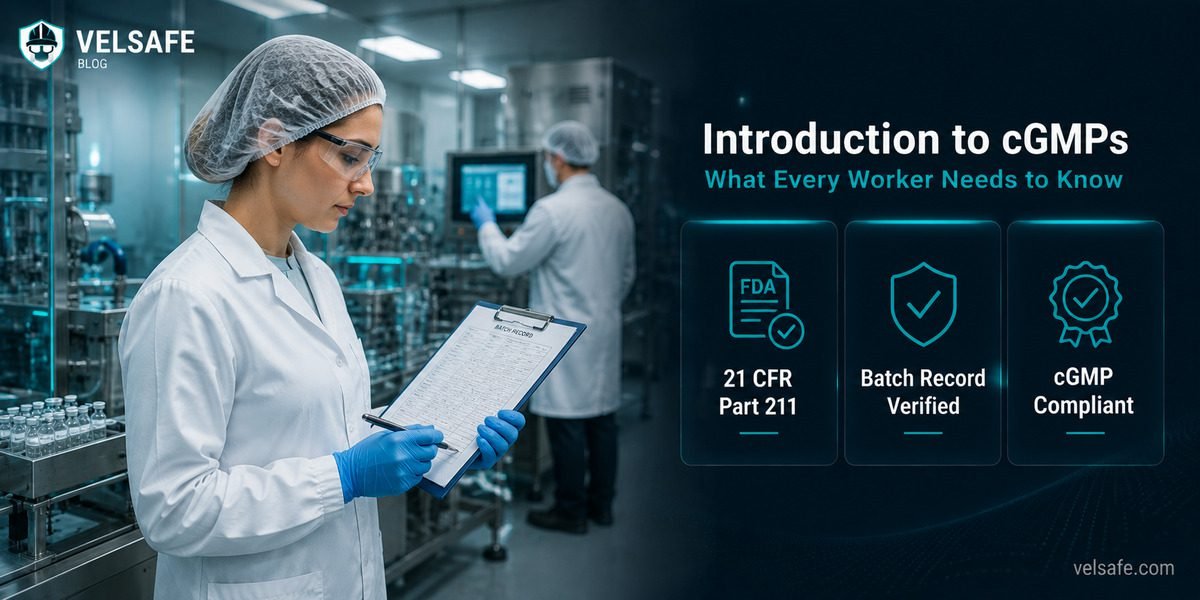
Current Good Manufacturing Practices (cGMPs) are the minimum quality standards that FDA requires for the manufacture of drugs, biologics, and medical devices. Every worker on a regulated manufacturing floor, regardless of role, operates within a cGMP framework. Understanding what cGMPs require, why they exist, and what happens when they are not followed is foundational knowledge for anyone working in a regulated facility.
21 CFR
The Regulatory Authority
FDA’s cGMP requirements are codified in Title 21 of the Code of Federal Regulations. Parts 210 and 211 cover drug manufacturing. Part 820 (now QMSR) covers medical devices. Part 111 covers dietary supplements.
eCFR, Title 21, 2026
500+
FDA Inspections Per Year
FDA conducts hundreds of domestic and foreign pharmaceutical and device facility inspections annually. Failures result in 483 observations, Warning Letters, import alerts, and facility shutdowns.
FDA, Inspections and Compliance, 2026
“C”
Current = Evolving
The “c” in cGMP stands for “current.” It means manufacturers must use the most up-to-date methods and technologies available, not just minimum standards from when the regulation was written.
FDA, Facts About cGMPs, 2024
Current Good Manufacturing Practices are a set of regulations issued by the U.S. Food and Drug Administration that establish the minimum requirements for the methods, facilities, and controls used in manufacturing, processing, packing, and holding of drugs and medical devices. They exist for a single purpose: to ensure that products are safe, pure, and effective, and that they are what their labels say they are.
Before cGMPs were established, contaminated and subpotent drug products caused mass casualties. The 1937 Sulfanilamide Disaster killed over 100 people and directly led to the Federal Food, Drug, and Cosmetic Act of 1938. The Kefauver-Harris Amendment of 1962 introduced the requirement that drugs be proven effective, not just safe, and gave FDA authority to establish manufacturing standards. The cGMP regulations you follow today are the direct descendants of those legislative responses to product failures that harmed real people.
FDA’s cGMP framework covers six interconnected areas. Failures in any one area can compromise product quality and lead to regulatory action, even if the other five are operating correctly.
1. Personnel
Qualified personnel must be in place for all regulated activities. This means the right training, the right experience, and written evidence of both. Everyone who performs a cGMP task must be trained on the relevant procedure before performing it, and that training must be documented and current.
21 CFR 211 Subpart B, eCFR.gov
2. Buildings and Facilities
Facilities must be of suitable size, construction, and location to facilitate cleaning, maintenance, and proper operations. Separate areas are required for different manufacturing operations to prevent mix-ups and contamination. Lighting, ventilation, temperature, and sanitation are all regulated.
21 CFR 211 Subpart C, eCFR.gov
3. Equipment
All equipment used in manufacturing must be of appropriate design, adequate capacity, and suitably located. Equipment must be qualified before use, calibrated on schedule, and maintained to prevent contamination or errors. Cleaning records must document when and how equipment was cleaned and by whom.
21 CFR 211 Subpart D, eCFR.gov
4. Control of Components and Containers
All incoming materials, including active ingredients, excipients, and packaging components, must be tested or examined before use. Rejected materials must be clearly identified and segregated. No component may be used in production unless it has been approved by Quality Control for release.
21 CFR 211 Subpart E, eCFR.gov
5. Production and Process Controls
Written procedures (SOPs) must govern every production activity. Batch records must be completed in real time, not from memory. Deviations from procedures must be documented, investigated, and resolved before product release. No manufacturing step may be completed without documented verification at each critical point.
21 CFR 211 Subpart F, eCFR.gov
6. Records and Reports
If it is not documented, it did not happen. cGMP requires complete, accurate, and contemporaneous records for every regulated activity. Records must be retained for required periods, be readily retrievable for inspection, and must not be altered without explanation. Data integrity is not optional; it is a core cGMP requirement.
21 CFR 211 Subpart J, eCFR.gov
The cGMP framework is not a single regulation. It varies by product type. Understanding which regulations apply to your facility is the starting point for cGMP compliance.
Element
Pharmaceutical (21 CFR 211)
Medical Device (QMSR / 21 CFR 820)
Governing Regulation
21 CFR Parts 210 and 211
21 CFR Part 820 / QMSR (effective Feb 2026); aligned to ISO 13485:2016
Quality System Framework
FDA-specific; no direct ISO alignment required (though ICH Q10 widely used)
ISO 13485:2016 incorporated by reference under QMSR
Batch Records
Required for every batch; must be reviewed and released by QC
Device History Records (DHRs) required for every production unit or lot
Validation
Process validation required; ICH Q8/Q9/Q10 guidance framework
Design validation + process validation; Design History File (DHF) required
API Manufacturing
ICH Q7 governs Active Pharmaceutical Ingredient manufacturing
Not applicable
21 CFR Part 211, eCFR.gov | FDA QMSR, 2026
cGMP obligations fall on the organization, but they are fulfilled through individual actions. Every person working in a cGMP environment has specific, non-delegable responsibilities.
cGMP failures have a documented chain of consequences that escalates from observation to enforcement action to criminal liability.
483 Observation
An FDA investigator documents conditions observed during inspection that appear to violate cGMP. The facility must respond with a CAPA. 483s are public records. Repeated 483s on the same issue signal to FDA that the facility cannot self-correct.
Warning Letter
Issued when FDA determines that 483 observations represent significant cGMP violations. Warning Letters are posted publicly and can halt new product approvals for the facility. Customers, suppliers, and partners monitor Warning Letter databases actively.
Import Alert / Recall
FDA can place a facility on import alert, blocking all products from entering US commerce, or compel a product recall. Class I recalls, involving products with a reasonable probability of causing serious harm, require nationwide notification and are among the most costly regulatory events a company can face.
Consent Decree / Criminal Action
For persistent or intentional cGMP violations, FDA can seek a consent decree that places manufacturing operations under court supervision. Individuals who knowingly falsify cGMP records face criminal prosecution under the Federal Food, Drug, and Cosmetic Act, including imprisonment.
cGMPs Protect Patients, Not Just Regulators
The regulations exist because uncontrolled manufacturing has killed people. Every cGMP requirement traces back to a specific failure mode that caused harm. When you follow a cGMP procedure, you are part of a patient safety system.
The “c” Means You Must Stay Current
cGMP compliance is not a fixed target. As science, technology, and industry practice advance, so do FDA’s expectations. Facilities that treat cGMP as a static checklist fall out of compliance even without changing anything.
Documentation Is Not Bureaucracy
cGMP documentation requirements exist because they create an auditable record that the right steps were taken in the right sequence with qualified materials and equipment. Without that record, there is no way to investigate a failure, defend a product release, or demonstrate regulatory compliance.
Deviations Must Be Reported, Not Hidden
A properly reported and investigated deviation is a quality event. A hidden deviation is a data integrity violation and a potential criminal matter. The cGMP system is designed to handle deviations. It is not designed to handle concealment.
Training Is a cGMP Requirement, Not Optional
Untrained personnel performing cGMP operations is a direct regulatory violation. Expired training is treated the same way. Facilities must maintain training records and verify currency before assigning personnel to regulated tasks.
Both Pharma and Device Are Regulated, Differently
The cGMP framework for pharmaceutical manufacturing (21 CFR 211) and medical devices (QMSR / 21 CFR 820) share the same philosophy but differ in structure, documentation requirements, and regulatory references. Workers must know which framework governs their facility.
What does “current” mean in current Good Manufacturing Practices?
“Current” means that manufacturers are expected to use the most up-to-date technologies and practices available, not just the minimum standards established when the regulation was written. If new testing technology, equipment, or control methods become available and are industry-standard, FDA expects manufacturers to adopt them. Compliance with the letter of a regulation written in 1978 is not sufficient if current science requires more.
Do cGMPs apply to all employees, or just manufacturing and quality staff?
cGMPs apply to anyone whose activities could affect product quality. This includes manufacturing operators, QC analysts, engineers, maintenance technicians, warehouse staff, and support personnel who enter controlled areas. Even contractors and visitors who access manufacturing areas are subject to cGMP behavioral requirements such as gowning, no food or drink, and hygiene standards.
What is the difference between a GMP and a cGMP?
GMP (Good Manufacturing Practice) is the general concept. cGMP (current Good Manufacturing Practice) is the FDA-specific regulatory standard that requires manufacturers to use current, up-to-date practices. In common usage, the terms are often used interchangeably. Internationally, WHO uses “GMP,” the EU uses “GMP” under EudraLex Volume 4, and FDA uses “cGMP.” The underlying principles are similar across all frameworks.
What is a 483 observation and what happens after one is issued?
A 483 observation (named after FDA Form 483) is a written statement from an FDA investigator documenting conditions observed during an inspection that appear to violate cGMP regulations. After issuance, the facility has 15 business days to submit a written response outlining corrective actions. FDA evaluates the response and determines whether the violations are adequately addressed. If not, FDA may issue a Warning Letter or pursue further enforcement action.
Can individual workers be held personally liable for cGMP violations?
Yes. Under the Federal Food, Drug, and Cosmetic Act, individuals who knowingly falsify cGMP records or who are responsible for significant violations can face personal criminal liability, including fines and imprisonment. The “responsible corporate officer” doctrine also means that senior managers can be held liable for violations that occurred within their area of responsibility, even if they did not personally commit the violation.
How often does FDA inspect pharmaceutical and device facilities?
FDA uses a risk-based inspection scheduling model. High-risk facilities, those with prior compliance issues or manufacturing high-risk products, are inspected more frequently. Routine domestic pharmaceutical facility inspections typically occur every two years. For-cause inspections can be triggered at any time by a complaint, a serious adverse event report, a product recall, or a whistleblower allegation. Foreign facilities supplying the US market are also subject to FDA inspection.
What is the Quality Management System Regulation (QMSR) and how is it different from the old QSR?
The QMSR (21 CFR Part 820, revised) became effective February 2, 2026, replacing the previous Quality System Regulation. The key change is that QMSR incorporates ISO 13485:2016 by reference, aligning FDA’s device quality system requirements with the international standard. Manufacturers with an existing ISO 13485 certification have a strong compliance foundation, but the QMSR adds FDA-specific requirements that go beyond ISO 13485 in some areas, including complaint handling and MDR obligations.
VelSafe Compliance Training
Every Worker on a Regulated Floor Is Part of the Quality System
cGMP compliance depends on every person performing their role correctly, documenting accurately, and reporting deviations honestly. VelSafe covers pharmaceutical GMP, medical device quality systems, and FDA compliance topics for manufacturing and quality teams.
Browse Worker Safety Articles