SITUATIONAL: Cosmetics Manufacturing
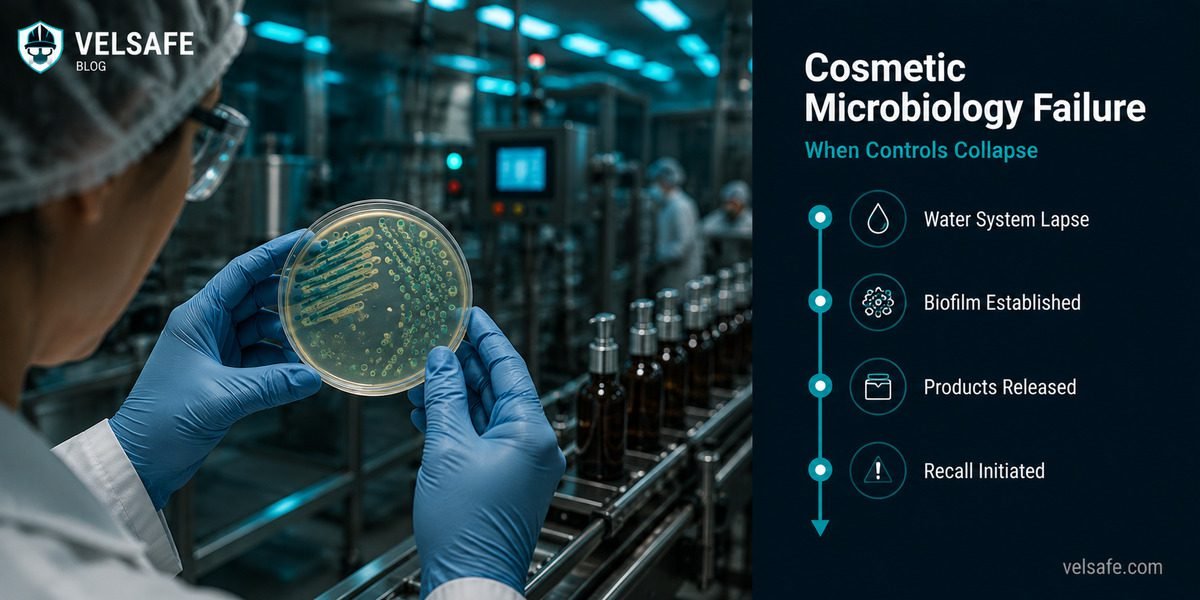
Cosmetic products do not require FDA pre-market approval, but they must be safe for use. When microbial contamination enters a product because manufacturing controls were inadequate, the consequences reach consumers, trigger regulatory action, and expose the manufacturer to significant liability. This situational guide follows a fictional cosmetics manufacturer whose microbiology programme failed at every control point.
Note: The organisation, individuals, and specific events described in this scenario are fictional and illustrative. The compliance failures, root causes, and corrective actions reflect patterns documented in FDA Warning Letters, voluntary recalls, and industry adverse event data involving cosmetic microbial contamination.
900+
Cosmetic Recalls Since 2018
FDA has reported hundreds of cosmetic recalls since 2018, with microbial contamination among the leading causes alongside undisclosed ingredients and labelling failures.
FDA Cosmetics Recalls and Alerts, 2024
MoCRA
New Authority Since Dec 2022
The Modernization of Cosmetics Regulation Act (MoCRA) gave FDA mandatory recall authority for cosmetics for the first time, along with requirements for facility registration, adverse event reporting, and safety substantiation.
FDA, MoCRA Overview, 2023
CFU
The Critical Measure
Colony-forming units per gram or millilitre is the standard measure of microbial contamination in cosmetics. Industry guidance specifies acceptable CFU limits by product type and intended use population, with near-zero tolerances for eye-area and infant products.
FDA, Microbiological Safety and Cosmetics
Manufacturer
Lumiere Botanical Labs, a fictional mid-size contract manufacturer of water-based skincare products including facial moisturisers, eye creams, and toners for multiple retail brands.
The Failure
Pseudomonas aeruginosa detected in finished eye cream batches. Three brands recalled. Consumer complaints of eye infections received before the contamination was identified internally.
Root Cause
Inadequate preservative challenge testing, contaminated water purification system not monitored for six months, and finished-product microbial testing performed as a documentation exercise rather than a control.
Regulatory Outcome
FDA Warning Letter citing failure to implement adequate microbiological controls. Mandatory recall under MoCRA authority. Facility placed under enhanced surveillance. Three brand client contracts terminated.
Lumiere Botanical Labs had operated for nine years as a contract manufacturer for mid-market skincare brands. Its product line was almost entirely water-based, a category that carries the highest microbial contamination risk in cosmetics manufacturing because water supports microbial growth and water-based formulas require effective preservative systems to remain safe through their shelf life.
For the first six years, the facility maintained an adequate microbiology programme: routine environmental monitoring, monthly water system testing, preservative efficacy testing on new formulas, and finished-product testing before release. In the seventh year, the quality manager who had designed and maintained that programme resigned. The position was not filled. Her responsibilities were distributed across three existing staff members, none of whom had formal microbiology training.
Over the following eighteen months, the microbiology programme degraded systematically. Not through a single dramatic failure, but through accumulated small decisions: environmental monitoring frequency reduced from monthly to quarterly “to save lab costs,” water system testing extended from monthly to “as needed,” preservative challenge testing discontinued for reformulated products on the assumption that the existing data covered similar formulas. Each decision was made locally, without formal change control, and none was flagged to senior management.
Failure 1: Water System Without a Monitoring Programme
Purified water used in cosmetic manufacturing is a critical raw material that requires its own monitoring programme: scheduled bioburden testing, conductivity checks, and documented corrective action limits. Without routine testing, biofilm can establish in filtration components and colonise the entire distribution system before any product-level testing would detect it. By the time contamination appears in a finished product, the source has been active for weeks or months.
FDA, Microbiological Safety and Cosmetics
Failure 2: Preservative Efficacy Not Revalidated After Reformulation
Preservative challenge testing (PCT) demonstrates that a formula’s preservative system can control microbial growth under defined challenge conditions. When a formula is changed, even marginally, the existing PCT data may no longer apply. Lumiere’s decision to assume that prior testing covered the reformulated product was not scientifically defensible. The reformulated eye cream’s preservative system was insufficient to control the Pseudomonas load it encountered in production.
Cosmetics and Toiletries, Preservative Efficacy Testing
Failure 3: Finished-Product Testing That Could Not Detect the Problem
The testing method used for finished-product microbial analysis had a detection limit above the contamination level present in two of the three affected batches. A test that cannot detect the contamination level of concern provides false assurance. The selection and validation of test methods is itself a quality control function, and using an unvalidated or insufficiently sensitive method is equivalent to not testing at all from a consumer safety perspective.
FDA, Cosmetics Safety Resources
Control Point
Required Practice
Finding at Lumiere
Water System Monitoring
Monthly bioburden testing with documented action limits
Not performed for 6 months. No deviation recorded.
Preservative Efficacy Testing
PCT required on all new and reformulated products
Not conducted after formula change. Prior data used without scientific justification.
Environmental Monitoring
Monthly surface and air sampling in production areas
Reduced to quarterly without formal change control or risk assessment.
Finished-Product Testing
Validated test method with appropriate detection sensitivity
Method not validated. Detection limit above contamination level in 2 of 3 affected lots.
Change Control
Formal review before changes to formulas, processes, or testing
No change control process in place. All programme reductions made informally.
Adverse Event Reporting
MoCRA requires reporting of serious adverse events within 15 business days
No written adverse event handling procedure. Reports received by brand clients, not manufacturer.
FDA, MoCRA Requirements, 2023
Contributing Factors by Severity
No qualified microbiologist after QM departure
Critical
The microbiology programme was designed and maintained by one person. No succession plan or knowledge transfer existed. When she left, the programme lost its only expert.
No change control for programme reductions
High
Reducing monitoring frequency and discontinuing testing were quality decisions that required formal review and risk assessment. Making them informally meant no one with authority assessed the cumulative risk.
Water system maintenance not integrated with production scheduling
High
Filter replacement and sanitisation schedules were managed separately from production planning. No automated flag prevented manufacturing from proceeding when water system maintenance was overdue.
Test method not validated for sensitivity
High
The finished-product test method was adopted without validation studies to confirm it could detect relevant pathogens at clinically significant levels for eye-area products. The method passed lots that should have been rejected.
No MoCRA adverse event procedure
Medium
Consumer complaints received by brand clients were not systematically forwarded to the manufacturer. The facility had no written procedure for receiving, evaluating, or reporting serious adverse events under MoCRA requirements.
FDA, MoCRA Adverse Event Reporting Requirements
Water Is a Raw Material, Not a Utility
Purified water used in cosmetics manufacturing must be treated with the same control rigour as any other critical ingredient. It requires its own specifications, incoming testing, monitoring programme, and release criteria. Treating it as a background utility is a systematic risk that, in water-based products, almost always reaches the product eventually.
FDA, Microbiological Safety and Cosmetics
Reformulation Resets Your PCT Data
Preservative challenge testing is formula-specific. A change in any ingredient, concentration, pH, or processing condition can affect the preservative system’s efficacy against the microbial challenge panel. Any reformulation, even one that appears cosmetically minor, must trigger a PCT review and, if the formula is materially different, a new study.
FDA, Cosmetics Safety and Compliance
MoCRA Changed the Regulatory Risk Profile
Before MoCRA, FDA’s authority over cosmetics was limited. Since December 2022, FDA has mandatory recall authority, can require facility registration, and must be notified of serious adverse events. A compliance programme designed for pre-MoCRA requirements is no longer adequate. Every cosmetics manufacturer must audit their programme against the new framework.
FDA, MoCRA, 2022
Every Water-Based Cosmetics Manufacturer Must Verify
☐ Written water system monitoring programme with monthly testing schedule
☐ Action and alert limits defined for water bioburden with mandatory hold on exceedance
☐ Filter replacement schedule documented and linked to production scheduling
☐ Preservative challenge test data on file for every marketed formula
☐ PCT revalidation triggered by any formula change
☐ Finished-product microbial test method validated with appropriate detection sensitivity
☐ Environmental monitoring programme with documented frequency and action limits
☐ Written change control process covering formula, process, and testing changes
☐ MoCRA adverse event procedure with 15-business-day reporting capability
☐ Qualified microbiologist or third-party microbiology support engaged
FDA, MoCRA Requirements | FDA, Microbiological Safety and Cosmetics
Microbial Contamination in Cosmetics Is Preventable at Every Stage
Lumiere’s contamination was not bad luck. It was the predictable result of removing every control that would have caught the problem: water monitoring, preservative testing, and sensitive finished-product testing. Any one of these controls, functioning properly, would have detected the issue before product release.
Eye-Area Products Carry the Highest Microbial Risk
The eye is an immunologically privileged site with limited ability to defend against Pseudomonas aeruginosa infection. Eye creams, mascaras, and eye-contact products require the most stringent microbial controls, the lowest acceptable CFU limits, and PCT against pathogens that are specifically dangerous in ocular exposure.
MoCRA Fundamentally Changed Cosmetics Regulatory Risk
FDA now has mandatory recall authority for cosmetics that was not available before December 2022. Facilities not registered under MoCRA, not compliant with adverse event reporting requirements, or not maintaining adequate safety substantiation face enforcement exposure that did not exist three years ago.
Programme Degradation Is as Dangerous as Never Having a Programme
Lumiere had an adequate microbiology programme once. The contamination did not happen because they never invested in one. It happened because they let it degrade without recognising that each individual reduction was removing a layer of protection that the other controls depended on.
Consumer Complaints Are a Surveillance Signal
Seventeen consumer complaints of eye infections were received before internal testing confirmed the contamination. A functioning adverse event system that routed those complaints to the manufacturer would have triggered investigation months earlier, potentially before the full 14,000-unit distribution reached retail.
Contract Manufacturers Cannot Delegate Safety to Their Clients
Lumiere manufactured under three brand labels but the manufacturing controls were entirely its responsibility. Under MoCRA, the responsible party for cosmetic safety is the person who causes the cosmetic to be manufactured. Brand clients do not share or absorb that obligation.
What microorganisms are most dangerous in cosmetic products?
Pseudomonas aeruginosa and Staphylococcus aureus are the highest-concern gram-negative and gram-positive organisms respectively in cosmetics, particularly for eye-area products. Burkholderia cepacia complex is a significant concern in preservative-free or low-preservative products. Industry standards and FDA guidance specify that these organisms must be absent in certain product categories. For products intended for use near or on the eyes, the acceptable bioburden limit is essentially zero for these pathogens.
What is preservative challenge testing and when is it required?
Preservative challenge testing (PCT), also called antimicrobial effectiveness testing or challenge testing, inoculates a finished product formula with a standardised panel of microorganisms and measures the preservative system’s ability to reduce them over a defined time period. ISO 11930 and USP are the primary standards used. PCT is required for all preserved cosmetic formulas before market release and must be repeated when the formula is changed in any way that could affect preservative efficacy, including changes to pH, water activity, or any ingredient that interacts with the preservative system.
What does MoCRA require that was not required before?
The Modernization of Cosmetics Regulation Act of 2022 added several requirements that did not previously exist: facility registration with FDA (required for facilities manufacturing cosmetics for US commerce), adverse event reporting (serious adverse events must be reported within 15 business days), safety substantiation requirements, fragrance allergen labelling, and FDA mandatory recall authority. Facilities also became subject to FDA records access requirements. Pre-MoCRA, FDA could not compel a cosmetics recall and had no authority to require facility registration.
How often should a cosmetics facility test its purified water system?
Industry guidance and ISO 22716 (Good Manufacturing Practices for Cosmetics) recommend at minimum monthly bioburden testing for purified water used in product manufacturing, with more frequent testing following any maintenance, deviation, or out-of-specification result. Action limits (requiring investigation and hold) and alert limits (requiring investigation without automatic hold) should be defined in the monitoring programme. Sanitisation frequency depends on the system design, but is typically monthly or quarterly with documentation of each cycle.
Is a qualified microbiologist required in a cosmetics facility?
No regulation specifies a mandatory microbiologist role by title, but ISO 22716 and MoCRA’s safety substantiation requirements effectively require that microbiology functions be performed by competent personnel. For any facility manufacturing water-based, preserved, or eye-area products, this means someone with formal microbiology training must own the monitoring programme, validate test methods, interpret results, and make release decisions. Facilities that do not employ a qualified microbiologist typically engage a contract laboratory or consultant to fill this function.
What should a cosmetics manufacturer do when a consumer reports an adverse reaction?
Under MoCRA, a responsible person (manufacturer or distributor) who receives a report of a serious adverse event must submit a report to FDA within 15 business days. A serious adverse event includes any event that results in hospitalisation, significant disability, a condition requiring medical intervention to prevent permanent impairment, or that is life-threatening. The manufacturer should also investigate whether the adverse event represents a safety signal, retain the complaint record, and consider whether the event warrants a product hold or recall evaluation.
What is ISO 22716 and does it apply to US cosmetics manufacturers?
ISO 22716 is the international standard for Good Manufacturing Practices for Cosmetics. It is not a legal requirement in the United States, but it is widely used as the industry reference standard and forms the basis of FDA’s guidance on cosmetics GMP. Compliance with ISO 22716 is increasingly expected by retail partners, certification bodies, and export markets, particularly the EU, where it is referenced in the EU Cosmetics Regulation. A facility that complies with ISO 22716 will also satisfy most MoCRA facility and safety substantiation requirements.
VelSafe Compliance Training
Microbial Control Is Not Optional in Cosmetics Manufacturing
Water systems, preservative testing, environmental monitoring, and validated test methods are the minimum foundation of a safe cosmetics manufacturing programme. VelSafe covers cosmetics GMP, MoCRA compliance, microbiology, and quality system requirements for manufacturing and quality teams.
Browse Situational Articles