
TIPS: FDA Inspections and Pharmaceutical GMPs
What your staff says during an FDA inspection shapes the outcome. Poor communication is one of the most preventable causes of Form 483 observations. These 10 techniques equip your team to respond accurately, confidently, and without creating unnecessary risk.
FDA Inspection Interview Techniques for GMP Teams
483
Observations Issued
The FDA issues Form 483 observations when investigators find deviations during inspections. Communication failures frequently trigger or escalate these findings.
FDA Form 483 FAQ, FDA.gov
21
CFR Part 211
The governing regulation for pharmaceutical GMP compliance in the US, and the primary framework against which FDA investigators evaluate facilities and staff conduct.
21 CFR Part 211, eCFR.gov
IOM
Investigator Playbook
The FDA Investigations Operations Manual defines how investigators conduct inspections, ask questions, and evaluate responses. Understanding it is the foundation of effective inspection readiness.
FDA IOM, FDA.gov
When an FDA investigator arrives at your facility, every employee interaction is part of the inspection. What your staff says, how they say it, and what documentation they produce in response to questions directly shapes the inspection outcome. Poor communication during interviews is one of the most preventable causes of FDA Form 483 observations and Warning Letters. These 10 tips equip GMP compliance teams with the techniques needed to respond to FDA investigator questions accurately, confidently, and without creating unnecessary risk.
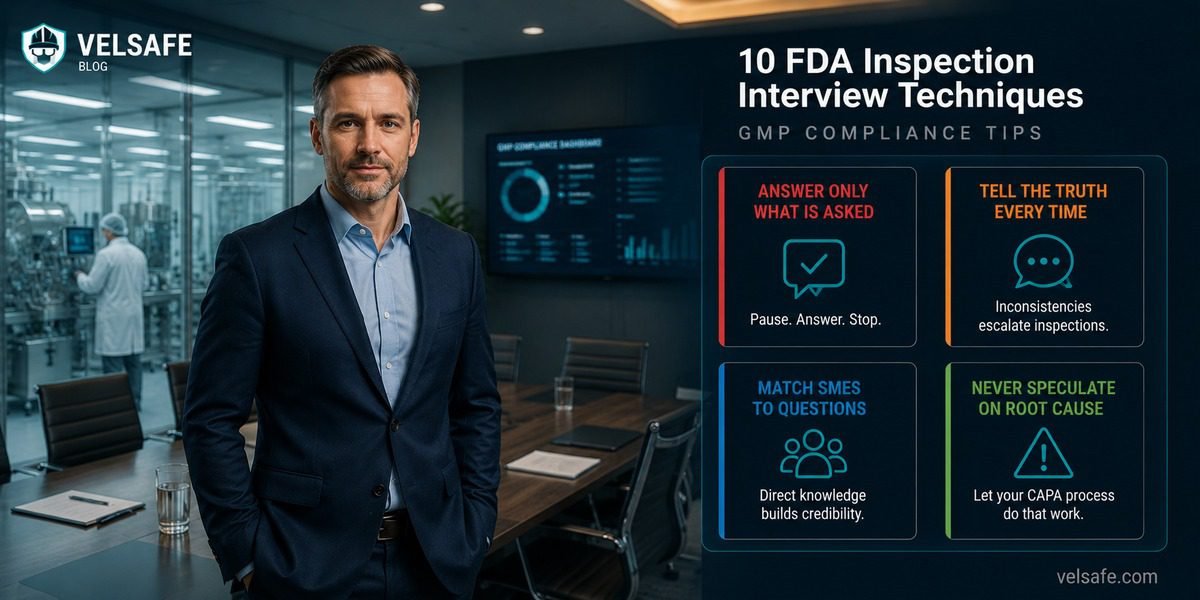
10 Techniques at a Glance
1. Answer Only What Is Asked
Pause, answer, stop. Every extra word is an open thread.
2. Tell the Truth, Every Time
Inconsistencies between statements and records escalate inspections.
3. Match SMEs to Questions
Direct knowledge builds credibility. Route questions to the right person.
4. Never Speculate on Root Cause
Commit your CAPA process. Verbal root cause guesses become admissions.
5. Know Your SOPs Cold
Verbal drift from written procedures is a primary inspection finding.
6-10. Systems and Mindset
Prompt records, escort-scribe system, composure, escalation, daily debrief.
1
Answer Only What Is Asked
Why It Matters
FDA investigators are trained to ask open-ended questions and observe what volunteers beyond the question. Every word beyond a direct answer is a potential thread the investigator can pull.
What To Do
Respond specifically to the question asked. Pause before answering. If the question requires a yes or no, give that first, then add only the minimum necessary context. If you do not know the answer, say so and offer to find out.
Common Mistake
Employees often fill silence with additional information, anecdotes, or explanations that were not requested. This overanswering frequently introduces new areas of inquiry that would not otherwise have come up.
Pro Tip
Practice “pause, answer, stop” as a mental model. Pause before speaking. Answer the question. Stop when the answer is complete.
2
Tell the Truth, Every Time
Why It Matters
Providing false or misleading information to an FDA investigator is a federal offense. Beyond legal consequences, inconsistencies between employee statements and records are a primary driver of escalated inspections.
What To Do
Always answer truthfully. If you are uncertain about a fact, say “I believe” or “to the best of my knowledge” and note that you will confirm. Never guess and present a guess as a fact.
Common Mistake
Employees sometimes correct themselves mid-inspection after realizing they gave an inaccurate answer but fear the correction will look bad. In practice, prompt self-correction is far better than allowing an inaccuracy to stand.
Pro Tip
Remind all staff before an inspection: it is always acceptable to say “I need to verify that and get back to you.”
3
Bring the Right People to the Right Questions
Why It Matters
FDA investigators expect the person answering a question to have direct knowledge of the process being discussed. Routing a manufacturing question to a QA manager who does not operate the equipment daily raises credibility concerns.
What To Do
Assign subject matter experts to accompany investigators in their areas. Your manufacturing supervisor answers manufacturing questions. Your lab analyst answers analytical method questions. Have a single escort coordinate and redirect as needed.
Common Mistake
Over-reliance on one or two senior staff to answer all questions, even those outside their direct day-to-day scope. Investigators notice when answers lack operational specificity.
Pro Tip
Prepare a contact map before inspections: a list of which employee is the primary SME for each area the inspector may visit.
4
Do Not Speculate on Root Cause
Why It Matters
Preliminary or speculative root cause statements made verbally can be treated as admissions even before a formal investigation is complete. A hasty explanation of why a deviation occurred can become the basis of a 483 observation.
What To Do
If asked why something happened, it is acceptable to say the investigation is ongoing or that root cause analysis will follow your standard CAPA process. You are not required to provide a root cause on the spot.
Common Mistake
Employees, trying to appear cooperative and competent, offer instant explanations for deviations that later turn out to be incorrect, contradicting what the investigation subsequently finds.
Pro Tip
Use the phrase “our CAPA process will establish root cause” as a standard holding response when asked to explain a deviation in the moment.
5
Know Your SOPs Before the Inspector Does
Why It Matters
Inconsistency between what an employee describes verbally and what the SOP actually says is one of the most common FDA inspection findings. Investigators routinely cross-reference verbal descriptions with written procedures.
What To Do
Conduct pre-inspection SOP walkthroughs with staff in their areas. Ensure every operator can describe their process in terms that align with current approved procedures. Flag any SOPs under revision so staff know which version is currently approved.
Common Mistake
Staff describe how they actually perform a task, which may have informally drifted from the written SOP without formal change control. This is both a training gap and an audit finding.
Pro Tip
Run tabletop interview simulations 2 to 4 weeks before a known inspection window. Ask employees questions an FDA investigator might ask about their specific procedures.
6
Produce Records Promptly and Completely
Why It Matters
Delays in producing requested records, or producing incomplete records, signal to the FDA investigator that document control may be inadequate. 21 CFR Part 211 requires batch records, training records, and deviation logs to be readily retrievable.
What To Do
Establish a document retrieval team before inspections. When the investigator requests a record, confirm receipt of the request, retrieve it promptly, and provide the complete record without unnecessary redaction.
Common Mistake
Providing partial records and promising the rest later, or providing photocopies with poor legibility. Both create unnecessary friction and observation risk.
Pro Tip
Pre-compile frequently requested record packages (last three batch records, recent deviation log, training records for the area) so retrieval takes minutes, not hours.
7
Use an Escort and Scribe System
Why It Matters
FDA investigators may ask questions rapidly across multiple areas. Without a system to capture what was asked and what was said, your team has no accurate record of the day’s interactions to reference when preparing a 483 response.
What To Do
Assign a dedicated escort to accompany the investigator at all times. Assign a separate scribe whose only role is to contemporaneously document questions asked, documents requested, and answers given.
Common Mistake
Using the same person as both escort and scribe. The escort cannot simultaneously manage the investigator’s movement, coordinate SME availability, and take accurate notes.
Pro Tip
At the end of each inspection day, the scribe’s notes should be typed and reviewed by the inspection team lead within two hours while recollection is fresh.
8
Stay Calm Under Pressure
Why It Matters
FDA investigators are trained observers. An employee who becomes visibly anxious, defensive, or evasive when questioned raises the investigator’s concern level, even if there is nothing substantively wrong.
What To Do
Train your team that an FDA inspection is a professional interaction, not an interrogation. Calm, direct, and factual responses build credibility. If a question is unclear, ask for clarification before answering.
Common Mistake
Employees sometimes interpret silence from the investigator after an answer as dissatisfaction and begin to add or modify their answer. This often makes the initial answer less clear, not more.
Pro Tip
Role-play silence. In training simulations, have the mock investigator pause after an answer for five to ten seconds. Train employees to hold their answer and not fill the silence.
9
Escalate Immediately When Something Goes Wrong
Why It Matters
If an employee realizes mid-inspection that they gave an inaccurate answer, or if a document reveals a previously unidentified gap, delay in escalating to QA or management creates compounding risk.
What To Do
Establish a clear escalation protocol before the inspection. Any employee who identifies a potential problem should notify the inspection team lead immediately. The team lead manages the response.
Common Mistake
Employees try to handle a problem quietly rather than escalating, hoping the investigator will not notice. This almost always makes the situation worse when the investigator does identify it.
Pro Tip
Frame the escalation protocol positively during pre-inspection training: “If you see something, tell us immediately. We handle it together.”
10
Conduct a Daily Debrief
Why It Matters
Multi-day inspections create cumulative pressure. Without a structured daily debrief, your team may not realize that the investigator’s questions are building toward a specific concern until the closeout meeting.
What To Do
Hold a 30 to 60 minute debrief at the end of each inspection day with the escort, scribe, and relevant SMEs. Review what was asked, what documents were requested, and what areas the investigator focused on. Use this to anticipate the next day.
Common Mistake
Skipping the debrief on day one because “nothing bad happened today.” Patterns only become visible when you review the full day systematically.
Pro Tip
Map the investigator’s questions visually across the day. Clustering around a specific system, product, or date range is a strong signal of where the investigation is heading.
Pre-Inspection Readiness Checklist
People
✓ SME contact map created and distributed
✓ Escort and scribe roles assigned
✓ Escalation protocol communicated to all staff
✓ Mock interview exercise completed in last 60 days
✓ Escort and scribe roles assigned
✓ Escalation protocol communicated to all staff
✓ Mock interview exercise completed in last 60 days
Procedures
✓ SOP walkthroughs completed in all areas
✓ SOPs under revision flagged to area staff
✓ Current approved version confirmed for all critical procedures
✓ Change control log reviewed for recent updates
✓ SOPs under revision flagged to area staff
✓ Current approved version confirmed for all critical procedures
✓ Change control log reviewed for recent updates
Records
✓ Document retrieval team assigned
✓ Frequently requested packages pre-compiled
✓ Batch records for last 3 lots verified complete
✓ Training records current for all GMP staff
✓ Frequently requested packages pre-compiled
✓ Batch records for last 3 lots verified complete
✓ Training records current for all GMP staff
FDA Investigations Operations Manual, FDA.gov
Answer Only What Is Asked
Silence is not an invitation to volunteer more information. Pause, answer, stop.
Truth Is Non-Negotiable
Inaccurate statements compound into far larger problems than the original gap they were meant to cover.
Match Every Question to the Right SME
Operational specificity builds investigator confidence. Route questions to the person with direct day-to-day knowledge.
CAPA Establishes Root Cause, Not the Interview
Never speculate on root cause under inspection pressure. Commit your formal investigation process to do that work.
SOP Alignment Must Be Confirmed Before the Window Opens
Verbal drift from written procedures is one of the most common and most preventable inspection findings.
Escort, Scribe, and Daily Debrief Are Your Best Tools
These two systems are the most underused inspection management tools in GMP facilities. Build them into every inspection protocol.
Frequently Asked Questions
Can an employee refuse to answer an FDA investigator’s question?
Employees cannot refuse to answer questions during an FDA inspection without legal basis. However, there is no obligation to speculate or provide information beyond what is directly asked. If a question involves legally privileged information, legal counsel should be involved before the inspection, not during it.
What should an employee do if they do not know the answer to a question?
The correct response is to say “I do not know, but I can find out” and then follow through. Never guess and present the guess as fact. Investigators expect that not every employee will have every answer immediately available, and a confident acknowledgment of uncertainty is far better than an incorrect answer.
How should a company respond if an investigator asks about a deviation that was never formally documented?
The company should not attempt to conceal the gap. The appropriate response is to acknowledge the investigator’s concern, note that you will investigate, and initiate a CAPA. Concealment of information during an FDA inspection carries far greater consequences than the underlying gap that was not documented.
Is it acceptable to ask the FDA investigator to clarify a question before answering?
Yes. Asking for clarification is not evasive; it is professional. A clear question produces a more accurate and useful answer. Employees should be trained that clarification requests are appropriate and expected, and that asking “could you clarify what you mean by that?” is a sign of a careful, professional respondent.
What is the role of legal counsel during an FDA inspection?
Legal counsel should be available by phone throughout the inspection but is typically not present in the room for routine questions. Counsel becomes critical if the investigation escalates to criminal referral territory, if legal privilege is at stake, or if the investigator requests access to attorney-client communications.
How far in advance should pre-inspection interview training begin?
Best practice is to conduct at least one full mock inspection exercise 30 to 60 days before an anticipated inspection window, with targeted SOP walkthroughs and verbal rehearsal 1 to 2 weeks prior. Facilities under consent decree or with a history of Warning Letters should conduct quarterly mock inspections regardless of inspection timing.
Does every employee need to be trained on FDA interview techniques?
Any employee who works in a GMP-regulated area and may be approached by an FDA investigator during a facility inspection should receive basic interview technique training. This includes operators, analysts, supervisors, and maintenance staff, not only QA and management. Investigators speak to whoever is in the area they are inspecting.
Government and Regulatory Sources
Government and Regulatory Sources
- FDA Investigations Operations Manual (IOM), U.S. Food and Drug Administration: the official playbook governing how FDA investigators conduct inspections, ask questions, and evaluate responses.
- 21 CFR Part 211, Current Good Manufacturing Practice for Finished Pharmaceuticals, eCFR.gov: the governing US federal regulation for pharmaceutical GMP compliance against which FDA investigators evaluate facilities.
- FDA Warning Letters Database, FDA.gov: the public record of enforcement actions following inspections, showing the types of observations and communications failures that escalate to formal action.
- FDA Form 483 Frequently Asked Questions, FDA.gov: official guidance on the nature, scope, and response process for FDA inspection observations.
- ICH Q10 Pharmaceutical Quality System, International Council for Harmonisation: the international framework for pharmaceutical quality systems, including CAPA and deviation management processes referenced throughout this article.
Related VelSafe Articles
Related VelSafe Articles
VelSafe Compliance Training
Inspection Readiness Is a Team Skill, Not Just a Management Skill
FDA inspection preparedness is not a one-time event. It is a continuous culture of documentation discipline, training, and communication. VelSafe covers the full spectrum of GMP compliance, FDA enforcement, and workplace safety topics to keep your team inspection-ready year-round.
Browse Compliance Tips