

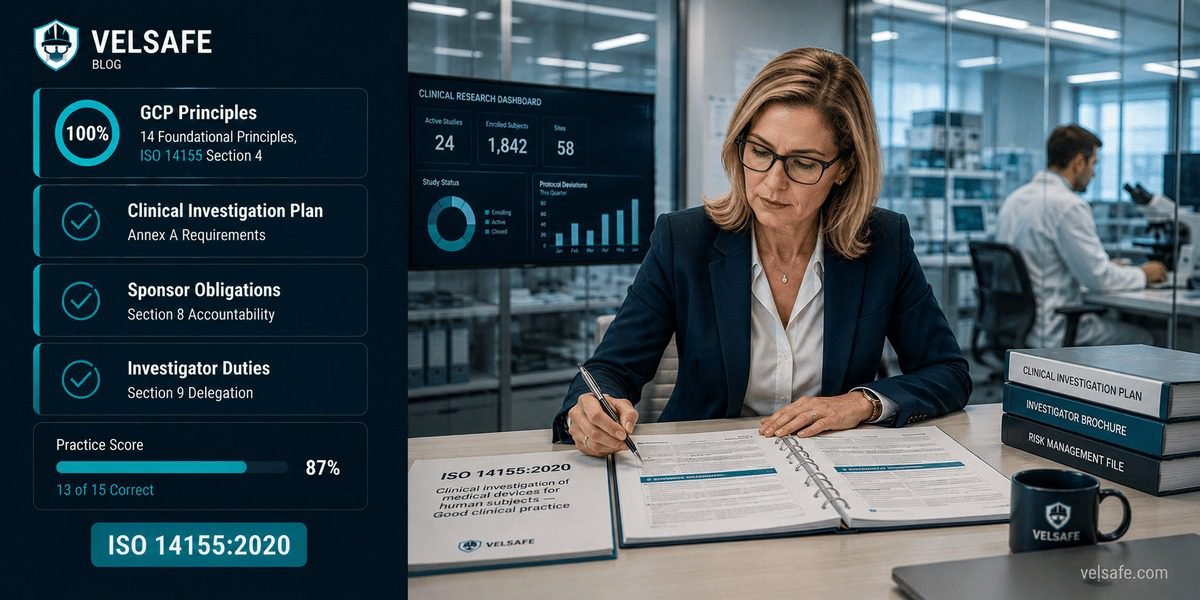
PRACTICE TEST: Clinical Medical Device
Test your knowledge of ISO 14155:2020, the international standard governing clinical investigations of medical devices for human subjects. Covering GCP principles, sponsor and investigator responsibilities, ethics, and the Clinical Investigation Plan, these 15 questions reflect real-world compliance scenarios.
15
Questions
Covering all major sections of ISO 14155:2020 including GCP principles, ethics, and investigation planning.
ISO 14155:2020, ISO.org
14
GCP Principles
ISO 14155 Section 4 outlines 14 foundational GCP principles that govern every clinical device investigation.
ISO 14155:2020, Section 4
2020
Current Edition
ISO 14155:2020 is the active edition. A 2026 revision is in development and expected to introduce further updates.
ISO.org
ISO 14155 sets the standard for Good Clinical Practice (GCP) in medical device clinical investigations. Whether you work in regulatory affairs, clinical affairs, quality management, or device development, understanding this standard is essential to ensuring that investigations are ethically conducted, scientifically valid, and compliant with global requirements.
This practice test covers the core content of ISO 14155:2020 across four key areas: GCP principles and ethics, the Clinical Investigation Plan (CIP), sponsor responsibilities, and investigator responsibilities. Each question includes the correct answer and an explanation to reinforce your understanding.
How to Use This Practice Test
Read each question, select your answer, then review the explanation. Questions are based on ISO 14155:2020 and reflect terminology and scenarios used in regulatory audits, inspector assessments, and compliance training. A score of 12 or more out of 15 indicates a solid grasp of the standard.
What Does This Practice Test Cover?
Key Topics Tested
GCP Principles and Ethics
ISO 14155 Section 4 defines 14 GCP principles. Questions test knowledge of informed consent, ethics committee review, Declaration of Helsinki alignment, and participant protection.
ISO 14155:2020, Sections 4 and 5
Clinical Investigation Plan (CIP)
The CIP is the master document governing every clinical investigation. Questions cover mandatory CIP content, amendments, justifications for deviations, and registration requirements.
ISO 14155:2020, Section 6 and Annex A
Sponsor Responsibilities
Questions address the sponsor’s obligations: selecting qualified investigators, monitoring visits, adverse device effect reporting, and managing deviations from the CIP.
ISO 14155:2020, Section 8
Investigator Responsibilities
The principal investigator holds direct responsibility for participant welfare at the site. Questions cover delegation, documentation, case report forms, and adverse event reporting timelines.
ISO 14155:2020, Section 9
Section 1: GCP Principles and Ethics
Section 1 of 4: GCP Principles and Ethics (Questions 1-4)
1. Which international ethical framework is explicitly referenced by ISO 14155:2020 as the foundation for clinical investigation ethics?
A. ICH E6(R2)
B. The Belmont Report
C. The Declaration of Helsinki
D. FDA 21 CFR Part 50
Correct Answer: C
ISO 14155:2020 explicitly aligns with the Declaration of Helsinki, the World Medical Association’s foundational ethical principles for research involving human participants. While ICH E6(R2) applies to pharmaceutical trials and FDA 21 CFR Part 50 governs US informed consent, ISO 14155 references Helsinki as its primary ethical anchor.
2. A clinical investigation may begin at a site only after which of the following conditions is met?
A. The sponsor has approved the budget
B. A favorable ethics committee opinion has been received
C. The device has received full market authorization
D. The investigator has completed GCP training
Correct Answer: B
ISO 14155:2020 requires a favorable ethics committee opinion before any clinical investigation can start. Market authorization is not required since clinical investigations often involve investigational devices. GCP training and budget approval are important but are not the gatekeeping requirement under the standard.
3. Under ISO 14155:2020, what is the minimum information that must be provided to a subject during the informed consent process?
A. Device brand name and manufacturer country of origin
B. Nature of the investigation, foreseeable risks, expected benefits, and the right to withdraw
C. Statistical analysis methodology and primary endpoint definition
D. The names of all monitors and auditors assigned to the investigation
Correct Answer: B
ISO 14155:2020 Section 5 specifies that informed consent must cover the nature and purpose of the investigation, foreseeable risks and inconveniences, expected benefits, and the subject’s unconditional right to withdraw without penalty. This ensures participants can make a genuinely informed decision before enrolling.
4. ISO 14155:2020 requires that all medical device clinical investigations be registered in a publicly accessible database. Which registry did the 2020 edition specifically reference?
A. FDA MAUDE database
B. EU EUDAMED
C. ClinicalTrials.gov
D. ISRCTN Registry
Correct Answer: B
The 2020 edition introduced an explicit requirement for registration in a publicly accessible database and specifically referenced EUDAMED, the European Union’s medical device database. This requirement increased transparency in medical device clinical research globally. National regulations may additionally require registration in local databases such as ClinicalTrials.gov.
Section 2: Clinical Investigation Plan
Section 2 of 4: Clinical Investigation Plan (Questions 5-8)
5. Which document serves as the primary plan governing every aspect of a medical device clinical investigation under ISO 14155?
A. Investigator’s Brochure (IB)
B. Device Master Record (DMR)
C. Clinical Investigation Plan (CIP)
D. Risk Management File (RMF)
Correct Answer: C
The Clinical Investigation Plan (CIP) is the master protocol document that defines the objectives, design, methodology, statistical considerations, and organization of the investigation. Annex A of ISO 14155:2020 details the mandatory content of the CIP. All other documents support but do not replace the CIP.
6. A deviation from the approved Clinical Investigation Plan occurs at a site. Under ISO 14155:2020, what should the investigator do first?
A. Amend the CIP retrospectively to match what occurred
B. Document the deviation and notify the sponsor and ethics committee as applicable
C. Exclude the affected subject’s data from the analysis
D. Suspend subject enrolment pending regulatory review
Correct Answer: B
Deviations must be documented promptly and reported to the sponsor. The sponsor then determines whether the deviation requires notification to the ethics committee or regulatory authority. Retrospective amendment of the CIP is not permitted as it would undermine the integrity of the investigation record.
7. Which section of ISO 14155:2020 provides the normative requirements for the content of the Clinical Investigation Plan?
A. Annex C
B. Annex A
C. Section 7
D. Section 9
Correct Answer: B
Annex A of ISO 14155:2020 is normative and lists the required elements of the Clinical Investigation Plan. Annex C covers Case Report Forms (informative), Section 7 addresses suspension and close-out, and Section 9 covers investigator responsibilities.
8. A sponsor wants to amend the CIP mid-investigation. Under ISO 14155:2020, which of the following changes would require prior ethics committee review before implementation?
A. A minor administrative update to the sponsor’s contact address
B. A change to the primary endpoint definition
C. Updating the version number of a referenced guidance document
D. A correction to a typographical error in the CIP cover page
Correct Answer: B
Substantial amendments, which include changes to the primary endpoint, subject population, device design, or procedures that could affect participant safety or data integrity, require ethics committee review before implementation. Administrative, non-substantial changes can typically be implemented and notified retrospectively per national regulations.
Section 3: Sponsor Responsibilities
Section 3 of 4: Sponsor Responsibilities (Questions 9-11)
9. Under ISO 14155:2020, which party holds overall legal and ethical responsibility for the conduct of a clinical investigation?
A. The ethics committee
B. The principal investigator
C. The sponsor
D. The regulatory authority
Correct Answer: C
The sponsor bears overall legal and ethical responsibility for the design, conduct, and reporting of the clinical investigation. While the principal investigator is responsible at the site level, and the ethics committee provides oversight, ISO 14155:2020 Section 8 places primary accountability on the sponsor. Regulatory authorities set requirements but do not conduct investigations.
10. The purpose of monitoring visits conducted by a sponsor-appointed monitor under ISO 14155:2020 is to verify which of the following?
A. That the site facilities meet specific square footage requirements
B. That data in case report forms is consistent with source documents and the investigation is conducted per the CIP
C. That the investigator has attended at least two ISO training courses
D. That subject enrolment targets are being met according to the commercial timeline
Correct Answer: B
Monitoring under ISO 14155:2020 exists to verify that investigation procedures are being followed in accordance with the CIP, that source data verification confirms Case Report Form accuracy, and that subject rights and safety are protected. Commercial timelines and facility size are not the monitor’s mandate under the standard.
11. Under ISO 14155:2020, how quickly must a sponsor report a Serious Adverse Device Effect (SADE) that is unexpected to the relevant regulatory authority?
A. Within 72 hours
B. Within 5 calendar days
C. As soon as possible, per applicable national requirements (typically within 7 or 15 days)
D. At the next scheduled monitoring visit
Correct Answer: C
ISO 14155:2020 requires expedited reporting of unexpected SADEs as soon as possible, with the precise timeframe determined by national regulatory requirements. In the EU under MDR, life-threatening events require reporting within 7 days and other serious events within 15 days. The standard defers to local law on specific timeframes, so understanding your regional requirements is essential.
Section 4: Investigator Responsibilities
Section 4 of 4: Investigator Responsibilities (Questions 12-15)
12. Under ISO 14155:2020, can a principal investigator delegate tasks to sub-investigators or other qualified staff at the site?
A. No, the principal investigator must personally perform all investigation-related tasks
B. Yes, but only tasks that do not involve direct subject contact
C. Yes, with a delegation log maintained, but the principal investigator retains overall responsibility
D. Yes, and once delegated, the sub-investigator assumes full legal responsibility
Correct Answer: C
ISO 14155:2020 Section 9 permits delegation of tasks to qualified site staff. A delegation log must document what was delegated to whom. The principal investigator, however, retains overall accountability for the investigation at that site. Delegation does not transfer legal or ethical responsibility to the sub-investigator.
13. A subject in a clinical investigation decides to withdraw their consent. Under ISO 14155:2020, the investigator must:
A. Attempt to persuade the subject to continue for at least 30 days
B. Immediately stop all investigation-related procedures for that subject and document the withdrawal
C. Continue data collection but cease device use
D. Request ethics committee approval before allowing withdrawal
Correct Answer: B
The right to withdraw is unconditional under ISO 14155:2020. When a subject withdraws consent, all investigation-related procedures must stop immediately. The withdrawal must be documented. Ethics committee approval is not required to honor a withdrawal, and no persuasion efforts are permitted.
14. Case Report Forms (CRFs) used in a medical device clinical investigation must meet which requirement under ISO 14155:2020?
A. They must be printed on sponsor-branded paper and signed in blue ink
B. They must be designed to capture all data required by the CIP and be traceable to source documents
C. They must be reviewed and approved by the ethics committee before use
D. Electronic CRFs are not permitted under ISO 14155
Correct Answer: B
ISO 14155:2020 Annex C (informative) provides guidance on CRF design. CRFs must capture all data specified by the CIP and entries must be traceable to source documents. Electronic CRFs are permitted provided they meet applicable data integrity requirements. Ethics committees do not typically approve CRF format.
15. How long must the investigator and sponsor retain essential documents related to a completed medical device clinical investigation under ISO 14155:2020?
A. A minimum of 3 years after study completion
B. A minimum of 5 years after study completion
C. As specified by national regulations, with ISO 14155 requiring retention for a period sufficient for regulatory review
D. Until the device is removed from the market
Correct Answer: C
ISO 14155:2020 requires retention of essential documents for a period consistent with national regulatory requirements, and for a time sufficient to allow regulatory inspection. In the EU under MDR, retention periods of 10 to 15 years post-market are common for certain device classes. Organizations must always comply with the most stringent applicable national requirement.
Scoring Guide
13 to 15
Excellent. Strong command of ISO 14155:2020. You are well prepared for regulatory audits and inspection readiness assessments.
10 to 12
Good. Solid foundational knowledge with some gaps. Review the sections where you missed questions before your next audit or inspection.
Under 10
Needs improvement. A structured review of ISO 14155:2020 Sections 4, 5, 8, and 9, plus Annex A, is recommended before applying this standard in practice.
Key Takeaways
Ethics Comes First
Every clinical investigation must align with the Declaration of Helsinki and receive ethics committee approval before starting. Participant rights, safety, and informed consent are non-negotiable requirements, not procedural formalities.
The CIP is Your Master Document
The Clinical Investigation Plan governs every decision during the investigation. Any deviation from it must be documented and reported. Substantial amendments require prior ethics committee review before implementation.
Sponsors Bear Overall Accountability
While investigators manage day-to-day site operations, the sponsor holds legal and ethical responsibility for the entire investigation. This includes monitoring, adverse event reporting, and ensuring data integrity across all sites.
Documentation Is Evidence
Case Report Forms must be traceable to source documents. Delegation logs, adverse event reports, and consent records must be maintained for periods defined by national regulations. Good documentation is the foundation of inspection readiness.
National Requirements Override Where Stricter
ISO 14155:2020 sets minimum requirements. When national regulations such as the EU MDR or FDA 21 CFR Part 812 impose stricter standards, those prevail. Always verify the most stringent applicable requirement for your jurisdiction.
Withdrawal Is Unconditional
A subject’s right to withdraw from a clinical investigation at any time, without penalty or persuasion, is absolute. Investigators must stop all investigation-related procedures immediately and document the withdrawal accurately.
Frequently Asked Questions
What is ISO 14155 and why does it matter for medical device companies?
ISO 14155 is the international standard for Good Clinical Practice in medical device clinical investigations. It defines how investigations must be designed, conducted, and reported to protect participants and produce credible, regulatory-compliant data. Compliance is required for CE marking under EU MDR and is expected by the FDA for US market submissions.
How is ISO 14155:2020 different from ICH E6(R2)?
ICH E6(R2) applies to pharmaceutical drug trials. ISO 14155:2020 was developed specifically for medical devices, addressing device-specific adverse event definitions, the Clinical Investigation Plan structure, and device performance endpoints. Both standards share the ethical foundation of the Declaration of Helsinki.
Does ISO 14155 apply to post-market clinical investigations?
Yes. ISO 14155:2020 states that its principles apply to post-market clinical investigations as far as relevant. Annex I of the standard provides guidance on how requirements apply across the different stages of the device lifecycle, including post-market surveillance studies.
Who is considered the sponsor under ISO 14155?
The sponsor is the individual, company, institution, or organization that takes responsibility for initiating, managing, and financing the clinical investigation. This is typically the medical device manufacturer. The sponsor may delegate tasks to a Contract Research Organization (CRO) but cannot transfer ultimate legal responsibility.
Is a 2026 revision of ISO 14155 available?
A 2026 edition of ISO 14155 was published in 2026. Organizations should verify the current edition applicable to their investigations, as regulatory bodies typically specify which edition they accept for submissions and market authorization applications.
What does SADE stand for in ISO 14155?
SADE stands for Serious Adverse Device Effect: a serious adverse event caused by or attributed to the investigational medical device. SADEs that are unexpected must be reported to the relevant regulatory authority as soon as possible, within the timeframe specified by national regulations.
Can small medical device companies conduct ISO 14155-compliant investigations in-house?
Yes, though it requires substantial infrastructure including a qualified CIP, ethics committee approval, trained investigators, monitoring processes, and adverse event reporting systems. Smaller companies often partner with CROs or academic research organizations to fulfill the sponsor’s obligations under ISO 14155.
Government and Regulatory Sources
- ISO 14155:2020, International Organization for Standardization: the international standard governing Good Clinical Practice for medical device clinical investigations.
- EU Medical Device Regulation (MDR) 2017/745, European Parliament and Council: the primary EU regulatory framework for medical devices including clinical investigation requirements.
- FDA 21 CFR Part 812, Investigational Device Exemptions, U.S. Food and Drug Administration: US federal regulations governing investigational medical device studies.
- Declaration of Helsinki, World Medical Association: the foundational ethical principles for medical research involving human subjects referenced by ISO 14155.
- ANSI Blog: ISO 14155:2026 Overview, American National Standards Institute: overview of the 2026 edition updates and scope changes.
Related VelSafe Articles
Related VelSafe Articles
Continue Learning
Explore More VelSafe Practice Tests
VelSafe covers clinical research compliance, medical device regulations, GMP standards, and workplace safety. Browse our full library of practice tests and compliance resources.
Browse All Practice Tests