Regulatory rules governing how pharmaceutical and medical device representatives engage with healthcare professionals are detailed and strictly enforced. This guide gives field teams a practical, step-by-step framework for staying compliant on every call, every event, and every interaction.
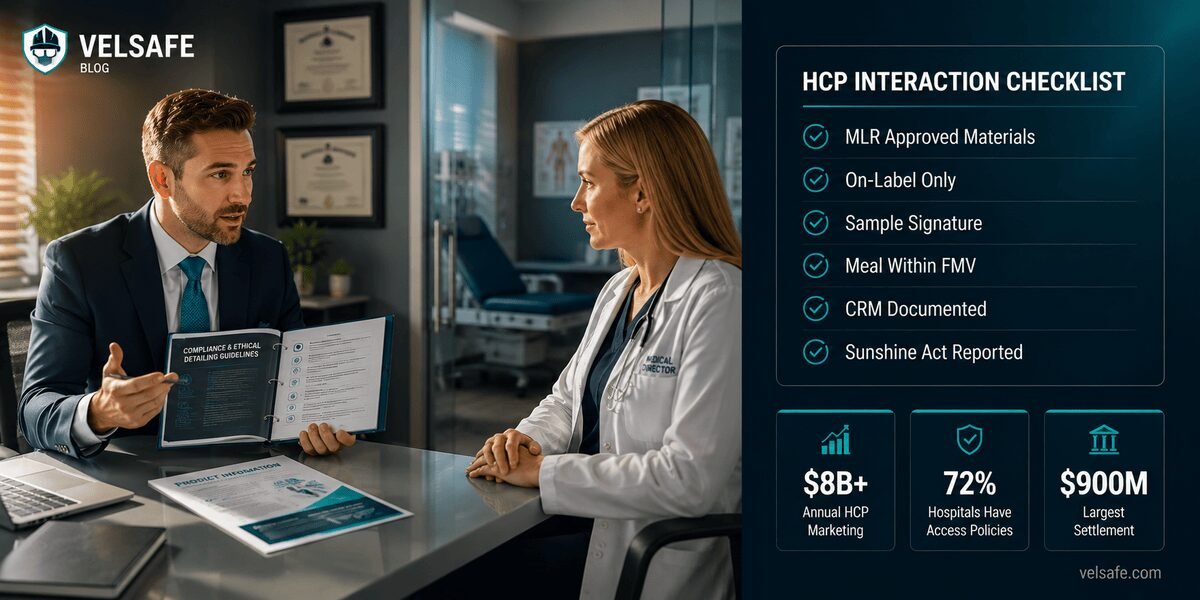
$8B+
Annual HCP Marketing Spend
The U.S. pharmaceutical industry spends over 8 billion dollars each year marketing directly to healthcare professionals.
JAMA Internal Medicine, 2022
72%
Hospitals With Access Policies
Nearly three-quarters of U.S. hospitals have formal policies restricting or managing pharmaceutical and device representative access.
AdvaMed / PhRMA Access Survey
$900M
Largest HCP Compliance Settlement
Companies have faced nine-figure settlements for off-label promotion and improper HCP interactions in enforcement actions.
U.S. Department of Justice
Working as a pharmaceutical or medical device field representative means operating inside one of the most regulated commercial environments in existence. Every meal you provide, every clinical study you discuss, every sample you leave behind, and every event you organize falls under a web of federal laws, industry codes, and institutional policies. The consequences of getting it wrong range from lost access privileges to federal criminal charges.
This guide gives you a practical, field-tested framework for navigating healthcare professional (HCP) interactions with confidence. It is built around the actual rules: the PhRMA Code, the AdvaMed Code, the Anti-Kickback Statute, the False Claims Act, the Sunshine Act, and institutional access policies. Follow it step by step and you will maintain both your access and your compliance record.
What You Will Learn in This Guide
The core federal laws and industry codes that govern HCP interactions
How to pre-plan and pre-clear field calls and events
Meal, gift, and sample compliance rules you can apply today
How to handle off-label question situations without triggering liability
Sunshine Act reporting requirements and what counts as a transfer of value
Navigating institutional access restrictions and credentialing systems
Documentation habits that protect you and your company
Common field mistakes and how to avoid each one
Prerequisites and Required Documents
Regulatory Awareness
Prerequisite
Familiarity with the Anti-Kickback Statute, False Claims Act, and your company’s compliance policy before reading this guide.
Approved Materials Only
Prerequisite
All promotional and educational materials must carry medical-legal-regulatory (MLR) approval before use in any HCP interaction.
Credentialing Completed
Prerequisite
Your Veeva, Vendormate, or institutional credentialing must be current before entering any hospital, clinic, or surgery center.
Annual Training Current
Prerequisite
Your company’s annual HCP interaction and compliance training must be completed and documented before conducting field calls.
Regulatory Framework: The Laws That Govern HCP Interactions
Understanding the legal framework is not optional. Field representatives are personally responsible for their own compliance. The three federal laws that matter most are the Anti-Kickback Statute (AKS), the False Claims Act (FCA), and the Physician Payments Sunshine Act. Each creates distinct liability exposure.
Law / Code
What It Governs
Key Risk for Field Reps
Anti-Kickback Statute (42 U.S.C. § 1320a-7b)
Prohibits anything of value given to induce or reward referrals of federally reimbursable services
Meals, gifts, speaker fees, and samples that appear linked to prescribing behavior
False Claims Act (31 U.S.C. §§ 3729-3733)
Prohibits submitting false claims for reimbursement to federal programs including Medicare and Medicaid
Off-label promotion that leads to non-reimbursable prescriptions billed to federal programs
Sunshine Act / Open Payments (42 U.S.C. § 1320a-7h)
Requires manufacturers to report all transfers of value to physicians and teaching hospitals
Failure to report meals, samples, or educational materials triggers penalties of up to $1.18M annually
PhRMA Code on Interactions with HCPs (2022)
Industry self-regulatory code for pharmaceutical company interactions with healthcare professionals
Meals exceeding fair value, unapproved venues, entertainment, and gifts not educational in nature
AdvaMed Code of Ethics (2020)
Industry self-regulatory code for medical device company interactions with healthcare professionals
Training payments, device loans, consulting arrangements, and facility support that lack legitimate purpose
Sources: U.S. Department of Justice | CMS Open Payments | PhRMA | AdvaMed
Anti-Kickback Statute. The AKS prohibits offering, paying, soliciting, or receiving anything of value to induce or reward referrals of items or services covered by federal healthcare programs. Violations carry criminal penalties of up to $100,000 per act and exclusion from federal programs. (DOJ, 42 U.S.C. § 1320a-7b)
False Claims Act exposure from off-label promotion. When off-label promotion leads an HCP to prescribe a drug or device for a non-covered indication billed to Medicare or Medicaid, the manufacturer faces FCA liability. Settlements have exceeded $900 million in single enforcement actions. (DOJ, False Claims Act enforcement record)
Sunshine Act reporting thresholds. Manufacturers must report transfers of value to covered recipients annually. Failure to report accurately carries penalties of up to $1.18 million per year. All field meal, sample, and educational material records feed into this reporting. (CMS Open Payments, 42 U.S.C. § 1320a-7h)
PhRMA and AdvaMed codes are not voluntary in practice. Although technically self-regulatory, companies operating under corporate integrity agreements are contractually bound to these codes. Violations of the codes constitute CIA breaches reportable to the OIG. (OIG Corporate Integrity Agreement Guidance)
Step 1: Pre-Call Planning and Verification
Objective: Establish a compliant foundation before any HCP contact occurs.
Why It Matters: Compliance failures almost always trace back to inadequate pre-call planning. Knowing which materials are approved, which HCPs have access restrictions, and what transfer-of-value thresholds apply for the interaction removes guesswork in the field.
Verify MLR Approval Status
Confirm every piece of material you plan to use carries a current MLR approval code. Approval codes expire. Using outdated materials, even accurate ones, creates regulatory exposure. Check your CRM or content management platform the morning of the call.
PhRMA Code, Section 1; Company SOP
Check HCP Prescriber Profile and Restrictions
Some HCPs are on restricted or no-see lists due to past compliance events, state-level restrictions, or institutional policies. Calling on a restricted HCP is not just a wasted trip. It can be a reportable compliance event under your corporate integrity agreement.
OIG Exclusion Database; CRM Restricted HCP List
Confirm Credentialing for the Facility
Hospital and health system credentialing requirements vary. A lapsed Vendormate or Symplr profile will result in access denial at the front desk. Log into your credentialing system and confirm your status for each facility on your call plan before departure.
ADVAMED Access Survey; Facility Policy
Step 2: Conducting the HCP Interaction
Objective: Conduct the HCP interaction within approved content boundaries and transfer-of-value limits.
Why It Matters: The field call itself is where most compliance events occur. Statements made during the call, materials left behind, and any value exchanged all create a regulatory record whether you document them or not.
Field Call Compliance Risk Areas
Off-Label StatementsHighest Risk
Any statement about unapproved uses, even in response to unsolicited questions, carries the highest regulatory risk.
Meals and EntertainmentHigh Risk
Meals that exceed the modest meal threshold, include non-HCP guests, or occur at inappropriate venues are frequently cited violations.
Sample Handling ErrorsModerate-High Risk
Leaving samples without a licensed practitioner signature, exceeding sample quantity limits, or leaving samples at unapproved sites.
Documentation GapsModerate Risk
Failure to record call outcomes, transfers of value, or signed sample receipts in the CRM within the required timeframe.
Off-label promotion is the leading enforcement category. The majority of large pharmaceutical settlements with the DOJ involve off-label promotion as the primary allegation. Even a single representative’s off-label statement, if documented or witnessed, can trigger a government investigation. (DOJ Pharmaceutical Enforcement Actions, 2010-2024)
Meal violations frequently trigger broader audits. Meals above fair market value thresholds, provided at entertainment venues, or given without a substantive educational component are among the most commonly cited PhRMA Code violations in government investigations. (PhRMA Code 2022, Section 3)
Sample signature requirements are strict. The Prescription Drug Marketing Act requires a licensed practitioner’s written request or signature for each sample transaction. No verbal authorization, office staff signature, or after-the-fact documentation is acceptable. (FDA, PDMA 21 U.S.C. § 353(d))
CRM documentation gaps amplify liability. In government investigations, missing or late CRM records are treated as evidence of intent to conceal rather than simple administrative failure. Same-day documentation is the field standard under most corporate integrity agreements. (OIG CIA Compliance Guidance)
Stay on-label: Discuss only FDA-approved indications, patient populations, dosing, and contraindications as reflected in the approved labeling. Never extrapolate beyond the label, even based on published studies, unless responding to an unsolicited scientific inquiry through your medical information team.
Use only approved materials: Leave only MLR-approved detail pieces, reprints, and samples. Do not supplement with personal notes, unapproved clinical summaries, or materials from other companies.
Obtain required signatures: For samples, the Prescription Drug Marketing Act (PDMA) requires a licensed practitioner’s signature. No signature, no sample. Record the signature in your CRM before leaving the facility.
Keep meals modest and educational: The PhRMA Code (2022) requires that meals provided to HCPs be modest by local standards, occur in a venue appropriate for education, and be accompanied by a substantive educational presentation. The AdvaMed Code sets similar expectations for device companies.
Step 3: Handling Off-Label Questions in the Field
Objective: Handle off-label questions from HCPs without creating regulatory liability for you or your company.
Why It Matters: HCPs frequently ask about unapproved uses, patient populations outside the label, and emerging clinical data. How you respond determines whether your company faces off-label promotion liability. The script below is field-tested and works consistently across call environments.
Off-Label Question Response Protocol
Step 1: Acknowledge
Thank the HCP for the question and note that it falls outside the approved indication. Example: “That is a great question, and I want to make sure you get accurate information. The indication I can discuss with you today covers [approved population]. Your question goes beyond what I am permitted to discuss.”
Step 2: Refer to Medical Affairs
Offer to connect the HCP with your Medical Science Liaison (MSL) or medical information line. “Our MSL team can address your question with full scientific depth. Can I arrange that contact for you?” Document the referral in your CRM immediately.
Step 3: Document
Record the question, your response, and the MSL referral in your call notes within 24 hours. “Unsolicited scientific inquiry received. Referred to [MSL name] on [date]. No off-label information provided.” This documentation protects you and your company.
Step 4: Sunshine Act Reporting and Transfer of Value Tracking
Objective: Ensure all transfers of value are correctly captured and reportable under the Sunshine Act.
Why It Matters: The Sunshine Act requires manufacturers to report all payments and transfers of value to covered recipients, including meals, educational materials, consulting fees, travel, and samples for certain product categories. The CMS publishes this data publicly in the Open Payments database.
Transfer of Value Type
Reportable?
Field Action Required
Meals provided to HCP
Yes
Record meal cost per HCP and HCP NPI in CRM same day
Educational materials left with HCP
Yes (if value exceeds $10)
Record item description and fair market value in CRM
Drug samples (most)
No (reported separately under PDMA)
Capture signature; record lot, quantity, HCP NPI in CRM
Speaker program honoraria
Yes
Handled by compliance team; confirm via contract and invoice
Device demonstration loan or trial
Yes (if non-trivial value)
Coordinate with compliance; document loan agreement and duration
Sources: CMS Open Payments Program | PDMA 21 U.S.C. § 353(d)
Meals are always reportable regardless of amount. Every meal provided to a covered recipient must be reported under the Sunshine Act. There is no de minimis exemption for meals. The $10 threshold applies to non-meal items only. (CMS Open Payments Program FAQ)
Drug samples are tracked separately under PDMA. Most drug samples are excluded from Sunshine Act reporting but fall under the Prescription Drug Marketing Act, which requires a licensed practitioner’s signature and quantity tracking for every sample transaction. (FDA, PDMA Implementation Guidance)
Device loan and evaluation arrangements require written agreements. Medical device companies providing equipment on a trial basis must document the arrangement with defined terms, duration, and legitimate business purpose. (AdvaMed Code 2020, Section 7)
Public visibility of Open Payments data affects HCP relationships. All reported transfers of value are published annually in the CMS Open Payments database, which is publicly searchable. (CMS Open Payments, cms.gov/OpenPayments)
Step 5: Post-Call Documentation
Objective: Complete all required post-call documentation within mandated timeframes.
Why It Matters: Post-call documentation is not optional record-keeping. It is a legal and regulatory requirement. Under corporate integrity agreements (CIAs) and company SOPs, documentation must occur within a defined window, typically same-day or within 24 hours. Late or incomplete documentation is itself a compliance finding.
Post-Call Documentation Checklist
HCP name, NPI, and facility recorded in CRM
Approved materials discussed or left behind logged by item code
Samples recorded: product name, lot number, quantity, and HCP signature confirmed
Meal cost per attendee recorded (if applicable); venue and time logged
Any off-label question received: documented with “unsolicited” notation and MSL referral recorded
Transfer of value amount and category entered for Sunshine Act aggregation
Next call date or follow-up action noted
Any access restriction, facility policy update, or HCP preference change flagged to manager
Best Practices for Sustained Compliance
Build Your Compliance Habit Stack
The most effective reps treat compliance as a habit, not a checklist. Pre-call review, on-call discipline, and post-call documentation become automatic over time. Build your habit stack around your CRM workflow so compliance actions occur without additional decision fatigue.
OIG Compliance Program Guidance
Know Your Company’s Fair Market Value Thresholds
Every company sets its own FMV meal cap, which varies by region and specialty. Knowing your exact threshold eliminates the most common field error. Keep it saved in your phone. When in doubt, call your compliance hotline before the meal, not after.
PhRMA Code 2022 | AdvaMed Code 2020
Treat Every Question as a Future Compliance Record
Assume that every conversation you have with an HCP could be reviewed by a compliance officer or a federal investigator. Not because this happens often, but because it shapes the right behavior. If you wouldn’t want your answer read aloud in an investigation, rephrase it or defer to your MSL.
DOJ Corporate Integrity Agreement Guidance
Common Field Mistakes
Common Field Mistakes and How to Avoid Them
Answering off-label questions directly
Even well-intentioned, factually accurate off-label responses create liability. Always redirect to your MSL and document the referral.
Leaving samples without a signature
A sample left without a licensed practitioner signature is a PDMA violation. No exceptions, no workarounds. If the HCP is unavailable to sign, take the samples with you.
Using outdated or unapproved materials
MLR approval expires. Verify the approval code every morning before calls. Using lapsed materials, even if the content has not changed, is a policy violation.
Meals above the FMV threshold
Ordering above your company’s fair market value cap, even by a few dollars, is a reportable event. Check the menu and calculate per-person cost before ordering.
Compliance Notes: Speaker Programs, Consulting, and Educational Grants
Field compliance is not a single event or an annual training exercise. It is a daily operational discipline. Three areas of regulation most frequently surface in government investigations of pharmaceutical and device field teams.
Speaker Programs: Legitimate speaker programs require a genuine educational need, a qualified speaker, an appropriate venue, a substantive educational presentation, and fair-market-value compensation. Programs held at restaurants without a clear educational component, programs where the speaker is the only attendee, and programs designed primarily to reward prescribing behavior have all been cited in enforcement actions.
Consulting Arrangements: HCP consulting contracts require a written agreement, pre-defined deliverables, fair-market-value compensation, and a legitimate business need. Consulting arrangements that lack these elements and correlate with prescription volume are a primary enforcement target.
Medical Education Grants: Educational grants to HCPs or institutions must be truly independent. Sales involvement in grant decisions or grant recipients, curriculum design, or faculty selection is a red flag. If your company has a grants function, keep your involvement strictly arm’s-length and document it.
HCP Interaction Compliance Checklist
HCP Interaction Compliance Checklist
Before the Call
MLR approval confirmed for all materials
HCP not on restricted or no-see list
Credentialing current for this facility
Annual compliance training completed
FMV meal threshold known for this region
During the Call
Only approved indications discussed
Off-label questions redirected to MSL
Sample signature obtained before leaving
Meal below FMV threshold; venue appropriate
Only MLR-approved materials left behind
After the Call
CRM updated within 24 hours
Transfers of value recorded for Sunshine
Sample lot, quantity, and signature confirmed
Off-label referrals documented
Access or policy changes flagged to manager
Escalate Immediately If
HCP requests cash, gift cards, or personal benefits
Facility requests improper product support
Manager asks you to bypass compliance policy
You receive a subpoena or government contact
Colleague uses unapproved materials or tactics
Key Takeaways
Compliance Starts Before You Arrive
Pre-call planning is your first compliance gate. Verifying MLR approval, checking HCP restrictions, and confirming credentialing before every call eliminates the majority of field compliance errors before they can occur.
Off-Label Questions Have One Correct Answer
Acknowledge the question, decline to answer it, and refer the HCP to your MSL. Document the referral the same day. This three-step protocol is the field standard across every major pharmaceutical and device company.
Every Transfer of Value Creates a Record
A meal, a detail piece, a sample, a consulting fee, a device loan. All of these flow through the Sunshine Act reporting process. Your CRM documentation feeds that process. Accuracy and timeliness protect you and your company.
Documentation Is Not Optional
Post-call documentation is a regulatory requirement, not a best practice. CRM entries must be completed within the required window. Late documentation, like missing documentation, is itself a compliance finding under most corporate integrity agreements.
When in Doubt, Call Compliance
Compliance hotlines exist precisely for field situations that do not fit neatly into the policy manual. Using the hotline before an interaction is never the wrong call. It shows good faith and ensures you are protected regardless of the outcome.
Institutional Policies Vary Significantly
A hospital, an academic medical center, a private clinic, and a community pharmacy each operate under different access and interaction policies. Know the policy for each facility on your call plan. What is permitted in one setting may be prohibited in another.
Frequently Asked Questions
What is the difference between the PhRMA Code and the AdvaMed Code?
The PhRMA Code applies to pharmaceutical manufacturer interactions with healthcare professionals. The AdvaMed Code applies to medical device and diagnostic company interactions. Both cover meals, gifts, educational activities, consulting arrangements, and speaker programs. The AdvaMed Code also addresses device demonstration and evaluation arrangements specific to device and capital equipment sales.
Can I answer an HCP’s off-label question if they bring it up first?
No. The fact that the HCP initiated the question does not authorize you to respond with off-label information. Unsolicited scientific inquiries must be referred to your Medical Affairs or Medical Science Liaison team. You can acknowledge the question, explain that it falls outside what you can discuss, and offer to arrange the MSL contact. Document the entire exchange.
What happens if I accidentally exceed the meal FMV threshold?
Report it to your compliance team as soon as you identify the discrepancy. Voluntary self-disclosure is always treated more favorably than discovered violations. Your compliance team will determine whether the amount requires escalation and will handle Sunshine Act reporting adjustments. Trying to hide or rationalize the overage creates far greater risk than the original error.
Do I need to report educational materials I leave with an HCP?
Yes, if the fair market value of the materials exceeds the Sunshine Act reporting threshold (currently $10 per item or aggregate). Your company’s compliance system typically tracks this automatically based on your CRM call notes. Always log the item description and quantity in your call record so the reporting system can calculate the correct transfer of value.
What should I do if a hospital changes its access policy without warning?
Respect the new policy immediately, even if you were mid-visit. Document the policy change in your CRM, including the date, source (typically the facility compliance officer or front desk policy notice), and any specific restrictions applied. Notify your manager and update your credentialing records if required. Do not attempt to work around the new policy by using a different entrance or contact point.
Are drug samples required to be reported under the Sunshine Act?
Most drug samples are excluded from Sunshine Act reporting but are subject to the separate Prescription Drug Marketing Act (PDMA), which requires a licensed practitioner’s signature for each sample transaction and mandates detailed record-keeping. Device companies may have different obligations. Confirm with your compliance team which of your product samples, if any, require Sunshine reporting.
What is a corporate integrity agreement and how does it affect me as a field rep?
A corporate integrity agreement (CIA) is a legal settlement between a manufacturer and the Office of Inspector General (OIG) following a compliance violation. CIAs typically require enhanced monitoring, mandatory training, auditing of field activities, and detailed documentation requirements. If your company operates under a CIA, your field documentation standards and escalation obligations are likely stricter than the industry baseline.
Government and Regulatory Sources
U.S. Department of Justice. Anti-Kickback Statute (42 U.S.C. § 1320a-7b) : federal law prohibiting remuneration to induce referrals of federally reimbursable services.
U.S. Department of Justice. False Claims Act (31 U.S.C. §§ 3729-3733) : governs fraudulent claims submitted to federal programs including Medicare and Medicaid.
Centers for Medicare and Medicaid Services. Open Payments Program (Sunshine Act, 42 U.S.C. § 1320a-7h) : public database of manufacturer transfers of value to covered recipients.
U.S. Food and Drug Administration. Prescription Drug Marketing Act (21 U.S.C. § 353(d)) : governs drug sample distribution and record-keeping requirements.
Office of Inspector General, HHS. Compliance Program Guidance for Pharmaceutical Manufacturers : framework for effective field compliance programs.
U.S. Food and Drug Administration. Guidance: Industry-Supported Scientific and Educational Activities : standards for CME and educational grants.
Research and Industry Sources
PhRMA. (2022). Code on Interactions with Healthcare Professionals : industry self-regulatory standards for pharmaceutical field interactions including meals, gifts, and speaker programs.
AdvaMed. (2020). Code of Ethics on Interactions with Health Care Professionals : self-regulatory standards for medical device and diagnostic company field teams.
JAMA Internal Medicine. (2022). Pharmaceutical Industry Spending on Physician Promotion : documents annual HCP marketing expenditure exceeding $8 billion.
VelSafe Staff is the editorial team at VelSafe.com, a workplace safety and compliance content platform. Our team of safety professionals, regulatory specialists, and compliance writers produces guides, tips, and insights on OSHA regulations, pharmaceutical GMP, healthcare compliance, and occupational health across construction, manufacturing, oil and gas, and life sciences sectors..