Pharmaceutical, medical device, and life sciences companies engage healthcare professionals (HCPs) continuously: as speakers, consultants, advisors, research collaborators, and training participants. Each of these interactions carries regulatory risk under the Anti-Kickback Statute, Stark Law, PhRMA and AdvaMed voluntary codes, and the Open Payments (Sunshine Act) reporting regime. Managing in-house HCP interactions compliantly requires a functioning framework covering fair market value, documentation, approval workflows, and training. This analysis examines the regulatory landscape, common failure patterns, and the compliance programme elements that distinguish low-risk from high-risk HCP engagement models.
Executive Summary
In-house HCP interactions (those managed and facilitated directly by company employees rather than through third-party agencies) present heightened compliance risk because the boundary between legitimate business activity and improper inducement is managed internally, often without the structural controls that outsourced arrangements impose. The Anti-Kickback Statute (42 U.S.C. 1320a-7b(b)) criminalises the offer, payment, or receipt of anything of value to induce or reward referrals of items or services covered by federal health care programmes. Every HCP engagement that has any connection to a federally covered product must be structured to fit within a recognised safe harbour or exception. The PhRMA Code on Interactions with Healthcare Professionals and the AdvaMed Code of Ethics provide voluntary compliance frameworks that, when followed, reduce but do not eliminate regulatory risk. Open Payments reporting under the Physician Payments Sunshine Act (42 U.S.C. 1320a-7h) requires disclosure of all transfers of value to covered recipients, creating a public accountability mechanism that amplifies the reputational consequences of non-compliant HCP engagement.
Key Statistics
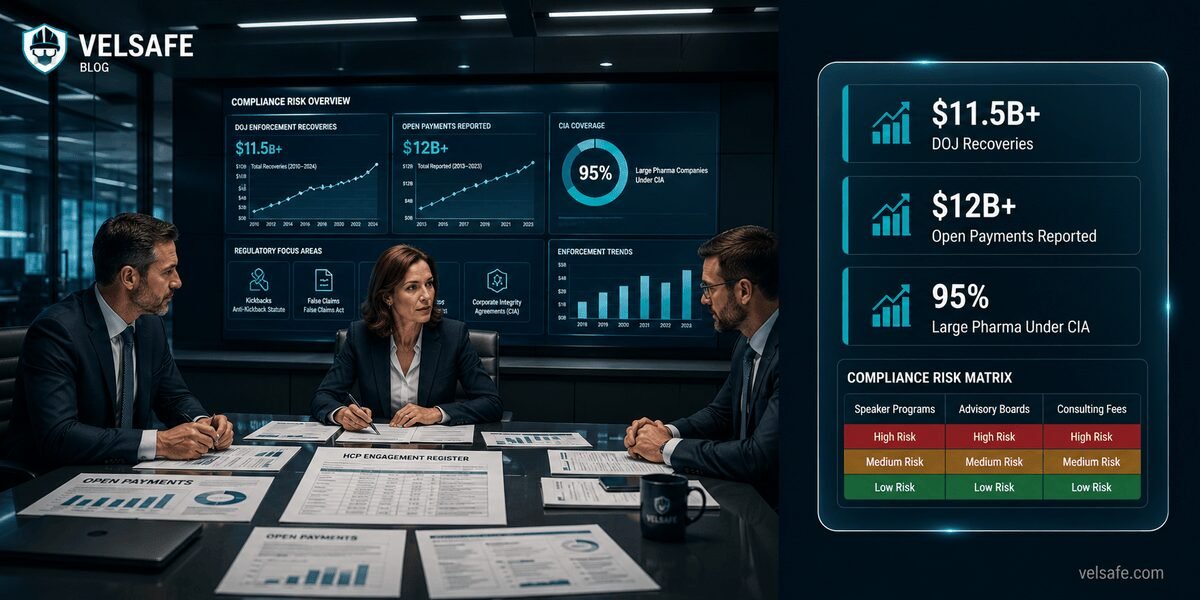
$11.5B+
DOJ Healthcare Fraud Recoveries in a Recent Year
The Department of Justice recovered over $11.5 billion through False Claims Act and healthcare fraud enforcement actions in a recent year, with Anti-Kickback violations representing a significant component of pharmaceutical and device company settlements
The CMS Open Payments database receives reports of over $12 billion in annual transfers of value from pharmaceutical and medical device companies to physicians and teaching hospitals, encompassing research payments, consulting fees, meals, travel, and educational grants
Of Large Pharma Companies Under Corporate Integrity Agreements
A significant majority of large pharmaceutical companies have been subject to Corporate Integrity Agreements (CIAs) with the OIG, which typically include enhanced HCP interaction monitoring, FMV documentation requirements, and annual independent review organisation audits
“The Anti-Kickback Statute does not require proof of corrupt intent for administrative violations. The government does not need to show that a payment was intended as a bribe; only that remuneration was offered or paid to a person in a position to generate referrals. This means that a speaker programme, an advisory board, or a consulting arrangement that provides fair market value compensation for legitimate services can still create risk if the selection criteria, the fee structure, or the volume of engagements suggests that the relationship was designed to generate or reward business rather than to obtain genuine services.”
1. The Regulatory Framework: What Governs In-House HCP Interactions
In-house HCP interactions in the pharmaceutical and medical device sector are governed by a layered framework of federal criminal statutes, civil liability provisions, voluntary industry codes, and federal reporting requirements. No single regulation covers all interaction types; compliance requires understanding how these layers apply to each specific engagement model.
Framework
Type
Key Requirement
Enforcement
Anti-Kickback Statute (AKS)
Federal criminal statute
No remuneration to induce or reward referrals of federally covered items or services
CRIMINAL/CIVIL
Stark Law (Physician Self-Referral)
Federal civil statute
Physicians may not refer Medicare/Medicaid patients to entities with which they have a financial relationship unless an exception applies
CIVIL
Open Payments / Sunshine Act
Federal reporting requirement
Report all transfers of value to covered recipients (physicians, teaching hospitals, advanced practice practitioners)
REPORTING
PhRMA Code / AdvaMed Code
Voluntary industry codes
Industry best-practice standards for HCP interactions including meals, educational events, consulting arrangements, and speaker programmes
VOLUNTARY
2. In-House HCP Engagement Types and Their Risk Profiles
Speaker Programmes
HCPs paid to present to other HCPs on disease state education or product-related topics. Speaker programmes are one of the highest-scrutiny areas in pharmaceutical compliance because the selection of speakers, the frequency of engagements, the compensation rates, and the audience composition all create risk indicators that regulators assess when evaluating whether the programme constitutes genuine education or an inducement mechanism.
Key risk factors: Speakers selected based on prescribing volume; fees above fair market value; frequent repeat engagements; small audiences; meals or entertainment disproportionate to the educational content.
Advisory Boards and Consulting Arrangements
HCPs engaged to provide genuine expert advice on clinical, scientific, or commercial topics. The OIG’s compliance guidance and enforcement history identify advisory board arrangements as a frequent vehicle for improper inducement when the number of advisors exceeds the legitimate need for advice, when the compensation exceeds fair market value for the services actually rendered, or when selection criteria favour high-prescribers over genuine subject-matter experts.
Key risk factors: Advisory board size disproportionate to stated objective; meetings in resort locations; compensation not commensurate with time and expertise; same advisors re-engaged repeatedly without documentation of ongoing need.
Medical Education and Training
HCPs invited to company-sponsored educational programmes, product training, or medical education grants. The distinction between legitimate medical education and promotional activity is a consistent area of scrutiny. Grants to independent medical education programmes are generally lower risk than company-controlled educational events; company-controlled events must be clearly educational rather than primarily promotional, with content that would withstand review by an independent medical expert.
Key risk factors: Educational content predominantly covers company products; speakers are company sales staff rather than independent experts; attendee selection tracks prescribing behaviour; travel and entertainment costs are disproportionate to educational value.
3. Fair Market Value: The Central Compliance Control
Fair market value (FMV) is the cornerstone concept in HCP compensation compliance. The OIG’s safe harbour for personal services arrangements (42 CFR 1001.952(d)) requires, among other elements, that aggregate compensation be set in advance, consistent with fair market value in arm’s-length transactions, and not determined in a manner that takes into account the volume or value of referrals. In practice, this means that every HCP compensation arrangement must be supported by a documented FMV determination that reflects what an independent party would pay for the same services.
FMV Determination Methods
Companies use several approaches to establish FMV: independent FMV surveys (published by compensation survey firms); internal rate cards built from survey data and validated by independent counsel; geographic and specialty adjustments; and for highly specialised services, individual FMV analyses. Rate cards must be updated periodically to remain current with market rates.
FMV Documentation Requirements
For each HCP engagement, the file should document: the services to be performed; the basis for the FMV determination for those specific services; the HCP’s qualifications justifying the rate; confirmation that the rate was not influenced by the HCP’s prescribing or referral history; and evidence that the services were actually performed as described.
Common FMV Failures
Paying rates above the 75th percentile of market data without documented justification; failing to update rate cards; using the same rate for different specialties or service types; not adjusting for actual time spent; and allowing sales or marketing teams (rather than compliance) to determine compensation rates.
4. Open Payments Reporting: What Must Be Disclosed
The Physician Payments Sunshine Act, implemented through CMS’s Open Payments programme, requires applicable manufacturers and group purchasing organisations to report payments and transfers of value to covered recipients annually. The reporting threshold is low: payments of $10 or more per occurrence, or $100 or more in the aggregate annually to a single recipient, must be reported. The publicly accessible database means that non-compliance or inaccurate reporting creates reputational risk as well as penalty exposure.
What Must Be Reported
Consulting fees, speaker fees, honoraria, gifts, meals, travel, accommodation, education grants, research payments, charitable contributions in the name of a covered recipient, and ownership or investment interests. Nature of payment categorisation (research, education, consulting, etc.) must be accurate.
Who Is a Covered Recipient
Physicians (as defined by CMS), teaching hospitals, and since 2022, non-physician practitioners including physician assistants, nurse practitioners, clinical nurse specialists, certified registered nurse anaesthetists, and certified nurse-midwives.
Common Reporting Failures
Failure to capture all transfers of value (particularly meals, travel, and samples); incorrect nature of payment categorisation; missing NPI numbers; failure to report delayed reporting for research payments; failure to include non-physician practitioners post-2022 expansion.
Penalties for Non-Reporting
Civil money penalties range from $1,000 to $10,000 per payment not reported (unknowing failure) and $10,000 to $100,000 per payment not reported (knowing failure). Annual caps apply per reporting cycle. The reputational impact of public database errors often exceeds the financial penalty.
5. In-House HCP Interaction Compliance Programme: Required Elements
Written Policies and Procedures
Every in-house HCP interaction must be governed by written policies that define: permitted and prohibited interaction types; approval workflows; FMV determination and documentation requirements; Open Payments capture and reporting processes; and escalation procedures for non-standard requests. Policies must be current (reviewed at minimum annually), accessible to all relevant employees, and enforced consistently.
Pre-Approval and Contracting Requirements
Legitimate need for each HCP engagement must be documented before the engagement begins. The number of engagements needed must be estimated against the legitimate business purpose. Selection criteria for HCPs must be based on expertise and qualifications, not prescribing volume. A written contract must be executed before services are performed, specifying the services, the compensation, and the FMV basis. No oral arrangements.
Training and Awareness
All employees who initiate, manage, or approve HCP interactions must be trained on the applicable legal framework, the company’s policies, and the specific documentation requirements. Training must be documented, repeated when policies change, and include a tested assessment component. Medical, marketing, sales, legal, and finance teams all interact with HCP engagement processes and all require appropriate training.
Monitoring and Auditing
Compliance programmes must include both monitoring (ongoing oversight of HCP interaction activity against defined metrics) and auditing (periodic structured review of samples of HCP engagement files against policy requirements). Monitoring metrics include: engagements per HCP per period; aggregate compensation per HCP; FMV documentation completion rates; and Open Payments capture rates. Audit findings must be remediated and tracked through to closure.
6. Common Violations and Enforcement Patterns
Violation Type
Regulatory Risk
Common Pattern
Speaker selection based on prescribing volume
AKS HIGH
Sales team selects speakers from top-prescriber lists rather than on qualifications; correlation between speaker programme participation and prescribing increases becomes evidence of intent
Compensation above FMV without documentation
AKS HIGH
Rate cards not updated; senior specialists paid at same rate as general practitioners; no specialty adjustment; FMV analysis not documented per engagement
Advisory boards with no genuine need for advice
AKS HIGH
Advisory board size exceeds what is needed for the stated purpose; advice received is not documented or used; marketing team initiates and controls advisory board selection
Open Payments under-reporting or mis-categorisation
REPORTING MOD
Meals and travel not captured at point of occurrence; nature of payment categorised as education when it should be promotional; non-physician practitioners excluded post-2022
Legitimate business need documented before HCP is selected
HCP selected on qualifications, not prescribing or referral volume
FMV determination documented for the specific services requested
Written contract executed and compliance approval obtained before services begin
Estimated number of HCP engagements reviewed against documented legitimate need
After Engagement
Services actually performed and deliverables documented in the engagement file
All transfers of value captured for Open Payments reporting at point of occurrence
Nature of payment categorised correctly in the Open Payments system
Aggregate annual compensation reviewed against HCP FMV ceiling and internal cap
Engagement file retained in accordance with records retention policy
Key Takeaways
The selection criteria for HCPs is as important as the compensation
Regulators evaluating HCP arrangements look first at how the HCP was selected. Selection based on prescribing volume or referral potential (even if the compensation is at FMV) indicates that the arrangement is designed to reward business rather than obtain services. Selection criteria must be documented, based on expertise and qualifications, and enforced by compliance rather than sales teams.
Fair market value requires documentation, not just compliance
An FMV rate card is a necessary starting point, not a sufficient compliance control. Each engagement must be supported by documentation that the rate for these specific services, from this specific HCP, at this specific time, was within the range that an independent party would pay. Where rates are at the upper end of market ranges, additional justification is required. Rate cards must be updated to remain current.
Open Payments accuracy is a compliance obligation, not an administrative task
The public nature of the Open Payments database means that errors, omissions, and mis-categorisations create reputational risk that persists beyond any penalty. Companies that treat Open Payments reporting as a data entry exercise rather than a compliance programme element consistently have higher error rates and face greater reputational exposure when the public database is searched by regulators, journalists, or plaintiff’s counsel. Capture must occur at the point of transaction, and reconciliation must be systematic rather than year-end.
Legal Disclaimer
This article provides educational information about the regulatory framework governing HCP interactions and is not legal advice. The application of the Anti-Kickback Statute, Stark Law, Open Payments requirements, and related regulations to specific business arrangements requires legal and compliance analysis of the facts of each arrangement. Consult qualified healthcare regulatory counsel for guidance on specific programmes and transactions.
Frequently Asked Questions
Does the Anti-Kickback Statute apply to arrangements with all physicians, or only those who prescribe or refer federally covered products?
The AKS applies to arrangements with any person who is in a position to generate referrals of items or services covered by a federal health care programme, including Medicare and Medicaid. This covers physicians, nurse practitioners, pharmacists, hospital administrators, and others who can influence purchasing or prescribing decisions for federally covered products. If your company’s products are reimbursed by any federal health care programme, the AKS applies to your HCP interactions regardless of whether the specific HCP you are engaging is a direct prescriber.
What is the difference between the AKS personal services safe harbour and the Stark Law personal services exception?
Both require FMV compensation set in advance and not based on referral volume. The AKS safe harbour protects against criminal prosecution and exclusion; the Stark Law exception protects against civil liability for improper physician self-referrals. They have different specific requirements and must be analysed independently for each arrangement.
How should a company respond when a compliance audit identifies that an HCP has been compensated above the FMV range?
Identify the scope of the over-compensation across all affected engagements. Document the finding in the compliance tracking system. Assess whether the over-compensation, when viewed in the context of all compensation to the HCP and the HCP’s referral or prescribing relationship with the company, creates material AKS risk. Consult legal counsel to determine whether self-disclosure to the OIG is appropriate. Implement corrective action: update the rate card, retrain relevant personnel, add FMV approval controls for the HCP category, and monitor future engagements with the affected HCP. Document all remediation steps.
Government and Regulatory Sources
OIG HHS – Anti-Kickback Statute Overview
OIG HHS – Corporate Integrity Agreements
CMS – Open Payments (Physician Payments Sunshine Act)
HCP interaction compliance is not just about avoiding violations. It is about having documented evidence that every arrangement was legitimate, every payment was disclosed, and every employee was trained. Explore VelSafe’s life sciences compliance library to build that foundation.
VelSafe Staff is the editorial team at VelSafe.com, a workplace safety and compliance content platform. Our team of safety professionals, regulatory specialists, and compliance writers produces guides, tips, and insights on OSHA regulations, pharmaceutical GMP, healthcare compliance, and occupational health across construction, manufacturing, oil and gas, and life sciences sectors..