

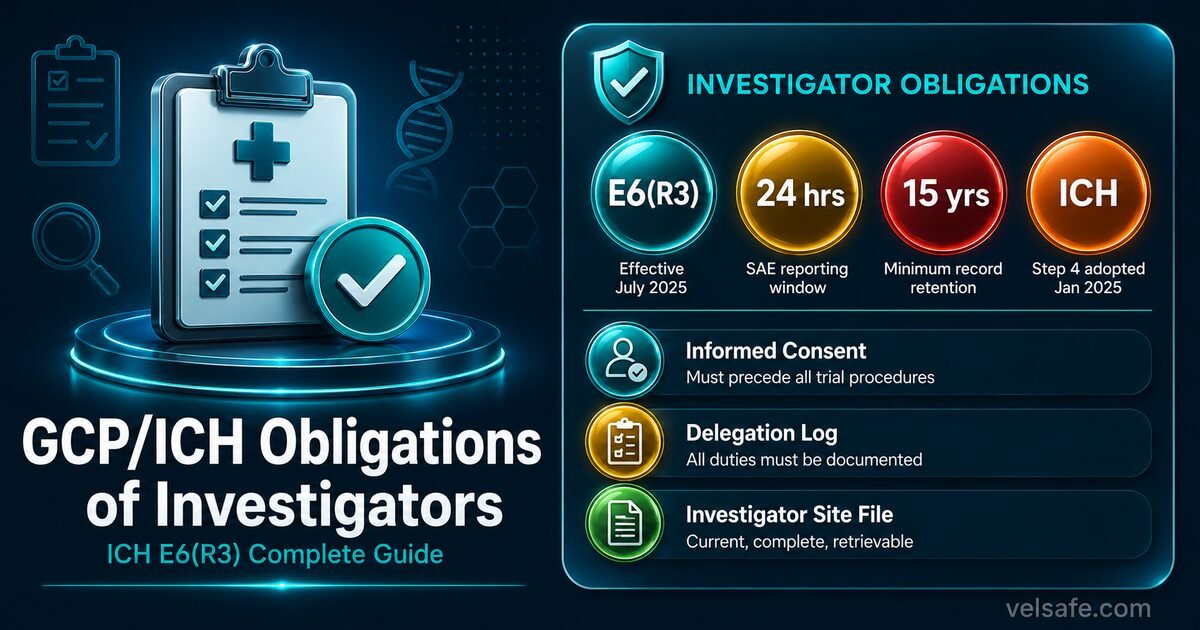
The principal investigator is the individual responsible for the conduct of a clinical trial at a site. Under ICH E6(R3), the Good Clinical Practice guideline that came into effect on 23 July 2025, the investigator’s obligations span every phase of a trial: from qualification and site readiness before the first participant is enrolled, to record retention long after the last participant completes.
This guide walks through each obligation in sequence so investigators, sub-investigators, and site coordinators understand exactly what GCP requires, where inspectors look first, and where most findings occur.
Confirm your site meets ICH E6(R3) qualification requirements before trial initiation.
Manage protocol deviations correctly, including emergency deviations.
Obtain and document informed consent in a GCP-compliant sequence.
Build and maintain a delegation log that passes inspection.
Identify, assess, and report adverse events within required timelines.
Maintain an Investigator Site File that is inspection-ready at all times.
ICH E6(R3) was endorsed under Step 4 by the ICH Assembly on 6 January 2025 and came into effect on 23 July 2025. It replaces E6(R2) (2016) and introduces a risk-proportionate, quality-by-design framework. In the United States, FDA implements GCP requirements through 21 CFR Parts 50, 54, 56, and 312. The EU operates under EU CTR No 536/2014. Both reference ICH E6(R3) as the operative GCP standard.
Step 1: Investigator Qualification and Site Requirements
What the Requirement Means
Under ICH E6(R3), an investigator must be qualified by education, training, and experience to conduct the trial and must meet all requirements specified by the applicable regulatory authority. Before enrolling any participant, the investigator must confirm that the site has adequate resources, including facilities, equipment, and staff, to conduct the trial properly for its anticipated duration.
The investigator must provide the sponsor with current, accurate information about their qualifications, including an updated curriculum vitae, and must inform the sponsor promptly of any changes that could affect their ability to conduct the trial.
Pre-Trial Site Readiness Requirements
IRB/IEC Approval: Written approval or favourable opinion from an Independent Ethics Committee or Institutional Review Board must be obtained before the trial begins and renewed according to the IEC/IRB’s requirements throughout the trial.
Informed Consent Process: The approved consent process must be in place before any participant contact occurs.
Staff Training: All delegated staff must be trained on the protocol, GCP, and their specific delegated tasks before performing any trial-related duties.
Verbal confirmation from the IRB/IEC is not sufficient. Written approval must be received, filed in the ISF, and verified current before any participant is approached. Inspectors check the date on the approval letter against the date of first participant contact.
Step 2: Protocol Compliance and Deviation Management
What the Requirement Means
The investigator agrees to conduct the trial in accordance with the approved protocol. Protocol changes require IRB/IEC review and sponsor agreement before implementation, except in urgent situations where a deviation is necessary to protect participant safety.
Protocol Deviation Management: Step by Step
1. Identify and document the deviation immediately. Any departure from the approved protocol, whether planned or unplanned, must be identified and documented at the time it occurs. The record must describe what happened, when, and why.
2. Notify the sponsor and IRB/IEC. Significant deviations must be reported to the sponsor. Deviations that affect participant safety or the integrity of the trial data must also be reported to the IRB/IEC according to their requirements.
3. Assess impact on participant safety and data integrity. The investigator must evaluate whether the deviation affected the participant’s safety or the reliability of trial data, and document this assessment.
4. Implement corrective action. Corrective and preventive actions must be documented and implemented to prevent recurrence where applicable.
If an immediate protocol deviation is necessary to eliminate an imminent hazard to participants, the investigator may act without prior sponsor or IRB/IEC approval, but must notify both the sponsor and the IRB/IEC as soon as possible after the action is taken. This exception is narrow and must be documented with the specific safety justification.
Documentation must occur at the time of the event, not during monitoring visits or audit preparation. Backdated or retrospectively created deviation records are a critical GCP finding and a data integrity violation under ALCOA+ principles.
Step 3: Informed Consent Obligations
What the Requirement Means
Obtaining and documenting properly informed consent is one of the investigator’s most fundamental obligations. Under ICH E6(R3), consent must be freely given, obtained before any trial procedures are performed, and documented according to the approved process.
Key Investigator Responsibilities
Before consent: The participant (or their legally acceptable representative) must be given adequate time and opportunity to ask questions and consider participation. No trial procedures may occur before consent is obtained.
During consent: The investigator or a delegated, IRB/IEC-approved person must explain the trial in language the participant can understand, confirm understanding, and witness the signing of the consent form.
After consent: A copy of the signed consent form must be given to the participant. If the consent form is revised during the trial, re-consent must be obtained from all active participants.
A consent form signed after a trial procedure has already been performed is not GCP-compliant consent. It is retroactive documentation of an event that occurred without consent. This is a major finding in inspections and a frequent source of protocol deviations. Dates on the consent form must precede the date of any trial procedure in the medical records.
A coordinator may conduct the consent discussion only if they are appropriately trained, listed on the delegation log for that specific task, and the IRB/IEC has approved this practice for the study. Without all three conditions met simultaneously, the consent process is non-compliant.
Step 4: Delegation of Trial-Related Duties
What Can and Cannot Be Delegated
The investigator may delegate specific trial-related activities to qualified members of the site team. However, delegation does not transfer the investigator’s ultimate responsibility for the conduct of the trial at the site.
What can be delegated: Specific clinical, administrative, and data-entry tasks may be delegated to appropriately qualified team members: coordinators, nurses, sub-investigators, pharmacists, and data managers, as appropriate to their qualifications and the task.
What cannot be delegated: The investigator’s personal medical judgments, including causality assessments for serious adverse events and decisions about participant eligibility that require the investigator’s direct clinical evaluation, cannot be delegated.
Delegation Log Requirements
The Delegation of Authority log (or signature and delegation log) must document every person to whom duties have been delegated, the specific tasks delegated, and the period of delegation. This log must be current and signed by the investigator.
Undocumented delegation is a GCP finding: if a task is performed by someone who is not listed on the delegation log for that task during that period, the activity is non-compliant regardless of whether the person was otherwise qualified.
Inspection findings consistently include: tasks performed during study periods not covered by the log; staff who left and were replaced without the log being updated; and tasks listed generically rather than specifically. The log must be updated in real time, not retrospectively.
Step 5: Adverse Event and Safety Reporting
Investigator vs Sponsor Obligations
The investigator is responsible for identifying, assessing, and reporting adverse events (AEs) and serious adverse events (SAEs) according to the protocol, ICH E6(R3), and applicable regulatory requirements. The investigator’s obligations in safety reporting are distinct from those of the sponsor.
The causality assessment, whether the event is considered related or unrelated to the investigational product, is the investigator’s medical judgment and must be documented as such. The sponsor may disagree with the assessment but cannot change the investigator’s documented medical opinion.
Serious adverse events must be reported to the sponsor immediately, typically within 24 hours of the investigator becoming aware. Delay because the event is still being evaluated does not suspend the reporting obligation. An initial report must be submitted immediately, with follow-up reports as additional information becomes available.
Step 6: Investigational Product Accountability
What the Requirement Means
The investigator is responsible for the investigational product at the site. This includes receiving, storing, dispensing, and returning or disposing of the product according to the protocol and sponsor instructions.
Store the investigational product according to sponsor specifications (temperature, security, light).
Dispense the product only to eligible participants enrolled per the approved protocol.
Maintain complete accountability records: amounts received, dispensed, returned, and destroyed.
Ensure the product is used only within the approved protocol.
Return unused product to the sponsor or destroy it per approved procedures at trial completion.
If an IP storage temperature excursion occurs, it must be documented immediately and reported to the sponsor. Product affected by an undocumented excursion may be quarantined by inspectors. The sponsor must evaluate whether the product remains suitable for use before any affected units are dispensed.
Step 7: Essential Records and the Investigator Site File
What Must Be in the ISF
The Investigator Site File (ISF), also called the Trial Master File at the site level, must contain all essential documents defined in ICH E6(R3) Annex 1. These documents demonstrate that the trial was conducted in accordance with GCP and applicable regulatory requirements.
Before trial initiation: Signed protocol and amendments, current Investigator’s Brochure, IRB/IEC approval, signed investigator agreement, CVs of investigator and sub-investigators, delegation log, consent form version approved by IRB/IEC.
During the trial: Updated IB versions, protocol amendments and approvals, updated delegation log, all correspondence with sponsor and IRB/IEC, monitoring visit logs, CRF pages, source documents, AE and SAE reports.
After trial completion: Final protocol, final study report notification, confirmation of product destruction or return, archiving confirmation.
ISF Retention Requirements
ISF records must be retained for the period required by local regulation, typically at least 15 years after trial completion or as specified in the investigator agreement, whichever is longer. The investigator must notify the sponsor before destroying any trial-related records.
The most common ISF finding in inspections is not missing documents. It is documents present but out of date, or records that exist but cannot be promptly retrieved during inspection. A well-organised ISF with a current index is as important as having the documents themselves. Inspectors should be able to locate any document within minutes.
Key Changes Under ICH E6(R3)
ICH E6(R3) introduces several significant changes that directly affect investigators’ obligations compared to E6(R2).
E6(R3) introduces a risk-proportionate framework. Oversight activities and documentation requirements should be calibrated to the risk level of the trial. Lower-risk trials require proportionately less intensive monitoring, but the investigator’s core obligations remain unchanged.
Investigators and sponsors must prospectively identify critical data and processes and build quality into the trial design. This shifts the focus from detecting problems through monitoring to preventing them through planning.
E6(R3) strengthens requirements that source data be accurate, complete, legible, and attributable, consistent with ALCOA+ principles, and that source data are accessible for verification at any time during or after the trial.
E6(R3) explicitly accommodates electronic systems, remote monitoring, and decentralised trial elements. Investigators using electronic source data or remote consent must ensure systems comply with applicable data integrity requirements.
Inspection Readiness Checklist
✓ IRB/IEC approval is current and filed in the ISF
✓ Delegation log is up to date and covers all active staff
✓ All consent forms are signed and dated before any trial procedure
✓ Protocol deviations are documented at the time of occurrence
✓ SAE reports were submitted to the sponsor within 24 hours
✓ IP accountability records are complete and reconcilable
✓ IP storage conditions are within specification and logged
✓ ISF index is current and all documents are retrievable
✓ Staff CVs and training records are current
✓ Source documents support all CRF entries
✓ All records are legible, dated, and attributable (ALCOA+)
Knowledge Check
Test your understanding of investigator obligations before applying these principles at your site.
It depends on whether the IRB/IEC has approved this practice for the study. ICH E6(R3) permits delegation of the consent discussion to a qualified, trained team member listed on the delegation log, but only if the IRB/IEC has explicitly approved this arrangement. If IRB/IEC approval exists, the process is training-dependent and log-dependent. If not, the consent is non-compliant regardless of the coordinator’s qualifications.
No. SAEs must be reported to the sponsor immediately, typically within 24 hours of the investigator becoming aware, regardless of weekends or incomplete information. An initial report with available information must be submitted immediately. Follow-up reports can provide additional details as they become available. Waiting to compile a complete report before initial notification is a GCP violation.
The deviation must be documented immediately upon discovery, even though it occurred two weeks earlier. The documentation should note the date the deviation occurred, the date it was discovered, the reason it was not identified earlier, and an assessment of its impact on participant safety and data integrity. The sponsor must be notified, and the IRB/IEC must be informed if required by their policies. A corrective action must be implemented to prevent recurrence.
It depends on the IRB/IEC’s renewal requirements. IRB/IEC approval must be renewed according to the IRB/IEC’s own requirements, which are typically annual for most trials. If 18 months have passed without renewal, the approval may have lapsed. The investigator must verify the current renewal status and obtain a current approval if required. Conducting a trial on lapsed IRB/IEC approval is a serious GCP and regulatory violation.
Related Resources
- A practice test covering GCP/ICH obligations of investigators and sponsors is available in the Practice Tests section.
- For informed consent documentation requirements, see the Guides section on clinical trial documentation.
Sources
- ICH E6(R3): Guideline for Good Clinical Practice, Step 4 (January 2025)
- EMA: ICH E6 Good Clinical Practice, Scientific Guideline
- Clinical Trials Toolkit UK: Summary of Key Changes in ICH E6(R3) (March 2026)
- FDA: ICH E6(R2) Good Clinical Practice Guidance
- MRCT Center: ICH GCP E6(R3) Resources and Guidance