

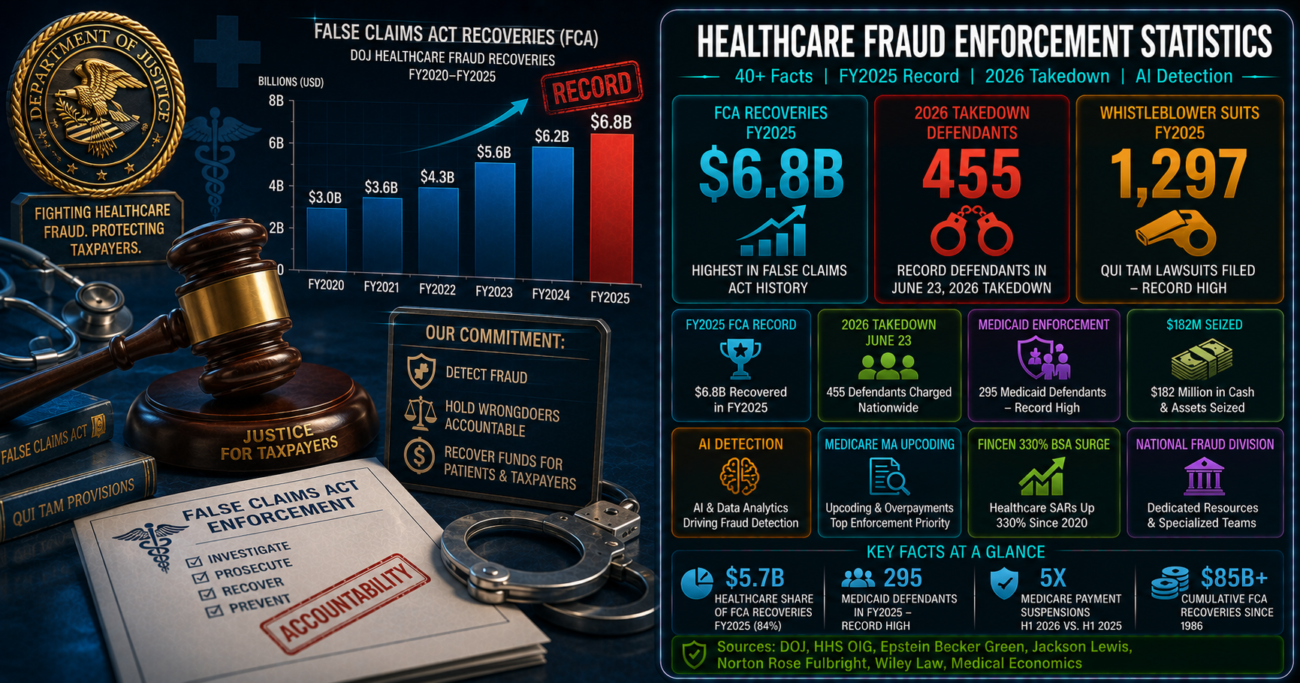
Healthcare fraud drains hundreds of billions of dollars from the U.S. healthcare system every year, driving up costs for patients, employers, and taxpayers while diverting resources from people who need them most. Fiscal year 2025 and the first half of 2026 have produced an enforcement environment that is, by every quantitative measure, the most aggressive in the history of federal healthcare fraud enforcement.
The False Claims Act’s FY2025 total of $6.8 billion shattered all prior records. The 2026 National Health Care Fraud Takedown charged more defendants than any in history. CMS reported a fivefold increase in Medicare payment suspensions in the first half of 2026. And DOJ’s creation of the National Fraud Enforcement Division in January 2026 – combined with 15 new dedicated Medicaid fraud prosecutors – signals that this is not a temporary spike but a structural shift. Below we compile 40+ statistics on the scale, enforcement actions, fraud schemes, detection technology, and compliance implications through mid-2026.
Editor's Choice: Key Healthcare Fraud Statistics for 2025-26
1. The Scale of Healthcare Fraud in the United States
- The National Health Care Anti-Fraud Association places total annual losses conservatively at 3% of healthcare expenditures, with some government agencies estimating the figure at 10% or higher. Applied to current U.S. healthcare spending, that range translates to between $130 billion and over $300 billion disappearing from the system each year. (NHCAA)
- Federal health programs consumed roughly 62% of all individual income tax, corporate income tax, and Medicare payroll tax revenue in 2025, up from 29% in 2000. Healthcare fraud is a direct contributor to that fiscal trajectory. Every fraudulent dollar raises premiums for employers and workers, increases out-of-pocket costs for patients, and diverts public funds from legitimate care. (federal fiscal data)
- FinCEN observed a 330% increase in Bank Secrecy Act reporting related to healthcare fraud between 2020 and 2025, with suspicious activity reports peaking in 2025 at over 3,800 initial filings. FinCEN acknowledged that this reporting likely represents only a small fraction of total illicit activity in the system. (FinCEN Advisory, March 2026)
- The problem is not static. The pace of fraud enforcement actions, new case filings, and whistleblower suits has increased in every year since 2021, reflecting both expanding government resources and the growing sophistication of data-driven detection. The current enforcement environment represents a structural escalation, not a cyclical peak. (DOJ FCA statistics; Jackson Lewis, 2026)
2. FY2025 False Claims Act Records: $6.8 Billion and 1,297 Whistleblowers
- On January 12-16, 2026, DOJ announced that FCA settlements and judgments exceeded $6.8 billion in FY2025 – the highest annual total in the statute’s history, surpassing the prior records of $6.1 billion (2014) and $5.7 billion (2021). Healthcare and life sciences drove over $5.7 billion, approximately 83% of total recoveries. (DOJ announcement; Epstein Becker Green; White and Case, January 2026)
- 1,297 new qui tam whistleblower lawsuits were filed in FY2025 – the highest number ever recorded. These suits generated over $5.3 billion in recoveries, meaning whistleblower actions drove the majority of the record total. The volume of new filings ensures a robust pipeline of FCA cases extending well into 2027 and beyond. (Jackson Lewis; Holland and Knight, January 2026)
- DOJ also opened 401 new government-initiated investigations in FY2025, expanding enforcement beyond traditional whistleblower-driven cases into proactive government-initiated detection. The government opened 401 new cases even while managing a record volume of qui tam suits simultaneously. (Jackson Lewis, 2026)
- Cumulative FCA recoveries since 1986 now exceed $85 billion, with the FY2025 total representing the largest single-year addition. Recoveries have exceeded $5 billion in a single year only three times: 2012 ($5.1B), 2014 ($6.1B), and 2021 ($5.7B). FY2025 at $6.8 billion now stands alone at the top. (Jackson Lewis; Government Enforcement Report, February 2026)
- Among the largest individual FY2025 healthcare settlements: a $948.8 million judgment against a long-term care pharmacy for fraudulently dispensing drugs without valid prescriptions, and a $1.6 billion trial verdict arising from allegations that prescription drug claims were induced by illegal kickbacks. Kaiser Permanente affiliates settled for $556 million in January 2026 for Medicare Advantage diagnosis code fraud. (Epstein Becker Green; White and Case, 2026)
3. The 2026 National Health Care Fraud Takedown: Record Defendants, Medicaid Focus
- On June 23, 2026, Acting Attorney General Todd Blanche announced the 2026 Takedown as “the greatest combined federal and state effort in combating healthcare fraud in history.” The action involved nine healthcare fraud strike forces, 56 U.S. Attorney offices, and 50 state Medicaid Fraud Control Units – the most of any in Takedown history. (Government Enforcement Report, July 2026)
- Medicaid enforcement was the dominant focus of the 2026 Takedown. The 295 Medicaid defendants and $518 million in alleged false Medicaid claims are both DOJ records for a single enforcement action. DOJ attributed the Medicaid emphasis to the Acting Attorney General’s expansion of the Health Care Fraud Unit and the hiring of 15 dedicated Medicaid fraud prosecutors nationwide. (Eye on Enforcement; National Law Review, 2026)
- Beyond criminal charges, the 2026 Takedown deployed a full suite of administrative enforcement tools: CMS suspended 1,079 providers and revoked billing privileges for 1,403 providers; 48 civil monetary payment settlements totaling over $73 million; over 1,400 provider exclusions; and 928 DEA administrative actions – the most in any single Takedown. (Healthcare Lawyers Blog; Government Enforcement Report, 2026)
- Over $182 million in assets were seized during the 2026 Takedown, including luxury items. DOJ’s aggressive asset forfeiture posture means that individuals charged in fraud schemes face not only criminal prosecution but also civil recovery of ill-gotten gains regardless of conviction status. (Wiley Law; Mondaq, July 2026)
- One of the most significant enforcement outcomes of the broader 2026 enforcement campaign: DOJ reported that Medicare allograft billings dropped from $14.4 billion to roughly $100 million since the start of 2026 – nearly a complete elimination of a major fraud category through a combination of targeted enforcement and prospective payment suspensions. (Government Enforcement Report, July 2026)
4. Fraud Schemes Under the Most Enforcement Scrutiny in 2025-26
- Medicare Advantage diagnosis code upcoding has emerged as the single most-targeted fraud category in 2025-26. DOJ’s theory focuses on retrospective chart reviews and physician queries specifically designed to add diagnosis codes that were never documented in real-time clinical encounters – producing inflated risk scores and higher capitation payments without corresponding patient conditions. (White and Case; Epstein Becker Green, 2026)
- The 2025 Takedown’s Operation Gold Rush produced $10.9 billion in alleged false claims from a single DME fraud network using shell entities, identity theft, and AI-generated patient consent forms. This operation alone accounted for approximately 75% of the entire 2025 Takedown’s dollar total and demonstrated the scale that coordinated technology-enabled fraud schemes can reach. (National Law Review; Medical Economics, 2026)
- AI-generated consent fraud has now been documented in federal enforcement actions – a development that creates a specific compliance obligation for healthcare organizations using AI in patient communication: ensuring that AI-generated communications cannot be exploited to create fraudulent consent documentation. (Medical Economics; existing article data)
- Cybersecurity-linked FCA liability is an emerging theory. DOJ has begun pursuing cases where healthcare entities certified cybersecurity compliance to obtain federal payments while having known material cybersecurity weaknesses. Cybersecurity compliance certifications submitted alongside claims for payment are now a new vector for FCA exposure. (Epstein Becker Green; Morgan Lewis, 2026)
- Anti-kickback enforcement remains a core component of every major healthcare fraud investigation. The $1.6 billion trial verdict for prescription drug claims induced by illegal kickbacks illustrates the scale of liability available when kickback schemes drive federal reimbursement. The Anti-Kickback Statute remains among the most-cited provisions in FCA healthcare settlements. (Epstein Becker Green, 2026)
5. The Shift Toward AI-Driven and Data-Driven Enforcement
- The 2026 Takedown explicitly highlighted technology-driven enforcement as central to the action’s success. Advanced data analytics and interagency data sharing allowed regulators to proactively detect anomalies and act faster than in prior years. The DOJ has described a “detect and deploy” model where AI identifies patterns, human reviewers confirm, and enforcement actions follow. (Mondaq; Wiley Law; Medical Economics, 2026)
- The reduction of Medicare allograft billings from $14.4 billion to approximately $100 million in the first half of 2026 is the most concrete illustration available of what prospective AI-driven payment suspension can accomplish. CMS suspended payments rather than waiting for post-payment recovery – a shift from reactive enforcement to pre-payment intervention. (Government Enforcement Report, July 2026)
- CMS reported a fivefold increase in Medicare payment suspensions in H1 2026 compared to the same period in 2025, and a 400% increase in provider revocations in Q1 2026. These figures reflect CMS deploying algorithmic screening at a scale that was not operational in prior years. (Government Enforcement Report, July 2026)
- Medical Economics notes that “investigations are increasingly triggered by analytics, so practices get flagged because their data does not look like their peers.” This peer-comparison methodology means that statistical outliers in billing patterns – not just obviously fraudulent claims – now generate investigation referrals automatically. (Medical Economics, July 2026)
- Provider-side AI use also creates new FCA liability risk. Clinicians using AI tools for coding assistance, documentation, or claims generation retain ultimate accountability for the accuracy of submitted claims. An AI coding tool that consistently upcodes does not create a “good faith” defense – the provider is responsible for all claims submitted under their provider number. (Medical Economics; Epstein Becker Green, 2026)
- DOJ’s creation of the National Fraud Enforcement Division in January 2026, combined with 15 new dedicated Medicaid fraud prosecutors, reflects a structural commitment to sustained enforcement intensity independent of political cycle. The Division specifically targets fraud against federal programs using cross-agency data and technology-assisted detection. (Epstein Becker Green; Government Enforcement Report, 2026)
6. Industry Impact: Patients, Providers, and Compliance Teams
- For healthcare providers, the most immediate operational implication of the 2026 enforcement environment is that billing pattern outliers now trigger algorithmic investigation referrals automatically. A practice billing at significantly higher rates than peer cohorts for the same services, or with unusually high rates of high-complexity codes, will be flagged by CMS’s predictive analytics before any human investigator reviews the file. (Medical Economics; CMS data analytics)
- For Medicare Advantage plans and their affiliated physician groups, the Independent Health, Kaiser Permanente, and Seoul Medical Group settlements establish a clear enforcement theory: retrospective chart reviews designed to add diagnosis codes not documented in contemporaneous clinical encounters are DOJ’s primary target. Plans should audit their risk adjustment documentation processes against this standard. (White and Case; Epstein Becker Green, 2026)
- For compliance teams, the DOJ’s creation of the National Fraud Enforcement Division creates a dedicated institutional structure for healthcare fraud enforcement that does not depend on the specific priorities of any individual administration. Compliance investments should be calibrated to a sustained high-enforcement environment, not to cyclical enforcement patterns. (Paul Hastings; Epstein Becker Green, 2026)
- The record 1,297 qui tam filings establish that whistleblower risk is now structural rather than exceptional. Any employee, contractor, or business associate with access to billing records and knowledge of billing practices is a potential relator. Organizations with strong internal reporting mechanisms and a culture that addresses compliance concerns before they escalate to external reporting are systematically at lower whistleblower risk. (Holland and Knight; Jackson Lewis, 2026)
7. Best Practices for Compliance in the Current Enforcement Environment
- Self-audit against peer benchmarks before CMS does. The government’s peer-comparison analytics flag statistical outliers automatically. Organizations should run the same analysis on their own billing data first – identifying high-complexity code rates, specialty-specific utilization patterns, and diagnosis code frequencies relative to national and regional peers – and investigate any outlier before it generates an inbound inquiry. (Medical Economics; CMS audit methodology)
- For Medicare Advantage plans, retrospective chart reviews must be able to demonstrate that added diagnosis codes reflect genuine, contemporaneous clinical findings – not codes added specifically to improve risk scores. The documentation must support the condition as it existed during the relevant care period, not only as identified through retrospective review. (White and Case; DOJ enforcement theory)
- Any AI tool used in coding, documentation, or claims generation must have a mandatory physician review step for every claim submitted. The provider number on a claim creates personal accountability for its accuracy regardless of how the claim was generated. AI output is not a shield against FCA liability – it is a risk factor if it introduces systematic miscoding. (Medical Economics; Epstein Becker Green, 2026)
- Compliance programs should treat cybersecurity compliance certifications submitted alongside federal payment claims as FCA exposure vectors, not merely IT governance items. Certifying cybersecurity compliance when material vulnerabilities exist that were known to leadership creates FCA liability independent of any billing fraud. (Epstein Becker Green; Morgan Lewis, 2026)
- Strong internal reporting channels are the most effective whistleblower risk reduction mechanism. Employees who can raise compliance concerns internally through a credible, non-retaliatory process are less likely to file qui tam actions. Organizations with active compliance hotlines, regular compliance training, and demonstrated leadership commitment to addressing reported concerns systematically reduce their external whistleblower exposure. (compliance program research; DOJ guidance on corporate compliance)
Key Takeaways for Healthcare Compliance and Legal Teams
Sources
Government Sources
- DOJ press release – 2026 National Health Care Fraud Takedown (June 23, 2026): 455 defendants, $6.5B, 56 districts, record Medicaid enforcement, FBI Director Patel statement
- HHS OIG – 2026 National Health Care Fraud Takedown: CMS suspensions (1,079), revocations (1,403), civil monetary penalties ($73M), 1,400+ exclusions
Legal and Industry Analysis Sources
- Epstein Becker Green (January 2026) – FY2025 FCA record: $6.8B total, $5.7B healthcare (83%), $1.6B trial verdict kickback case, $948.8M pharmacy judgment, cybersecurity FCA theories
- Jackson Lewis (February 2026) – FCA FY2025 statistics: $6.8B total, 1,297 qui tam suits (record), $5.3B from qui tam, 401 new government investigations, $85B+ cumulative since 1986
- Holland and Knight (January 2026) – FCA FY2025: $820M+ pandemic fraud recoveries, $532M other sources, defense fraud 3.8% of total cases
- Government Enforcement Report (July 2026) – 2026 Takedown details: $14.4B to $100M allograft reduction, 5x Medicare suspension increase H1 2026, 400% revocation increase Q1, 928 DEA actions
- National Law Review / Eye on Enforcement (June-July 2026) – 295 Medicaid defendants (record), $518M Medicaid false claims (record), 15 new Medicaid prosecutors, Operation Gold Rush $10.9B context
- Norton Rose Fulbright (2026) – 2026 Takedown: 455 defendants, 90 doctors, 56 districts, 50 MFCUs, largest in DOJ history by multiple measures
- Wiley Law (2026) – Takedown analysis: $182M seized, data analytics centerpiece, tools beyond criminal charges, Medicare and Medicaid focus
- Medical Economics (July 2026) – Peer-comparison analytics triggering investigations; provider-side AI accountability; detect-and-deploy model; $14.6B 2025 Takedown vs $6.5B 2026
- Morgan Lewis (February 2026) – FCA 2025 trends: cybersecurity and customs as new FCA vectors, sustained cross-administration enforcement posture
- Paul Hastings – Healthcare Enforcement Roundup: National Fraud Enforcement Division creation, 2026 as high-water mark, cross-agency coordination
- NYU Compliance and Enforcement / White and Case (February 2026) – Independent Health $98M, Kaiser $556M, Seoul Medical $60M MA upcoding; cybersecurity and digital health FCA theories